
What are agentic workflows and how do they transform automation?
- Written by
- Jack Limebear
- Published
- Last updated
ListenListen to this article
Most automations run on scripts that execute the same predetermined path every time. If a conversation strays from the path, it breaks or gets kicked to a human. Agentic workflows work differently.
An agentic workflow is a sequence of tasks where an AI agent reasons through each step, decides what to do next, and takes action. When automation can only follow the script, those cases get bounced to a queue, dropped, or resolved more slowly and less consistently than they should be.
Agentic workflows close that gap by letting the agent handle the judgment call itself in the moment. These workflows aid companies looking to handle variable, judgment-heavy interactions, including a customer asking an unscripted question, a collections call that requires negotiating terms, or a support ticket that spans three different systems.
In this article, we'll break down how agentic workflows work, where they differ from conventional automation, and how businesses are putting them to use today.
Summary
- Agentic workflows let an AI agent reason through each step of a task and decide what to do next, instead of following a fixed, pre-scripted path.
- Agentic workflows combine an LLM reasoning layer with RAG, memory, and guardrails, so the agent can make judgment calls while high-risk steps still route through approval.
- Businesses use AI agents for a wide variety of tasks, from customer support to lead qualification, collections, and government services.
Understanding what agentic workflows are and how they work
Traditional automation (think basic RPA scripts or rule-based chatbots) follows an "if this, then that" structure. Every branch is defined in advance, meaning that if the input doesn't match a pre-built path, the AI system fails or hands off to a human.
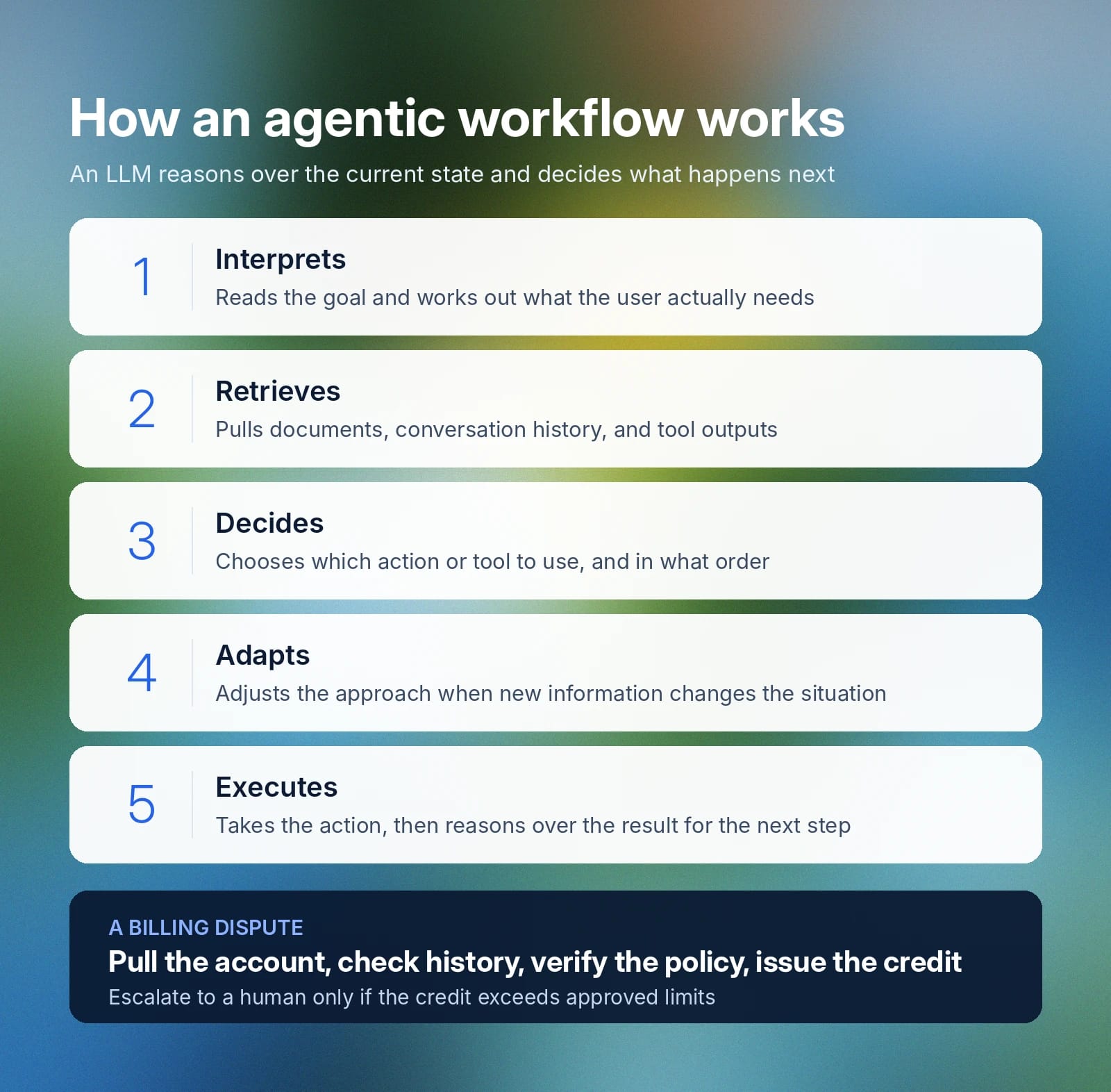
With agentic systems, an LLM sits at the center of the process, reasoning over the current state of the conversation or task and deciding what should happen next. Instead of picking from a small set of scripted answers, the agent:
- Interprets: The agent reads the goal it's been given and determines what the user actually needs.
- Retrieves: The agent pulls relevant context, including documents, prior conversation history, and tool outputs.
- Decides: The agent chooses which action or tool to use, and in what order.
- Adapts: The agent adjusts its approach when new information changes the situation.
- Executes: The agent takes the action, then reasons over the result to determine the next step.
Take a voice agent handling a billing dispute. A traditional IVR script can route the caller to "billing" and stop there. An agentic workflow can pull the customer's account, check payment history, verify the dispute against a refund policy, issue a credit if it's within approved limits, and escalate to a human only if it isn't.
Key components and characteristics of agentic workflows
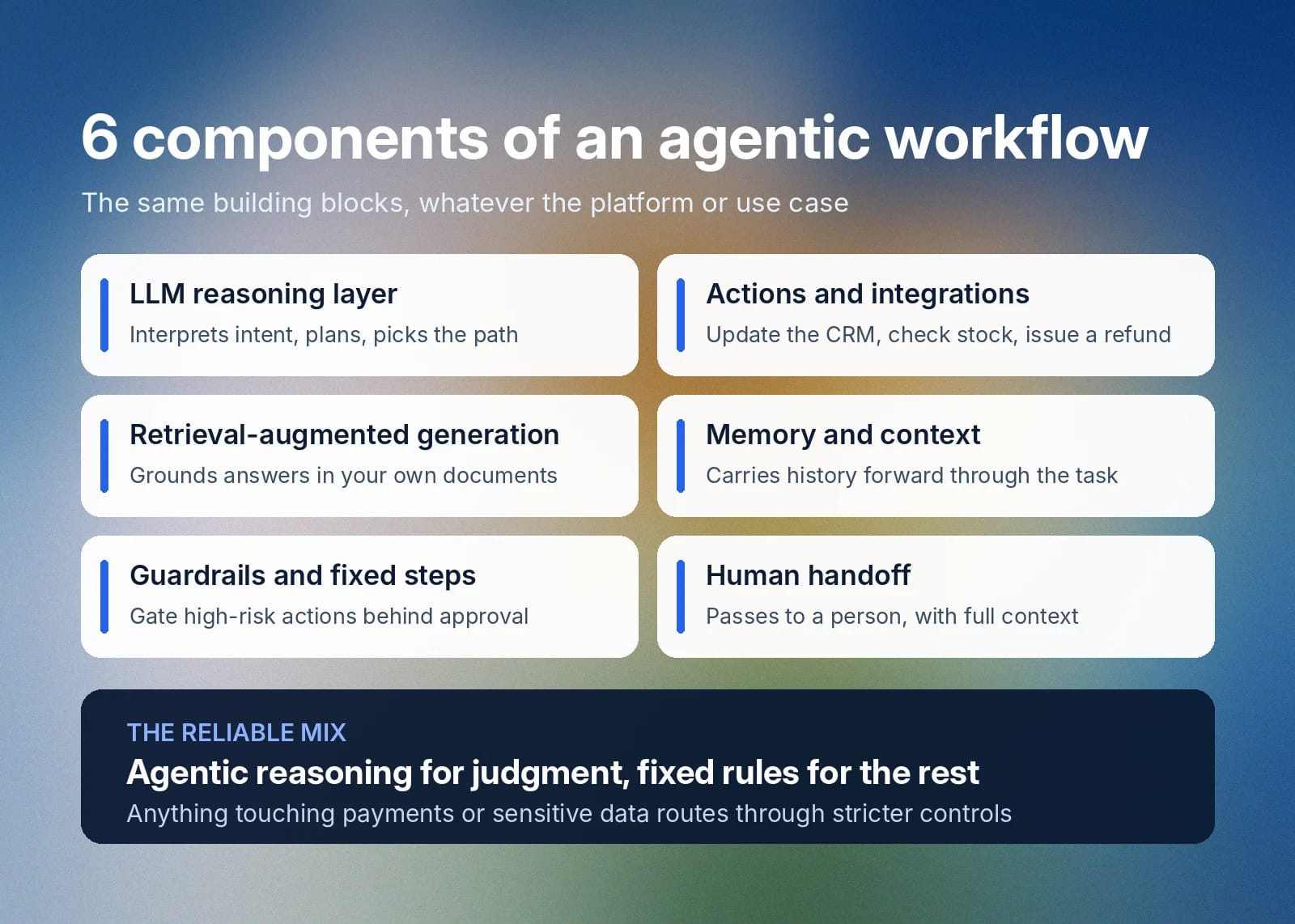
Most agentic workflows share the same underlying building blocks, regardless of the specific platform or use case.
Here's an overview of what each component does:
Component | What it does |
LLM reasoning layer | Interprets intent, plans the next step, and decides which tool or path to use. |
Actions and integrations | Lets the agent take real actions, such as updating a CRM, checking inventory, or issuing a refund. |
Retrieval-Augmented Generation (RAG) | Grounds the agent's responses in a business's actual documents and knowledge base, rather than general training data. |
Memory and context | Carries conversation history and prior outputs forward so the agent doesn't lose track mid-task. |
Guardrails and deterministic workflows | Gate high-risk or irreversible actions (such as a refund above a certain threshold) behind fixed approval steps, helping teams maintain control over sensitive interactions. |
Human handoff | Transfers the conversation to a live person with full context when the agent hits the edge of its authority. |
The most reliable agentic systems combine agentic reasoning for the parts of a task that need judgment with structured, rule-based steps for the parts that don't, particularly anything touching payments or sensitive data. That combination lets the workflow move efficiently on judgment calls while routing higher-stakes steps through stricter controls.
The ElevenAgents Workflows editor, for example, lets teams map decision points explicitly and route between specialized subagents or a human operator, so agent behavior stays auditable.
How agentic workflows differ from traditional automation
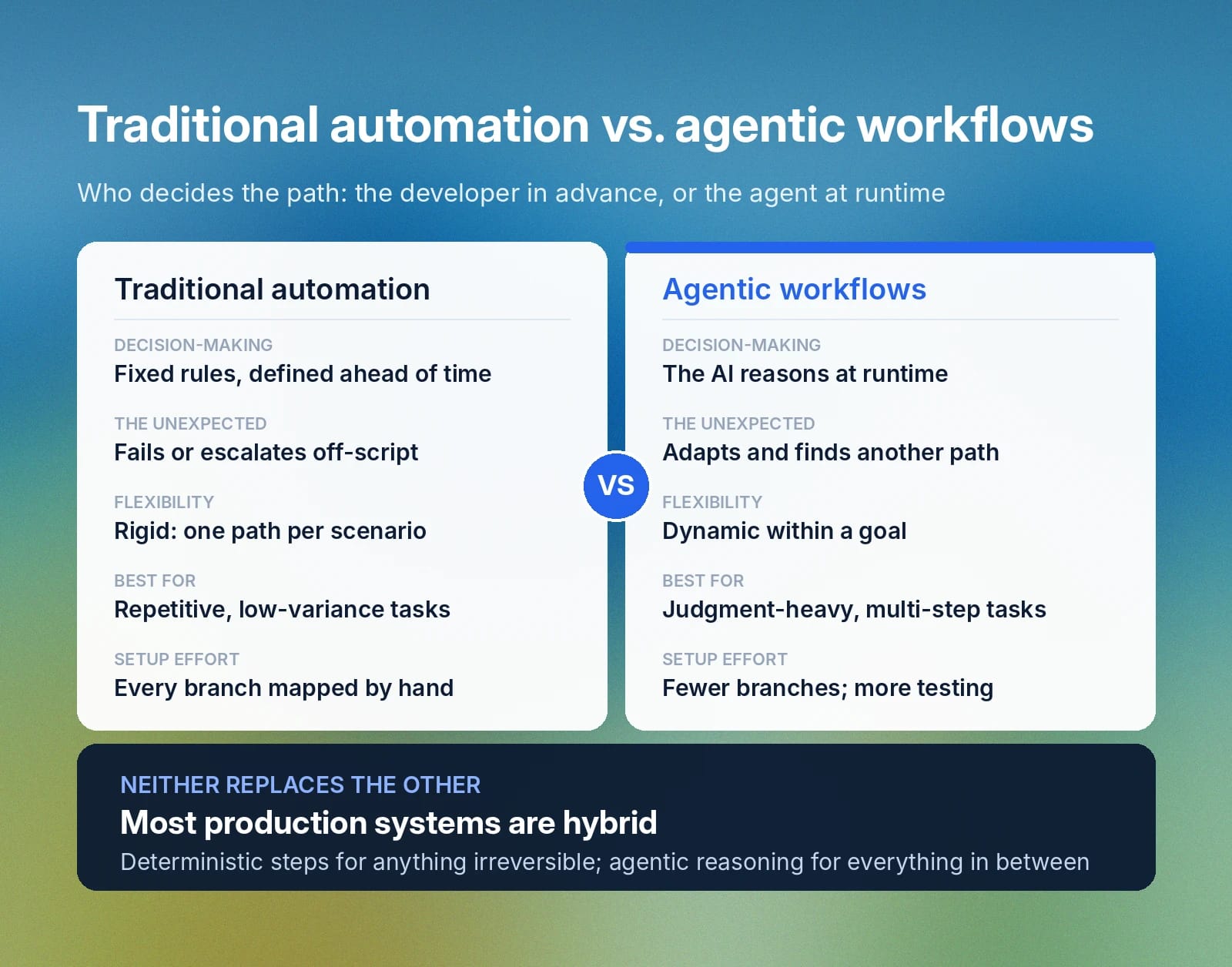
The core distinction between traditional automation and agentic workflows comes down to who decides the path: the developer in advance or the agent at runtime.
Traditional automation | Agentic workflows | |
Decision-making | Fixed rules defined ahead of time. | AI reasons and makes decisions at runtime. |
Handling the unexpected | Fails or escalates outside scripted paths. | Adapts and finds an alternate path. |
Flexibility | Rigid: one path per scenario. | Dynamic: handles variation within a goal. |
Best suited for | Repetitive, high-volume, low-variance tasks. | Complex, judgment-heavy, multi-step tasks. |
Setup effort | Every branch must be mapped manually. | Fewer branches to hard-code, but requires guardrails and testing. |
Neither approach replaces the other outright. Fixed automation is still the right call for genuinely low-risk, repetitive tasks, such as resetting a password or confirming an appointment time.
Agentic systems are better when the task involves ambiguity: a customer whose issue doesn't fit a template, a lead whose intent needs to be judged, or a call that needs to shift tone based on how the person responds. Many production systems use a hybrid approach with deterministic steps for anything irreversible and agentic reasoning for everything in between.
Agentic workflow examples in real-world applications
Agentic workflows are already handling live customer conversations across healthcare, real estate, and government. The specific tasks vary, but the underlying pattern is the same: an agent reasons through a request end to end instead of routing it to a human.
Customer support and issue resolution
For customer support applications, an agent might authenticate the caller, pull their order or account history, diagnose the issue against a knowledge base, and resolve it directly, handing off to a human only for edge cases.
For example, CareCode, a Brazil-based healthcare communications platform, built Portuguese-language voice agents into its patient-scheduling workflow and found that 43.9% of callers had already tried and failed to complete their request through another channel first. Voice agents were able to schedule those appointments without adding headcount.
Lead qualification and real estate
Real estate listings generate plenty of inbound interest, but sorting serious buyers from casual browsers still eats up agents' time.
Immobiliare.it, Italy's largest real estate platform, built a conversational agent that answers listing questions on a seller's behalf, qualifies buyer intent, and summarizes the interaction. After rollout, lead qualification rates rose from 19% to 63%, and the share of users willing to provide a phone number for follow-up climbed from 42% to 73%.
Public services and citizen inquiries
Government agencies are starting to apply the same approach to end-to-end resolution, letting an agent complete a request instead of routing it.
For example, Ukraine's Ministry of Digital Transformation is building what it calls the world's first agentic government, using AI agents to connect national systems with individual citizen requests across health, education, and economic services.
Multi-step operational tasks
Beyond conversation, agentic systems increasingly chain together retrieval, verification, and action in a single pass. A healthcare intake agent, for example, can check a patient's insurance eligibility, update their record, and confirm the appointment. These steps would otherwise require routing the caller through separate systems or teams. You can also use multi-agent systems to combine several agentic workflows into one here.
Benefits and challenges of using agentic workflows
Agentic workflows offer advantages over scripted automation. However, those advantages also come with new demands to fulfill.
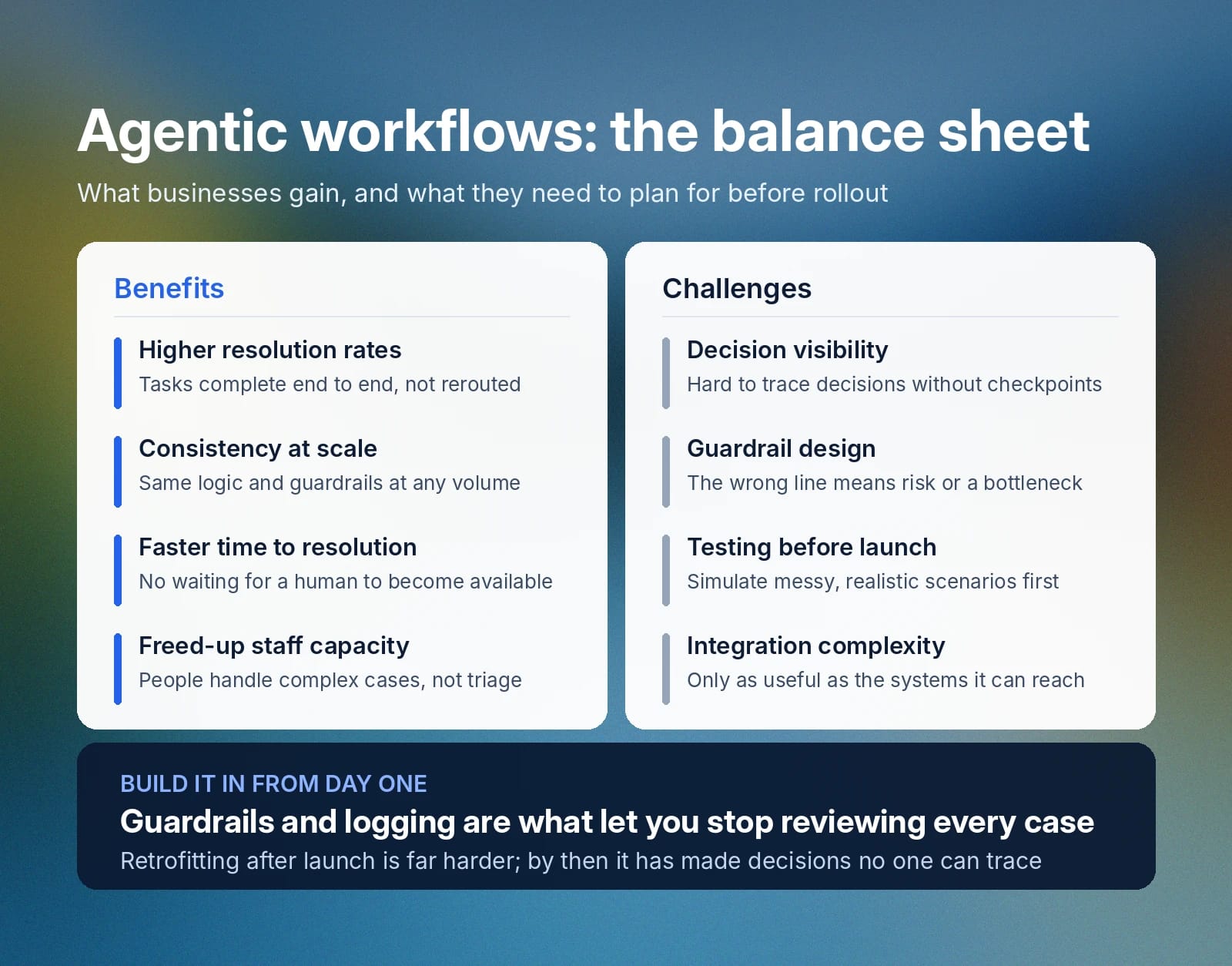
Here are the main benefits and challenges of working with agentic systems:
Benefits
- Higher resolution rates: Agents can complete a task end to end rather than routing it to a human by default.
- Consistency at scale: Every conversation follows the same underlying logic and guardrails, regardless of volume.
- Faster time to resolution: There's no waiting for a human to become available for tasks the agent can handle directly.
- Freed-up staff capacity: Human agents spend more time on genuinely complex cases and less time on repetitive first-pass triage.
Challenges
- Visibility into AI agent's decision-making: Without deterministic checkpoints, it can be hard to reconstruct why an agent took a particular action.
- Guardrail design: Because the agent can choose its own path, teams need to decide upfront which actions require approval and which can run autonomously. Get the line wrong, and the agent either creates risk by acting on something it shouldn't or becomes a bottleneck by escalating things it could have handled.
- Testing before launch: Agentic systems behave differently from scripted ones, so pre-launch simulation against realistic scenarios matters more. Teams need to stress-test it against realistic, messy scenarios before it ever talks to a real customer.
- Integration complexity: The agent is only as useful as the systems it can actually reach. If it can't reach the CRM, payment system, or scheduling tool a task depends on, it either stalls or has to hand off anyway, undercutting the whole point of using one.
Agentic workflows shift work from having someone review every case to reviewing only the cases that need it. That shift only pays off if the guardrails and audit trail are built in from the start. Retrofitting them after an agent is already live is far harder, since by then it's already made decisions no one can fully reconstruct. Guardrails and logging built in from day one are what let a business trust the agent enough to stop reviewing every case in the first place.
Get started with ElevenAgents for agentic automation
ElevenAgents brings everything an agentic workflow needs into one platform. Choose your own LLM and ground its answers in your knowledge base and SOPs through RAG. Deterministic workflows keep high-risk actions gated behind approval steps, and every conversation is logged for full auditability. Before launch, teams can define and test guardrails with pre-launch simulation, then deploy the same configuration across voice, chat, email, and WhatsApp.
For businesses that need agents to hand off cleanly when a case goes beyond their authority, human handoff carries full conversation context to the live agent, so customers never have to repeat themselves.
To learn how agentic workflows can support your business, speak to our team or sign up to start building with our no-code platform today.
What are agentic workflows FAQ

Jack Limebear is on the Growth team, acting as a content writer and strategist across the blog and insights pages. Before ElevenLabs, he spent over a decade leading content strategy for organizations ranging from fast-growing SaaS startups to Fortune 500 companies. He holds a Master's degree in English Literature from the University of Cambridge.