
Multi-agent systems explained: How AI agents work together
- Written by
- Jack Limebear
- Published
- Last updated
ListenListen to this article
Since large language models (LLMs) emerged, industries have explored ways to optimize business processes. Among the methods gaining traction is the multi-agent system.
Multi-agent systems allow organizations to automate complex workflows using a collaborative set of autonomous AI agents. They overcome predicaments that previously prevented businesses from fully leveraging the benefits that LLMs offer.
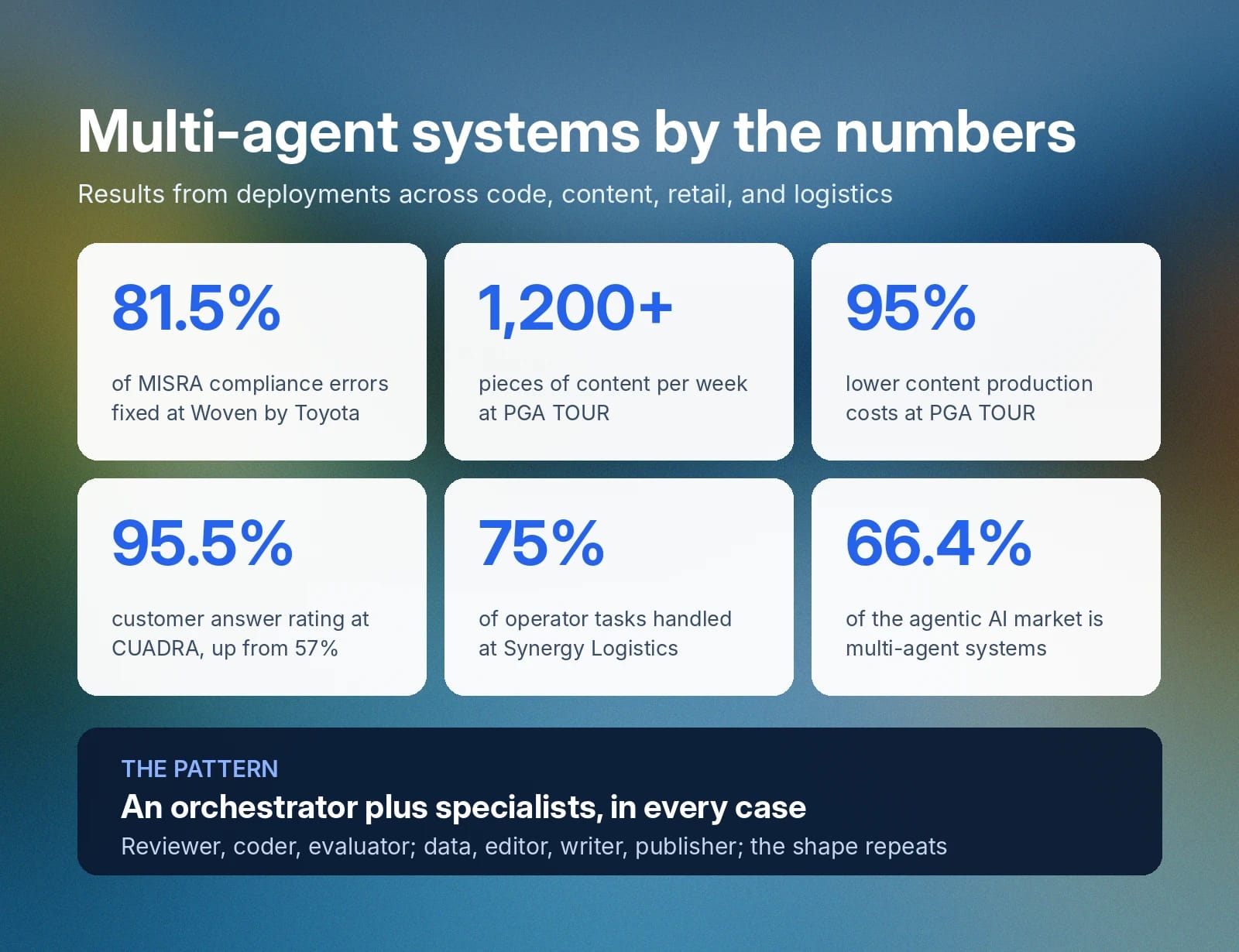
According to a survey, multi-agent systems account for 66.4% of the agentic AI market share, underscoring business growth, innovation, and productivity as the architecture gains traction.
This guide explores the fundamentals of multi-agent systems and why they matter. Beyond that, we expand on common architectures, types of AI agents, challenges, benefits, and use cases, including in voice AI.
Summary
- Multi-agent systems use multiple AI agents to perform complex tasks that a single agent couldn’t.
- There are seven types of AI agents that a multi-agent system could deploy, including simple reflex, model-based, and goal-based agents.
- Agents can operate in a centralized or decentralized architecture.
- Key benefits of using multi-agent systems are scalability, parallelism, and specialization the architecture provides.
- Organizations deploy multi-agent systems across various use cases, including software development, warehouse management, and content distribution.
What are multi-agent systems?
Multi-agent systems are collections of AI agents that work towards collective goals to solve complex problems that a single agent can’t.
An AI agent is an autonomous application powered by large language models (LLMs) that reason, act, and connect to external tools. While a single AI agent is useful for well-defined tasks, it struggles to perform in unpredictable, massive, or overly complex tasks spanning across multiple domains.
How multi-agent systems work
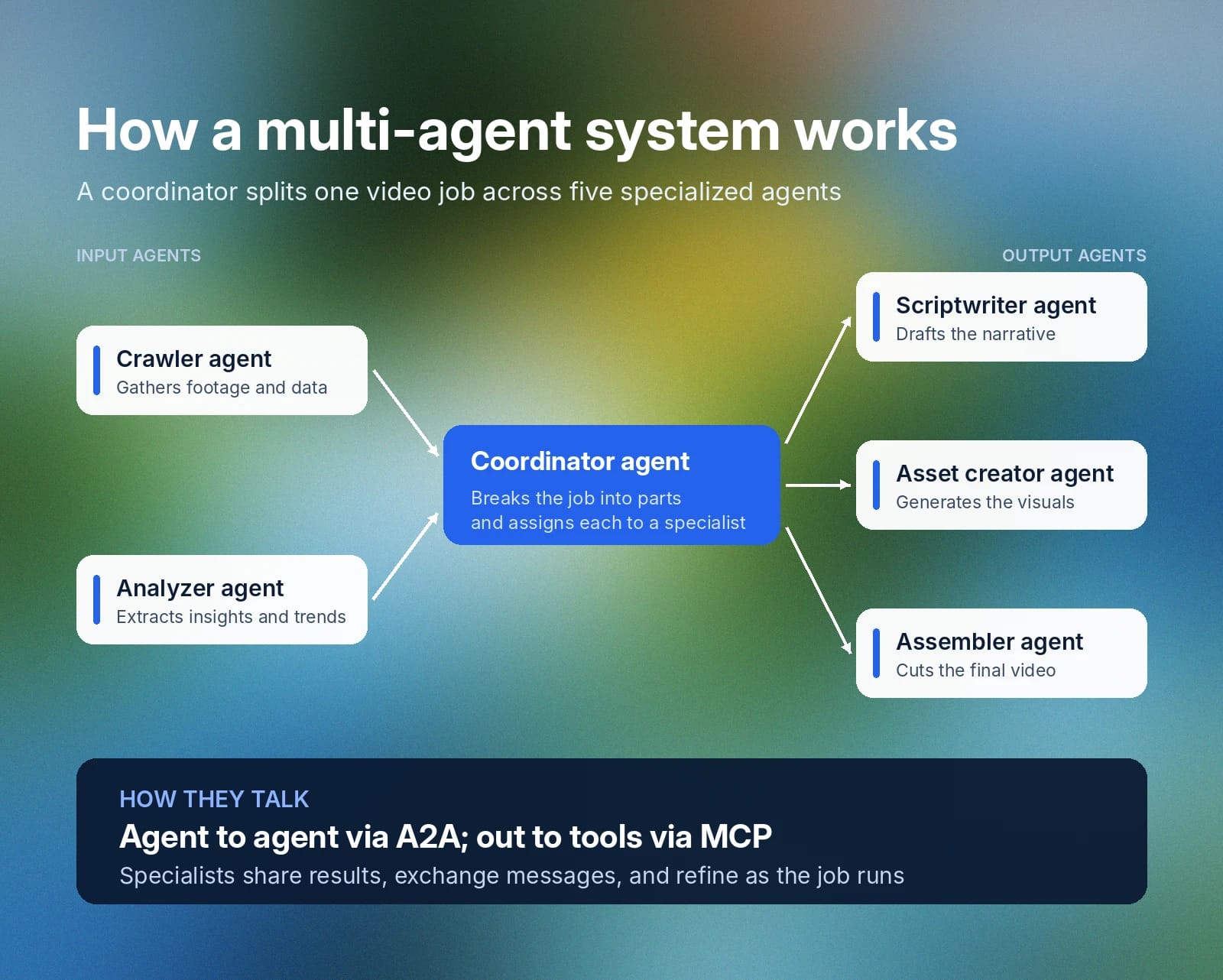
In a typical multi-agent system architecture, a centralized coordinator breaks a complex task into multiple smaller parts. Then it assigns each task to specialized agents deployed within the shared environment.
Communication is key to a high-performing and reliable multi-agent system.
- Agents exchange data with each other using proprietary messaging services or the A2A protocol.
- Agents interact with external tools using third-party APIs and the Model Context Protocol (MCP).
To complete the task, the specialized agents share information, exchange messages, and continuously refine themselves through interactions with users and the environment.
Why do multi-agent systems matter?
Multi-agent systems provide a flexible, distributed platform that expands the context window of a single-agent LLM. A single agent can reasonably infer within a given domain, but forcing it to complete a substantial number of tasks within a limited time and with limited information will reduce its accuracy.
By using multi-agent systems, you can scale AI across different use cases through parallel processing, specialized agent control, and greater adaptability.
Let’s consider a content marketing workflow as an example. A single AI agent would have difficulties completing topic research, audience analysis, content creation, publication, and reporting. To do that, you need to intervene at different touchpoints.
Meanwhile, a multi-agent system deploys dedicated AI agents, each proficient in their respective knowledge domains, and connects to the tools required to automate the workflow.
Types of AI agents in multi-agent systems
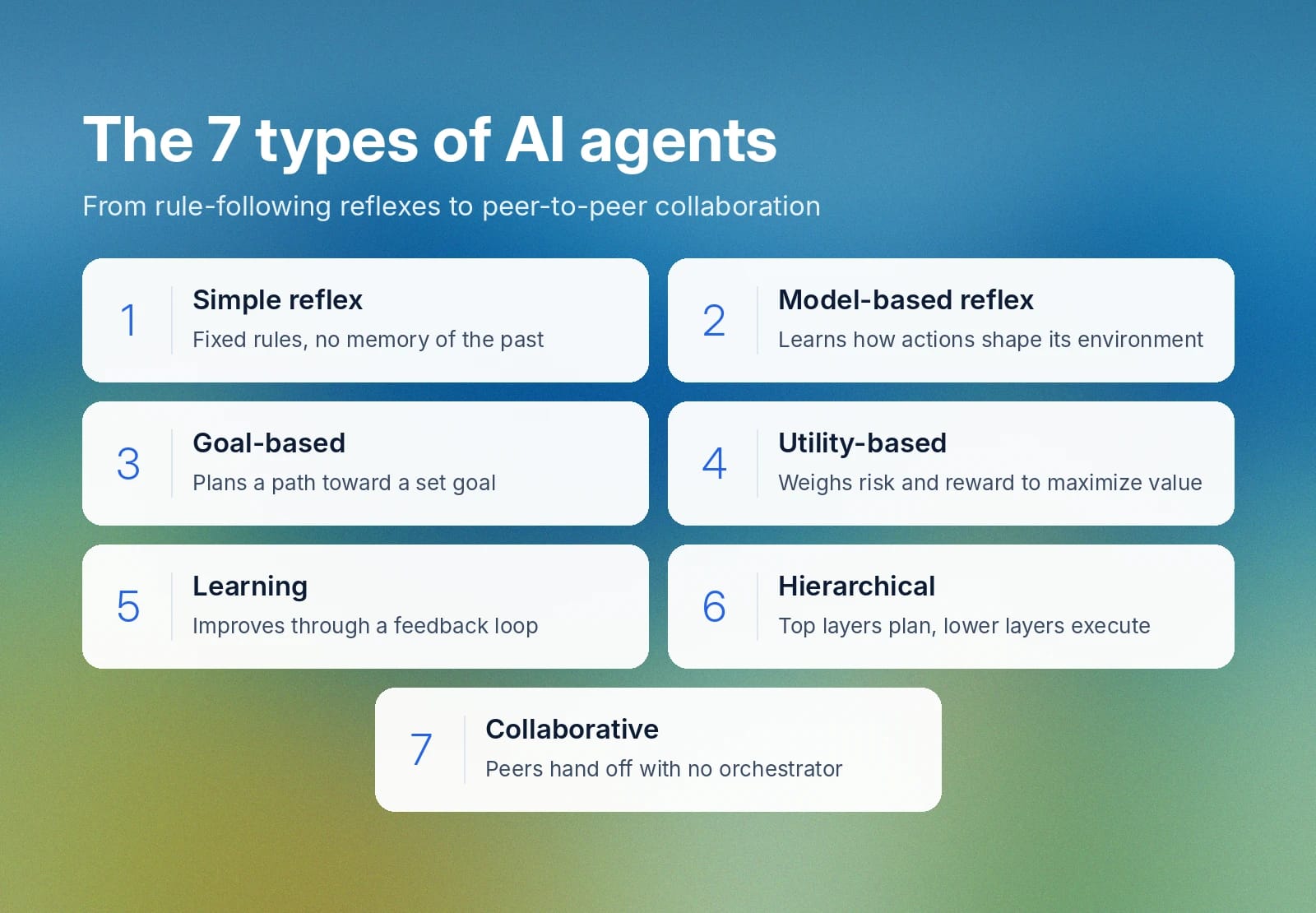
There are seven types of AI agents, each with its own characteristics.
1. Simple reflex agent
A simple reflex agent reacts to sensory input based on preset conditional rules. When the agent receives input, it produces an output, which could be an action, text, audio, or another format. It doesn’t retain any memory of the results or its environment, which means every inference starts from a blank slate.
2. Model-based reflex agent
A model-based reflex agent is partially aware of the environment it’s deployed in. Through continuous interactions, the agent learns how its actions affect the environment and uses the information to augment conditional rules for inference.
However, the agent doesn’t retain memory of its past inference, which, in a way, operates almost similarly to a simple reflex agent.
3. Goal-based agent
A goal-based agent considers possible actions that will lead it to achieve a predetermined goal. Instead of acting based on conditional rules, the AI agent uses search and planning algorithms to predict future outcomes for each path it has mapped. Then it chooses the path it deems most likely to yield successful results.
4. Utility-based agent
A utility-based agent is designed to work towards an outcome that maximizes utility. Utility, in the context of AI agents, is the value you derive from the system. When deployed, the agent predicts different paths that it could take and assigns a weight to each. Then it considers potential risks and rewards before choosing the option that offers the most benefit.
5. Learning agent
A learning agent continuously improves its performance through past experiences and interactions with the environment. By operating in a feedback loop, the agent evaluates its performance against specific criteria and refines its behavior to produce desirable outcomes.
6. Hierarchical agent
Hierarchical agents are AI agents that operate through different chains of command between high- and low-level agents. Higher-level agents typically deconstruct large tasks into smaller parts for lower-level agents.
Meanwhile, low-level agents are responsible for tactical implementations, such as ingesting sensor data and controlling actuator response. In a complex setup, machine learning engineers deploy agents in multiple tiers to better synchronize and distribute tasks.
7. Collaborative agent
Collaborative agents are AI agents that share a peer-to-peer relationship with each other. Instead of relying on a central orchestrator, each agent will share information, hand off control, and work collaboratively towards a common goal.
Common multi-agent system architectures
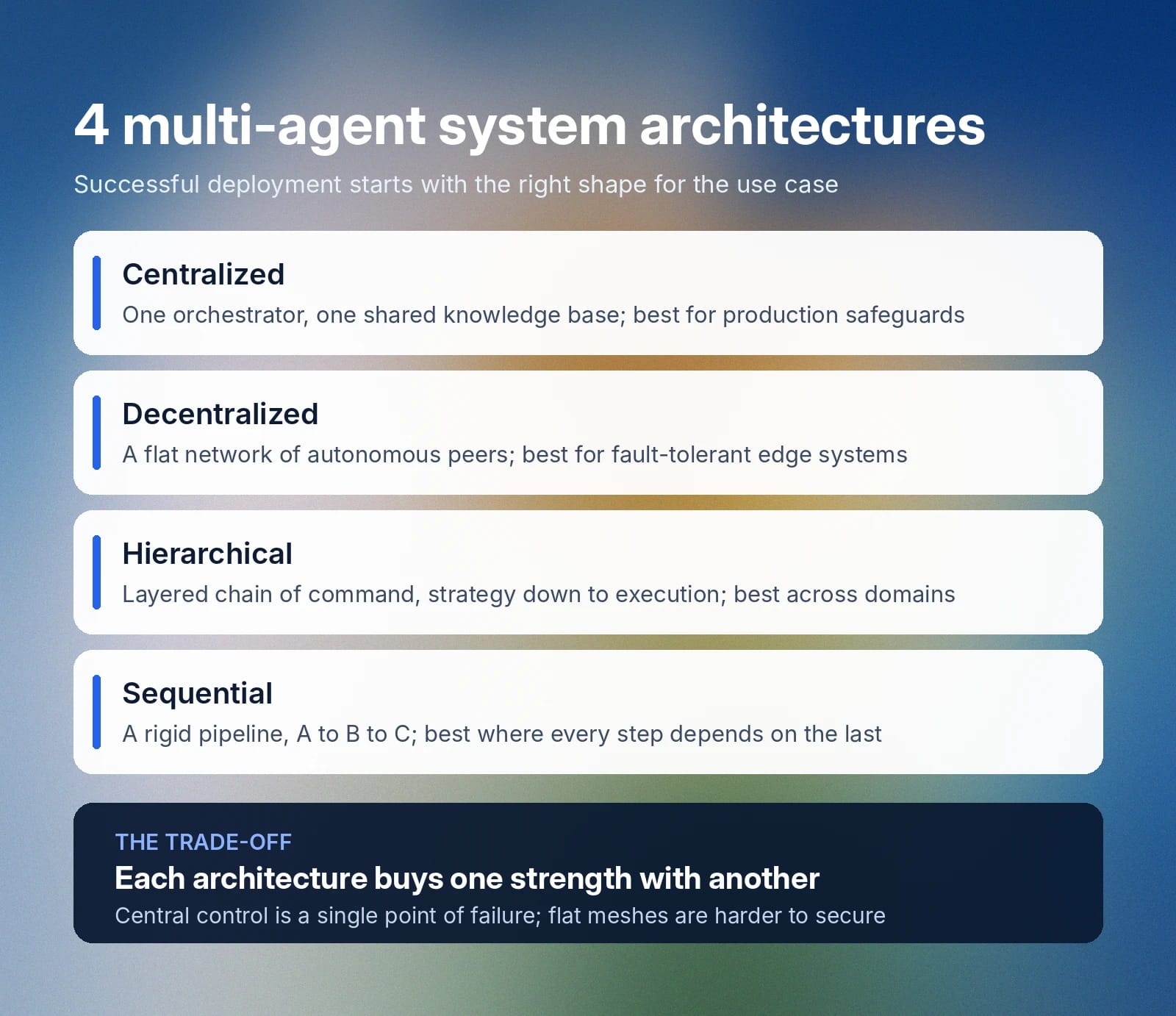
While multi-agent systems will improve operational efficiency, successful deployment relies on fitting the right architecture for the use case.
Here’s a quick comparison of different multi-agent system architectures.
Architecture
Structure
When to use
Centralized
Single central orchestrator controlling a shared knowledge base and designating tasks to worker agents.
Production environments requiring easy safeguarding and change propagation.
Decentralized
Flat hierarchy of autonomous agents sharing reasoning, action, and communication equally.
Scalable, fault-tolerant AI systems like edge computing.
Hierarchical
Layered chain of commands. Strategize at the top and implement at the lowest layer.
Multi-agent systems spanning multiple domains, such as supply chain management.
Sequential
Rigid linear pipeline where each agent passes results directly to the next.
Workflows with strict, step-by-step dependencies, such as medical diagnosis.
Let’s dive deeper into each architecture.
Centralized
Centralized multi-agent architecture consists of a single central orchestrator and multiple worker agents. They share a common knowledge base, which the orchestrator controls. When assigned a task, the orchestrator breaks it down into smaller, specialized parts and designates them to the respective agents.
By design, a centralized architecture simplifies execution. You define goals, enforce security policies, and supervise agents from a unified dashboard.
However, the single point of control the architecture relies on is also an operational risk. If the orchestrator fails, the entire system fails, as agents depend on it to coordinate and share information.
Use centralized multi-agents when you need to easily safeguard and propagate changes in production environments.
Decentralized
A decentralized network of agents distributes reasoning, communication, and action equally amongst all agents in the system. It builds on a flat hierarchy, with no particular agent having a higher authority than others. Each agent is an autonomous entity. This makes the decentralized architecture robust, privacy-friendly, and less prone to failure.
Unlike a centralized multi-agent network, a decentralized architecture continues to operate even if a single agent fails. Through consensus or task-sharing mechanisms, other agents can assume the problematic agent's role. The downside of this architecture is the complexity of distributing messages and securing communications across complex communication meshes.
Use decentralized agent architecture if you want a scalable, fault-tolerant AI system like edge computing.
Hierarchical
Hierarchical architecture consists of AI agents operating through layers of a chain of commands. Think of the architecture as a company’s organizational chart, with department heads, middle managers, and operations executives overseeing different parts of the same campaign. A top-layer AI agent plans, and a mid-layer agent coordinates, while low-layer agents implement at a fine-grained level.
A clear hierarchy enables governance and an audit trail. You trace decisions across agents in different layers. However, stacks of agents introduce overhead and might cause noticeable latency in real-time applications.
Use a hierarchical AI architecture when you need a scalable multi-agent system spanning multiple domains, such as supply chain management.
Sequential
Sequential agent systems operate by passing the results from one AI agent to another following a rigid pattern. For example, Agent A hands over to Agent B, which passes to Agent C. In a sequential architecture, each step is directly dependent on the previous result, which makes the architecture well-suited for predictable workflows.
Predictability is a major strength of sequential AI. It lets you easily trace errors and fine-tune the affected agent. However, a sequential pipeline loses speed because downstream agents cannot initiate inference or run in parallel.
Use sequential agents when strict dependencies are critical, such as medical triage leading to a diagnosis.
Key benefits of using multi-agent systems
Operations teams deploy multi-agent systems because of evidential benefits.
Here are a few example benefits of using multi-agent systems:
- Flexible specialization
- Improved parallelism
- Enhanced fault isolation
- Better scalability
Let’s break these down in more detail.
Specialization
Rather than assigning a broad range of tasks to a single agent, a multi-agent system assigns them to AI agents specifically designed to handle them. This allows the operations team to design an agent system that closely mimics their workflows.
For example, you use a web scraping agent to retrieve product data, an analytics agent to forecast market trends, and an e-commerce agent to update the price.
Parallelism
Multiple AI agents run simultaneously to expedite the outcome. Instead of looping through a series of agents, you delegate non-dependent tasks to different autonomous agents. Once they complete inference, you consolidate the results for further analysis.
For example, customer success teams launch agents to retrieve customer data, compile past transactions, and surface historical conversations simultaneously.
Fault isolation
Failure doesn’t necessarily halt the entire system in a multi-agent system. When an agent fails, you remediate it or isolate it to prevent it from affecting subsequent agentic workflows. This makes multi-agent systems attractive for mission-critical applications with low tolerance for operational disruptions.
For example, agentic robots for warehousing assume the operations of a failed robot.
Scalability
Multi-agent systems scale easily when workload grows. Instead of redesigning the architecture from scratch, you add more agents to improve efficiency. Because of the shared environment, all agents access the same context, which helps additional agents infer more accurately.
For example, a startup deploys a multi-agent marketing workflow to manage incoming leads. When the agents hit a bottleneck, they introduce additional AI agents to the same platform.
Challenges and limitations of multi-agent systems
Despite the benefits that multi-agent systems offer, several challenges still complicate implementations.
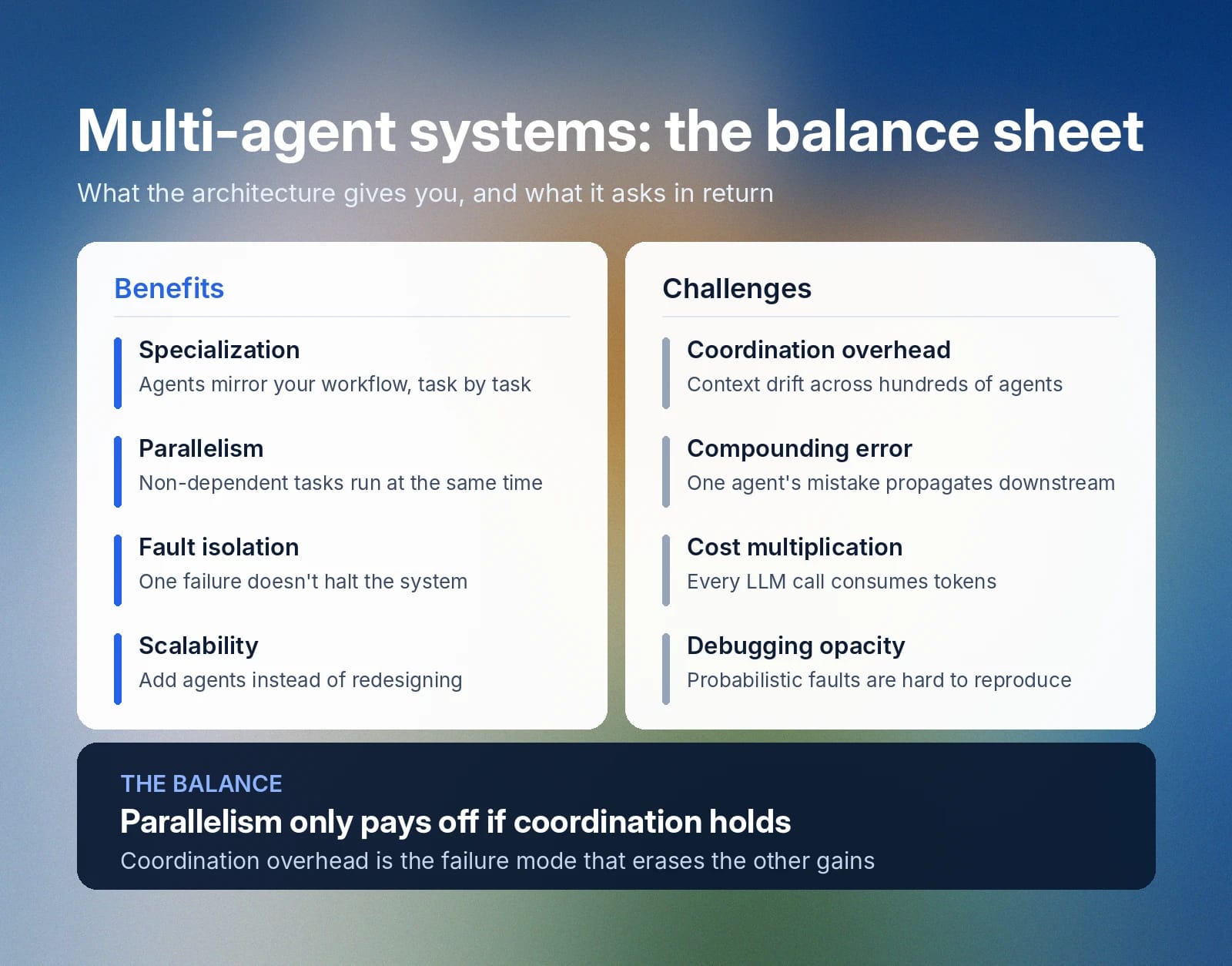
- Coordination overhead: Agents must pass context accurately to ensure they consistently achieve the desired outcomes. In a complex architecture, particularly one with hundreds of agents, reliable message exchange is difficult. This might result in context drift, which requires rigorous coordination to mitigate.
- Compounding error: LLMs, which are the foundation of AI agents, can make mistakes. Any inaccuracy that escapes an agent will propagate to the next one. Consequently, teams might observe significant variation in the final result, which affects operational outcomes.
- Cost multiplication: Running AI agents is potentially expensive, particularly for complex processes. Every API call to an LLM provider consumes tokens, which add up to substantial cost.
- Debugging opacity: Troubleshooting a multi-agent system is challenging. When multiple agents are involved in producing an outcome, locating the root cause requires more effort. Even if you managed to trace the fault to an agent, reproducing the symptom is extremely difficult because of LLMs’ probabilistic nature.
Real-world examples of multi-agent systems
Multi-agent systems have gone beyond in-house innovation to solving operational challenges in real life.
Below are some examples of how multi-agent systems have improved real-world workflows.
Woven by Toyota uses multi-agent systems for automated code fixes
Woven by Toyota is a modern mobility company that delivers autonomous driving solutions. The software they build must comply with MISRA, a coding standard for the automotive industry. However, complying with MISRA isn’t easy, as engineers must validate their code against hundreds of pages of standards.
Therefore, Woven by Toyota designed a multi-agent system to improve code safety at scale. The system consists of a Reviewer, Coder, and Evaluator agents. Both Reviewer and Coder iterate through the source code to find and fix coding issues. Then, the Evaluator performs a final check and includes reasoning for its verdict.
Consequently, the engineering team managed to correct 81.5% of MISRA compliance errors using the multi-agent system.
PGA TOUR uses agentic AI for media research and content production
PGA TOUR runs prestigious golf tournaments and is followed by a sizeable fanbase. However, it struggles to deliver content that adequately covers its players and distribute it for exposure. With hundreds of players on the field, the organizer wanted to shorten the time from content creation to publication.
By deploying multiple AI agents, each with a distinct role, the editorial team creates content that aligns with the PGA TOUR’s brand style. When the system receives a content request, a data agent runs research before passing the outcome to the editor agent. Then, a writer and an image agent create the draft, which, upon review, is sent to a publication agent.
Upon deployment, PGA TOUR ramped up its content production to 1,200+ pieces of content per week. More importantly, it lowered costs by 95%.
CUADRA leverages a multi-agent system to boost customer support
CUADRA is a Mexican premium retail brand that serves customers across multiple channels, including social media, website, and phone. The company is aware that customers prefer timely and personalized responses, but faces challenges during peak seasons.
Instead of relying solely on human customer teams, CUADRA built a multi-agent system to filter incoming requests and escalate them as needed. At the core of the system is an orchestrator that coordinates several specialist agents for product recommendations, order history, and customer interactions.
The agents proved to be a success for CUADRA, with customers rating the answers they receive at 95.5%, up from 57% when fully handled by humans.
Synergy Logistics deploys multi-agents for warehouse operations
Warehouse operations are time-sensitive. For example, human operators might miss shipping deadlines or risk stockouts, which cost companies financially. Synergy Logistics is a leading warehouse management solution provider. It took the initiative to help operators improve their efficiency and reduce oversights when managing stock using multi-agent systems.
The warehouse solution provider built a centralized agentic AI system to predict stock movements and provide clarity across warehouse operations. An orchestrator agent acts as a coordinator, delegating tasks to a stock-at-risk, task-prioritization, and stockout-prediction agent. These agents use WMS data to infer and provide recommendations.
Together, these agents could handle up to 75% of the workloads operators handle.
Multi-agent systems in voice AI
Voice AI is a technology that listens to humans, understands intent, and responds in human-like voices. You can build a multi-agent voice AI system to enable smarter, scalable, and more efficient verbal interaction with minimal human intervention.
For example, you use an AI phone system to augment your customer support team. An AI phone system, unlike a traditional interactive voice response system, synthesizes speech in real time instead of using a pre-recorded audio library. Customers get the response they want without waiting minutes to be attended to.
However, building an AI phone system requires collaboration among multiple agents. In the agent workflow, a triage agent filters initial customer requests, retrieves the required data, and transfers the call to another agent. The agent transfer mechanism passes the context and chat history, so that conversations remain seamless and intelligible.
Get started with ElevenAgents for seamless AI agent collaboration
ElevenAgents allows you to design, test, and deploy multi-agent voice and chat systems from a single platform. Apply security guardrails, track chatbot performance, and revisit transcripts to improve conversations, whether internally or on client-facing channels.
Learn more about multi-agent systems in ElevenAgents or sign up today to start building agents for your workflows.
FAQ: Understanding multi-agent systems

Jack Limebear is on the Growth team, acting as a content writer and strategist across the blog and insights pages. Before ElevenLabs, he spent over a decade leading content strategy for organizations ranging from fast-growing SaaS startups to Fortune 500 companies. He holds a Master's degree in English Literature from the University of Cambridge.