
Selective specialization: how to architect agents that hold up in production
- Written by
- Adarsh Shiragannavar
- Published
ListenListen to this article
Building a demo-quality agent has never been faster. Wire up a capable model, give it a handful of tools, and within an afternoon you have something that books a meeting, drafts a reply, or pulls a report on command. The trouble starts later. The VP of CX, the head of operations, the platform lead - whoever is responsible for making that agent work at enterprise scale - hits a wall. The thing that worked in the demo turns slow and unpredictable the moment real volume and real stakes arrive. The platform underneath is rarely what failed. The architecture on top of it was.
The bottleneck: one agent doing everything
The natural instinct after a successful first agent is to feed it. More tools. More context. Broader responsibilities. If it handled one job well, surely it can handle ten.
That instinct creates a bottleneck. When a single agent is responsible for planning, executing, remembering, and reflecting across a wide scope, a few things break down at once.
Its decision-making gets slower and harder to steer, because every step now competes for room in one context window and one reasoning pass. Tool selection gets less reliable, because accuracy tends to drop as the number of available tools grows. And the system gets fragile, because a small misunderstanding at step one goes unchecked. With no boundaries between responsibilities, an early error quietly poisons everything downstream.
Picture a single voice agent built to handle inbound insurance claims from start to finish. On one call it has to verify the caller's identity, pull the right policy, check coverage, interpret the claim, estimate a likely payout, log the interaction, and decide whether to escalate to a human. In the demo, with a cooperative caller on a clean line, it handles everything cleanly. In production, the caller's name is misheard at step one on a noisy mobile connection. The agent never recovers. It retrieves the wrong policy, reasons confidently about coverage the caller does not have, and quotes a payout for a plan they never bought. Nothing sat between hearing the name and acting on it, so one transcription slip became a wrong promise spoken out loud to a customer.
In a regulated industry, that is not just a bad experience - it is a compliance event with liability attached. It is one reason agent insurability is becoming a prerequisite for production deployments, and why we built ElevenAgents to be the first conversational AI platform eligible for AI insurance through AIUC.
Notice what actually broke. The agent was not bad at conversation. It was bad at carrying every responsibility alone, with no checkpoint between understanding something and acting on it. The fix is not a smaller ambition or a quieter agent. It is structure.
Worth being precise here. This is not mainly a limitation of the models themselves. A stronger model raises the ceiling, but it does not remove the structural problem. This is a systems design problem.
The mental model: departments, not a CEO who decides everything
Think about how a company grows. If the CEO personally makes every decision across engineering, marketing, and HR, the company grinds to a halt. You do not fix that by hiring a smarter CEO. You fix it by building specialized teams with clear scope.
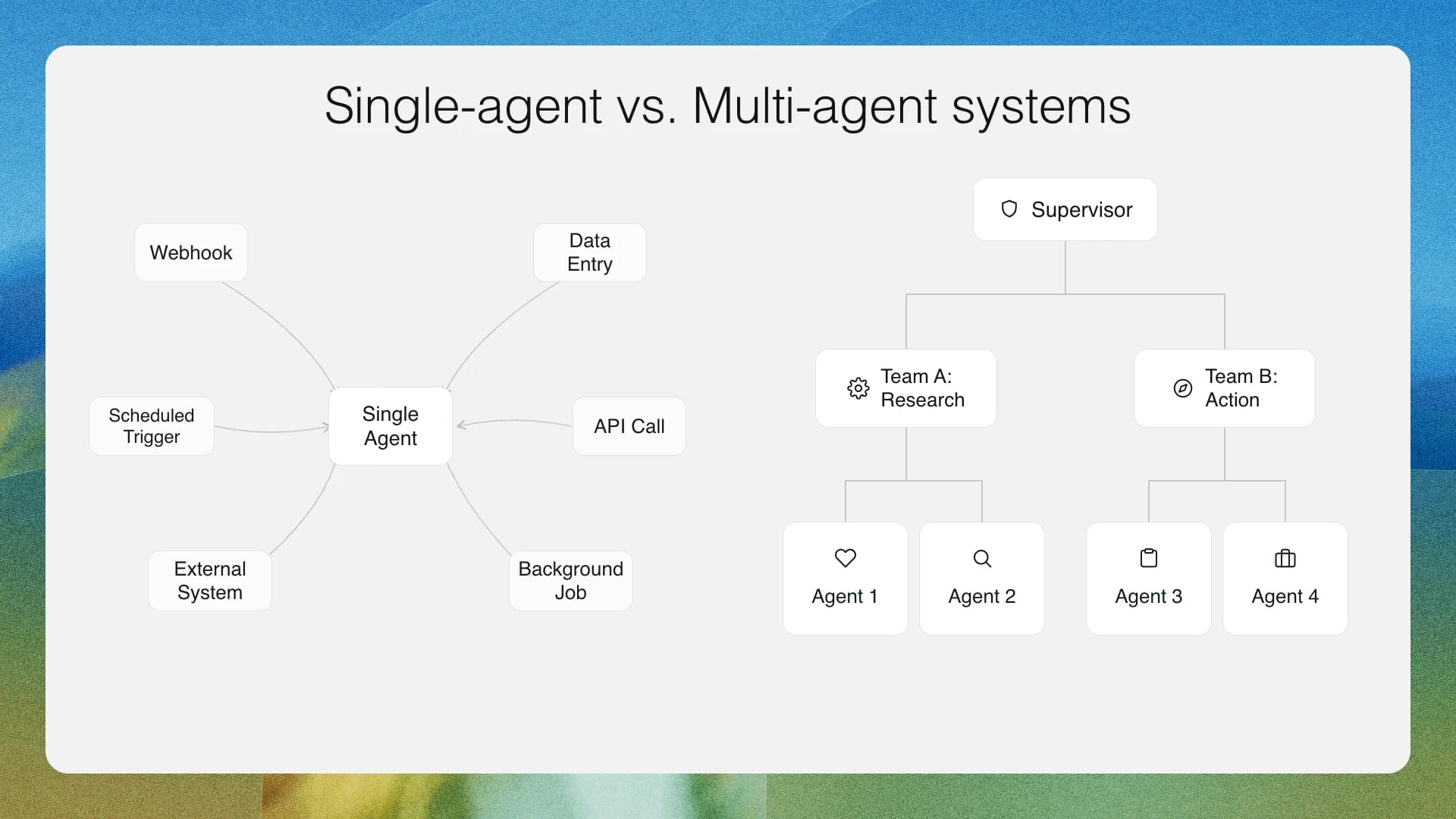
The same logic applies to AI systems. Instead of one massive agent, you can break the system into specialized agents with bounded responsibilities. One agent retrieves data. One writes code. One does nothing but fact-check. Each has a narrower focus, which makes its individual decisions cheaper, faster, and easier to trust.
None of this requires specialized infrastructure. Our platform, ElevenAgents, already ships the building blocks for it: a conversational agent at the center, tool calls for lookups and updates, agent transfer to hand off cleanly when the scope changes, knowledge retrieval to stay grounded, and workflows to connect the pieces. Building this well is mostly a matter of using those primitives on purpose, rather than collapsing every responsibility into one prompt and hoping it holds.

That is the appeal of a multi-agent architecture, and for the right kind of work it is real. A contact center example makes this concrete. Suppose you want to score yesterday's ten thousand support calls for quality. The work splits cleanly: one agent checks whether the rep followed the compliance script, another rates empathy and tone, another flags calls that should have been escalated, and another extracts the reason the customer called. None of these judgments depends on the others, and they can all run in parallel across the same transcript. This is exactly the shape that multi-agent rewards. The parts are independent, the work is read-heavy, and isolating each judgment in its own context actually makes each one sharper.
The honest tradeoffs
Multi-agent is not a free win. Any technical leader evaluating this architecture will - and should - pressure-test the coordination costs before committing to it. The caveat that matters most is this.
The most common failure mode is context fragmentation. When you split a task across agents that do not share full context, each agent acts on a partial view, and their decisions can conflict in ways the coordinator cannot reconcile.
The same trap appears in live conversations. Imagine a collections call broken into a negotiation agent and a compliance agent that do not share state. The negotiation agent, trying to be helpful, offers the customer a six-month payment plan. The compliance agent, which never saw that offer, would have rejected it because the customer's region caps such plans at three months. Each agent behaved reasonably on its own slice. Together they produced a commitment the company cannot honor, made to a real person in real time. The error was not a weak model, and it was not the voice layer. It was two narrow views that never met.
The fix is not more agents. It is to keep the conversation whole and let it consult the compliance rule as a tool before it commits, so the rule and the offer meet before anything is said aloud. That is a design choice, and a capable platform makes it the easy one.
The practical takeaway is that the choice is task-dependent. Multi-agent shines on parallel, read-heavy work where the parts are genuinely independent - research, retrieval, and verification. It struggles on tightly coupled work where everything has to cohere, such as writing one body of code. For anything latency-sensitive, like a real-time voice pipeline, every additional agent hop adds round-trip time against a tight budget, so deep chains of agents are risky by default. This is also where our infrastructure matters. ElevenAgents co-locates speech recognition, turn-taking, and voice generation in a single stack, so the baseline latency is already minimal before any orchestration overhead is added.
What actually drives ROI
The teams seeing real return from agents are usually not the ones reaching for the single smartest model and expecting it to carry the load. They are the ones making deliberate architectural choices about where to specialize, where to keep things in one continuous context, and how agents coordinate when they must.
In other words, the answer is rarely "one giant agent" and rarely "split everything." It is selective specialization. The gains come from drawing boundaries in the right places, not from the number of agents or the capability of any single one. Keep a task in a single agent when the work is coupled and the context needs to stay continuous. Break it into specialized agents when the work is parallel and the contexts can be isolated cleanly.
The recommendation
For an upcoming project, the move is not to pick an architecture first. It is to map the work first.
List the specific capabilities the system actually needs. Mark which parts are genuinely independent and which are tightly coupled. Identify where an isolated context is a feature rather than a liability - for example, a fact-checking pass you want kept separate from the main reasoning thread. Then, and only then, decide where to split responsibilities into separate agents.
Here is what that looks like for a production loan reminder line. The live conversation stays inside one continuous agent, because the customer's words, the tone, and the back-and-forth are tightly coupled and every extra hop adds delay the caller can hear. Around that single conversational core, you attach bounded specialists that do not interrupt the flow: a tool call that fetches the account and outstanding balance, a compliance guardrail the agent consults before any payment offer is spoken, a clean transfer to a human when the situation calls for it, and a separate batch of evaluation agents that score the recordings the next morning for quality and risk.
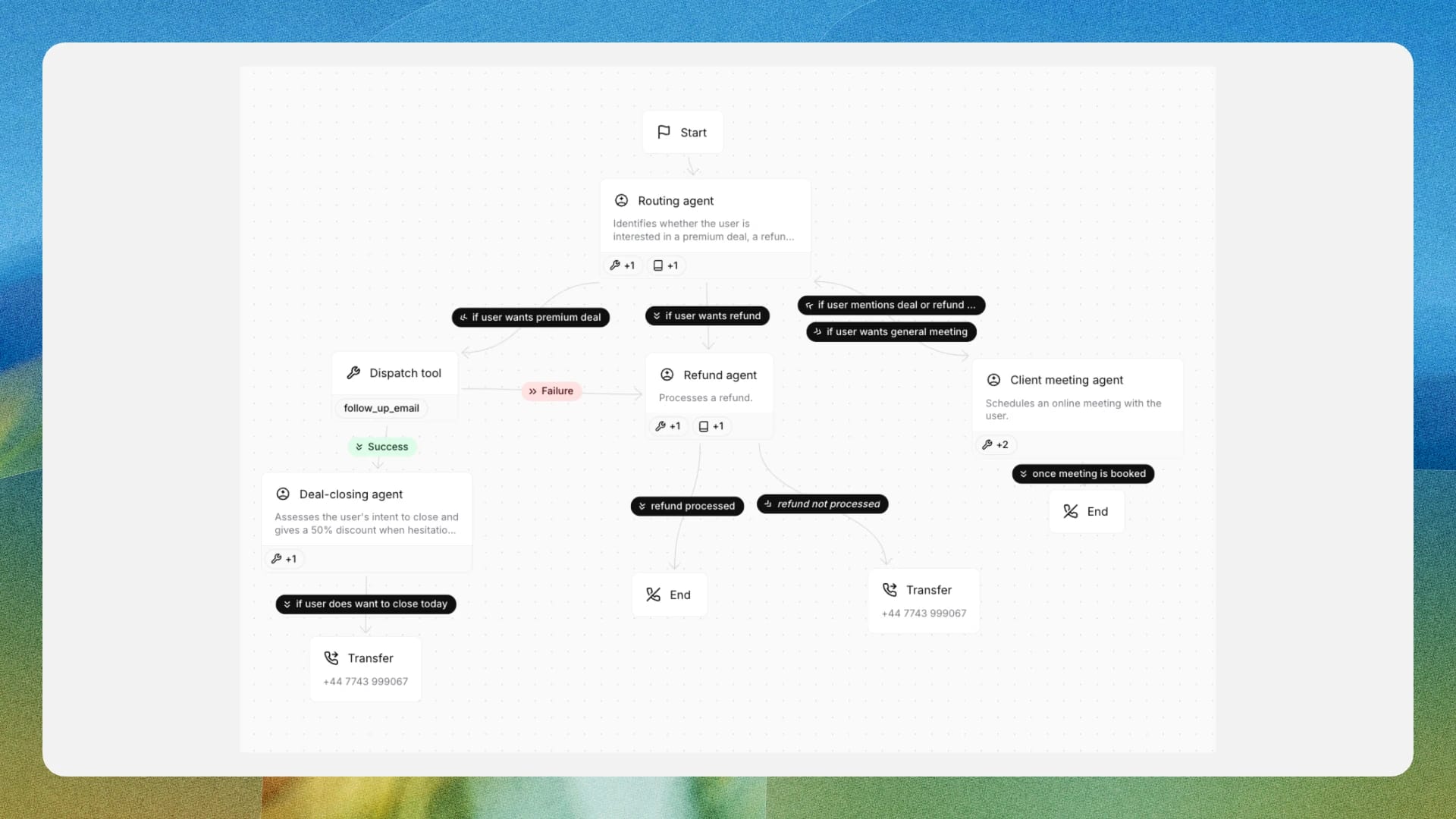
The conversation is coupled, so it stays whole. The lookups, the checks, and the scoring are independent, so they get their own boundaries. That is selective specialization rather than splitting for its own sake, and it maps directly onto the primitives a good agent platform already gives you.
Do that, and you get the upside of specialization without inheriting the coordination tax you did not need. Predictable behavior, contained failures, and a system whose complexity you chose on purpose rather than discovered in production. Used this way, an agent platform is not a demo that gets shakier as you scale it. It is infrastructure that gets steadier as you give each part a clear job. That is what we built ElevenAgents to be.

Adarsh is a Forward Deployed Engineer at ElevenLabs, taking the company's frontier research into enterprises and helping customers turn it into real-world outcomes.