
What is AI orchestration? Coordinating AI models at scale
- Written by
- Jack Limebear
- Published
- Last updated
ListenListen to this article
When it comes to complex processes, AI tools often don't handle jobs end to end. One model might excel at Speech to Text while another handles payment processing, which means you need a layer between these systems to sequence steps, pass context between them, and decide what happens next.
AI orchestration is that layer, helping to coordinate multiple models, agents, and tools so they work as one system. Instead of trying to optimize one AI agent for multiple tasks, AI orchestration gives you the benefit of multiple agents, each specialized in its own function. This not only improves efficiency but also makes it easier to upgrade and troubleshoot systems when something goes wrong.
This piece covers what AI orchestration is, how it works, and where it's already being used, so you can start applying it to your own workflows.
Summary
- AI orchestration coordinates models, agents, and tools into a single governed workflow, sequencing steps, sharing context, and deciding when a task needs human review.
- AI orchestration becomes necessary once a task spans multiple steps, like identity checks, data lookups, and policy decisions, since something has to manage handoffs between them.
- Strong orchestration platforms support multiple LLMs, maintain context across an entire workflow, and combine rule-based and model-driven routing depending on how much certainty each step needs.
- Industries from financial services to healthcare to retail rely on orchestration to connect their existing systems (CRM, EHR, payment tools) into one continuous customer interaction.
What is AI orchestration, and why is it important?
AI orchestration coordinates multiple AI components, such as language models, specialized agents, retrieval systems, and third-party tools, so they operate as a single, governed workflow.
A model answering one question can function well in isolation. But when a process has multiple steps that span different systems, orchestration is needed. For example, if an AI customer service agent is helping a customer file a support ticket, it would need to:
- Verify identity: Confirm who the customer is and pull up their account.
- Check the knowledge base: Confirm the issue matches a known problem with RAG.
- Apply policy: Determine whether the issue qualifies for a refund or replacement.
- Log and confirm: Record the ticket in the CRM and confirm next steps with the customer.
Each of these tasks may require a series of different models, agents, or tools, and something has to keep them in sync and working together.
Investing in AI orchestration is only becoming more important as businesses adopt more AI agents and expect them to work together. Gartner has tracked a sharp rise in enterprise inquiries about multi-agent systems over the past two years and projects that 40% of enterprise applications will feature task-specific AI agents by 2026, up from less than 5% in 2025.
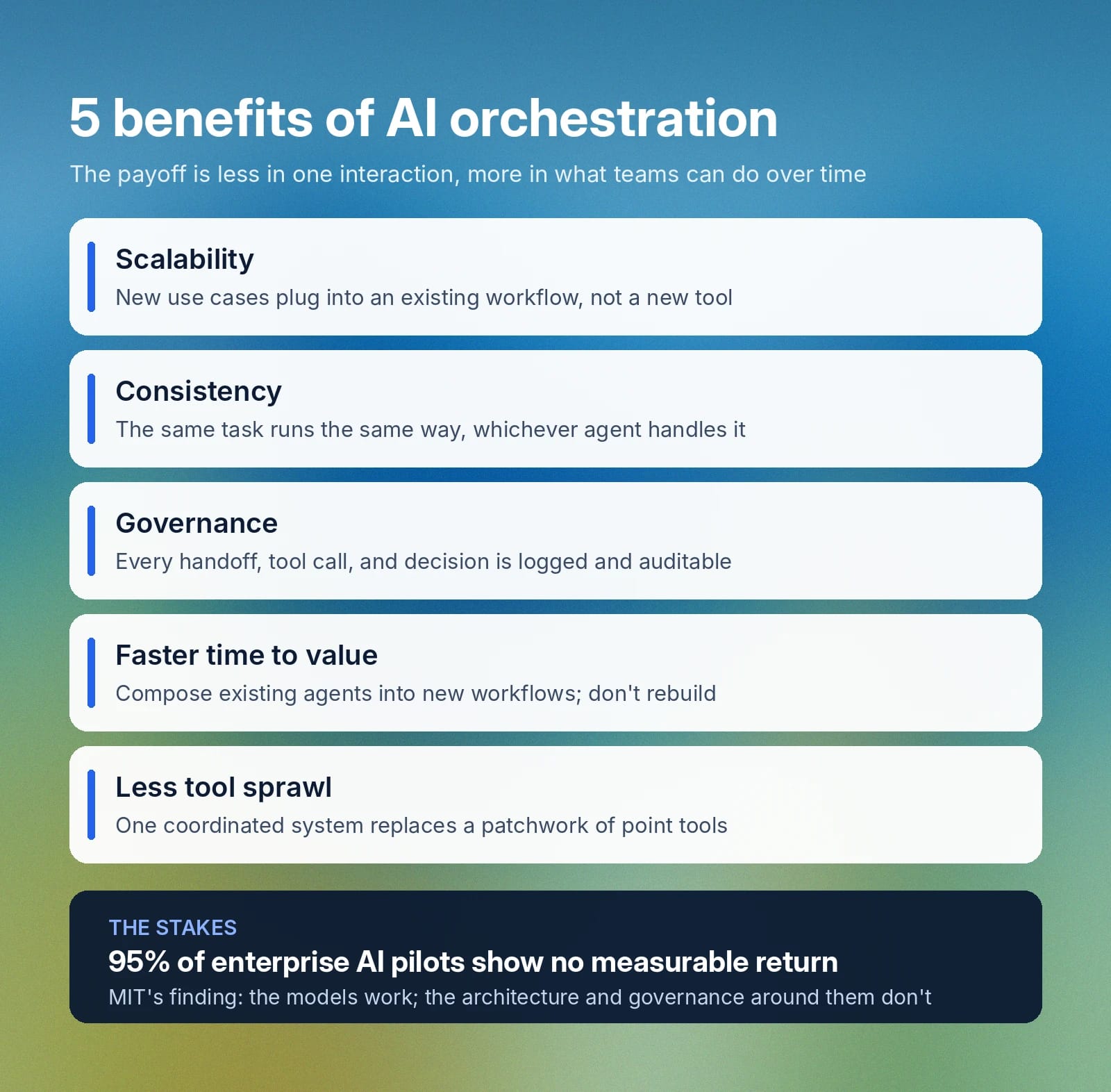
But adoption alone isn't the challenge. MIT's NANDA initiative found that 95% of enterprise generative AI pilots deliver no measurable return, even though the models themselves work well. The surrounding systems lack the architecture, governance, and integration depth to run reliably at scale.
Orchestration is the missing piece that the successful 5% use.
How AI orchestration works to automate complex workflows
When working with multi-step processes that rely on different agents, orchestration will help connect disparate systems and create a coherent, complex response.
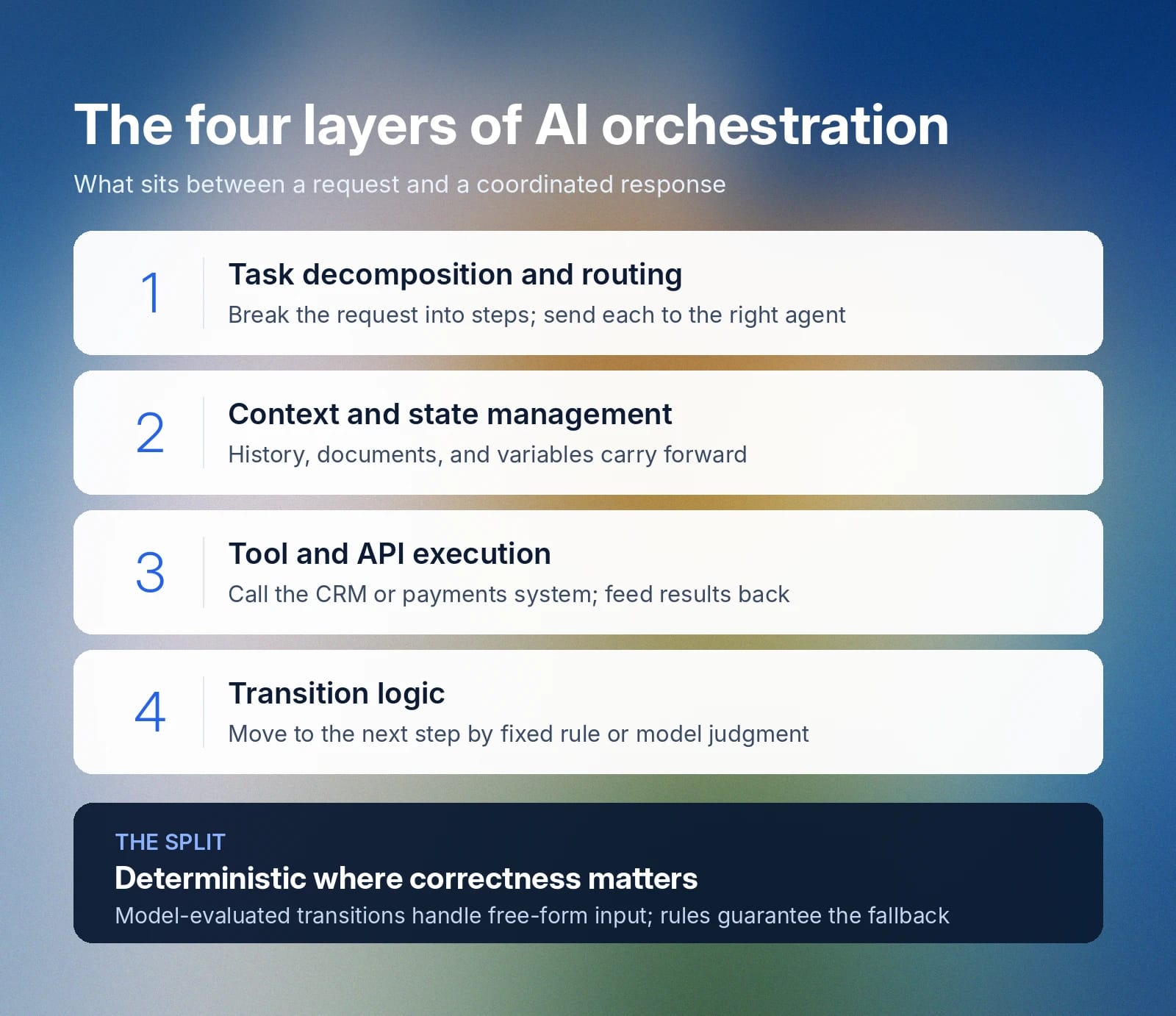
There are four main layers in AI orchestration:
- Task decomposition and routing: Break a request into steps and send each one to the right model, agent, or tool.
- Context and state management: Carry conversation history, retrieved documents, and variables forward so later steps have what they need.
- Tool and API execution: Call external systems, like a CRM or payments processor, and feed the results back into the workflow.
- Transition logic: Decide when to move to the next step, either with a fixed rule or a model's judgment.
AI orchestration platforms tend to diverge on transition logic. A deterministic transition gives you a guarantee. For example, if a payment fails, the workflow always routes to the same fallback step. On the other hand, a model-evaluated transition handles free-form input better but needs guardrails to prevent a misread signal from sending someone down the wrong path.
Most production systems use both, leaning on fixed rules where correctness matters and model judgment where the input can't be pinned down in advance. ElevenAgents workflows work this way too: Each transition between sub-agents can be set as deterministic or left to the model's evaluation.
With ElevenAgents' orchestration engine, an independent agent handles a single-purpose interaction with a system prompt, knowledge base, and set of tools. A workflow adds a directed graph of specialized sub-agents with set tasks, including verification, billing, and escalation.
Each sub-agent gets a narrow slice of context, so information doesn't leak into a role it doesn't belong to. And the transitions between them can be rule-based or model-evaluated, depending on how much certainty that step needs.
Key benefits of integrating AI orchestration
Orchestration pays off less in any single interaction and more in what it lets teams do over time. Here's what ops, engineering, and support teams gain once orchestration is in place:
- Scalability: New use cases plug into an existing workflow instead of needing a new point solution every time.
- Consistency: The same task runs the same way regardless of which model or agent handles it.
- Governance: Every handoff, tool call, and decision is logged and auditable.
- Faster time to value: Teams compose existing agents and tools into new workflows instead of rebuilding integrations from scratch.
- Less tool sprawl: One coordinated system replaces a patchwork of separate AI tools and manual handoffs between them.
By keeping each tool specialized, orchestration makes the whole system less fragile, which is what lets you scale to new use cases and offer experiences your customers will actually appreciate.
AI orchestration use cases across industries
AI orchestration works the same way in every industry: It sequences identity checks, data lookups, and policy rules into one continuous interaction. What changes is which systems get connected, like a CRM in customer support or an EHR in healthcare. Here's what that looks like in a few sectors:
Customer support
Freedom Forever, one of the largest residential solar installers in the U.S., uses ElevenAgents to route each caller to a specialized sales or support agent, resolve routine questions, and account updates, and hand off to a human with full transcript context when needed. The deployment delivered a 90% improvement in support efficiency.
Financial services
Better.com's ElevenAgents-powered loan agent, Betsy, authenticates borrowers, pulls account and loan status, and walks them through next steps under mortgage-industry compliance requirements. Betsy now automates 35.5% of borrower inquiries, cutting origination costs and doubling loan conversion.
Healthcare
EliseAI's ElevenAgents-powered voice agents schedule appointments, answer billing questions, and route clinical questions to staff across healthcare providers nationwide. The system delivers natural-sounding interactions while maintaining AI disclosure, helping healthcare providers manage high call volumes efficiently.
Sales and lead qualification
ElevenLabs uses its own AI SDR to screen inbound leads from its contact-sales form, asking about use case, expected volume, and timeline before booking a meeting directly on a rep's calendar. The agent qualifies 78% of inbound leads without a human on the call, with an average customer satisfaction score of 8.7 out of 10.
Retail and e-commerce
Meesho, one of India's largest e-commerce marketplaces, built a voice agent that resolves order delays, cancellations, and refunds in Hindi and English. The agent now handles more than 60,000 daily calls without human intervention.
Core features to look for in an AI orchestration platform
Orchestration platforms vary a lot in how much complexity they can actually handle.
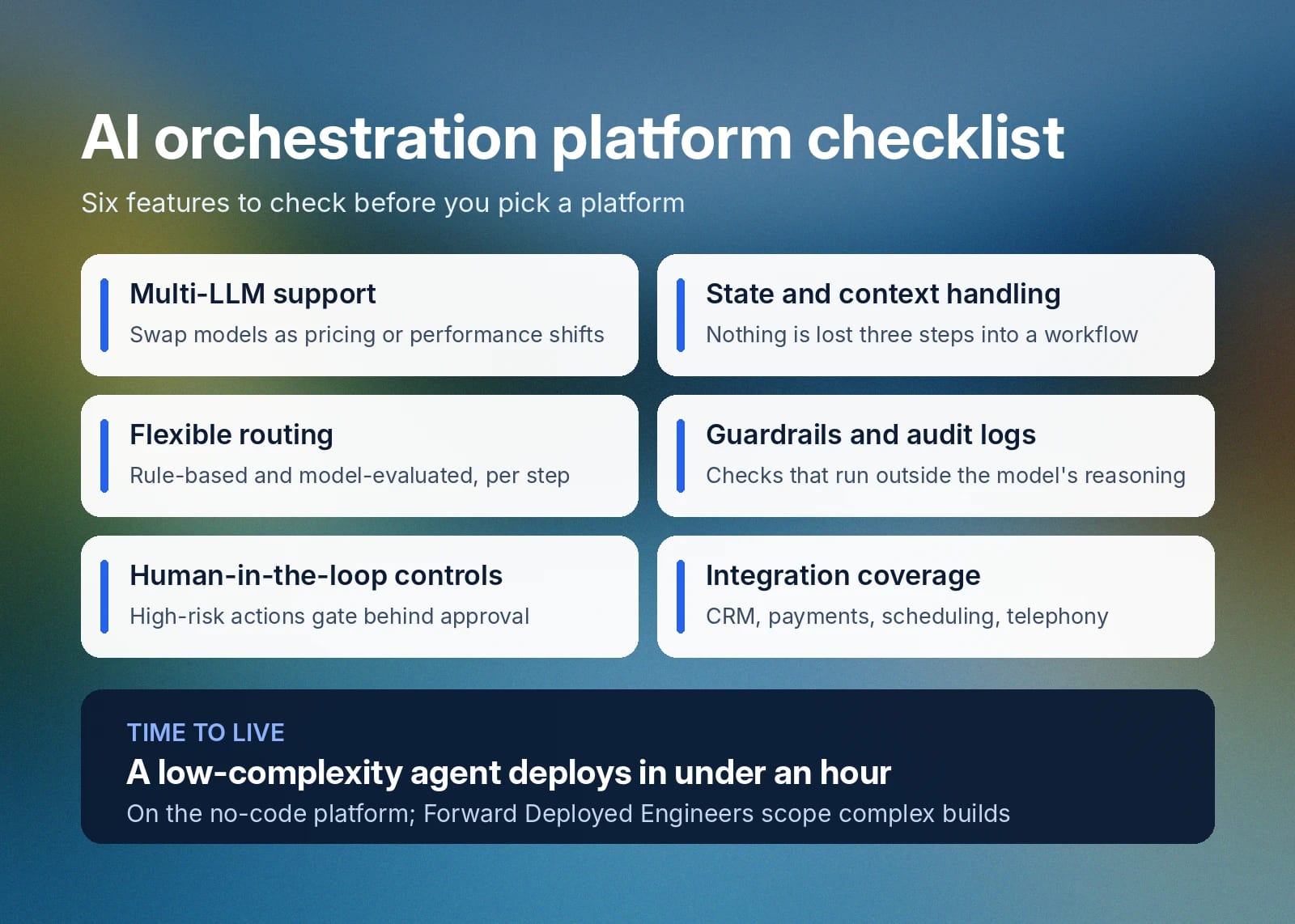
Before you pick one, check for:
- Multi-LLM support: You're not locked into a single provider and can swap models as pricing or performance shifts.
- State and context handling: The platform tracks conversation history and variables across every step, so a workflow doesn't lose track of what happened three steps earlier.
- Flexible routing: Both rule-based and model-evaluated logic are supported, so you can choose the right level of control per step instead of forcing every decision through the same approach.
- Guardrails and audit logs: These run as independent system checks outside the model's own reasoning, so a bad response gets caught automatically rather than relying on a prompt to discourage it.
- Human-in-the-loop controls: High-risk actions can be gated behind approval or handed off to a live person with context intact, so mistakes on payments, refunds, or account changes get caught before they ship.
- Integration coverage: The platform connects to the systems the workflow needs to touch, including CRM, payments, scheduling, telephony, and internal databases.
Another important consideration is how difficult it is to get an orchestrated AI agent live. With ElevenLabs, most teams can configure and deploy a low-complexity agent through the no-code web platform in under an hour. For more complex workflows, Forward Deployed Engineers can scope and build it directly with your team.
Get started with ElevenAgents for streamlined AI orchestration
Building an orchestrated workflow from scratch means solving state management, tool integration, and transition logic before you even get to your actual use case. ElevenAgents' visual workflow builder lets teams design multi-step, multi-agent conversations in a no-code environment. Deterministic workflows gate high-risk actions behind approval, guardrails run outside the model's own reasoning, and every conversation is logged for audit.
Sign up for ElevenAgents and start building a custom agent designed for your own workflows, or talk to our team to see how we can help your team deploy AI agents.
What is AI orchestration FAQ

Jack Limebear is on the Growth team, acting as a content writer and strategist across the blog and insights pages. Before ElevenLabs, he spent over a decade leading content strategy for organizations ranging from fast-growing SaaS startups to Fortune 500 companies. He holds a Master's degree in English Literature from the University of Cambridge.