
What is human in the loop? How people improve AI workflows
- Written by
- Jack Limebear
- Published
- Last updated
ListenListen to this article
Human in the loop (HITL) is a workflow used in AI models that divides tasks between automated systems and human experts based on clear operational boundaries. In a HITL system, AI handles predictable, rule-based tasks, while human specialists retain responsibility for complex decisions, compliance requirements, and edge cases.
For businesses, HITL provides a practical way to automate routine work while keeping people involved when their judgment is needed. An AI agent might look up account details, collect claim information, send onboarding forms, or book an appointment, then flag an uncertain or sensitive case for a person to review, approve, correct, or take over.
Beyond live workflows, HITL also applies to machine learning development. People can label training data, evaluate model outputs, correct errors, or provide feedback that helps improve how a model performs. In this context, the human is part of the model’s training or improvement process rather than a live business workflow.
In this article, we’ll show you where human involvement belongs in AI systems and workflows, why it matters, and what effective HITL looks like in practice.
Summary
- Human-in-the-loop AI divides a workflow between AI and people based on predefined responsibilities.
- Teams build human reviews, approvals, handoffs, and exception paths into the workflow, then refine those rules as needed after deployment.
- HITL can improve accuracy, efficiency, and risk management by combining automation with human judgment where it is needed.
What is human in the loop?
Human in the loop is a system where a human is actively included in the process to manually make decisions or supervise an AI workflow. It works by combining automated task handling with built-in rules that pause the workflow or hand it to a person when defined conditions are met.
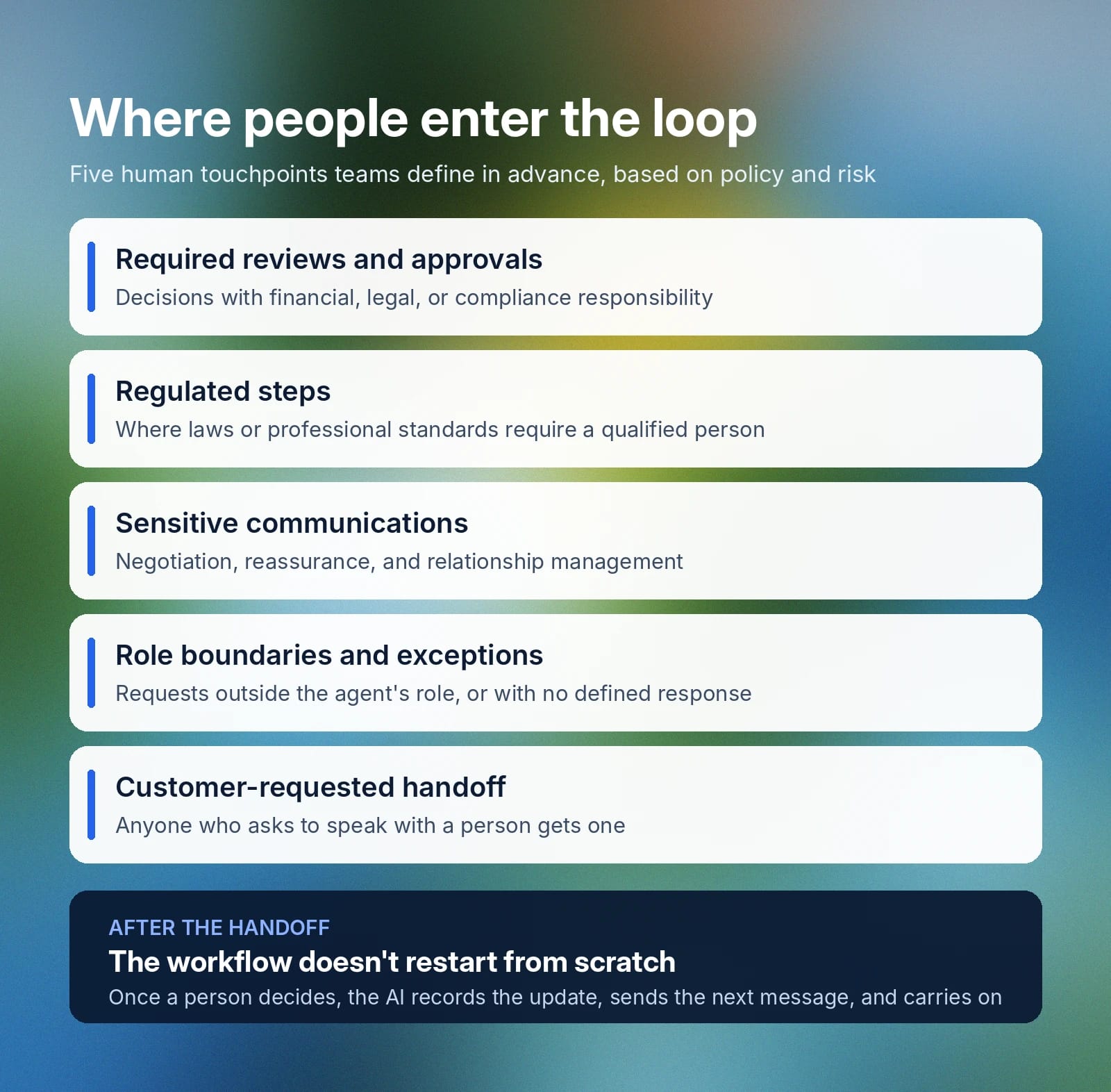
Human involvement can be a planned part of the workflow or a response to situations the AI should not handle on its own. Teams define these human touchpoints in advance based on policy, risk, customer experience, and the type of decision involved.
Common human touchpoints include:
- Required reviews and approvals: A person reviews or authorizes decisions that carry financial, legal, compliance, or operational responsibility.
- Regulated steps: Agentic workflows route decisions or documentation to qualified employees when laws, policies, or professional standards require human involvement.
- Sensitive or high-value communications: People handle conversations where negotiation, reassurance, relationship management, or careful judgment matters.
- Role boundaries and exceptions: Requests that fall outside the AI's assigned role, involve unusual circumstances, or lack a defined response move to a person.
- Customer-requested handoff: A customer can be transferred to a live team member when they ask to speak with someone.
Humans can also enter the loop dynamically when a situation changes during the workflow. Conflicting information, a new customer concern, or circumstances the original rules did not anticipate can trigger a handoff even when the task initially followed the standard path.
A human stepping in doesn’t necessarily mean the automated process has to start over from scratch. Once a team member makes a decision or resolves an issue, the AI saves the update to the record, sends the next required communication, and carries on with the rest of the workflow.
What does human-in-the-loop mean in machine learning?
Human-in-the-loop machine learning uses the same principle as HITL, but during the development stage. Instead of stepping into a live workflow, people participate at defined points in the model-development process.
Researchers may label training data, evaluate model responses, correct errors, or provide feedback that helps improve model behavior before deployment. Domain experts can also review outputs when accuracy depends on specialized knowledge or judgment.
Key benefits of integrating humans into AI workflows
For businesses, HITL can mean fewer costly mistakes, more consistent handling of sensitive or regulated cases, and faster processing of routine work without giving AI unchecked control over higher-risk decisions.
Here are some of the key benefits and use cases of using HITL systems.
Improve accuracy and decision quality
HITL improves accuracy and decision quality by pairing AI's consistency on structured tasks with human judgment on the parts a model can't reliably handle alone. AI can handle structured tasks consistently, gather the information needed for a decision, and prepare routine responses or recommendations.
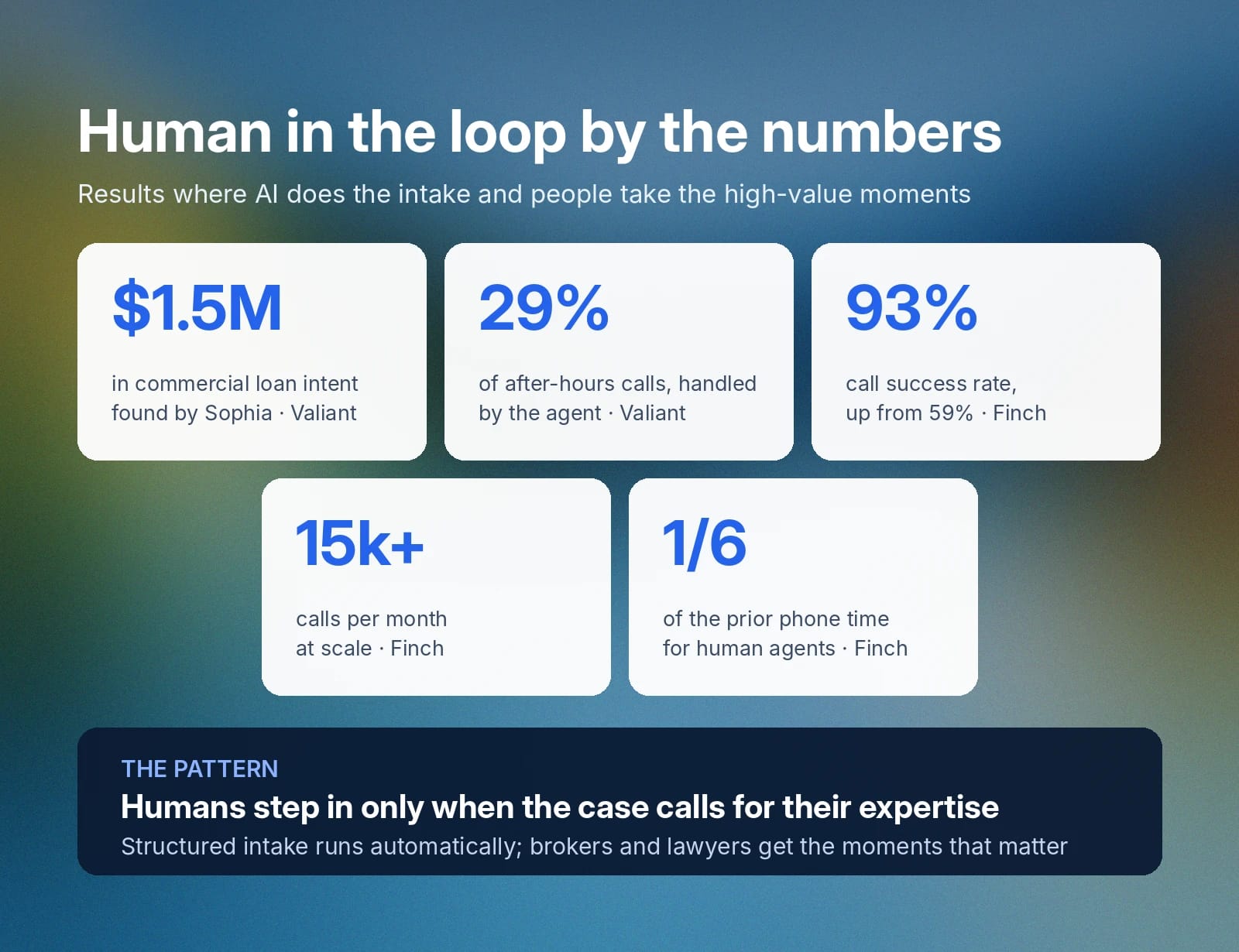
Valiant’s after-hours agent, Sophia, handles structured intake and then passes off cases to a human broker where appropriate. Built on ElevenAgents, Valiant’s agent was able to identify over $1.5M in commercial loan intent, with Sophia handling around 29% of after-hours calls.
Human input improves decision quality when information is:
- Incomplete or conflicting
- Dependent on context or interpretation
- Reliant on negotiation and relationship-building
- Dependent on specialized expertise
Better outcomes can reduce costly errors and avoidable rework, especially in situations with financial, regulatory, or customer consequences.
Reduce risk and support compliance
HITL can help organizations reduce compliance risk by making sure regulated or high-consequence decisions reach the right person before they move forward.
AI supports procedural compliance by:
- Sending required documents.
- Collecting information.
- Checking whether required fields are complete.
- Retrieving policies or disclosures.
- Recording completed steps.
- Routing cases to the appropriate person.
People remain responsible when regulations require interpretation, an exception needs to be resolved, or a legally accountable decision must be made.
For example, UK insurer Admiral sets deliberate scope boundaries for its customer voice agents. Admiral routes vulnerability and arrears cases to people and tests regulated AI workflows against a high validation bar before launch.
Increase efficiency while preserving human expertise
AI can handle repetitive administrative work, gather information, prepare records, and move routine cases forward without requiring a person at every step. For businesses, the result can be shorter turnaround times, less administrative backlog, and more capacity for employees to handle work that directly affects customers, revenue, or risk.
Finch Legal was able to use ElevenAgents to improve call success rates from 59% to 93% while scaling to 15k+ calls per month. Implementing an agent to handle these processes meant human agents spent roughly a sixth of the time on the phone than previous deployments. Humans only needed to step in when the case called for their expertise, reserving them for high-value moments.
Challenges and considerations for human-in-the-loop systems
Even a well-designed human-in-the-loop system can break down if the handoff is poor or the person taking over lacks enough context to act. Balancing automated speed with human oversight comes down to workflow design.
When a human-in-the-loop system doesn’t work as intended, the problem often lies in the rules that determine when people enter the process and what information they receive.
Here are some of the main challenges in human-in-the-loop systems.
1. Vague handoff triggers
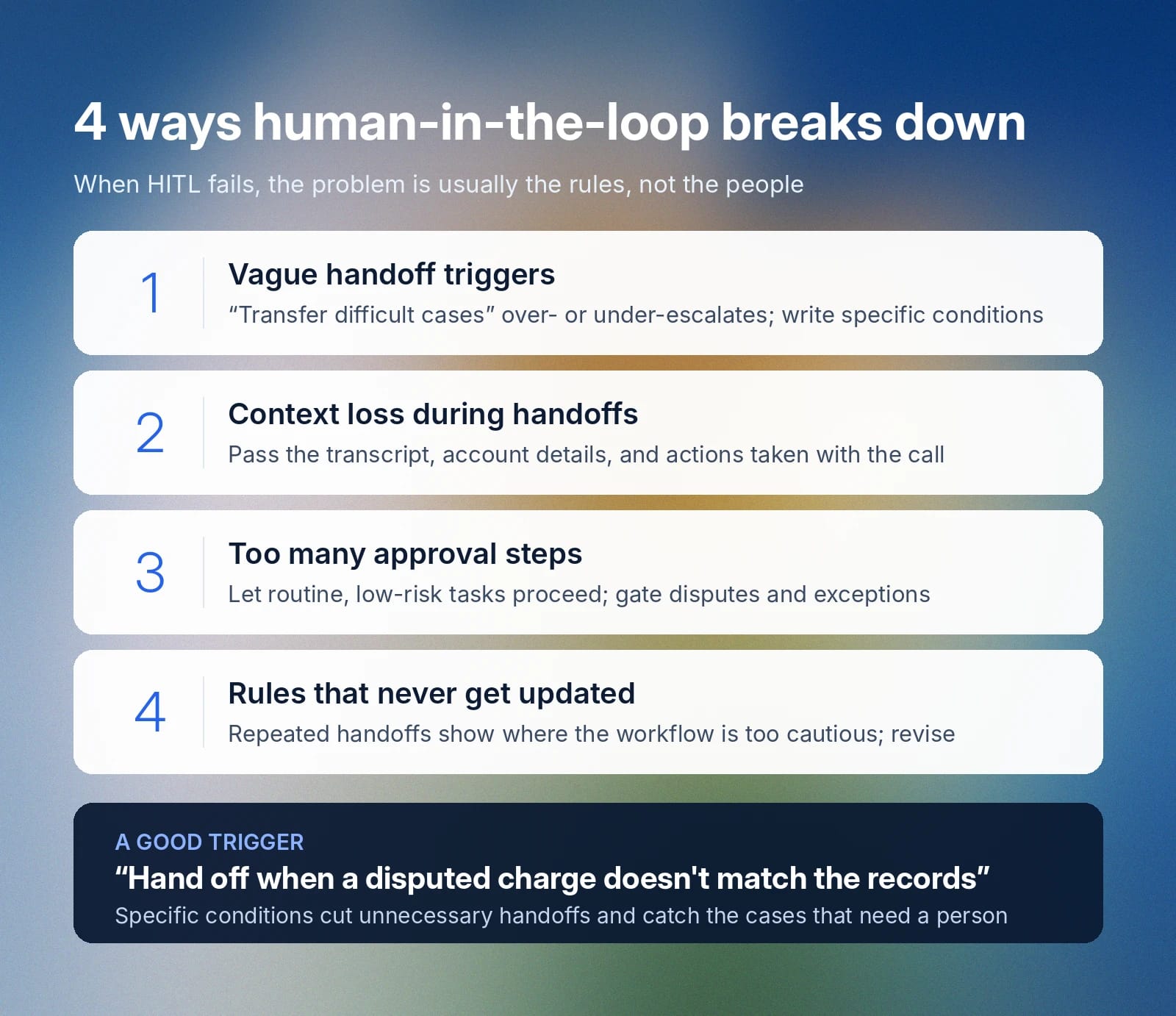
Programming AI agents with subjective instructions like “transfer difficult cases” or “send unusual requests to a human agent” can lead to unnecessary handoffs or allow the AI to continue with a situation that should involve a person.
For example, instead of telling an AI customer service agent to “transfer complex billing questions,” a team might set a rule such as “hand off the case when a customer disputes a charge and the account records do not match.” Detailed guardrails give AI agents specific conditions to follow, which can reduce unnecessary handoffs and lower the risk of the AI continuing with a case that needs human involvement.
Teams can set similarly specific handoff conditions for requests that fall outside an AI agent’s role, like conflicting or missing information, customer requests for a human agent, and other situations that require human involvement.
2. Context loss during handoffs
When an AI agent hands off a live customer interaction to a human representative without carrying over session history, the employee is forced to re-interview the caller from scratch. This sloppy transfer creates immediate friction, frustrates the customer, and adds time to the interaction.
A customer may spend several minutes explaining a billing problem and verifying their account with an AI agent before the issue requires a human agent, but if the transcript, account details, and actions already taken don’t transfer with the call, the customer has to repeat the entire process.
To avoid losing context during handoffs, make sure the system passes the information the AI agent has already collected directly to the human representative along with the handoff.
3. Too many approval steps
Requiring human sign-off on routine, low-risk tasks can slow down work that the AI agent is equipped to handle safely. If an employee has to approve every standard appointment change, basic intake form, or routine status lookup, human review starts adding work instead of helping the team manage higher-risk cases.
Teams can avoid unnecessary checkpoints by deciding in advance which actions truly require human review and letting lower-risk tasks continue automatically. For example, routine appointment changes or standard status requests can proceed without approval, while billing disputes or policy exceptions still route to a person.
4. Rules that never get updated
Handoff rules that made sense before launch may need to change once the AI agent starts handling real conversations. Repeated handoffs can reveal where the original workflow is too cautious, where the AI agent lacks information, or where a new type of request needs its own rule.
For example, if an AI agent keeps handing off routine shipping questions because customers phrase them in ways the original workflow didn’t anticipate, the team can update the AI agent’s knowledge or handoff rule so those requests stay automated.
Treating human-in-the-loop rules as fluid allows teams to automate more routine work safely while keeping human oversight focused on genuine edge cases.
Comparing human in the loop vs. human on the loop
HITL and human on the loop (HOTL) are two different models for human oversight of AI.
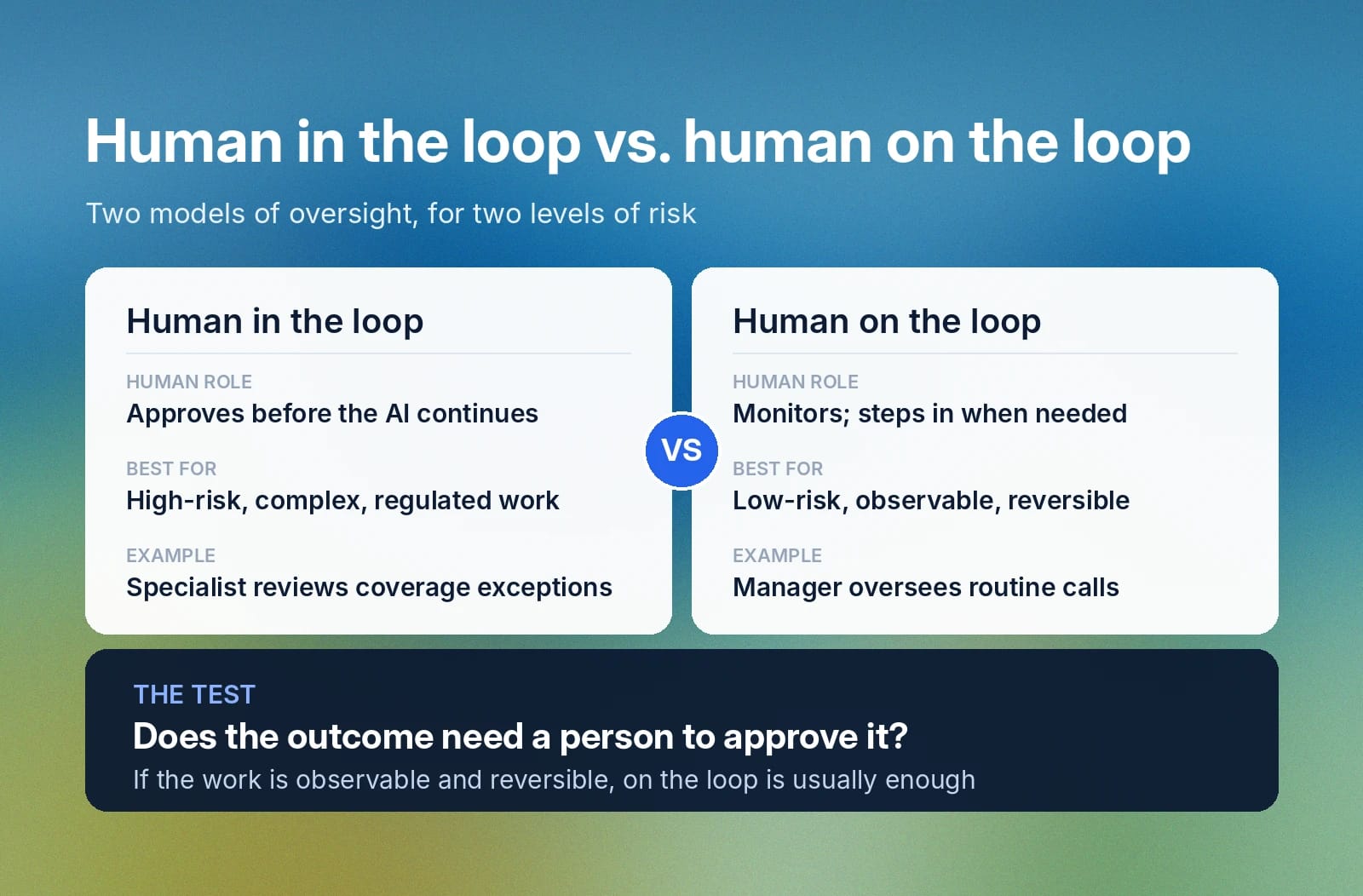
HITL requires a person to participate before certain decisions or actions can continue. It’s best suited to higher-risk or complex work in which compliance, financial responsibility, clinical judgment, or policy exceptions require human review or approval before the workflow moves forward.
HOTL lets the AI work without waiting for human approval, but a person monitors the system and can step in when needed. It’s best suited to low-risk work that’s both observable and reversible, like general informational questions, order-status updates, or other low-risk interactions that do not require a person to approve the outcome.
A supervisor can watch the overall activity and respond only when something needs attention. Here are the main differences between HITL and HOTL.
Approach | Human role | Operational example |
HITL | A person must review, decide, or approve at defined checkpoints before the AI can continue. | An AI agent prepares an insurance claim, but a human claims specialist must review any coverage exceptions before the decision moves forward. |
HOTL | AI works independently while supervised by a human who steps in if needed. | An AI voice agent handles routine calls while a contact center manager monitors activity and intervenes when a conversation needs human attention. |
Human-in-the-loop AI examples
HITL can take different forms depending on which decisions, approvals, or conversations require human involvement.
Banking
Customers Bank is rolling out ElevenAgents for account inquiries, card services, transfers, onboarding, and employee coaching, with human handoff paths built into every agent. AI agents can handle routine banking support, while human bankers remain available when a conversation requires personal attention or a decision outside the agent’s role.
Insurance
Insurely uses AI voice agents for insurance sales and customer care, including answering questions and helping customers complete quotes. When a customer needs a person, the AI agent hands off the call or schedules a callback.
Healthcare
mdhub, a behavioral health platform, uses ElevenAgents for patient admissions and support. AI agents capture patient information, verify insurance, match patients with providers, and schedule appointments, while healthcare professionals determine treatment and make decisions that require clinical judgment.
Fintech
Klarna, a global digital bank and payments provider, uses an ElevenAgents voice AI agent as the first line of phone support for U.S. customers. The AI agent handles informational requests and gathers relevant context, then hands the conversation to a human agent when the issue becomes more complex or sensitive, or when the customer wants to speak to a person.
Creative
For content and creative work, ElevenProductions uses a HITL approach for AI-assisted production with human editing. AI handles work such as transcription and AI-generated audiobook production, while human editors review the work, make corrections, and approve the final result.
In a different kind of human-AI collaboration, composer and singer Patrick Darling, who lost his ability to sing, used ElevenLabs voice technology to perform his own music again.
Get started with ElevenAgents
ElevenAgents gives businesses several ways to define what an AI agent can handle and where people should remain part of the workflow. Agents can use company knowledge and business tools, follow defined workflows, and operate within guardrails. Human handoff can transfer a conversation and its context to a live person, while simulations help teams test behavior before launch.
Get started with ElevenAgents to build AI agents with clear workflow boundaries, human handoff, and controls for testing and oversight. Talk to sales to scope your implementation, or sign up to create an agent to try it yourself.
Human-in-the-loop FAQ

Jack Limebear is on the Growth team, acting as a content writer and strategist across the blog and insights pages. Before ElevenLabs, he spent over a decade leading content strategy for organizations ranging from fast-growing SaaS startups to Fortune 500 companies. He holds a Master's degree in English Literature from the University of Cambridge.