
Conversational AI use cases, examples, and applications
- Written by
- Jack Limebear
- Published
ListenListen to this article
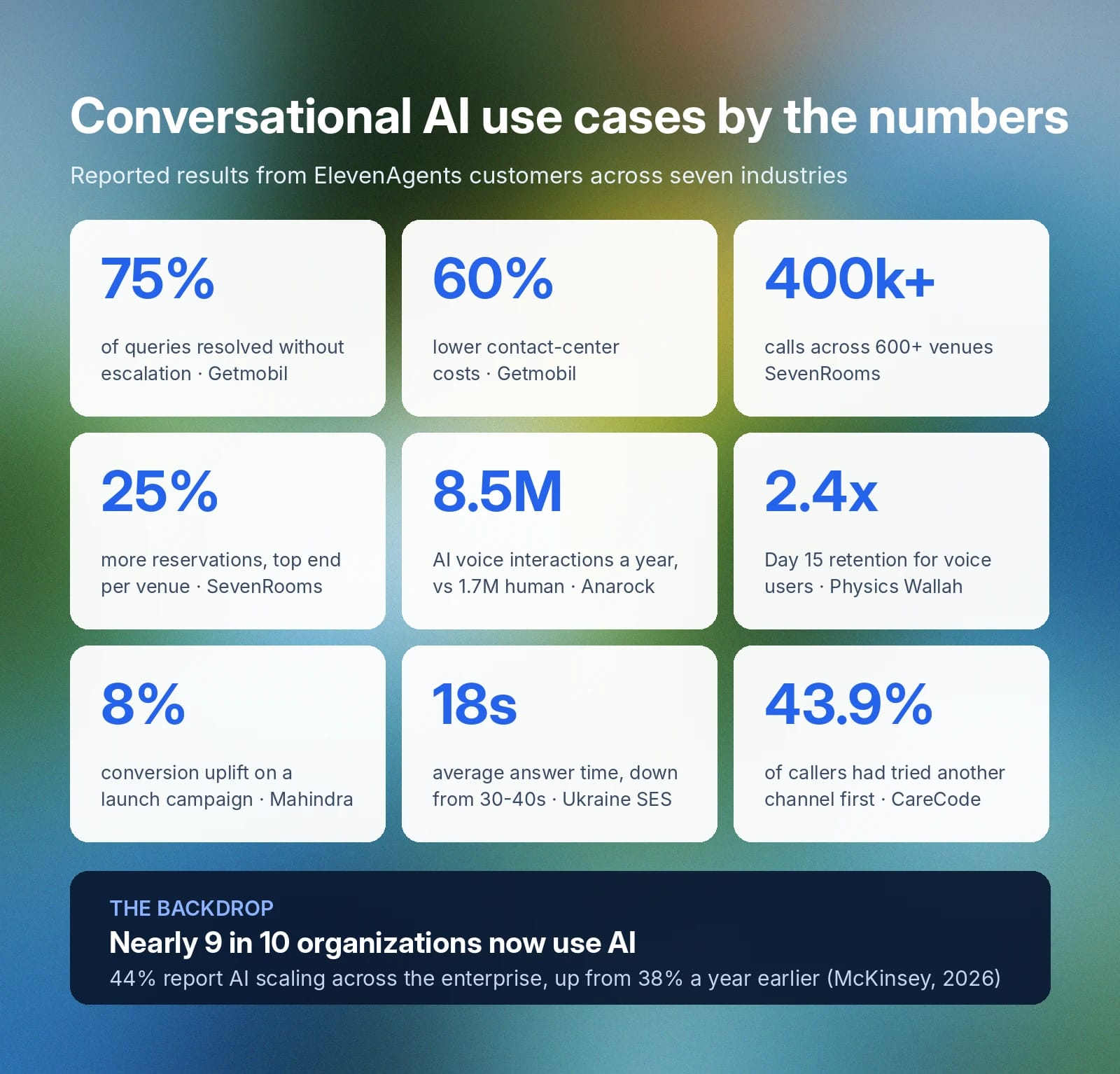
Businesses across all industries are adopting conversational AI to help with customer service, sales, scheduling, employee support, and other everyday interactions. McKinsey's 2026 survey found nearly nine in ten organizations now use AI in at least one business function, and 44% report AI scaling across the enterprise, up from 38% the year before.
Conversational AI use cases include answering questions, retrieving information, completing routine requests, and guiding users through multi-step processes. These are specific business tasks that AI agents handle from end to end or transfer to a person when human judgment is needed.
The examples below cover the most common conversational AI use cases across business functions, followed by industry-specific applications and practical guidance for choosing and deploying them.
Summary
- Conversational AI uses voice and chat agents to handle customer and employee interactions, including support, scheduling, sales, transactions, and internal assistance.
- Businesses apply conversational AI differently by industry, from patient scheduling and insurance claims to retail orders, education, telecom support, and public services.
- The strongest conversational AI use cases have a clear task, access to the right information and tools, and defined rules for human handoff when a conversation requires judgment or specialist support.
What are the most impactful conversational AI use cases?
Conversational AI has the greatest impact on repeatable interactions with a clear goal, where an agent can answer a question, retrieve information, or complete a defined task. The best use cases reduce friction for customers or employees while giving the AI clear boundaries for what it should handle and when to involve a person.
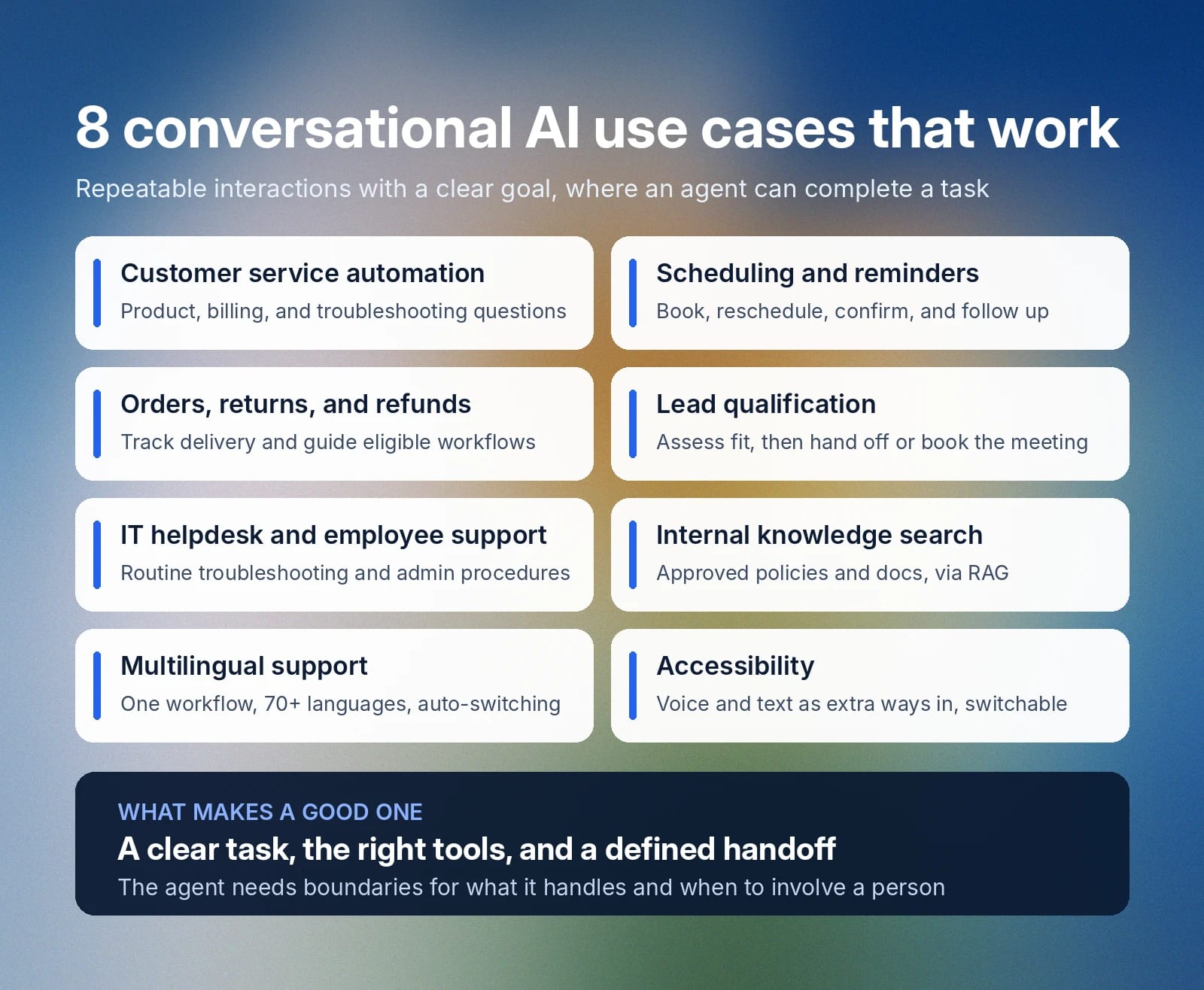
Here are some of the most effective ways businesses use conversational AI in 2026:
- Customer service automation: Answer product, account, billing, and troubleshooting questions, then transfer unresolved requests to a representative with the relevant conversation context.
- Appointment scheduling and reminders: Check availability, book or reschedule appointments, send confirmations, and follow up with reminders.
- Order tracking, returns, and refunds: Retrieve current order information, answer delivery questions, and guide customers through eligible return, exchange, or refund workflows.
- Lead qualification and sales outreach: Gather information from inbound prospects or outbound contacts, assess fit, and move qualified leads to a salesperson or booked meeting.
- IT helpdesk and employee support: Guide employees through routine troubleshooting and administrative procedures, with specialist requests routed to the appropriate internal team.
- Internal knowledge base search: Give employees conversational access to approved policies, documentation, FAQs, and other company information via retrieval-augmented generation.
- Multilingual customer support: Run the same voice or chat workflows across languages. ElevenAgents supports more than 70 languages and can automatically detect and switch languages during a conversation.
- Accessibility and assistive experiences: Offer voice and text as additional ways to access information, complete forms, and get support, including the ability to move between spoken and typed interactions when appropriate.
The industries below show how businesses apply these capabilities to the systems, information, and workflows specific to their work.
With ElevenAgents, your business can build out an agent that supports customers and streamlines internal operations.
10 industry-specific conversational AI use cases
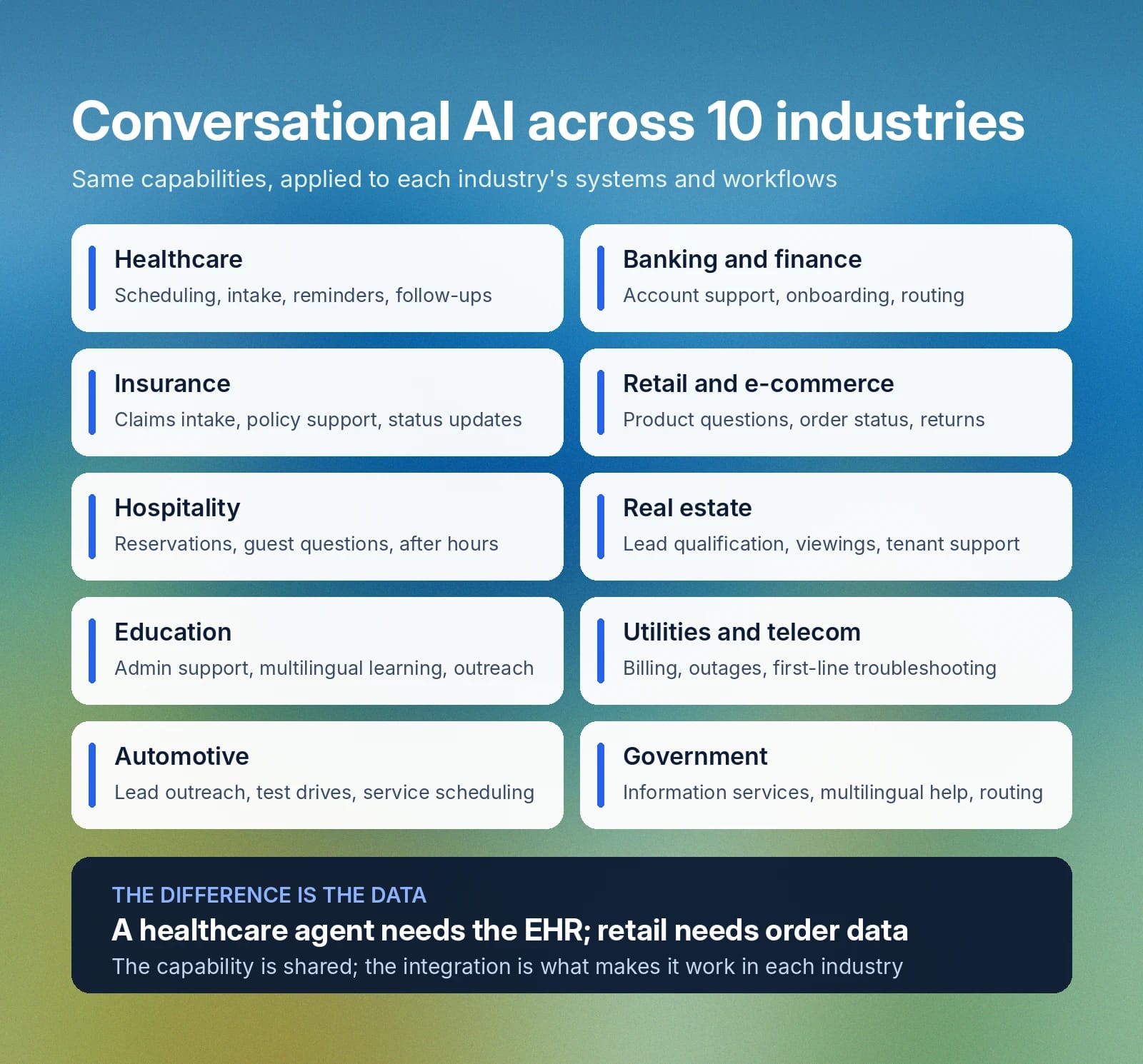
The conversational AI use cases above apply differently depending on the industry. A scheduling agent in healthcare may need access to an electronic health record (EHR), while a retail support agent may depend on product and order data.
Here’s a quick look at some of the most common use cases across industries.
Industry
Common uses
Healthcare
Appointment scheduling, patient intake, reminders, follow-up outreach
Banking and financial services
Account support to reduce wait times, onboarding to guide new customers, routing complex requests to the right specialist
Insurance
Claims intake, policy support, status updates
Retail and e-commerce
Product questions and recommendations, order-status support, returns and exchanges
Hospitality and restaurants
Reservation booking, guest questions, after-hours call coverage
Real estate and property management
Lead qualification, property viewings, property management support
Education
Administrative support, multilingual learning assistance, student outreach
Utilities and telecom
Billing and account questions, service requests, outage information, first-line troubleshooting
Automotive and repair services
Lead outreach, test-drive booking, service scheduling
Government and public services
Information services, multilingual assistance, call routing
The examples below get into specifics and show how businesses are applying conversational AI to workflows specific to their customers and operations.
Healthcare
Healthcare organizations use conversational AI for administrative conversations around care, including patient intake, appointment scheduling and reminders, billing questions, and follow-up outreach. Agents can connect to scheduling and EHR systems to retrieve information or complete eligible actions, while clinical questions follow established escalation rules.
For example, CareCode uses ElevenAgents for patient communications, including appointment scheduling, confirmations, reminders, and routine questions. CareCode found that 43.9% of callers had already tried another scheduling channel before turning to voice AI, showing how voice AI can give patients another way to complete scheduling when digital channels don’t meet their needs.
Banking and financial services
Banks and financial services companies use conversational agents for account and transaction questions, card services, transfers, onboarding, and customer support. After appropriate authentication, an agent retrieves information from banking systems or routes requests that require a specialist.
Customers Bank is rolling out conversational AI across customer and employee support, including 24/7 help with account questions, card services, and transfers, guided onboarding for new customers, and real-time assistance for employees during live calls. The rollout is designed to give customers faster answers, shorter hold times, and consistent access to support outside normal business hours, while keeping human escalation available when a conversation needs it.
Insurance
Insurance policyholders often reach out during high-stress events like auto accidents or property damage, where tone and responsiveness matter just as much as speed. Conversational AI voice agents can detect vocal tone and emotional context, adjusting their delivery to match caller sentiment while gathering claim details, answering policy questions, and retrieving status updates from connected databases.
Insurely uses voice AI to recover abandoned quotes, answer routine questions, and provide 24/7 support, while emotional context detection helps the agent adjust its response to how the customer sounds. The result is more completed quotes, higher sales, and lower support volume.
Retail and e-commerce
Retailers use conversational AI before and after a purchase, for everything from helping shoppers choose products to tracking orders and handling returns. Conversational agents also answer questions about availability, guide shoppers toward suitable products, recover abandoned carts, or help with order changes.
Getmobil, Turkey’s leading marketplace for refurbished electronics, uses AI voice agents to answer product questions, track orders, and assist with returns. Routine requests are resolved during customer conversations, while issues that require judgment or account-specific review are transferred to a human representative. The retailer is also expanding voice AI into outbound customer calls, vendor onboarding, and collection scheduling.
After implementing AI agents across customer service, Getmobil reports three times faster response times, 75% of customer queries resolved without human escalation, and a 60% reduction in contact-center costs. Getmobil also reports more consistent customer service around the clock.
Hospitality and restaurants
Hotels and restaurants use conversational agents to handle reservations, booking changes, guest questions, takeout orders, and questions about menus or venue policies. AI voice agents also give businesses a way to answer customer calls after hours or when on-site staff are busy serving guests.
SevenRooms reports that its voice AI has handled more than 400,000 calls across 600+ restaurants, with one in five calls occurring after hours and venues seeing up to 25% more reservations.
Real estate and property management
Conversational AI helps real estate teams respond to inquiries, qualify leads, and book viewings while prospects are still engaged. They also collect details such as budget, preferred property type, and timing before sending qualified leads to the right agent, giving sales teams useful context before they take over the conversation.
Property management companies use conversational agents for a different set of interactions, including answering routine tenant questions, handling maintenance requests, and taking after-hours calls.
Anarock real estate consultants use AI voice agents to qualify real estate leads, re-engage inactive prospects, and handle overflow calls when sales teams are unavailable. In one financial year, the company reported 8.5 million successful AI voice interactions versus 1.7 million human interactions the previous year.
Education
Conversational AI gives students faster access to academic help and support outside scheduled classes or counseling sessions. Voice-based tutoring can explain difficult material aloud, while student-support tools handle outreach and counseling conversations at scale. Multilingual voice also makes those interactions easier to access for students who are more comfortable learning in another language.
Physics Wallah uses voice AI across tutoring and support tools for learners preparing for competitive exams such as JEE, NEET, and government entrance tests. Its Ask AI tool delivers spoken explanations for academic questions, while other voice applications support counseling and student outreach. Voice users generate nearly three times as many queries per session as non-voice users, and Physics Wallah reports Day 7 retention is 2.2 times higher and Day 15 retention is 2.4 times higher among voice users.
Utilities and telecom
Conversational AI handles routine utility and telecom requests about billing, service changes, outages, and account questions through voice or chat. For technical issues, conversational agents guide customers through first-line troubleshooting, such as restarting a router, checking connection status, or confirming service settings.
Deutsche Telekom, Europe's largest telecommunications company, integrates AI voice directly into its network so subscribers can use a call assistant to answer questions, retrieve information, perform tasks in real time, translate conversations, and create call summaries for later review. The project also shows what telecom providers require from voice AI at a carrier scale: low latency, high concurrency, strong audio quality, security, and reliability.
As Christoph Hilz, Group SVP Core Network & Services at Deutsche Telekom, puts it: “It is about jointly learning how to make AI carrier-grade: fast enough for the AI-native world, but trusted, secure, and reliable for Deutsche Telekom and our customers.”
Automotive and repair services
Dealerships and automotive businesses use conversational AI to answer questions about available vehicles, follow up with leads, schedule test drives, and book service appointments. The agents check current vehicle availability and open appointment times, then transfer qualified leads or service requests to the appropriate dealership team.
For the launch of its XUV 7XO, Mahindra used AI voice agents for large-scale customer outreach, answering questions, registering inquiries, and booking test drives. The campaign produced an approximately 8% uplift in conversion compared with previous methods.
Government and public services
Public agencies use conversational AI for informational and administrative services such as explaining processes, helping residents locate services, answering routine questions, scheduling appointments, and routing requests. Requests involving protected records or decisions that require a government employee are transferred to the appropriate staff member.
Ukraine's State Employment Service uses a voice agent in its contact center to answer routine questions around the clock and transfer callers when human review is needed. In its first 80 days, the agent handled about 25% of total call volume and reduced average answer time to 18 seconds, down from 30–40 seconds.
Across industries, larger conversational AI deployments require careful attention to integration, compliance, governance, and production requirements. Our guide to deploying enterprise conversational AI at scale covers these considerations in more detail. And our guide to conversational AI design for more human user experiences explains how workflows, handoffs, turn-taking, and other design decisions affect the conversation itself.
Build conversational AI with ElevenAgents
Businesses use ElevenAgents to build voice and chat agents for the kinds of use cases covered throughout this guide, from customer support and scheduling to sales, internal help, and other routine conversations. Agents can use company knowledge, connect to business tools, follow defined workflows, and operate across phone and digital channels in more than 70 languages.
Ready to apply conversational AI to your own workflows? Discover more about ElevenAgents or sign up to build a voice or chat agent around a real customer or employee workflow, connect it to the information and tools it needs, and test how it handles conversations before launch.
Conversational AI use case FAQs

Jack Limebear is on the Growth team, acting as a content writer and strategist across the blog and insights pages. Before ElevenLabs, he spent over a decade leading content strategy for organizations ranging from fast-growing SaaS startups to Fortune 500 companies. He holds a Master's degree in English Literature from the University of Cambridge.