
Conversational AI in banking: Use cases, benefits, examples
- Written by
- Jack Limebear
- Published
ListenListen to this article
Financial institutions tend to keep short, restrictive hours that compete with customers’ workdays and class schedules. Implementing conversational AI in banking fills this gap by offering 24/7 service to customers without increasing operating costs. Even during open hours, AI agents reduce long wait times by answering routine questions, verifying customer identities, and even handling payment disputes.
Cost-effectiveness and improved customer experience from these automated services have made conversational AI a mainstay in banking. But chatbots spreading quickly isn’t necessarily an advantage. The Consumer Financial Protection Bureau reported in 2023 that the top 10 U.S. banks had already added chatbots to their workflows, and more than a third of Americans had interacted with these bots. Yet, the CFPB also found problems with how those bots performed, demonstrating why real resolutions and clear handoffs to people matter even more.
This guide shows what conversational AI in banking is and how modern financial teams build high-volume support pipelines to bring human-level dialogue to customer interactions while securing sensitive data. We also discuss the types of artificial intelligence technology used by banks and how to measure success across various channels.
Summary
- Conversational AI in banking uses agents that process natural language requests to provide 24/7 support to customers.
- Customers use conversational banking to quickly handle tasks, such as resolving routine queries or getting updates to pending account issues.
- Secure conversational banking systems protect financial data through strict cybersecurity protocols and by maintaining compliance with SOC 2 Type II, ISO 27001, and PCI DSS.
- Operational leaders track performance across different banking chatbot use cases by measuring key metrics, such as first-contact resolution rates and escalation frequencies.
- High-impact chatbot use cases include account onboarding, payment reminders, dispute intake, and fraud alerts.
- Voice agents let customers handle phone banking in natural conversation, with faster responses across dozens of languages.
What is conversational AI in banking?
Conversational AI in banking uses automated chat and voice systems to handle bank interactions and resolve customer queries. Instead of routing every request to a human, these AI agents only escalate issues they cannot resolve or when specifically asked to do so by a customer.
These chatbots are different from basic rules-based models that follow rigid scripts. Modern conversational banking platforms understand natural language and pull real account context. These systems handle tasks like requesting information, interpreting intent, verifying user identities, and resolving complex workflows in real time.
In short, conversational AI lets customers speak or type to their bank the same way they would to a human agent.
What types of AI do banks use?
Financial institutions implement AI models for both customer-facing and back-office functions. While they need AI models for customer experience and support, banks also use specialized models for things like risk management and fraud detection.
These are the core technologies they use to optimize workflows:
- Conversational AI: Conversational AI, built on natural language processing (NLP), powers customer-facing roles through real-time voice and chat interactions. For example, ElevenAgents implemented at banks uses NLP to interpret user intent and execute routine transactions across channels.
- Generative AI: Generative AI also uses NLP but can ingest other types of data, such as images. Gen AI agents speed up internal research, analyze complex documents, and draft reports for banking staff. Administrative use cases are distinct from customer-facing tasks like powering chatbots.
- Machine learning: ML models analyze transactional history and historical data to identify potential fraud in real time and execute risk scoring on demand. These algorithms also monitor network activity continuously to identify anomalies and block suspicious transactions.
Conversational AI vs. chatbots vs. IVR in banking
Banks have used phone menus and scripted chatbots for years. Conversational AI takes a different approach, building out a more natural way of interacting with banking systems.
Here is how the three approaches differ in practice.
Criteria
IVR
Rules-based banking chatbot
Conversational AI agent
How customers interact
Keypad presses or single-word voice commands
Typed text and preset options
Natural speech or text
Understands open-ended requests
No
Limited to scripted topics
Yes, understands natural language
Uses account context
Limited
Limited
Yes, through integrations
Takes action
Limited
Limited
Yes, through integrations
Channels
Phone
Chat
Phone, chat, and messaging
Best for
Simple call routing
Frequently asked questions
Open-ended service and end-to-end tasks
Learn more about IVR and how an AI voice agent differs from traditional options. For most banks, the practical path is conversational AI for open-ended requests, with clear handoffs and guardrails in place.
Conversational banking versus traditional banking
Modern financial institutions have faced increasing competition from fintech companies that successfully reduced friction and transformed static customer service by automating services. Many also provided 24/7 support via chat with humans and AI agents.
Operations leaders at large financial institutions are catching up and capturing the full benefits of AI in banking by implementing automated workflows. These changes prioritize customer convenience while reducing the cost of running contact centers.
Here’s how modern conversational banking compares to traditional systems.
Operational area
Traditional banking
Conversational banking
Service availability
Operates during fixed business hours and uses phone trees to filter call queues
Delivers 24/7 support across voice and digital chat channels
Customer navigation
Forces users to use rigid menus and manual keypad selections to get assistance
Processes natural spoken or written dialog without mandatory preset options
Session context
Requires repeated identity verification and manual account lookups for each channel
Authenticates users once and maintains full account history and context across each touchpoint for that interaction
Data processing
Manual data entry by workers or static web form submissions from users
Automated API calls that execute account actions in real time
Capacity and cost
Requires physical and human assets to scale operations, such as more office space, equipment, workers, and training
Handles customer inquiries with the same quality and consistency, whether it’s handling high peak call volumes or low-volume requests
System integration
Standalone interfaces disconnected from core banking software
Direct integration with backend ledgers, CRMs, and security tools
Security and compliance
Manual ID checks and fragmented compliance tracking across legacy silos
End-to-end data encryption with SOC 2 Type II, ISO 27001, and Zero Retention modes
Some banks fall somewhere in the middle between traditional and conversational banking. However, optimizing for the full benefits of modern banking requires workflow changes involving advanced conversational AI systems.
Phone banking with voice AI: How a voice agent handles a call
Phone banking is where conversational AI feels most different from a static menu that some customers may be used to. A voice agent listens, understands what a customer wants, and replies in real time in natural speech.
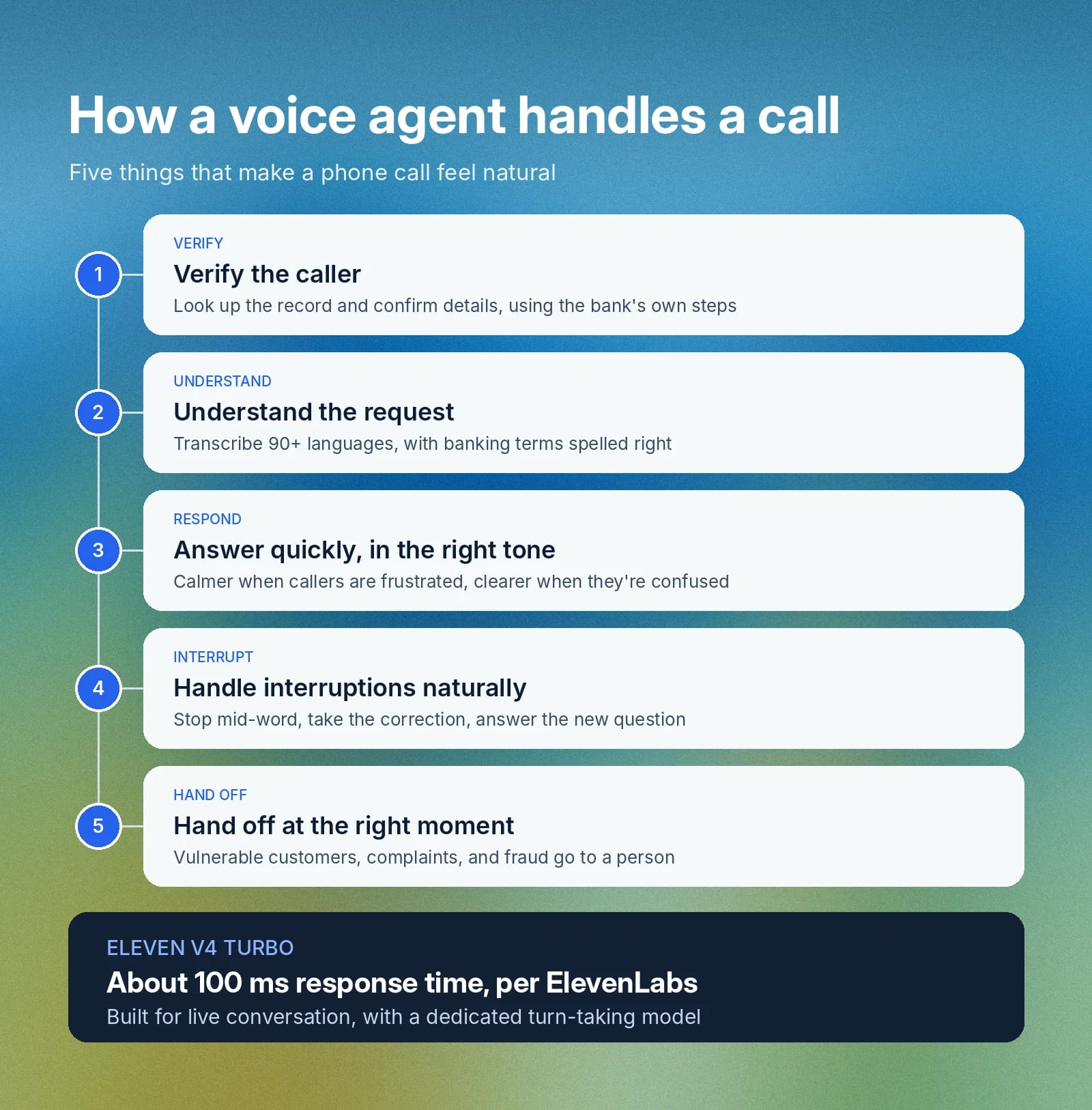
A good call comes down to five things: verifying who is calling, understanding what they say, answering quickly, handling interruptions gracefully, and handing off to a person at the right moment.
The sections below follow a call from start to finish.
1) Verify the caller
Every call begins with the same question: who is this? Before the agent shares any account details, it looks up the caller’s record in connected systems, such as a CRM or a core banking platform, using the phone number and other details the caller provides. It will then ask to confirm information on file using secure caller identification workflows.
Each bank sets its own verification requirements, with the agent then applying the same steps the bank outlines. Our guide to voice agent integrations explains how agents read and update customer records during a call.
Once the caller is verified, the agent can focus on understanding the request.
2) Understand the caller
Customers from different regions or countries may speak in different ways. Agents need to be able to understand them accurately and reply in a way that suits the customers.
Here are some of the components that help ElevenAgents to support banking customers:
- Hearing every caller: Scribe v2 transcribes speech in 90-plus languages. Key term prompting lets you add product names and banking terms so they are transcribed correctly. Scribe v2 real-time accepts up to 50 key terms.
- Answering in the caller’s language: Eleven v4 Turbo supports 90-plus languages and accents. Any voice can speak every language your agent supports and can switch mid-call, while voices keep the same identity across turns and languages. Revolut’s Agent, for example, detects and switches languages in real time and is live in 31+ languages.
- Delivering in a trustworthy voice: Pick from 17,500+ voices in 90+ languages, filtered by accent, tone, and style, or clone a voice from a short recording so that customers hear the same voice on every call.
- Pronouncing banking terms correctly: Pronunciation control lets you fine-tune how the agent says brand names, technical terms, and place names with phoneme rules or inline IPA. A term like “IBAN transfer” is a typical example.
3) Rapidly respond
A call only feels natural when the agent answers without awkward pauses and sounds right for that exact moment. ElevenLabs reports about a 100-millisecond response time for Eleven v4 Turbo, the voice model built for live conversation.
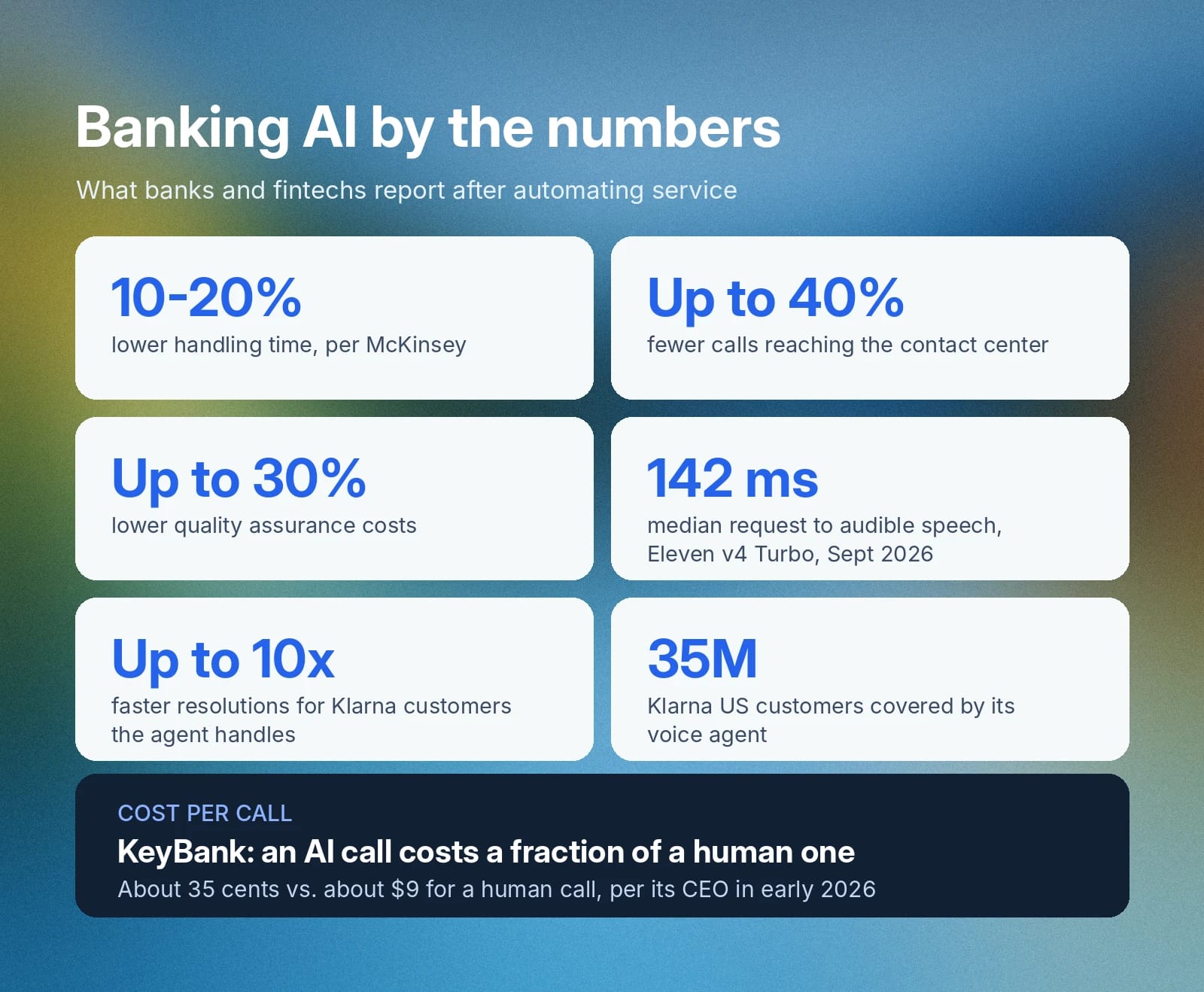
In an ElevenLabs benchmark run in September 2026, Eleven v4 Turbo over WebSocket streaming had a median time from request to audible speech of 142 milliseconds. Competing TTS models, tested with identical scripts and default settings, ranged from 262 to 814 milliseconds.
Banking calls are not alike. Balance checks, payment plans, and fraud alerts each land differently, and ElevenAgents with Eleven v4 Turbo adjusts its tone mid-call to the caller's emotion, calmer when they're frustrated and clearer when they're confused. Audio tags and conversation context let you steer delivery even further. Fast, well-pitched answers also make it natural for callers to cut in, which is where turn-taking comes in.
4) Handle interruptions naturally
Callers interrupt, pause, and change their minds mid-sentence. A good agent keeps pace despite these interruptions. In ElevenAgents, a dedicated turn-taking model manages interruptions and conversational timing. With Eleven v4 Turbo, the agent stops mid-word when a caller cuts in, takes the correction, and answers the new question in the same turn.
5) Hand off to a person at the right moment
A good agent also knows its limits. Vulnerable customers, complaints, and suspected fraud should go to a person with a quick, context-rich handoff. A customer’s conversation should be summarized and passed to the human agent to ensure they never have to start from scratch.
Each bank decides which situations trigger a handoff, with the agent applying those rules on every call.
Together, these five parts make a conversation with a voice agent feel similar to the one a customer would have with a human support agent. A better call experience builds trust in the institution, which leads to deeper engagement and a stronger relationship with the customer over time.
Benefits of conversational AI in banking
Replacing manual support queues with automated resolutions helps even big financial institutions achieve the agility inherent in fintech companies. Conversational AI changes the way contact centers work and improves scalability and customer experience. Here’s why so many financial institutions are implementing ElevenAgents to optimize pipelines.
Reduced wait times and call center load
McKinsey and Company report that implementing conversational AI in banking reduces the average handling time by 10–20% and reduces overall call volumes by up to 40%. Reducing call center loads also translates to lower operational costs for financial institutions. KeyBank’s CEO told investors in early 2026 that an AI-handled call costs about 35 cents, compared with about $9 for a human-handled call, significantly cutting costs.
Continuous availability across voice and chat
Voice and chat agents provide round-the-clock availability for customers when they need it. This constant availability of high-quality support boosts customer experience metrics, such as:
- Customer satisfaction (CSAT) and net promoter score (NPS): These measure the overall satisfaction across customers using digital channels.
- Containment rate: It tracks the percentage of inquiries resolved completely by automated systems, i.e., without any human intervention.
- First-contact resolution (FCR): FCR measures the rate of tasks completed on the first point of contact with the bank.
- Customer churn and retention rates: Tracks how long customers keep their accounts or remain loyal to the bank.
Consistent, compliant responses at scale
Automation streamlines and optimizes tasks for better quality assurance, which reduces QA costs by up to 30%. It also enforces strict policy guardrails across millions of interactions with a clear audit trail for regulating bodies and auditors. Organizations can further strengthen compliance by choosing a platform that meets SOC 2 Type II and PCI DSS standards. Additionally, connecting voice agents to core ledgers reduces manual entry and the resulting errors they may cause.
Banking chatbot use cases across the customer journey
Banks can compound the benefits of conversational AI by deploying it across the customer journey and not just when account holders need assistance. If you’re wondering, how do banks use AI, these are some examples that take modern agents from basic customer support roles to execute end-to-end financial workflows in backend systems:
- Pre-sale and onboarding: Virtual assistants help applicants choose products that meet their needs, collect Know Your Customer (KYC) documentation, and streamline account setup to reduce drop-off rates.
- Account servicing: Automated agents handle high-volume banking chatbot use cases like balance checks, password resets, and routine fund transfers.
- Dispute intake and reminders: Automated workflows send reminders to customers of upcoming payment due dates and process structured dispute claims via voice or chat.
- Fraud alerts and recovery: Systems notify the bank and account holders of potential fraud and may freeze compromised cards or accounts in seconds.
- Account closures and retention: Automated agents can detect churn signals and present tailored incentives or alternative product recommendations to retain customers.
How generative AI in banking improves customer conversations
Generative AI improves customer conversations by producing accurate, context-aware responses. AI models ground these responses in real-time account data and company policies using Retrieval-Augmented Generation (RAG). Unlike rigid decision trees or pre-scripted chats, RAG-enabled models analyze transaction histories and individual account data to give answers that are both dynamic and factual.
In spite of this, financial institutions remain cautious about deploying gen AI directly into customer-facing interactions. Hallucinations, inaccurate guidance, or the AI agent failing to withstand deliberate attacks would have disastrous consequences for a financial institution.
Because incorrect statements carry severe penalties in the industry, banks generally prioritize generative AI technology for internal and back-office uses. As fintech companies make bold moves to implement generative AI for a better customer experience, however, more financial organizations are also finding safe methods of implementation.
How to build secure, compliant banking voice experiences
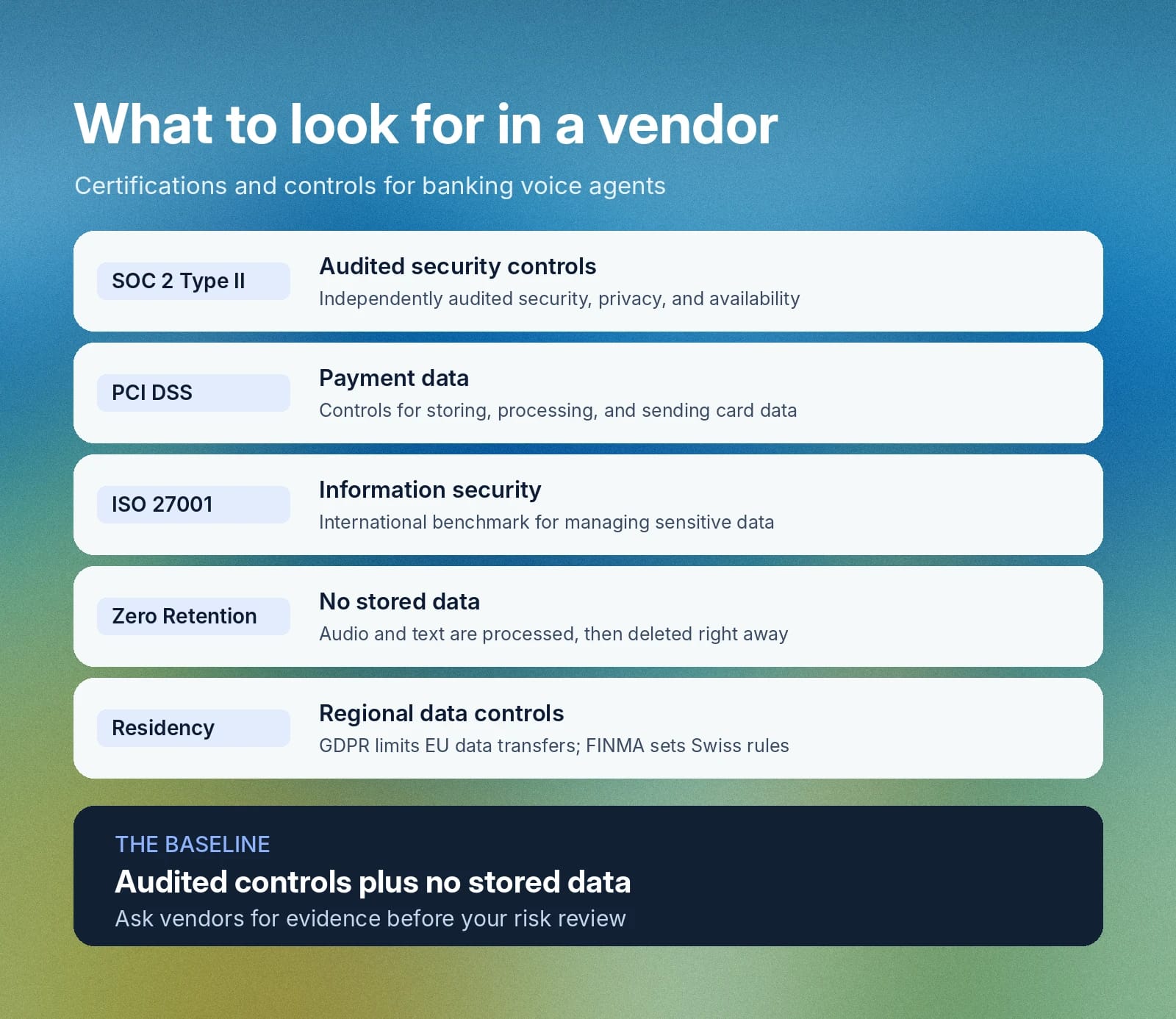
Financial institutions that are committed to safe voice agent deployment must evaluate conversational AI providers for enterprise-grade security and compliance standards. The main certifications to look for include:
- SOC 2 Type II: Shows that a platform maintains strict and independently audited controls for security, data privacy, and operational availability.
- PCI DSS: Establishes mandatory global security controls for storing, processing, and transmitting payment data.
- ISO 27001: Serves as an international benchmark for managing information security, particularly for organizations handling sensitive data like financial information.
Banks should also look for Zero Retention Mode to secure sensitive financial data. This feature ensures that models transiently process interaction audio and text, but then delete it immediately after executing necessary tasks. It prevents models from storing sensitive data points outside of the banking system.
Banks must also consider regional data residency controls to ensure customer data remains in localized geographical jurisdictions. For example, the GDPR restricts how personal data from the European Union and the European Economic Area can be transferred outside those regions, and FINMA sets requirements for Swiss banks.
How to measure conversational AI performance in banking
Speed and response times are excellent starting points for judging the performance and cost-efficiency of AI models. However, operational leaders need to look beyond these basic metrics to determine true operational impact and service quality.
The three main metrics to track include:
- Resolution rate: Measures the percentage of customer inquiries resolved without the need for follow-up.
- Escalation rate: Tracks how often customers need to transfer queries or climb the resolution ladder to get assistance from human agents when AI models fail to resolve the issue.
- Compliance-adherence checks: Audits whether agents enforce mandatory financial regulations with strict adherence, such as customer verification, KYC documentation, and accurate responses.
Check out our guide on measuring conversational AI for a more detailed breakdown on evaluation frameworks and testing methodologies.
How banks keep regulated steps under control with ElevenAgents
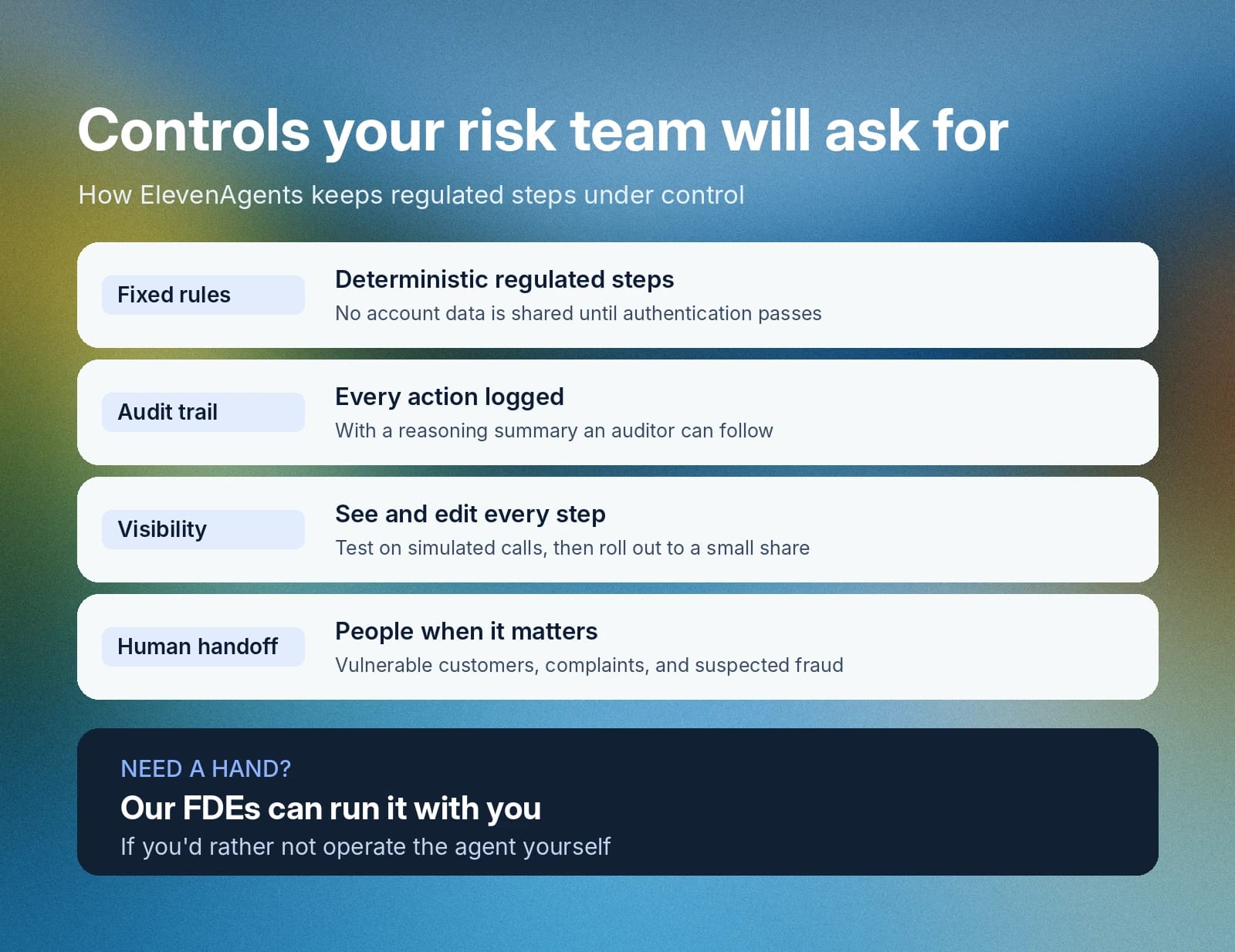
For a bank, the question often isn’t solely whether an AI agent can hold a conversation, but rather whether the bank’s risk team can approve it. ElevenAgents is built for safe deployment, with four controls that matter most to risk and compliance teams:
- Fixed rules on regulated steps: High-risk steps run as deterministic workflows. For example, the agent can’t share any account data until authentication passes.
- An audit trail on every action: Every action the agent takes is logged with a reasoning summary, meaning any decision is explainable to an auditor or examiner.
- Full visibility and control: Your team can see and edit every step of the agent, test changes on simulated calls, and roll them out to a small share of calls before everyone. If you’d rather not run it yourself, our FDEs can run it with you.
- People for the moments that need a human: Vulnerable customers, complaints, and suspected fraud go to a human agent, with the full context of the conversation passed along.
Conversational AI in financial services in practice: Use cases from ElevenLabs customers
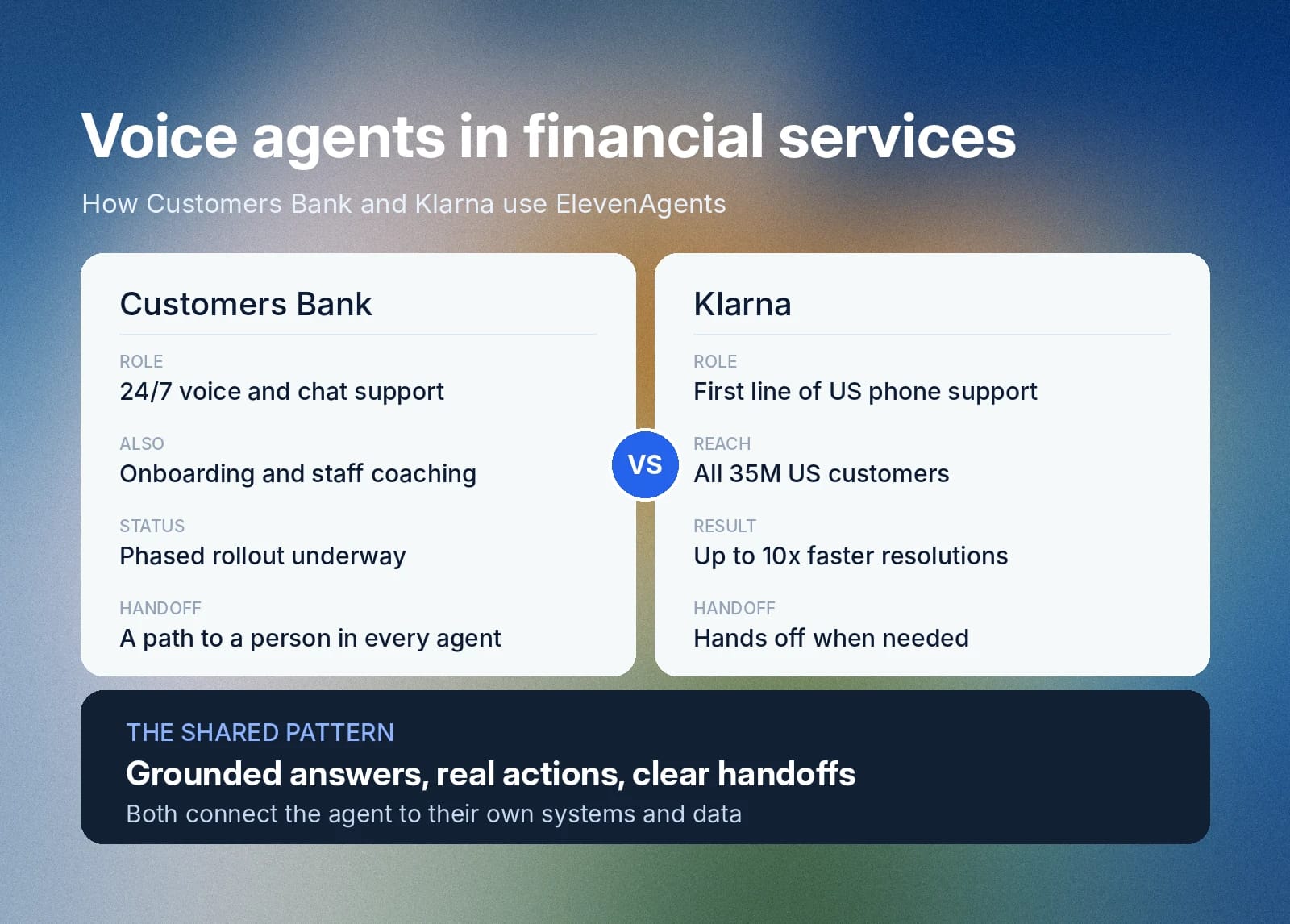
Conversational AI works in financial services when generative models are grounded in a financial institution’s own data and paired with clear handoffs to people. Two ElevenLabs customers show what that looks like on live customer calls.
Use cases at a glance
Customer
Use case
Reported result
Customers Bank
Round-the-clock support across phone, web, and mobile; guided onboarding for new customers; and live coaching for contact center staff
Phased rollout over the coming months, with human escalation built in
Klarna
First line of US phone support for informational requests, with handoff to a human when needed
Resolutions up to 10x faster for customers the agent handles
Customers Bank
Customers Bank, a $25 billion US bank known for a Net Promoter Score nearly double the industry average, is rolling out three agents built with ElevenAgents: a 24/7 voice and chat agent for account inquiries, card services, and transfers; an onboarding agent that guides new customers through account setup; and a real-time coaching agent that supports contact center staff during live calls. Every agent includes a path to a person.
Read the Customers Bank story.
Klarna: instant answers on US phone support
Klarna launched a voice agent built with ElevenAgents as the first line of phone support for US customers, available to all 35 million Klarna customers in the country.
- What the agent does: It manages informational calls such as product guidance, payment status, and next steps. It gathers relevant context and hands over to a human when it detects complexity or sensitivity.
- Results: Klarna reports resolutions up to 10x faster for customers whose queries the agent handles, with shorter phone queues for simple, high-volume requests.
- Approach: Customers can always reach a human, and the agent hands over when a conversation calls for one.
Both deployments follow the pattern described above: grounding answers in the company’s own data, taking action in connected systems, and handing off to people when a request needs them. To see how ElevenAgents applies to your own workflows, explore ElevenAgents for financial services.
Get started with ElevenAgents for banking customer service
ElevenAgents gives financial institutions the peace of mind to capitalize on the benefits of conversational AI models while maintaining security and compliance.
We built our agents for enterprise compliance with support for SOC 2, PCI DSS, and GDPR standards alongside Zero Retention modes. Our goal is to ensure that an improved customer experience doesn’t come at the cost of exposing sensitive financial data.
Whether you're starting with after-hours coverage or a single high-volume request type, our team can walk you through how banks scope, validate, and roll out their first agent, including the evidence your risk and security reviews will ask for. Find out more about ElevenAgents for financial services or contact our sales team to get started today.
Frequently asked questions about conversational AI in banking

Jack Limebear is on the Growth team, acting as a content writer and strategist across the blog and insights pages. Before ElevenLabs, he spent over a decade leading content strategy for organizations ranging from fast-growing SaaS startups to Fortune 500 companies. He holds a Master's degree in English Literature from the University of Cambridge.