
Measuring conversational AI: Essential metrics for success
- Written by
- Jack Limebear
- Published
- Last updated
ListenListen to this article
Conversational AI tools drastically cut the cost of providing customer support around the clock. They do so without staffing a graveyard shift or taking the data privacy risks of outsourcing roles overseas.
But cost savings only matter if an AI agent is able to solve customer issues. Measuring conversational AI with the right key performance indicators tells you whether it’s working, especially for enterprises managing high-volume customer queries.
This article outlines how evaluating conversational flow and response accuracy protects both the customer experience and your brand. We explain how customer experience teams run effective A/B testing experiments on caller greetings. You’ll also learn how to maintain a reliable, multilingual conversational AI platform.
Summary
- Systematically measuring conversational AI across quality, experience, and operational metrics provides the data needed to protect the customer experience.
- Automated evaluation tools continuously track and improve conversational AI metrics at scale, while human workers conduct regular spot checks.
- Isolating one specific variable at a time for A/B tests makes it easy to pinpoint precisely what went wrong so that you deploy fixes that directly target identified problems.
- Continuous improvement is necessary as AI companies frequently update underlying models, which often causes previously reliable chatbots to behave differently in production.
What measuring conversational AI means and why it matters
Measuring conversational AI involves a systematic evaluation of how well your tested or deployed AI agents address customer requests and solve issues. The goal is to determine how effectively your automated systems handle multi-turn conversations in the real world based on the performance standards you set. These standards generally reflect how well the models understand user intent, stay on-brand, deliver accurate responses, and successfully resolve the issue.
Model assessments might seem like a lot of extra work for a system meant to reduce the tasks your team handles. But without consistent evaluation, it would be hard to know how well the model performs in real use cases. In other words, you know that your AI system reduces customer support operations costs, but can you confirm whether it’s making customers happy or driving them to seek other solutions?
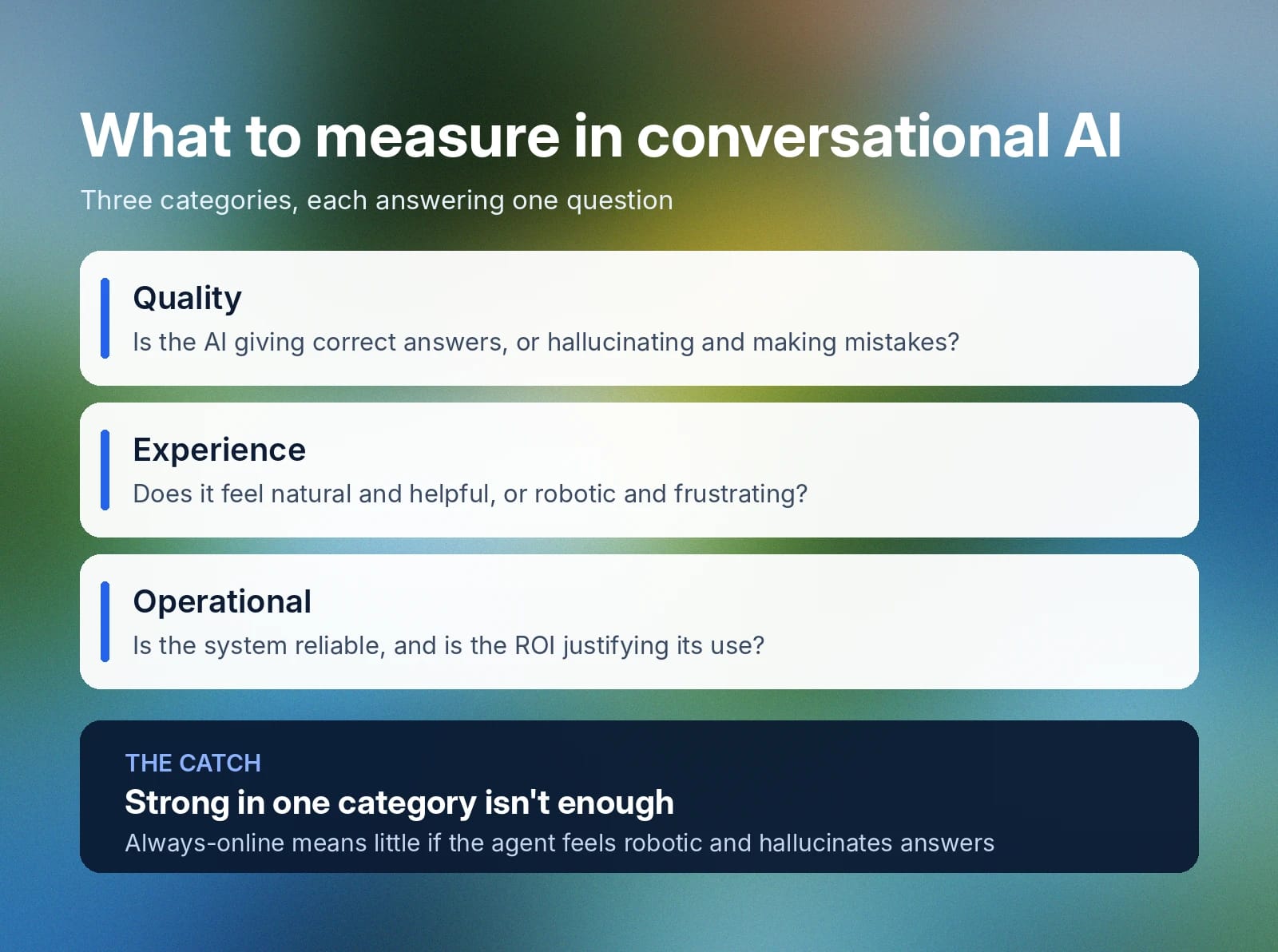
Comprehensive measurement requires looking at the model across three main categories:
- Quality: Assess how accurate, coherent, and relevant an AI’s responses are based on the user’s initial request. The main question here is: Is the AI getting things right and giving users the correct answers, or is it hallucinating and making mistakes?
- Experience: Evaluate the customer experience, such as whether the AI responded quickly and how many turns it needed to give a satisfactory answer. The main question here is: Does the experience feel natural and helpful for the user, or does it feel robotic and frustrating?
- Operational: Determine whether the system performs reliably and remains a cost-effective solution for your customer support needs. Common concerns here include: Does the system have high uptime and is it delivering the necessary return on investment to justify its use?
Success looks different for every team, and your initial pain points before automating support play a big deciding role in this. For example, if your team initially struggled with maintaining 24/7 customer support, the round-the-clock availability of AI agents easily boosts customer support performance. However, each of these categories is important to overall success, so a system that is always online and rarely crashes won’t do much for customers if it feels robotic and hallucinates answers.
Core conversational AI metrics to track
Track clear and actionable numbers to judge agent performance with customers and whether your current implementation is generating real business value. Continuous assessment also paves the way for regular improvement. When you pinpoint specifically where you have bottlenecks in your workflow or need to make adjustments, you have the data to effectively address the root cause.
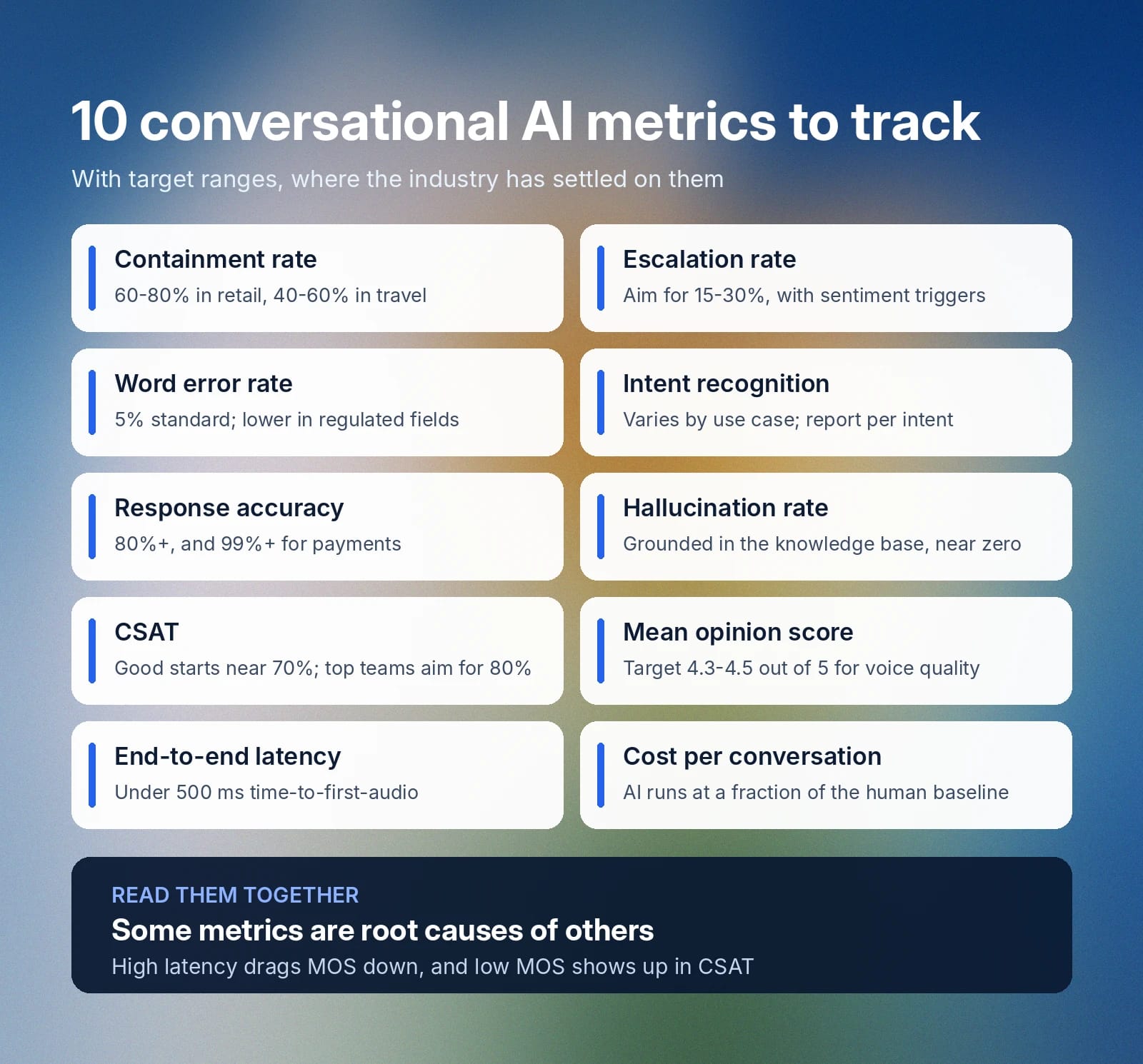
Use these conversational AI metrics as a starting point when evaluating voice calls and chatbot performance:
- Containment rate: Track the percentage of inquiries resolved fully within the automated channel. Goals vary across industry, context, use cases, and the bot type. For example, 60–80% is fairly standard for retail, while the numbers fall between 40–60% for travel sites.
- Escalation rate: Measure how often AI agents handle calls without escalating them to a human. Proactive companies set automatic thresholds to transfer calls to humans as soon as sentiments turn negative. Good escalation rates vary based on industry and task complexity, but aim for 15–30%.
- Word error rate (WER): Track how well the AI accurately “hears” words during a call or transcription. A good industry standard is 5%, but you need lower WER for use cases in regulated areas or those that handle sensitive information like healthcare, finance, and law.
- Intent recognition accuracy: Beyond just words, successful AI agent performance begins with accurately understanding the user’s pain point and what they need. Accuracy goals vary based on use case and across per-intent categories.
- Response accuracy: Determine how reliably the model gives truthful and meaningful responses. This is crucial for ensuring customers solve their problems. General customer service queries require 80% or higher, but sensitive use cases, like payments, require 99% or higher.
- Hallucination rate: While closely related to response accuracy, hallucination specifically determines the factual accuracy of responses based on the knowledge base. Low hallucination rates are crucial for helpfulness and ensuring models don’t make promises the company can’t keep.
- Customer satisfaction (CSAT): Collect customer sentiment with post-call surveys to determine satisfaction. Companies collect this data using a five-point scale, but often express the results using percentages. According to SurveyMonkey, good CSAT scores usually start at around 70%, with some companies aiming for 80% or higher.
- Mean opinion score (MOS): This human-first metric also uses a five-point scale, but the goal is to measure how natural the AI response sounds and the clarity of the synthetic voice. Aim for an MOS around 4.3-4.5.
- End-to-end voice latency: Count the total delay between a user completing their request and when the agent starts to respond. Production-grade agents aim for an end-to-end time-to-first-audio (TTFA) of under 500 milliseconds. The ElevenLabs Flash v2.5 model currently achieves an internal model inference latency of about 75 ms. Actual end-to-end latency will vary with factors such as your location and endpoint type used.
- Cost per conversation: Measure the total operation cost for each automated customer interaction compared to human sessions. ElevenLabs conversations start at 10 cents per minute, while average hourly pay for customer service reps suggests that human conversations amount to around 32 cents per minute. This leads to cost savings of roughly 70%, although pricing may vary by plan and usage. Check the ElevenLabs pricing page for current pricing.
When choosing the metrics you’ll use to measure your model performance, consider the areas that are most important to your industry and business model. For example, accuracy and factuality are especially important for areas like banking and patient information, while latency, MOS, and escalation rates matter most to companies prioritizing customer experience.
Note that some metrics provide root causes for the others. For example, high latency likely leads to a low MOS score and resulting low customer satisfaction expressed as CSAT.
How to measure conversational AI accuracy
Measure model accuracy by building a ground-truth test set from around 500 to 1,000 real historical conversations. Real logs capture the messy, natural phrasing that synthetic data often fails to include, such as typos, slang, and user error. Then, evaluate your system against these real logs across intent recognition, response accuracy, and hallucination rate.
Run automated evaluations for these interactions using an LLM-as-a-judge scoring method. However, always validate the automated scores against human-labeled systems to ensure they align. Human reviewers then do weekly spot checks for evaluating chatbot performance via a simple three-point rubric:
- Correct: The response is factual, contextually relevant, and directly satisfies the user’s primary intent.
- Acceptable: The response is technically correct and helpful, but it has a few minor stylistic issues, some awkward phrases, or off-brand formatting.
- Wrong: The response needs immediate correction because it contains factuality errors, severe hallucinations, or completely misunderstands user intent.
Ideally, you use a per-intent method to evaluate the model because AI agents perform well in some contexts and fail miserably in others. Using aggregate numbers causes high-performance areas to hide critical weak points.
We simplified this workflow by building Next Reply (Scenario) testing directly into our ElevenAgents testing. The Next Reply feature evaluates the follow-up message an agent sends instead of the full multi-turn conversation. However, you provide the chat history leading up to the evaluation point and score the reply against policy, tone, and quality standards.
How to A/B test conversational AI responses
A/B testing gathers real-world feedback to avoid guessing what customers prefer. You then use this empirical data to fine-tune AI model performance. After tracking metrics, your team likely has a list of things it wants to change or experiments to run. However, changing multiple things at once makes it difficult to figure out what worked and what didn’t.
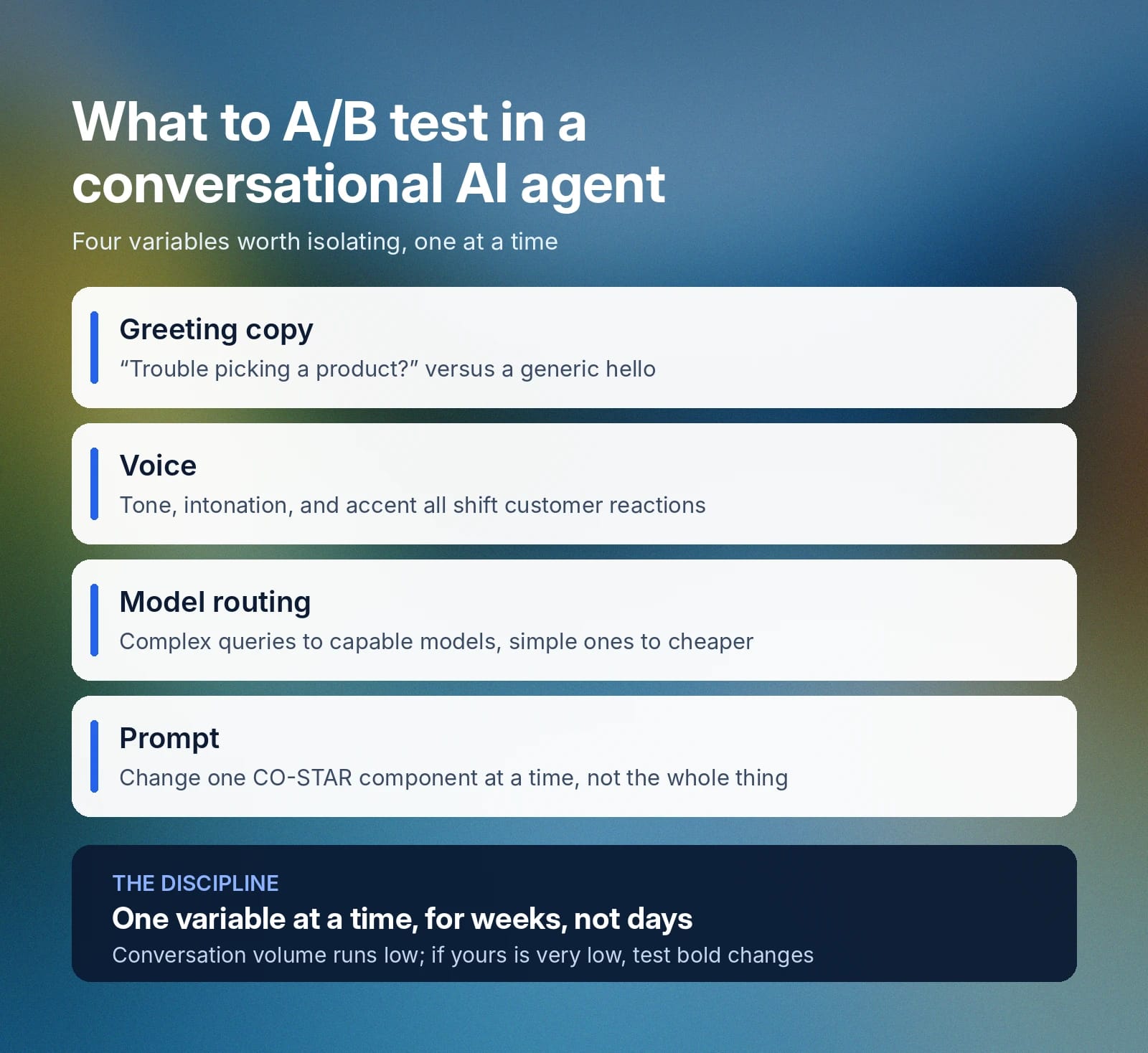
Consequently, running a valid test requires isolating one specific variable at a time, while holding the rest of the underlying knowledge base constant. Potential elements to vary include:
- Greeting copy: Adjusting the initial greeting message for something specific, like, “Hey there. Trouble picking a product?” instead of just saying, “Hello, how can I help?”
- Voice: Customers might react more favorably to some voices over others in specific circumstances based on masculinity versus femininity, tone, intonation, and even accent.
- Model routing: Highly capable models usually cost more, so the efficient and cost-effective option involves routing complex versus simple queries accordingly.
- Prompt: Prompts have several components, so change only one aspect at a time, such as the context, objective, style, tone, audience, or response template (CO-STAR).
Teams should also adjust the testing timeline. Conversational traffic is typically much lower than web page views, so you’ll need to run the test for weeks instead of days to achieve statistical significance. If you have extremely low volume, test large, bold changes instead of minor tweaks.
A practical workflow also requires agent versioning, comparison, and rollback tools. We’ve built these directly into ElevenAgents.
How to test a conversational AI agent before deployment
Customer service is a direct touchpoint with the people impacting your bottom line, and AI sometimes reacts in unpredictable ways to small changes. Consequently, always test a new or revised conversational AI agent before launching it in production. Simply “vibe testing” isn’t enough.
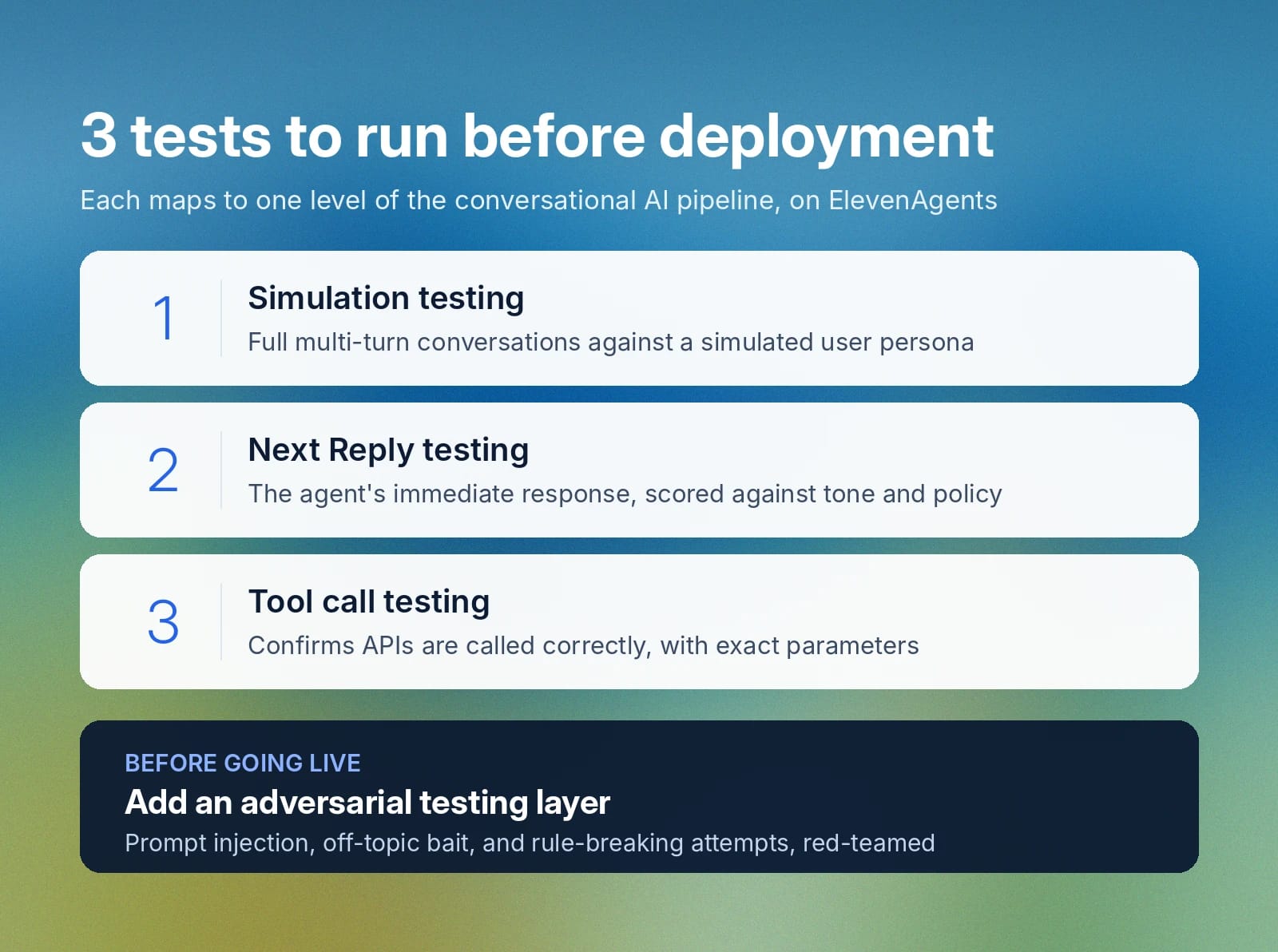
We designed our ElevenAgents testing framework around three main test types that target specific levels of your conversational AI pipeline:
- Simulation testing: Runs a complete, multi-turn conversation against a simulated user persona to confirm whether the dialog meets the preferred performance levels.
- Next Reply testing: Tests only the agent’s immediate responses against specific tone, policy, or other constraints to confirm appropriateness and accuracy of responses.
- Tool call testing: Ensures that agents correctly call connected APIs and pass the exact parameters needed for high-stakes database lookups or transfers.
With so many attackers trying to jailbreak models for nefarious purposes, you’ll also need an adversarial testing layer before going live. Work with QA teams, prompt engineers, and red-team cybersecurity professionals to test prompt injection, off-topic bait, and rule-breaking attempts.
Finally, use a phased rollout by launching pilot versions to a small group of users and monitoring their real-world behavior. Set strict criteria for the model to pass before releasing it to a larger group or your full customer base. Remember to assign a single accountable owner to oversee the release and create a rollback path in case an adjustment causes a dip in performance metrics.
Evaluating chatbot performance in production
Before launching your conversational AI model, define what success looks like for each use case. This is especially important for applications in highly regulated fields where accuracy and data privacy have higher benchmarks and stricter requirements.
Automated responses make it easy to A/B test models at scale, but objective testing requires pairing this with ad-hoc transcript reading and feedback from human testers. Humans in the loop catch conversational nuances that AI models miss and quirks in the data that otherwise get lost in aggregate numbers. A comprehensive evaluation strategy also involves sentiment analysis and direct user feedback.
Continuous improvement further differentiates mature systems that deliver a high return on investment. While competitors treat testing and monitoring as separate tasks, a mature pipeline combines them into one. In this case, production failures directly feed your test set to train the next optimized agent.
Regular adjustments also become necessary when AI companies update the base models your agent runs on. This change often causes a previously effective prompt to suddenly contribute to unreliable or even inappropriate answers.
We’ve built this feedback loop directly into our platform. Use our conversation analysis tools to automate structured data collection and easily evaluate sentiment. Large organizations also use our enterprise conversational AI infrastructure to confidently monitor and scale their agents worldwide.
Get started with ElevenAgents for customer service metrics
Successfully launching conversational AI at scale requires more than just high-quality voices and low-latency models. You need an integrated ecosystem for designing, building, testing, deploying, and adjusting multi-agent workflows.
ElevenAgents gives you the scalable infrastructure you need. Your team has access to tools like Next Reply verification, sentiment tracking, and automatic data collection to continuously monitor and optimize models for the best results. Even better, you catch regressions before they reach your customers.
Are you ready to simplify the process of measuring conversational AI? Explore our agent testing features and see how our enterprise teams deploy reliable agents that boost your customer service metrics.
Learn more about ElevenAgents or sign up to get started today.
Frequently asked questions about measuring conversational AI

Jack Limebear is on the Growth team, acting as a content writer and strategist across the blog and insights pages. Before ElevenLabs, he spent over a decade leading content strategy for organizations ranging from fast-growing SaaS startups to Fortune 500 companies. He holds a Master's degree in English Literature from the University of Cambridge.