
What is an LLM? A practical guide to language models
- Written by
- Jack Limebear
- Published
ListenListen to this article
A large language model (LLM) is an artificial intelligence system trained on a vast dataset to analyze, predict, and generate natural language. Popular LLMs include OpenAI’s GPT models, Anthropic’s Claude, and Google’s Gemini, which are often used for things like writing, editing, and coding.
Initially, LLM datasets mainly included text from sources like books, blogs, and even online forums. Modern LLMs now use multimodal data to expand use cases, such as powering conversational voice agents or making music.
Before implementing this technology, organizations often need answers to questions like: what is an LLM, how does an LLM work, and what architectures should the team use? This guide tackles these questions while also showing real-world applications of the technology and their tangible benefits.
Summary
- A large language model (LLM) is an artificial intelligence model trained on vast datasets of text and multimodal datasets with the goal of analyzing, predicting, and generating output.
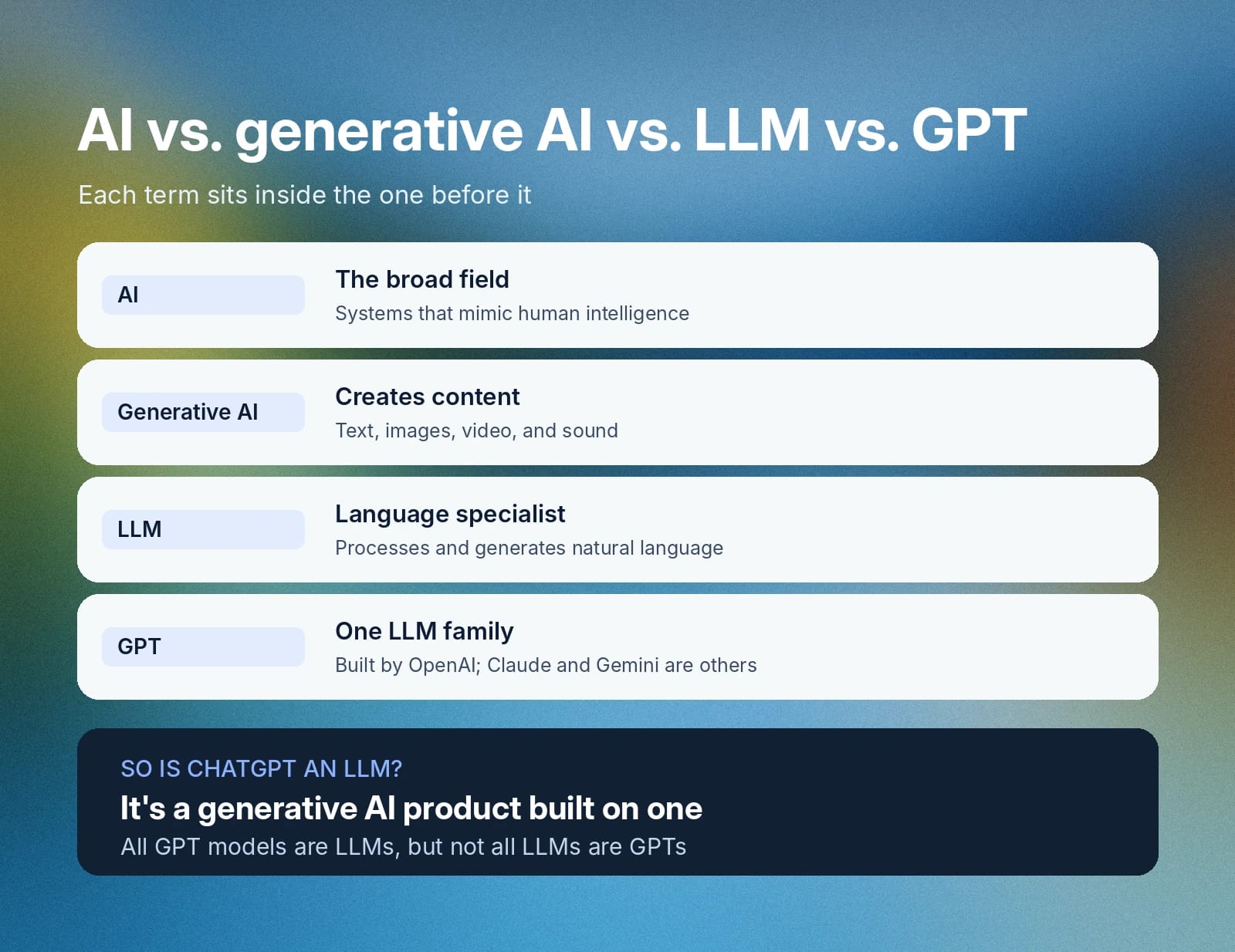
- The main difference between GPTs and LLMs is that GPT (Generative Pre-trained Transformer) is a specific family of LLMs created by OpenAI, whereas LLM is the umbrella term for models like Claude and Gemini.
- Generative AI is the broad category for models that create a wide range of content based on training data, while LLMs are a specialized subset of generative AI that focus on natural language processing.
- LLMs work by using transformer neural networks to break text into smaller units called tokens, and then predict the next token based on contextual information from the prompt and existing chat history.
- Practical large language model examples include customer service chatbots, automated writing tools, code generators, and natural language processing layers for voice applications.
What is an LLM? The large language model definition
A large language model is an AI program built on deep learning neural networks for analyzing, predicting, and generating natural language. Developers trained these models on datasets that contain billions of works across books, academic papers, websites, and blogs. The term “large” refers to both the massive volume of data used to train these models and the billions of internal parameters that govern their behavior.
Large language models are a major shift from how earlier software worked; traditional software relied on explicit syntax commands but LLMs do not. Rather than processing each word in isolation, LLMs use contextual relationships to recognize complex linguistic patterns and grammar. They interpret unstructured human language and continue to respond to open-ended user prompts, adapting to context changes mid-conversation.
These advancements in natural language processing power ElevenAgents so that they understand complex customer intents and execute automated workflows.
How do large language models work?
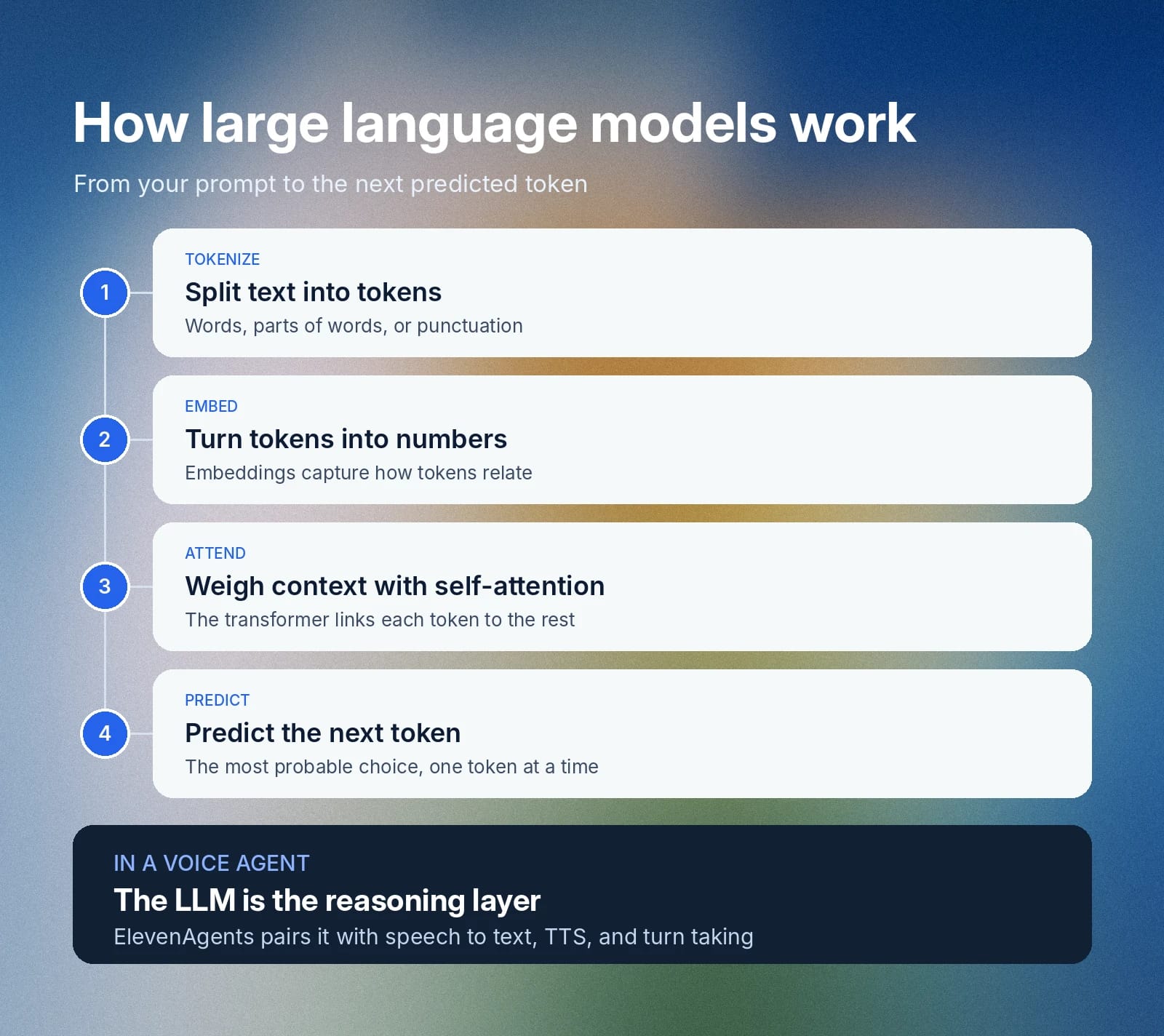
Large language models process text through artificial neural networks to analyze natural language input and generate relevant content. The process begins with tokenization, where the model splits input text into smaller units called tokens. The model then translates these tokens into numerical representations (called embeddings) to evaluate mathematical or statistical relationships across tokens.
Most modern LLM systems rely on the transformer neural network architecture. Transformers use self-attention mechanisms, which handle the work of evaluating the contextual relationships between tokens. The model predicts the most statistically probable token to complete a sequence by using learned patterns to calculate probability distributions.
Self-attention makes it possible for natural language processing models to maintain long-range context and adapt to shifts in the middle of a conversation. Platform integrations with ElevenAgents build on these capabilities to deliver low-latency, relevant responses that mirror natural human conversation.
What is temperature in an LLM?
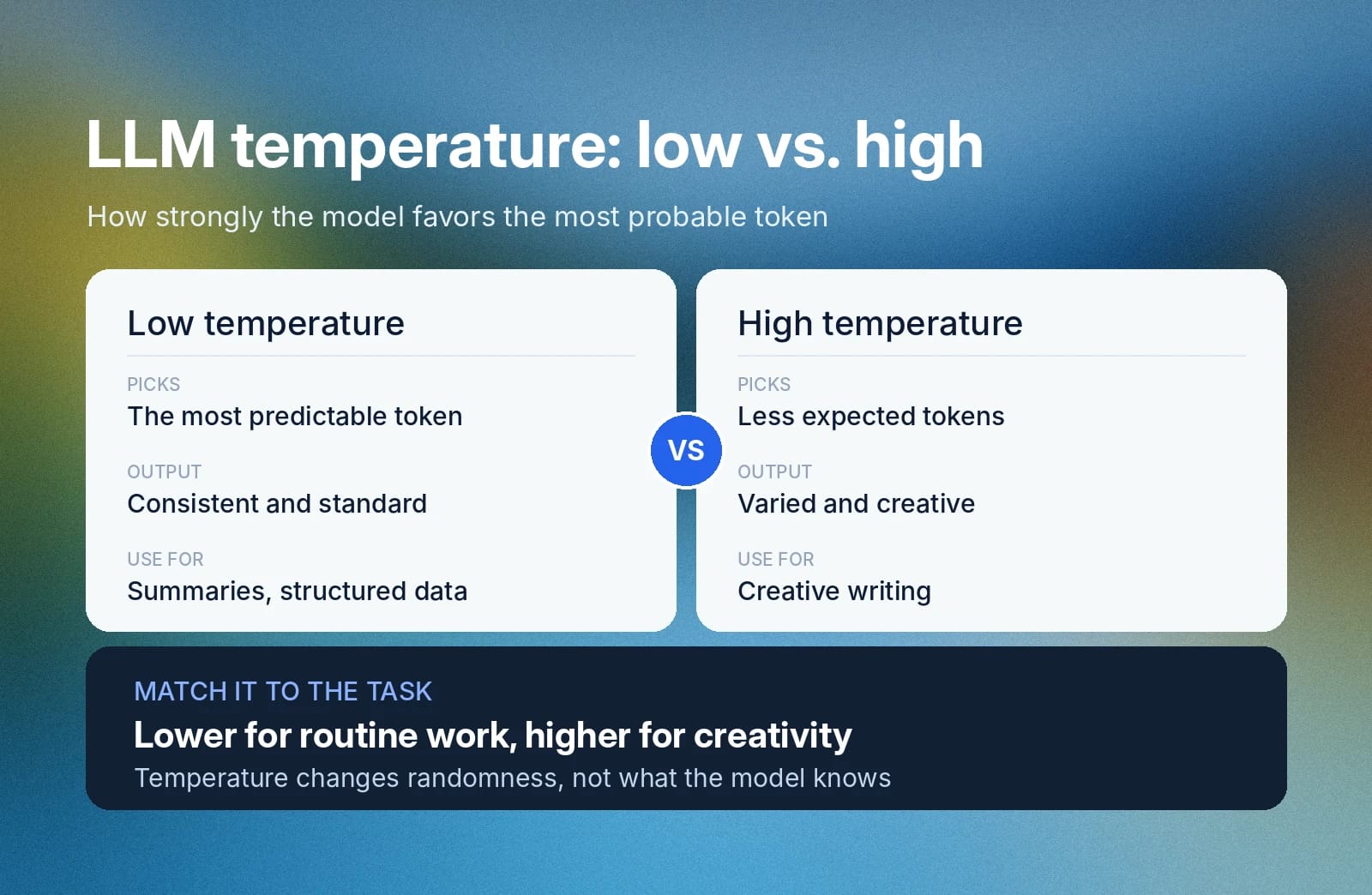
LLM temperature is a variable setting that developers can configure to determine how random an LLM’s outputs will be. LLMs generate the next token in a string of words by selecting the option that is most common. However, for every choice the LLM makes, there could be several other alternatives that have similar weighting.
By adjusting the LLM temperature, you change how strongly an LLM favors the most probable option. A low temperature setting would produce a standard and consistent output (as it would lean toward always choosing the most predictable next token in a string). On the other hand, a high temperature would deviate from the expected choice more frequently, producing more creative and varied outputs.
You should adapt your LLM temperature value to the task you want to achieve. Anything that needs an element of creativity should lean toward higher temperatures, while routine tasks or structured outputs (like data summaries) should lean lower.
How are LLMs trained and fine-tuned?
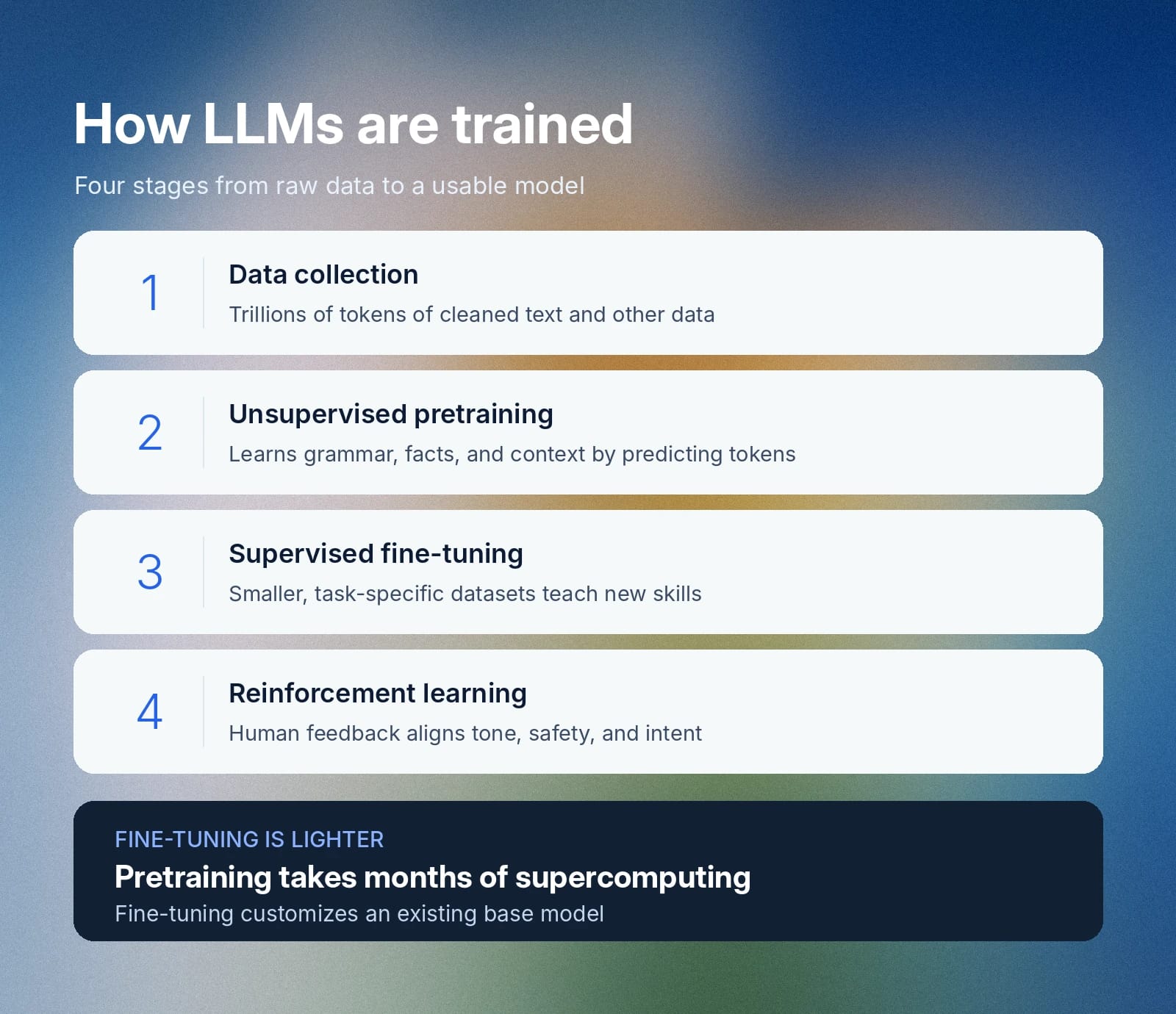
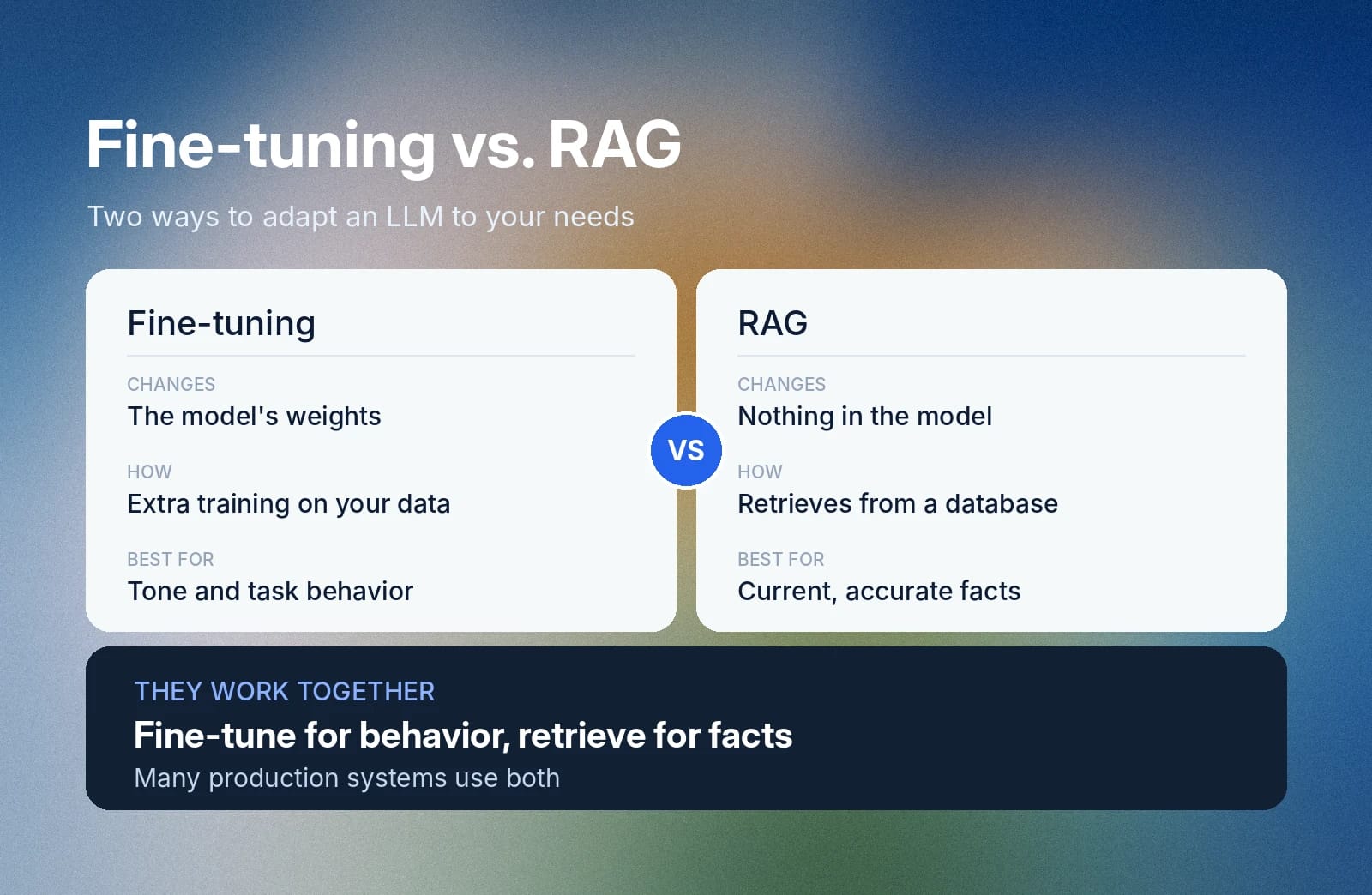
Training LLMs requires a multistage process to transform raw text and multimodal data into functional language systems. Companies need advanced supercomputing capacity running for several months, whereas fine-tuning is a lighter process that customizes the existing base model.
Frontier AI companies tend to treat their exact training process as proprietary information and most do not disclose source code or weights. Nevertheless, training generally follows this process:
- Data collection and preprocessing: Developers build datasets from multiple sources with pre-training corpora that include trillions of tokens taken from terabytes of cleaned text. Scraping or mining text from internet sources is one of the main ways that companies build these datasets.
- Unsupervised pretraining: The large language model reads trillions of tokens to learn grammar rules, factual relationships, and linguistic context. It essentially pretrains itself through autoregressive language modeling powered by self-attention mechanisms that calculate the statistically probable next token in a sequence.
- Supervised fine-tuning: Engineers use smaller and more task-specific datasets to adjust the pretrained model. This step teaches the model specific competencies, ranging from answering general questions to generating logos or conducting lab research.
- Reinforcement learning and alignment: Developers refine the model’s behavior using human reviewer feedback and reward models. This stage aligns model outputs with safety guidelines, tone requirements, and human intent.
Types of LLM architectures: encoders, decoders, and hybrid models
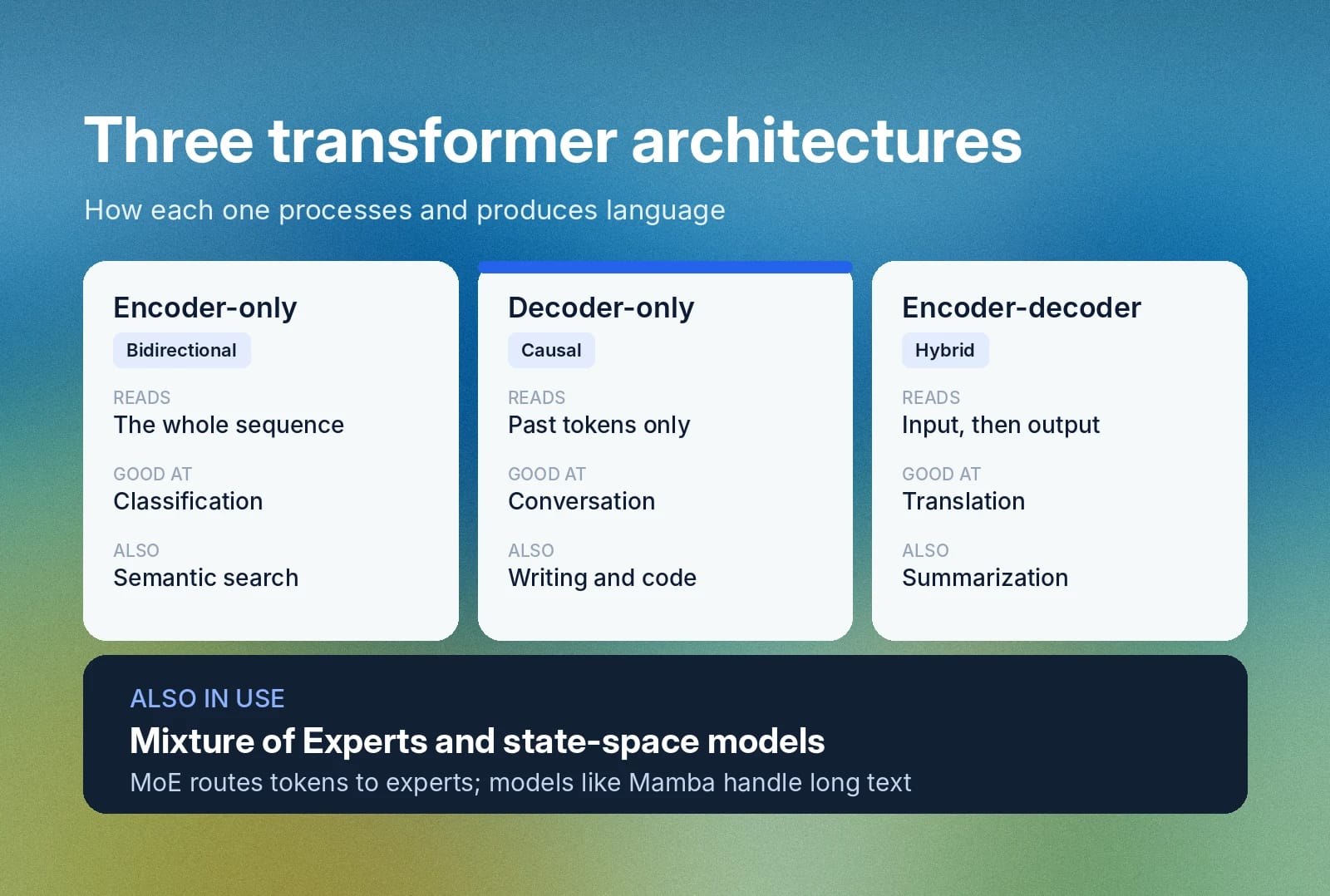
Transformer architectures organize neural network layers in different ways to process inputs and produce content. Classic transformers fall into three main categories: encoder-only, decoder-only, and encoder-decoder (hybrid) models. However, modern systems also incorporate efficiency architectures to scale performance.
Encoder-only models
Encoder-only architectures process entire sequences at once using bi-directional self-attention. This allows the machine to weigh the relationship of each token against other past and future tokens. In practice, this optimizes models for tasks like:
- Text classification
- Sentiment analysis
- Information retrieval
- Semantic search
Tasks like these also appear in speech workflows. ElevenLabs’ Scribe speech to text model transcribes speech in over 90 languages, and its entity detection feature flags sensitive details and offensive language in transcripts.
Decoder-only models
Decoder-only architectures use causal attention to process tokens, predicting each word based on past tokens. These models generate fluid conversations and serve as the main architecture behind modern conversational chatbots, open-ended writing assistants, and code generation tools.
In ElevenAgents, the LLM you choose, which is typically a decoder-only model, generates the agent’s responses, while a proprietary turn-taking model handles conversation timing.
Encoder-decoder (hybrid) models
Encoder-decoder models use an encoder to process input and a decoder to generate output. This dual-structure approach makes hybrid models better suited for tasks that require strict context preservation, such as document summarization, language translation, and data reformatting.
Translation is a classic encoder-decoder task, and ElevenLabs Dubbing supports 90+ languages.
Mixture of Experts (MoE) and state-space models
Instead of firing every neural network parameter for each word, Mixture of Experts (MoE) routes individual tokens to smaller teams of specialized “expert” sub-networks. This delivers a reasoning depth comparable to massive models but with faster speeds and lower compute costs. Meanwhile, state-space models (like Mamba) efficiently process extremely long texts.
ElevenAgents includes open-source LLMs that ElevenLabs hosts in our own infrastructure.
Large language model examples and everyday applications
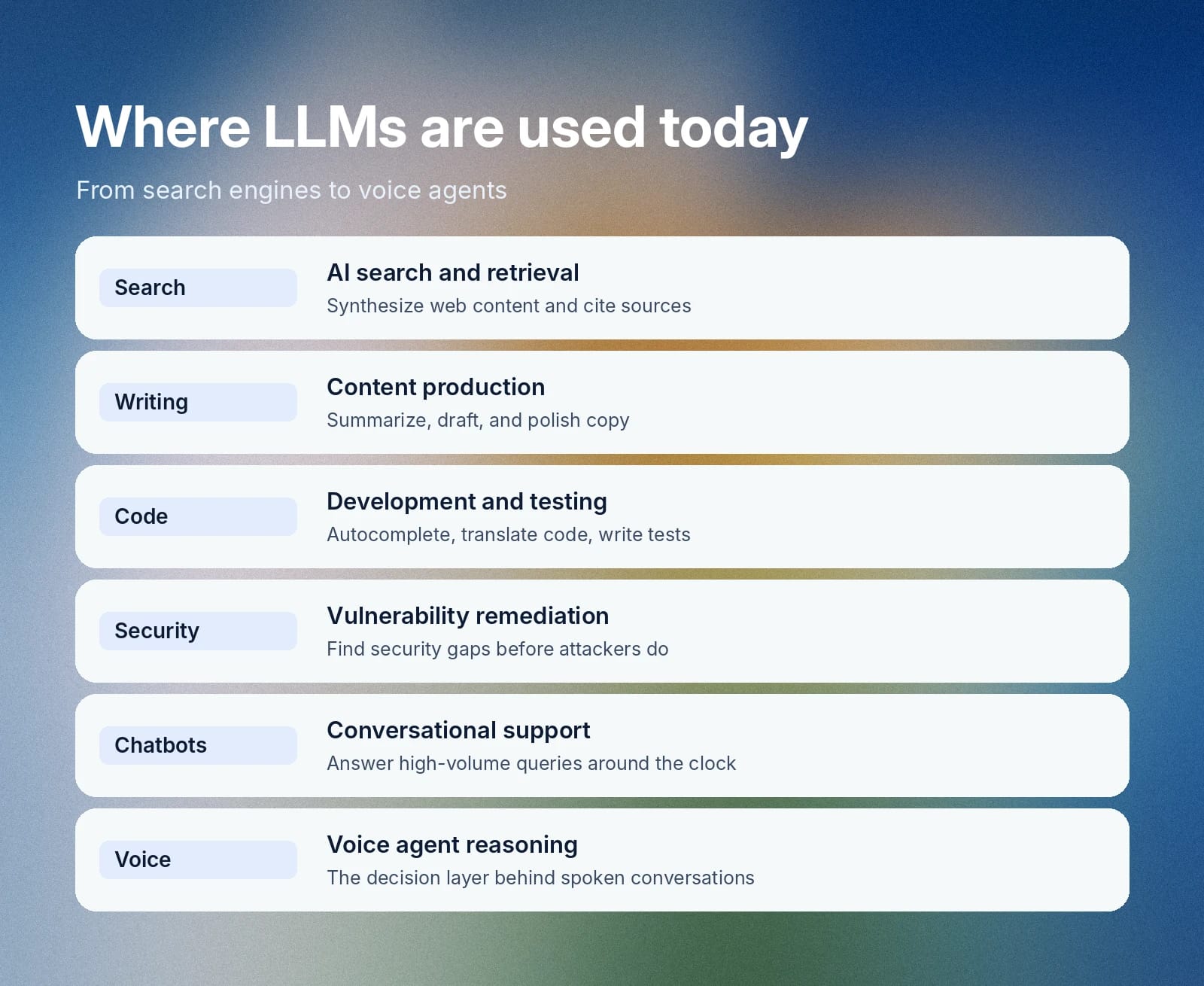
Organizations have found a wide range of use cases for large language models. These use cases show how AI transitioned from experimental research into a standard feature across the web, software applications, and everyday devices. While AI scientists continue to study and optimize the underlying architecture, real-world LLM examples show how teams have implemented them so far:
- AI search and information retrieval: Conversational search engines like Bing, Google AI Overviews, and Perplexity use LLMs to analyze web content in real time. The models synthesize information, cite sources directly, and allow users to ask follow-up questions.
- Writing, editing, and content production: LLMs and other AI-powered tools make it easy to write and edit material for internal and external use. For example, NotebookLM summarizes lengthy reports, Jasper AI writes ads, and Grammarly polishes copy.
- Code generation, development, and testing: AI powers coding tools like GitHub Copilot to autocomplete functions and translate code from one programming language to another. Teams can also use it to generate automated test suites so they can easily identify and fix bugs before deployment.
- Cybersecurity and vulnerability remediation: AI frontier companies have released specialized models for detecting security gaps, which helps organizations deploy fixes before attackers can find and exploit them.
- Chatbots and conversational assistants: Organizations deploy conversational interfaces to deliver 24/7 customer support. Integrating platforms like ElevenAgents allows companies to automate high-volume queries using conversational solutions instead of relying on FAQs.
- Voice agent reasoning engine: LLMs also serve as the central reasoning layer for voice AI systems. ElevenAgents pairs your choice of LLM with Speech to Text, low-latency Text to Speech, and a proprietary turn-taking model to hold natural, real-time conversations.
What are the limitations of large language models?
As the backbone of most AI products that consumers interact with, LLMs are a powerful piece of architecture that help in numerous workflows and use cases. But if you’re looking to build with LLMs or train your own model, you should be aware of their main limitations:
- Hallucinations: There is no guarantee that what an LLM generates is accurate. A response can easily contain fabricated or simply incorrect information.
- Static knowledge: Without RAG, an LLM is limited to its pre-established scope of knowledge afforded to it during the training process.
- Bias: If your training data has bias, your model will reflect those biases. This is especially important to take note of if you are using an LLM to classify data or make decisions about information, as certain implicit bias within your data could end up influencing the outputs negatively without your knowledge.
- Limited context window: LLMs typically only work with a fixed amount of text, which means that longer conversations might begin to lose out on details and become less effective over time.
- Cost and latency: The larger the LLM, the more compute that’s required to run it. If you opt for more powerful models, you’ll likely be paying a premium for that improved service.
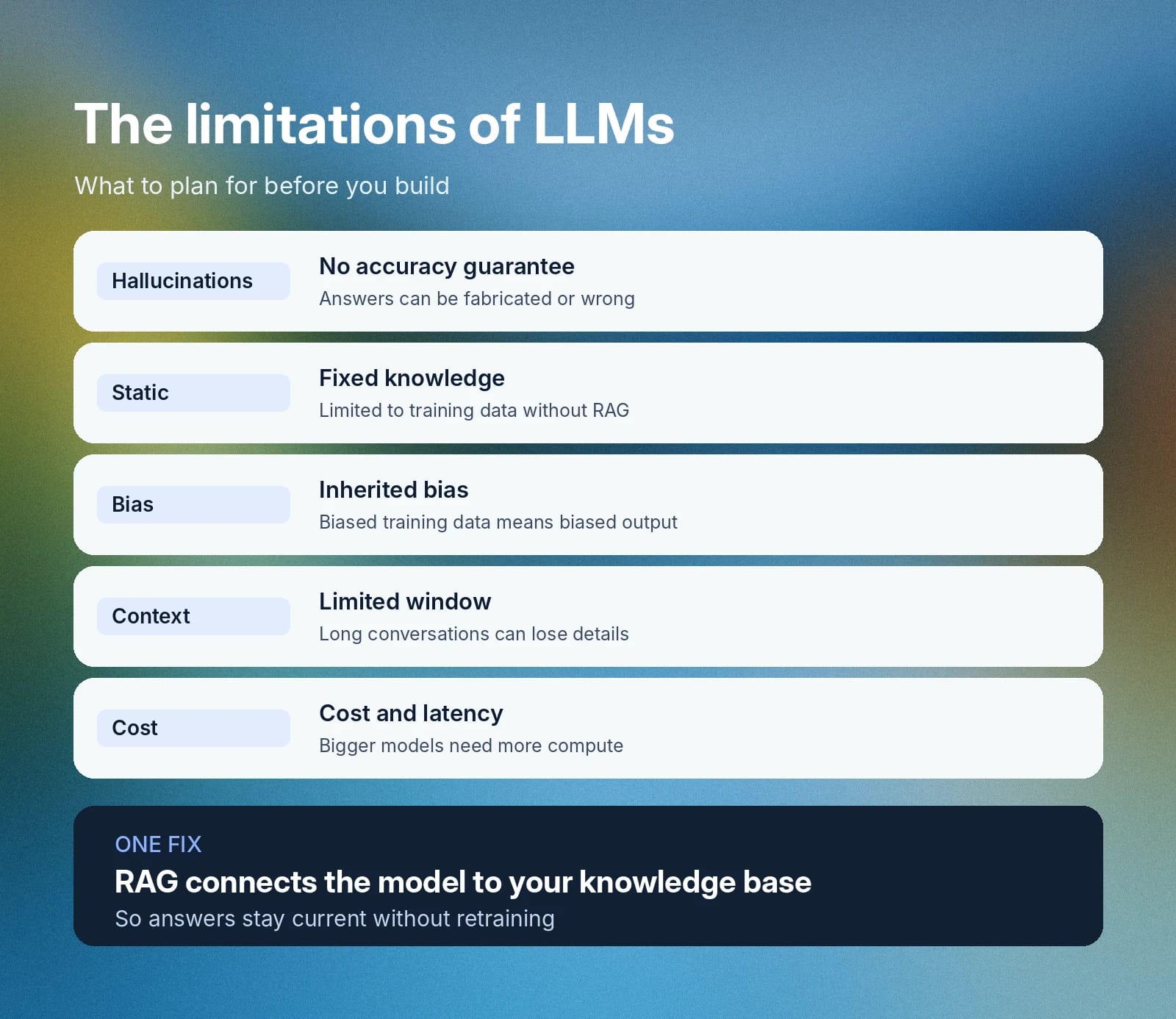
There are several strategies you can consider or implementations you can make to reduce the impact of these limitations. For example, enabling RAG in an LLM and attaching an ever-expanding knowledge base would overcome the static knowledge problem.
Build voice-enabled LLM experiences with ElevenAgents
Choosing a large language model for your use case is a critical decision that you may need to adjust as your business needs and even regulatory requirements change. Avoiding vendor lock-in maintains business agility and flexibility when building conversational voice AI solutions.
ElevenAgents lets you choose from supported LLMs from providers including OpenAI, Anthropic, and Google, or connect your own custom model through an OpenAI-compatible endpoint. This makes it easy for you to choose the optimal balance of speed, reasoning capability, and cost for your specific needs.
Explore ElevenAgents to see how hosted LLMs streamline voice workflows or contact sales to start building your low-latency voice agents today.
Frequently asked questions about LLMs

Jack Limebear is on the Growth team, acting as a content writer and strategist across the blog and insights pages. Before ElevenLabs, he spent over a decade leading content strategy for organizations ranging from fast-growing SaaS startups to Fortune 500 companies. He holds a Master's degree in English Literature from the University of Cambridge.