
AI voice agent pricing: What it costs for your business
- Written by
- Jack Limebear
- Published
ListenListen to this article
AI voice agent pricing depends on three line items: the platform that runs the agent, the large language model (LLM) that powers each conversation, and the telephony provider that connects your calls. Most pricing pages lead with a monthly plan fee, but that fee covers only the first of those three.
This guide explains how AI voice agent pricing works, what sets your price per minute, and how to calculate ROI against your current staffing costs.
We use real ElevenAgents pricing throughout, so you have concrete figures to plan with.
Summary
- Your voice agent cost equals platform minutes plus LLM usage plus telephony, and the LLM and telephony costs are billed separately at cost.
- ElevenAgents plans run from a free tier with 15 minutes per month to custom Enterprise pricing. Every paid tier works out to $0.08 per platform minute.
- A plan's concurrent call limit determines how many calls your agent handles at once, which matters as much as the per-minute rate.
- The free tier and the Startup Grants Program cover prototyping and early builds, but production volume carries real LLM and telephony costs.
- Compare total agent cost against the fully loaded cost of human staffing for the same call volume, adjusted for the share of calls the agent resolves end to end.
AI voice agent pricing at a glance
ElevenAgents uses tiered monthly plans. Each tier includes a set number of call minutes, a concurrent call limit, and features that scale with team size.
Plan
Price per month
Minutes included
Concurrent calls
Notable additions
Free
$0
15
4
Workflow builder, knowledge base, widget
Starter
$6 ($1 for the first month)
75
6
Commercial license, text messages
Creator
$22 ($11 for the first month)
275
10
Additional minutes billed at $0.08
Pro
$99
1,238
20
More concurrency
Scale
$299
3,738
30
3 workspace seats
Business
$990
12,375
40
10 workspace seats, 10 Professional Voice Clones
Enterprise
Custom
Custom
Elevated
Custom DPA and SLAs, BAAs for HIPAA customers, custom SSO, discounts at scale
Divide any paid plan's price by its included minutes, and you get the same platform rate: $0.08 per minute. Additional minutes on Creator and above bill at that same $0.08 rate, and text messages cost $0.003 each. Prices exclude taxes. Because every paid tier shares the same platform rate, volume discounts come through custom Enterprise pricing.
The table shows platform cost only. LLM usage and telephony sit on top, which the next two sections explain.
How AI voice agent pricing models work
The providers of AI voice agents tend to price their offerings in one of three main ways, with many often blending more than one. These models include:
- Usage-based pricing: You pay per minute or per call. Costs track volume directly, which suits teams with variable or seasonal traffic.
- Seat-based pricing: You pay per user who builds, manages, or monitors agents. This model appears most often on business and enterprise tiers.
- Flat subscription tiers: You pay a fixed monthly fee that includes a minute allowance. This gives predictable budgeting up to the allowance.
ElevenAgents combines all three. Each plan has a fixed monthly fee with included minutes, per-minute billing for additional usage, and workspace seats on the Scale and Business tiers.
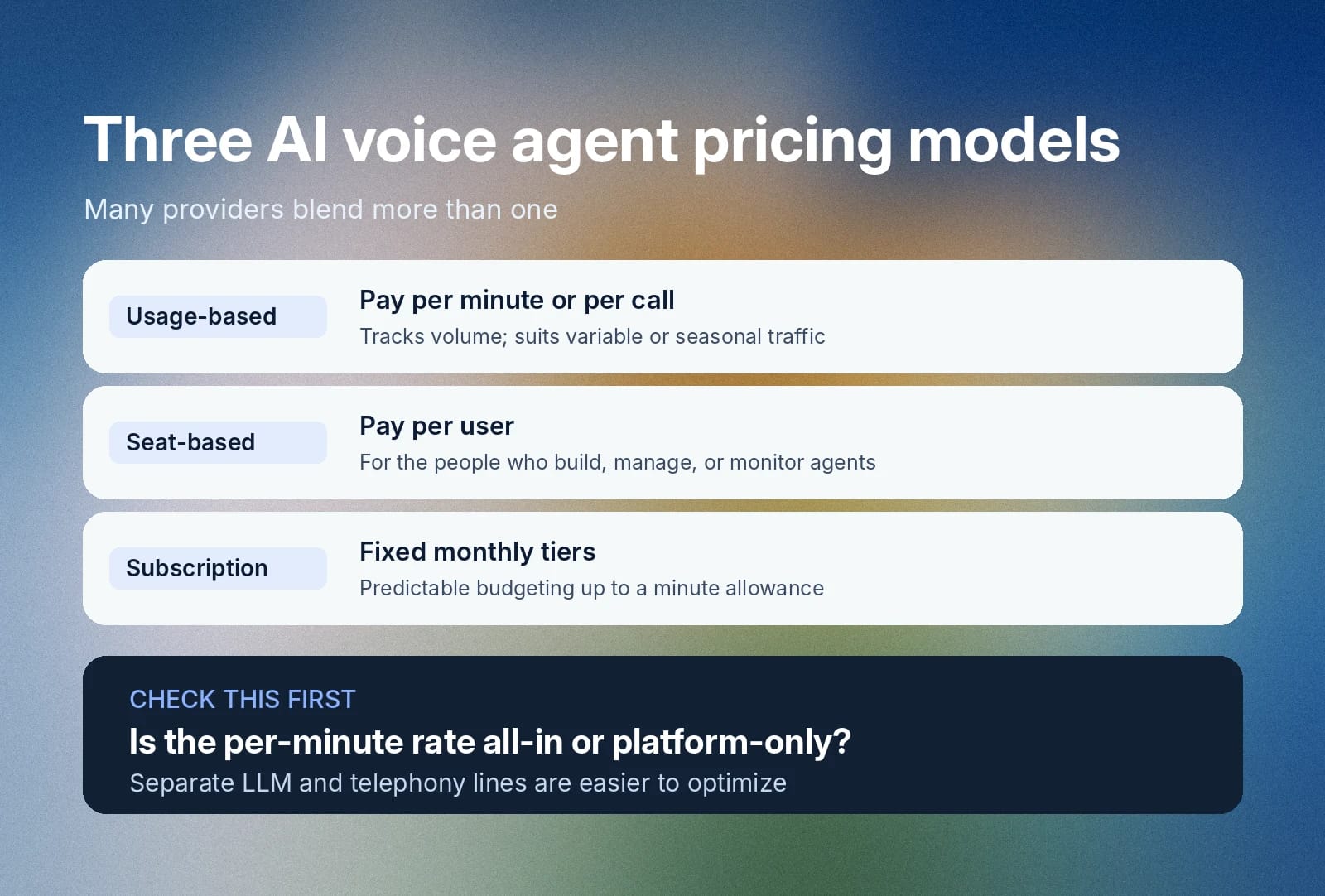
When you compare AI voice agent pricing models, check one detail first: whether the advertised per-minute rate is all-in or platform-only. A platform-only rate with LLM and telephony billed at cost gives you visibility into each line item. A bundled rate hides the split, which makes it harder to optimize.
What determines your AI voice agent price per minute?
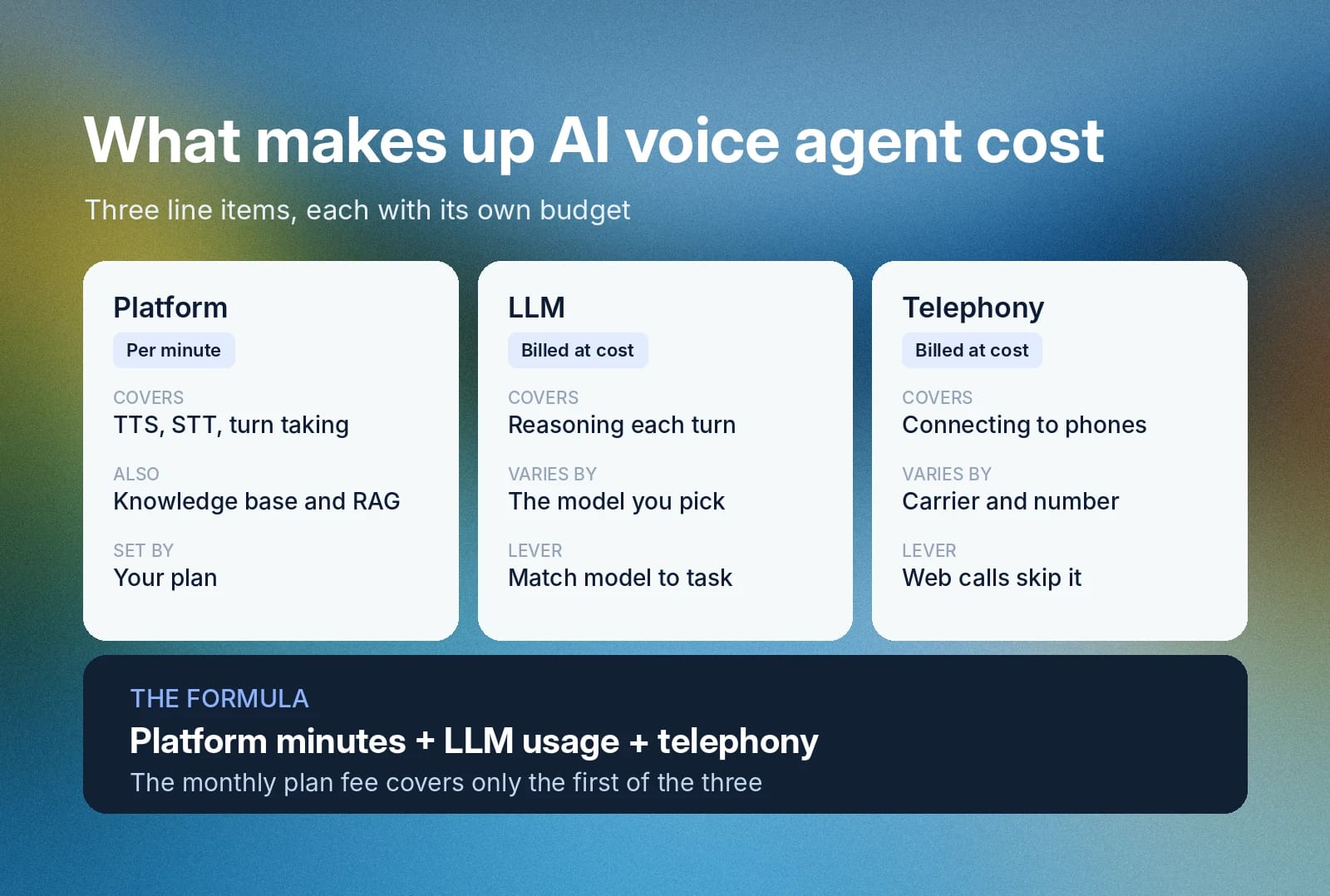
Your effective price per minute is the sum of three separate line items. Treat them as distinct budgets, because each one responds to different decisions.
Total monthly cost = (call minutes × platform rate) + LLM usage + telephony
Platform cost
The platform rate covers the voice and conversation layer. On ElevenAgents, that includes text to speech, speech to text, turn taking, knowledge bases, and RAG.
Voice quality sits inside this rate. Eleven v4 Turbo in ElevenAgents runs at a median inference latency of about 100 ms across more than 90 languages.
LLM cost
The LLM reasons through each turn of the conversation, and its cost varies by model. ElevenAgents bills LLM usage at cost, so a larger reasoning model costs more per minute than a lighter one.
Match the model to the task. Routine requests such as order status or appointment changes rarely need the most capable model, while complex troubleshooting often does.
Telephony cost
Telephony connects your agent to the phone network. Carriers bill at their own rates, and ElevenAgents passes those through at cost.
Your telephony spend depends on your provider, number type, and call direction. Web and in-app voice conversations through the widget skip carrier charges entirely.
Concurrency and burst capacity
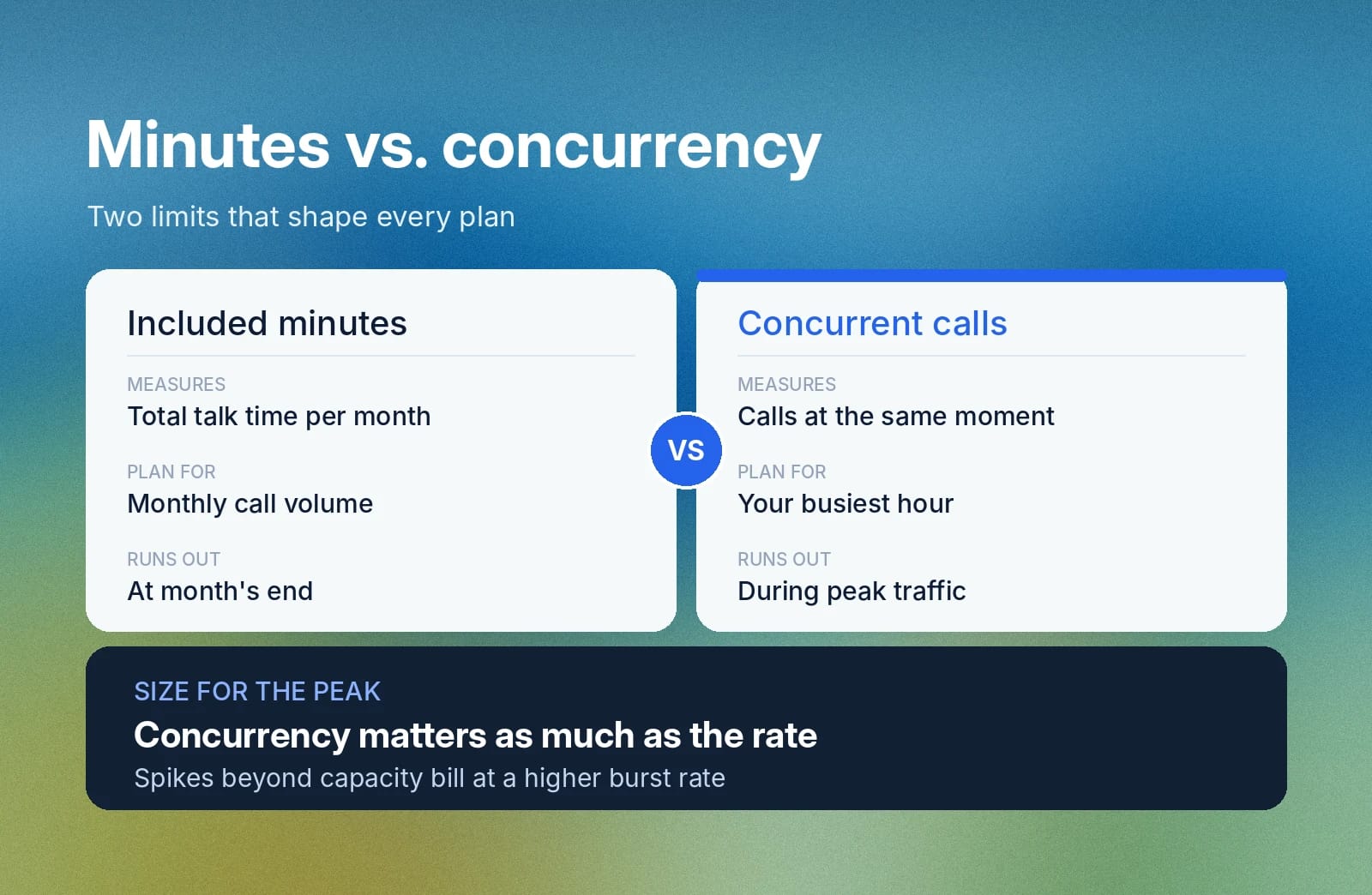
Concurrency is the number of calls your agent handles at the same moment. A plan with 20 concurrent calls supports 20 simultaneous conversations, no matter how many minutes remain in your allowance.
Size your plan against peak hour traffic, not monthly totals. ElevenAgents also lists a burst rate of $0.16 per minute for call spikes beyond standard capacity, and Enterprise plans offer elevated concurrency limits.
Average AI voice agent pricing by use case
No single average exists, because the range from $0 to custom Enterprise pricing reflects different use cases rather than inconsistent pricing. A useful way to estimate is to translate plan minutes into calls.
Assuming a four-minute average call, here is how the tiers map to real workloads:
- Prototyping and testing: The Free ($0) and Starter ($6 per month) plans cover early builds and internal demos, with 15 and 75 minutes per month.
- Small business support: The Pro plan ($99 per month) includes 1,238 minutes, covering roughly 300 calls per month, enough for a single location handling inbound questions.
- Growing support teams: The Scale plan ($299 per month) includes 3,738 minutes, covering about 930 calls per month, with three workspace seats for the team managing the agent.
- Contact center volume: The Business plan ($990 per month) includes 12,375 minutes, covering about 3,090 calls per month, with 40 concurrent calls for peak traffic.
- Regulated and high-volume operations: Enterprise plans add compliance terms, custom SSO, and volume discounts for organizations above those thresholds.
Add your LLM and telephony estimates to the platform figure for each tier to see the full monthly number.
Is voice AI free?
Voice AI is free to test, but not free at production scale. The ElevenAgents free tier includes 15 minutes per month, four concurrent calls, the workflow builder, a knowledge base, and the embeddable widget. That covers building and testing a working agent before you commit to a budget.
Startups get even more room here. The ElevenLabs Startup Grants Program gives qualifying new products 12 months free with 33M characters to build, launch, and test conversational agents. That allowance covers over 680 hours of Agents usage.
Once an agent handles real customer volume, LLM and telephony costs apply alongside platform minutes. Plan for all three before you move from pilot to production.
Learn more about ElevenAgents pricing
Standard pricing
·For businesses
·How to calculate AI voice agent ROI before you buy
AI voice agent ROI comes from comparing two numbers for the same call volume: the total cost of running the agent, and the fully loaded cost of human staffing. A single universal ROI figure would mislead you, because the answer depends on your volume and on how many calls the agent resolves without escalation.
Work through these five steps with your own figures.
- Measure your call volume: Multiply monthly calls by average handle time to get total minutes.
- Calculate your fully loaded staffing cost: Include wages, benefits, training, turnover, supervision, and tooling, then express it as cost per handled hour.
- Estimate your resolution rate: This is the share of calls the agent resolves end to end. Our own AI support agent resolves 65% of tickets end to end across more than 22,000 tickets per month, with average first response down to 60 seconds.
- Calculate total agent cost: Add platform minutes, LLM usage, and telephony.
- Compare like for like: Add agent cost to the staffing cost of escalated calls, then compare that total to your current staffing cost.
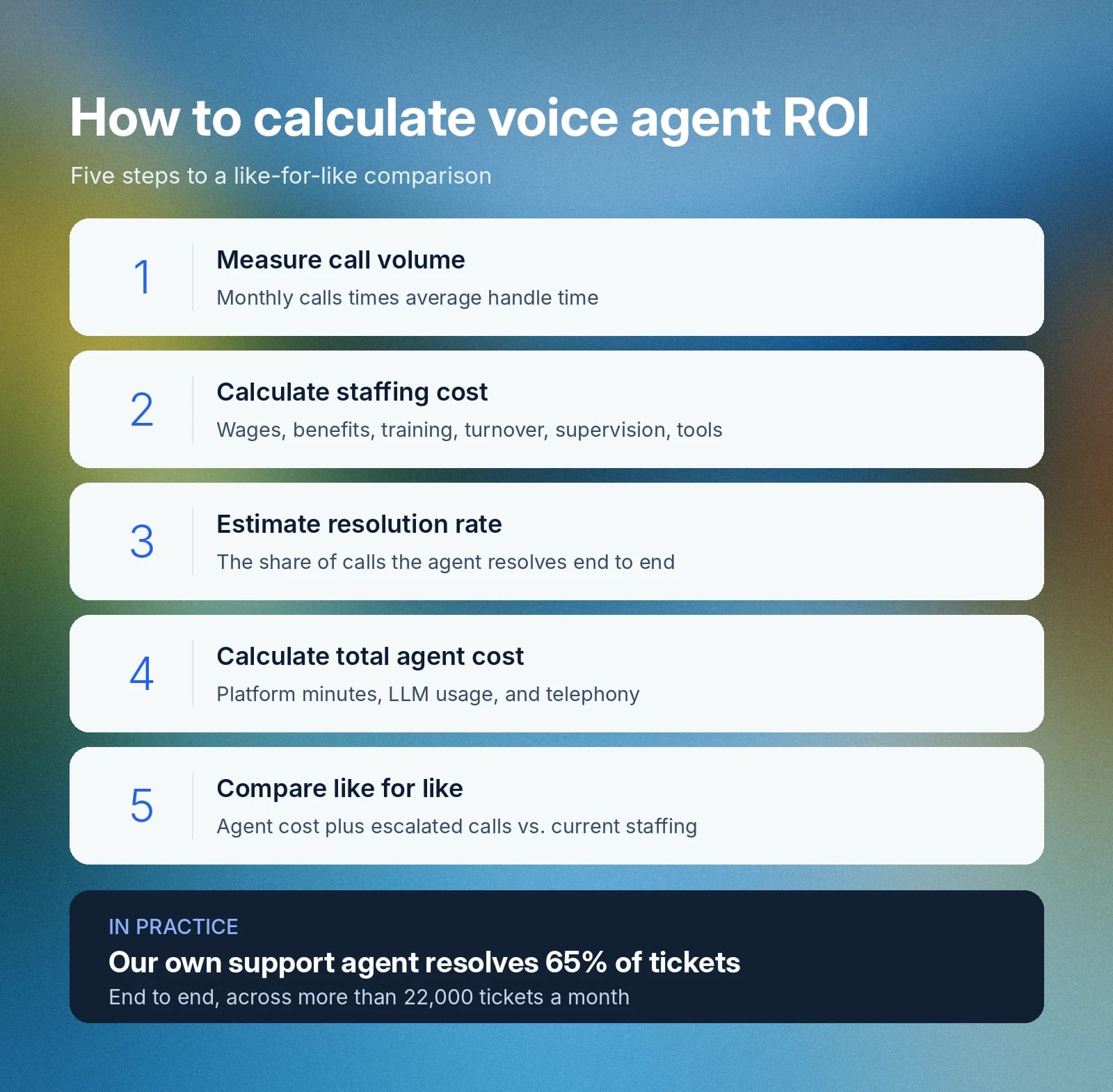
Together, these steps give you a like-for-like comparison. The example below applies them to sample figures.
A practical example
The figures below are assumptions for illustration. Replace them with your own.
- Call volume: 8,000 calls per month at five minutes each equals 40,000 minutes, or about 667 hours.
- Current staffing cost: At an assumed fully loaded $40 per handled hour, those 667 hours cost about $26,667 per month.
- Agent platform cost: 40,000 minutes at $0.08 equals $3,200 per month.
- Remaining human cost: At an assumed 60% resolution rate, human agents still handle 40% of calls, or about $10,667 per month.
- Net difference: $26,667 minus ($3,200 + $10,667) leaves about $12,800 per month before LLM and telephony costs.
Subtract your LLM and telephony estimates from that net figure to get your monthly savings. Then check that your plan's concurrency covers your busiest hour.
Cost is only part of the return. Voice agents answer at any hour, respond in seconds, and free human teams for complex or sensitive calls. We run sales, support, hiring, and operations on our own platform, and how ElevenLabs uses ElevenAgents shows where those gains show up across functions.
Hidden costs to budget for
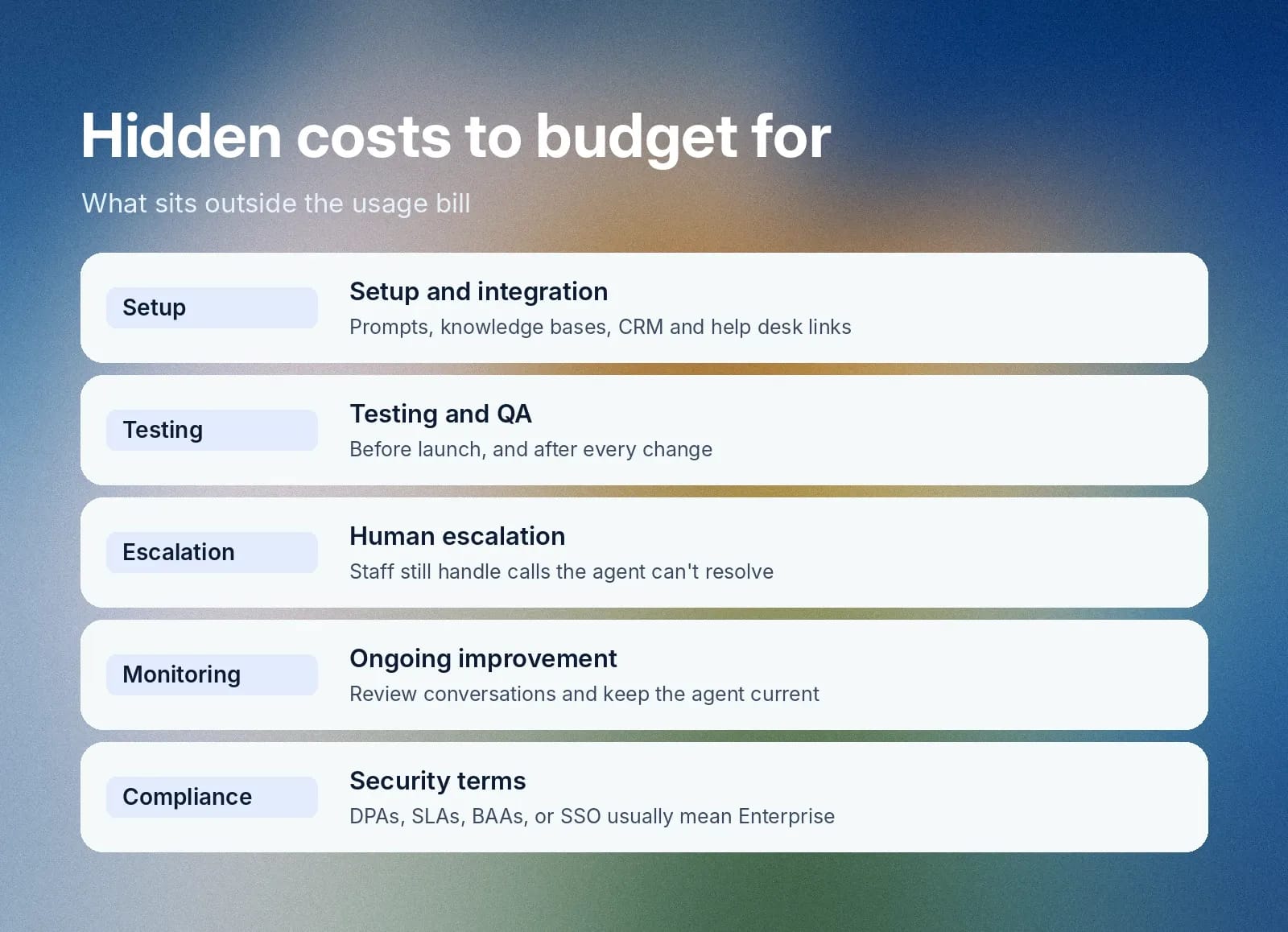
Platform minutes, LLM usage, and telephony make up your usage bill, but a full budget includes these items too:
- Setup and integration time: Configuring prompts, knowledge bases, and CRM or help desk integrations takes team time before launch.
- Testing and quality assurance: Agents need testing before launch and again after each change to prompts, tools, or knowledge.
- Human escalation: Staff still handle the calls the agent cannot resolve, so keep their cost in your model.
- Monitoring and improvement: Someone has to review conversations and update the agent as your business changes.
- Compliance and security: Requirements such as custom DPAs and SLAs, BAAs for HIPAA, or custom SSO typically move you to Enterprise pricing.
Add an allowance for each item to your ROI model so your comparison with current staffing costs stays consistent.
How to reduce your AI voice agent costs
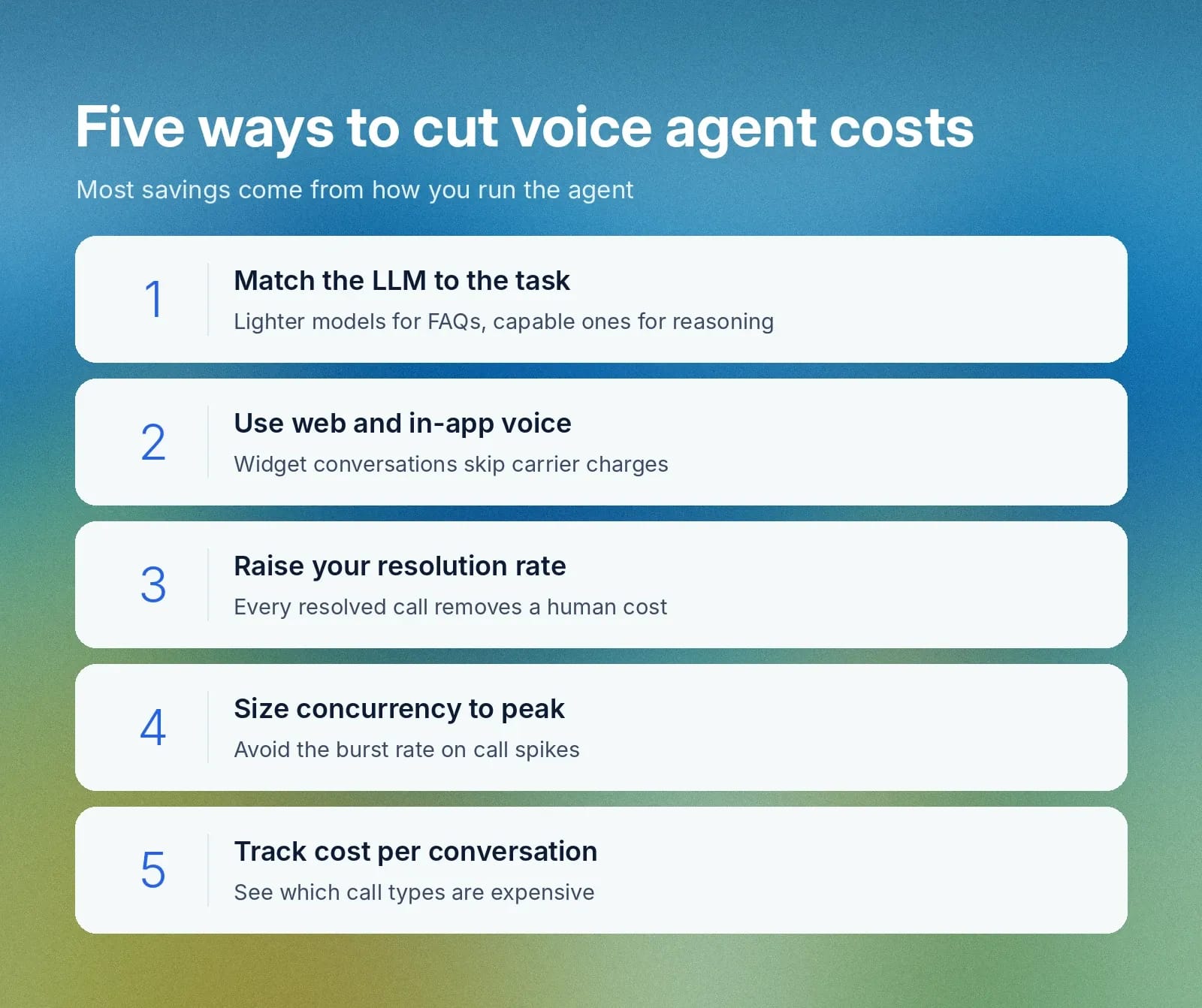
Platform pricing is fixed per minute. That means most savings come from how you configure and run the agent:
- Match the LLM to the task: Use a lighter, lower-latency model for simple jobs such as FAQs or intent classification, and a more capable model only where the conversation needs complex reasoning. Splitting an agent into subagents lets you choose the LLM for each one.
- Use web and in-app voice where it fits: Conversations through the widget skip carrier charges entirely.
- Raise your resolution rate: Every call the agent resolves end to end removes the human cost of that call, so better knowledge bases and workflows reduce escalations.
- Size concurrency to peak traffic: Planning for your busiest hour helps you avoid the $0.16 per minute burst rate on call spikes.
- Track cost per conversation: Monitoring conversation duration and LLM cost shows which call types are expensive.
Review these levers regularly as your call volume and mix of call types change. You can also test different settings over time and track how each change affects your costs.
How to choose the best AI voice agent platform
The best AI voice agent platform for your business is the one whose pricing, capacity, and controls match your workload.
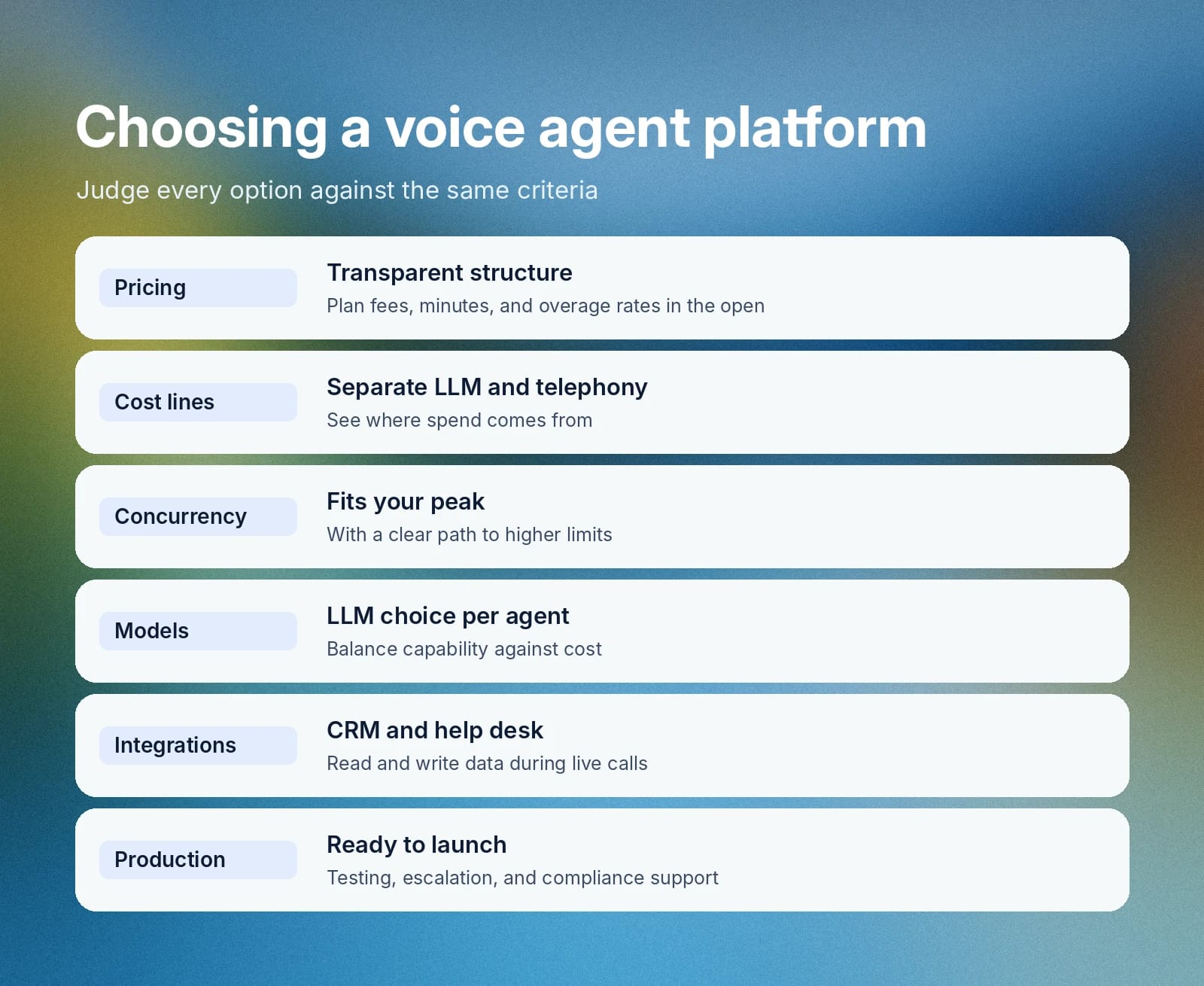
Evaluate every option against the same criteria:
- Transparent pricing structure: The pricing page shows plan fees, included minutes, overage rates, and exactly what each tier adds.
- Separate cost lines: LLM and telephony costs appear as distinct line items, so you see where spend comes from and optimize each part.
- Concurrency that fits peak volume: Concurrent call limits match your busiest hour, with a clear path to higher limits as you grow.
- Model choice: You select the LLM for each agent, so you balance capability against cost per task.
- System integrations: The agent reads and writes data in your CRM and help desk during live calls. Our guide to AI voice agent integrations for CRM and help desk platforms covers what to look for.
- Production readiness: The platform supports testing, human escalation, and compliance requirements. A case study on how one of Europe's largest insurers got AI agents into production shows what that looks like in a regulated industry.
- Team support: Workspace seats let the people who build, review, and improve agents work in the same environment.
A platform that meets these criteria keeps your total spend predictable as call volume grows.
Get started with ElevenAgents for customer service
ElevenAgents gives you transparent, tiered pricing with LLM and telephony billed at cost, so you know exactly what each conversation costs. Start on the free tier to build and test, then move to the plan that matches your call volume and concurrency needs.
Compare ElevenAgents plans and pricing to find the right tier for your team, or create a free ElevenAgents account to build your first voice agent today.
Frequently asked questions about AI voice agent pricing

Jack Limebear is on the Growth team, acting as a content writer and strategist across the blog and insights pages. Before ElevenLabs, he spent over a decade leading content strategy for organizations ranging from fast-growing SaaS startups to Fortune 500 companies. He holds a Master's degree in English Literature from the University of Cambridge.