
What is SIP trunking? A business guide to modern calls
- Written by
- Jack Limebear
- Published
ListenListen to this article
Session Initiation Protocol (SIP) trunking is a technology that allows businesses to make and receive voice calls over the internet.
SIP trunking helps businesses scale their customer service systems without the high costs and complex installation processes of physical phone lines. This is particularly helpful for businesses implementing AI voice agents, which aren’t inherently compatible with traditional phone systems.
If you’re looking for a way to scale your business’s phone system efficiently, SIP trunking may be an effective solution. In this guide, we’ll explore how SIP trunking works, why it’s effective for growing businesses, how to choose a SIP trunking provider, and how to use SIP trunking with AI agents.
Summary
- SIP trunking connects your business phone system to the public phone network over the internet instead of traditional copper phone lines.
- It’s typically cheaper and easier to scale than traditional phone lines. Cost will mainly depend on the number of channels and minutes you use.
- Encryption, access controls, failover, number porting, and call capacity are key factors when choosing a provider.
- SIP trunking replaces PRI and ISDN lines while still working wtih or underneath hosted PBX and UCaaS systems.
- ElevenAgents connects to standards-compliant SIP trunks so AI voice agents can handle inbound and outbound calls.
What is SIP trunking and how does it work?
SIP trunking is the process of connecting your business’s phone system to public phone networks using the internet, rather than using traditional copper phone lines.
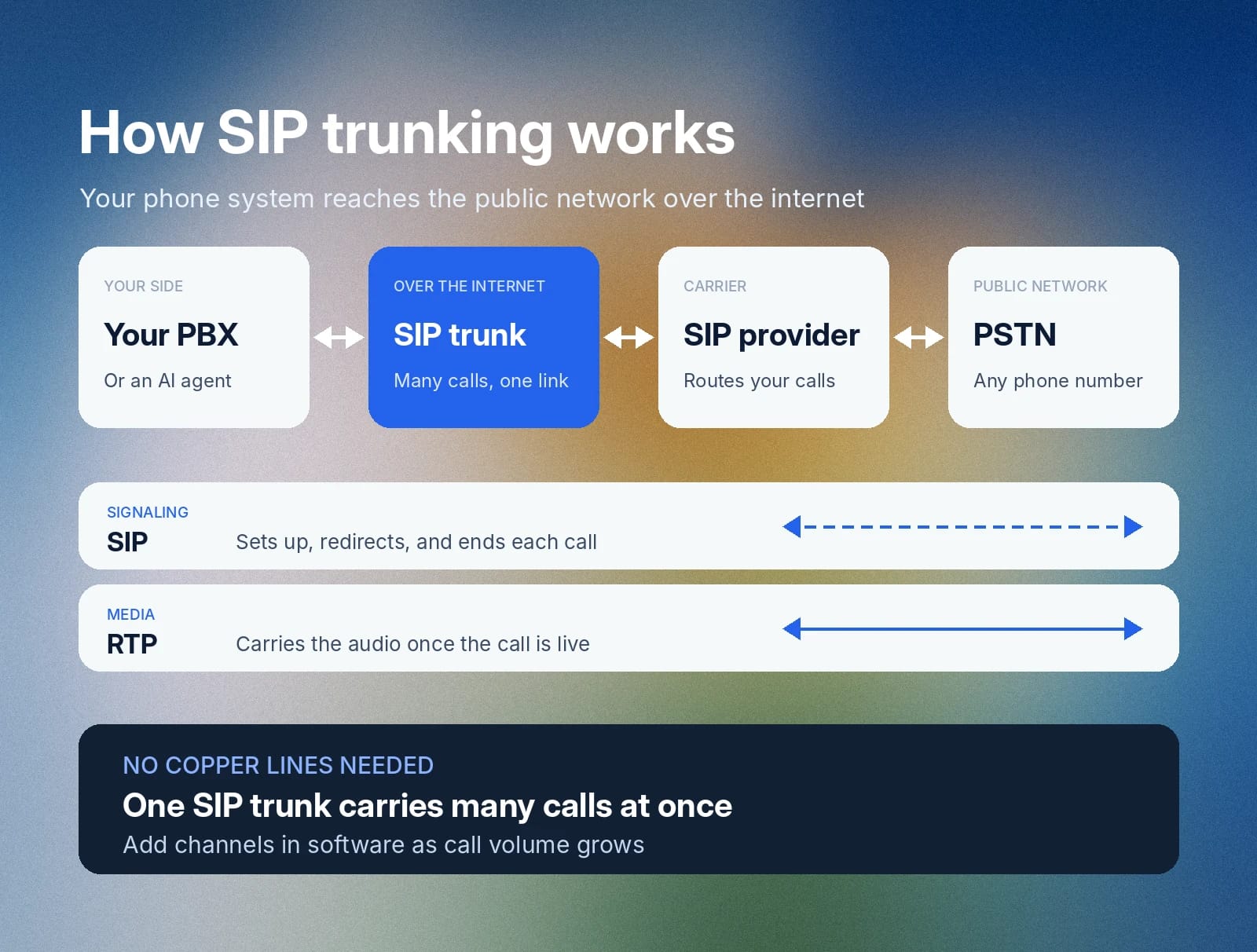
SIP trunking uses Session Initiation Protocol to connect your internal Private Branch Exchange (PBX) system to the Public Switched Telephone Network (PSTN). Then, you can send voice calls over this virtual connection. Some providers also support video calls and text messages.
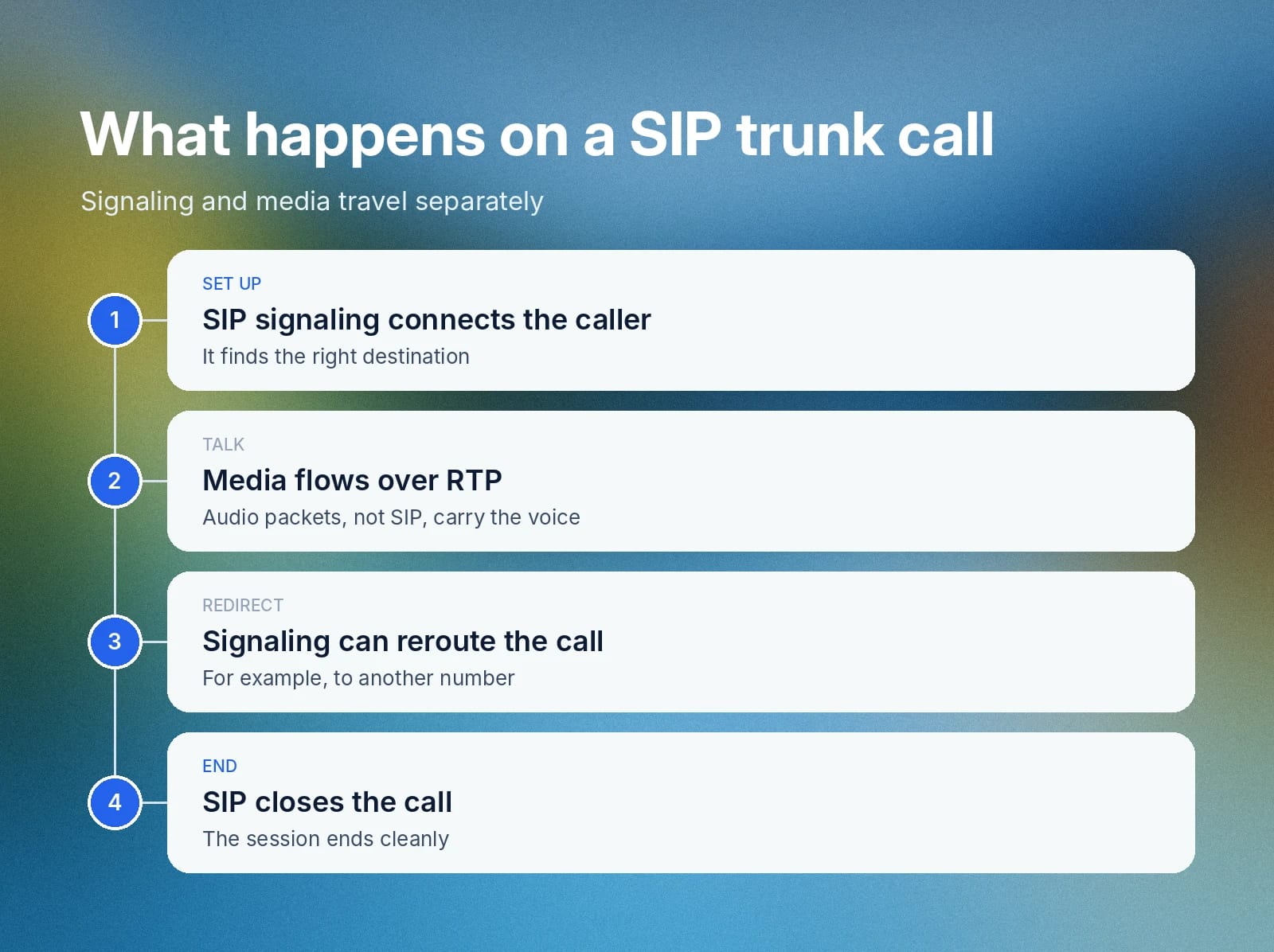
The SIP trunking process starts with signaling, which involves setting up the process and connecting the caller with the correct destination. The signaling process may also involve redirecting a call or closing a call once it’s over.
Once the call has been set up, the data packets travel over a separate Real-time Transport Protocol, or RTP, not over the SIP itself. The data packets transmitted during a call are called ‘media’.
SIP vs. SIP trunk: What’s the difference?
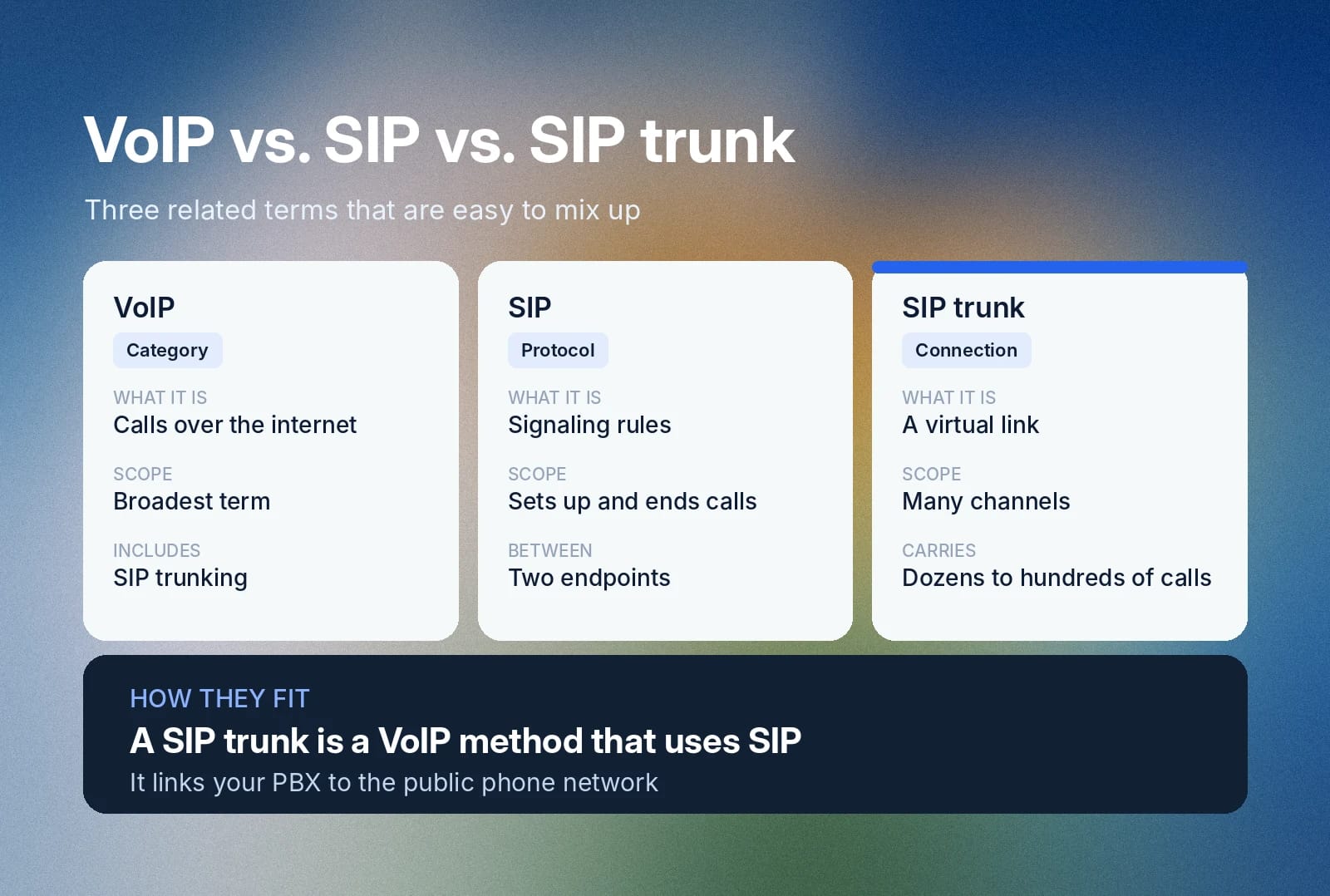
Session Initiation Protocol, or SIP, is a signaling protocol that sets up, manages, and ends calls between two endpoints. In this case, the endpoints are your internal phone system and your SIP trunking provider, which connects you to the public phone network.
A SIP trunk is the specific virtual connection that facilitates the call. One SIP trunk can contain multiple channels and handle dozens or even hundreds of calls at the same time.
SIP trunking vs. VoIP: How the technologies work together
Voice over Internet Protocol, or VoIP, is a general term for any voice call that happens over the internet. SIP trunking is a specific VoIP method that connects your company’s internal PBX to the public phone network to facilitate calls.
SIP trunking benefits for growing businesses
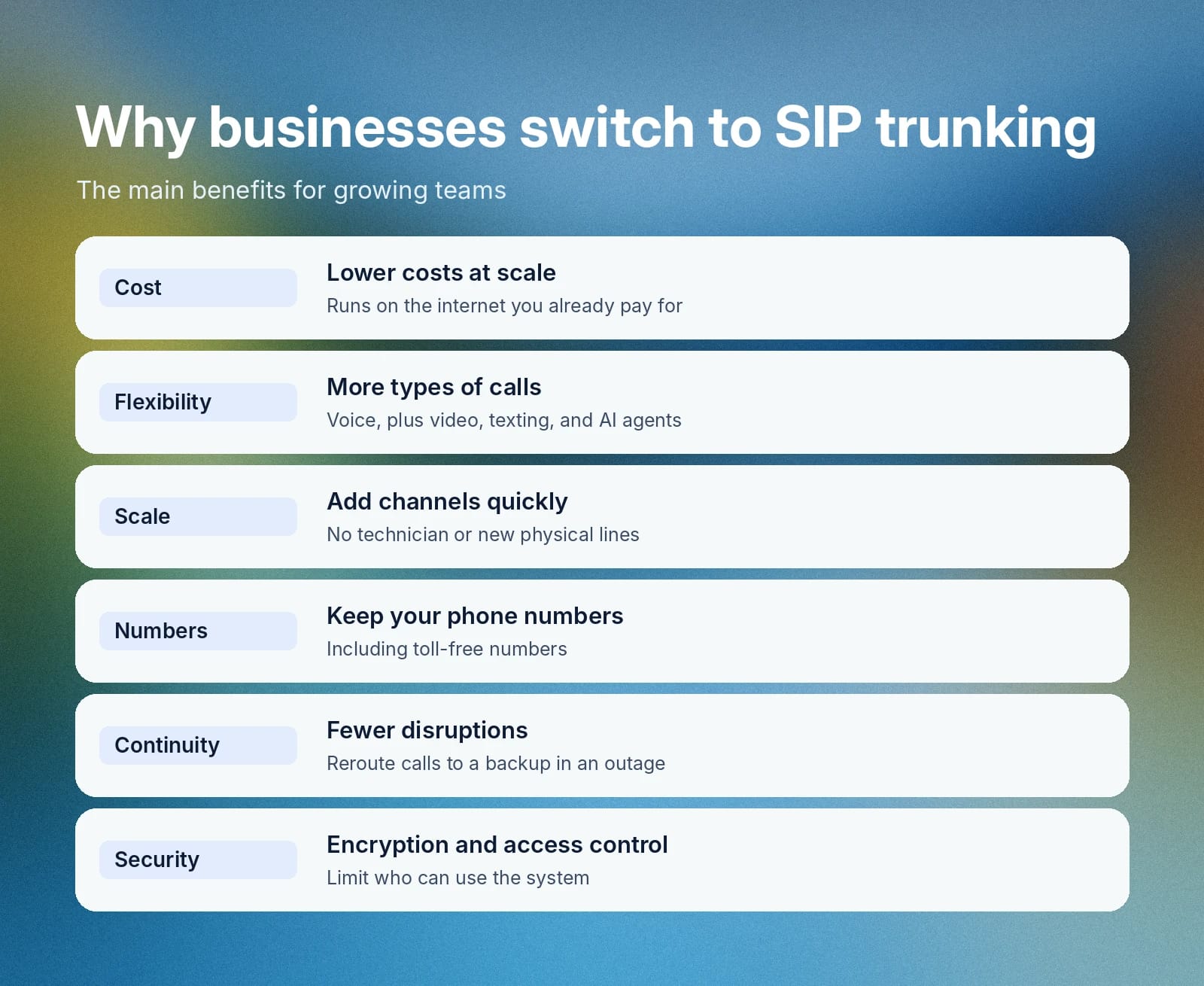
SIP trunking offers a number of benefits for growing businesses, especially when they need to expand their phone systems to support a higher volume of calls. Here are some of the advantages of using SIP trunking for your phone systems.
Cost-effective
SIP trunking is generally cheaper than using traditional phone lines, especially at scale. That’s because SIP trunks run over the internet connection you’re already using, so you don’t need to pay to install and maintain separate phone lines.
With SIP trunking, you also typically avoid the high long-distance charges of traditional phone lines, because calls travel over the internet instead of separate circuits. International rates still apply and vary by provider, but they’re often lower than what physical lines charge, which makes SIP trunking a cost-effective option for organizations operating internationally.
Supports different types of calls
SIP trunking is primarily used for voice calls. Some providers also support video calls and business texting, and you can connect AI voice agents to your SIP trunk to handle customer service calls. This means you can use the same system to handle many different types of business communications.
Easy to scale
As your business grows, SIP trunking systems scale with you. You can add more channels to your SIP trunks quickly as your call volume grows.
To scale a traditional phone system, you’ll need to bring in a technician to install new physical lines, which is both time-consuming and expensive. SIP trunking is much more flexible.
Allows you to keep your existing phone numbers
You don’t have to change your business’s phone number when you switch from a physical phone connection to SIP trunking. This is particularly helpful if you already have a toll-free phone number that’s part of your brand identity.
Many SIP trunking providers allow you to keep your existing carrier and phone numbers when you make the switch. You can also use local number porting to keep your phone number while switching to a new carrier.
Low risk of disruptions
With SIP trunking, you can configure your phone calls to reroute to a backup system in the event of a power outage or other performance issue. This means you’re far less likely to miss an important call, and you’ll provide consistently reliable service for your customers.
Advanced security
Calls happening on a SIP trunk can be encrypted for privacy and security. Some SIP trunking providers also offer access control features, which allow you to limit who uses your business phone system and who they can call.
If a threat actor gets access to your phone systems, it could expose sensitive data or put your business at risk of a cyber attack. Using these security features helps reduce these risks.
What affects SIP trunking cost?
There are two primary factors that affect the cost of your SIP trunking system: the number of channels you have and the number of minutes you use each month. If you have an unlimited SIP trunking plan, you’ll be charged based on the number of channels you have. If you have a metered plan, you’ll be charged based on the number of minutes you use.
Metered plans tend to be more cost-effective for small businesses that only need a few channels. However, unlimited plans are more cost-effective for large or fast-growing businesses with many channels operating continuously.
Some SIP trunking providers also charge one-time fees for setup and number porting, or add-on fees for features like Direct Inward Dial (DID) numbers, toll-free numbers, business texting, call recording, or call rerouting. Providers may also charge higher fees for international calls, although they still tend to be much cheaper than long-distance calls on a physical phone line.
How to choose SIP trunking providers for reliability and scale
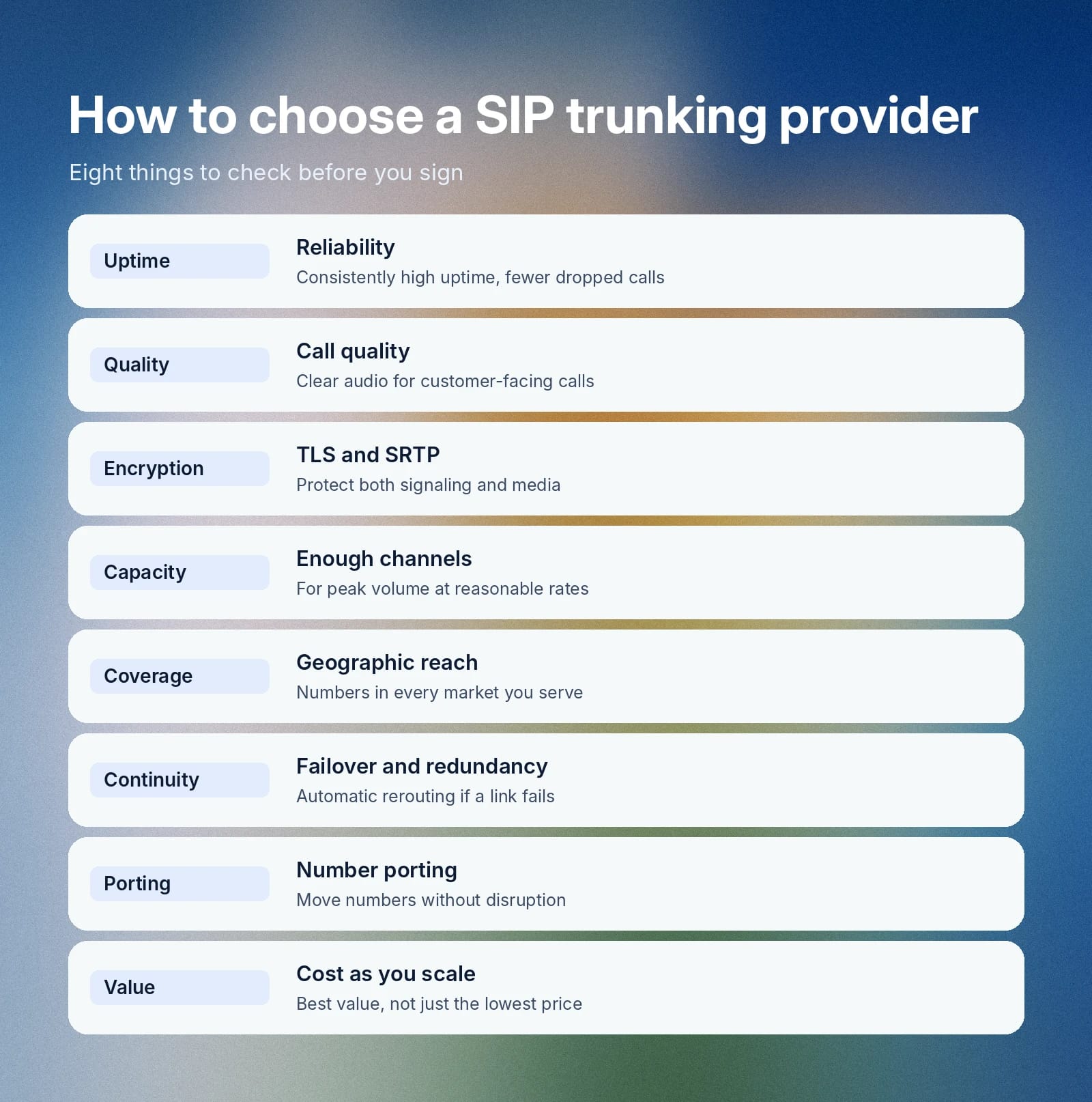
There are many SIP trunking providers on the market, and you’ll need to determine which one best fits your business’s needs. Here are key factors to consider when choosing a SIP trunking provider:
- Uptime and reliability: Look for a provider that offers consistently high uptime rates, so you don’t have to worry about calls dropping. Providers that own and maintain their own SIP trunking infrastructure often have more control over reliability.
- Call quality: Look for a SIP trunking provider who prioritizes good audio and video quality, as this is essential for customer-facing calls. Some SIP trunking providers offer demos or free trials to help you determine whether their services meet your standards.
- Encryption support: Your SIP trunking provider should use TLS and SRTP protocols to encrypt both the signaling and media transfer processes.
- Call capacity: Consider how many channels you’ll need for consistent high-volume service and whether your SIP trunking provider supports that at reasonable rates.
- Geographic coverage: Make sure your SIP trunking provider supports numbers in the countries and regions where your business operates.
- Business continuity: Look for failover and redundancy, such as automatic rerouting to a backup number or site if your primary connection fails, so a single outage doesn’t stop your calls.
- Number porting: Choose a provider that can port your existing phone numbers without disrupting your operations.
- Cost-efficiency: Instead of opting for the cheapest provider on the market, look for SIP trunking services that provide the best value for the price. Consider how costs will increase as your business scales and whether your budget supports it.
Use SIP trunking with voice AI in your contact center
With voice AI, you can scale your customer service operations without hiring more agents. ElevenAgents connects directly to any standards-compliant SIP trunking system you already have in place, so you can implement voice AI without making significant changes to your phone infrastructure.
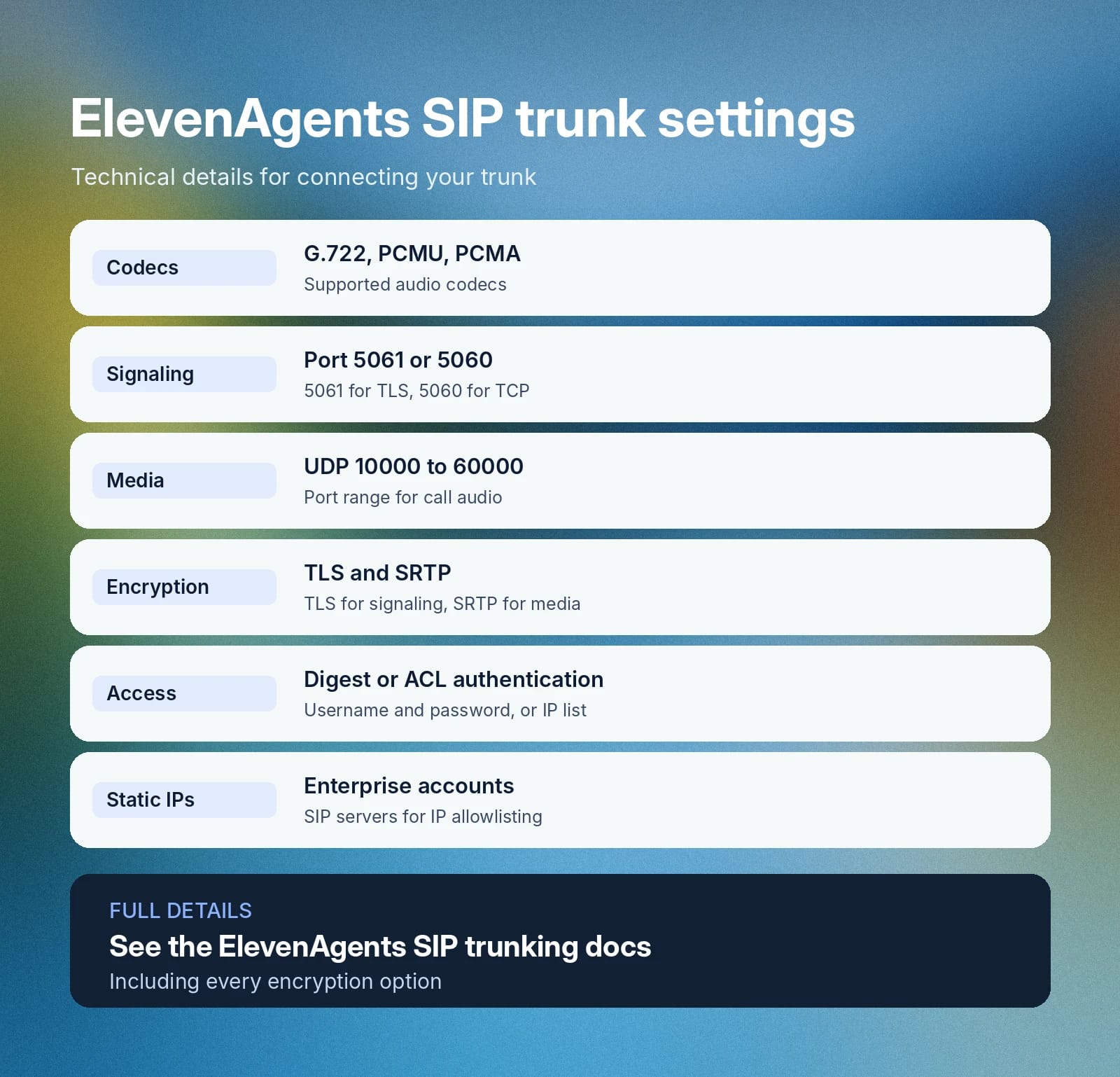
With ElevenAgents, you can route your inbound calls to AI agents using your SIP INVITE address. AI agents can also make calls through your SIP trunk with a configured hostname. ElevenAgents supports TLS encryption for call signaling, and you can enable SRTP media encryption.
ElevenAgents supports access control with SIP trunking for businesses that need it. This happens using either a username and password (digest authentication) or Access Control List authentication. If your business requires IP allowlisting, ElevenLabs offers SIP servers with static IP addresses for Enterprise accounts.
If you connect a SIP trunk to ElevenAgents, ElevenLabs doesn’t charge an extra fee for SIP trunking, and you pay your trunking provider separately for channels and minutes. ElevenAgents conversation minutes are billed on top of that, with LLM usage billed separately. The Free plan includes 15 minutes and 4 concurrent calls, paid plans start at $6 per month for 75 minutes and 6 concurrent calls, and additional minutes on Creator and above cost $0.08 per minute.
Concurrency rises with your plan, up to 40 concurrent calls on Business, and Enterprise plans offer higher limits.
Connect your SIP trunk to ElevenAgents
With ElevenAgents, you can connect your existing SIP trunk so AI voice agents handle inbound and outbound customer calls in over 90 languages. ElevenAgents works with providers including Twilio, Telnyx, Vonage, Sinch, and Plivo, and supports TLS, SRTP, and digest or IP-based authentication.
Customize each agent’s voice, knowledge base, and workflow, then route calls to human agents when needed. Learn more about ElevenAgents or contract sales today.
Frequently asked questions about SIP trunking

Jack Limebear is on the Growth team, acting as a content writer and strategist across the blog and insights pages. Before ElevenLabs, he spent over a decade leading content strategy for organizations ranging from fast-growing SaaS startups to Fortune 500 companies. He holds a Master's degree in English Literature from the University of Cambridge.