
How many calls can an AI voice agent handle at scale?
- Written by
- Jack Limebear
- Published
ListenListen to this article
The total number of calls an AI voice agent can handle depends on three factors: your plan’s concurrency limit, your telephony trunk capacity, and how quickly your language model and CRM integrations respond.
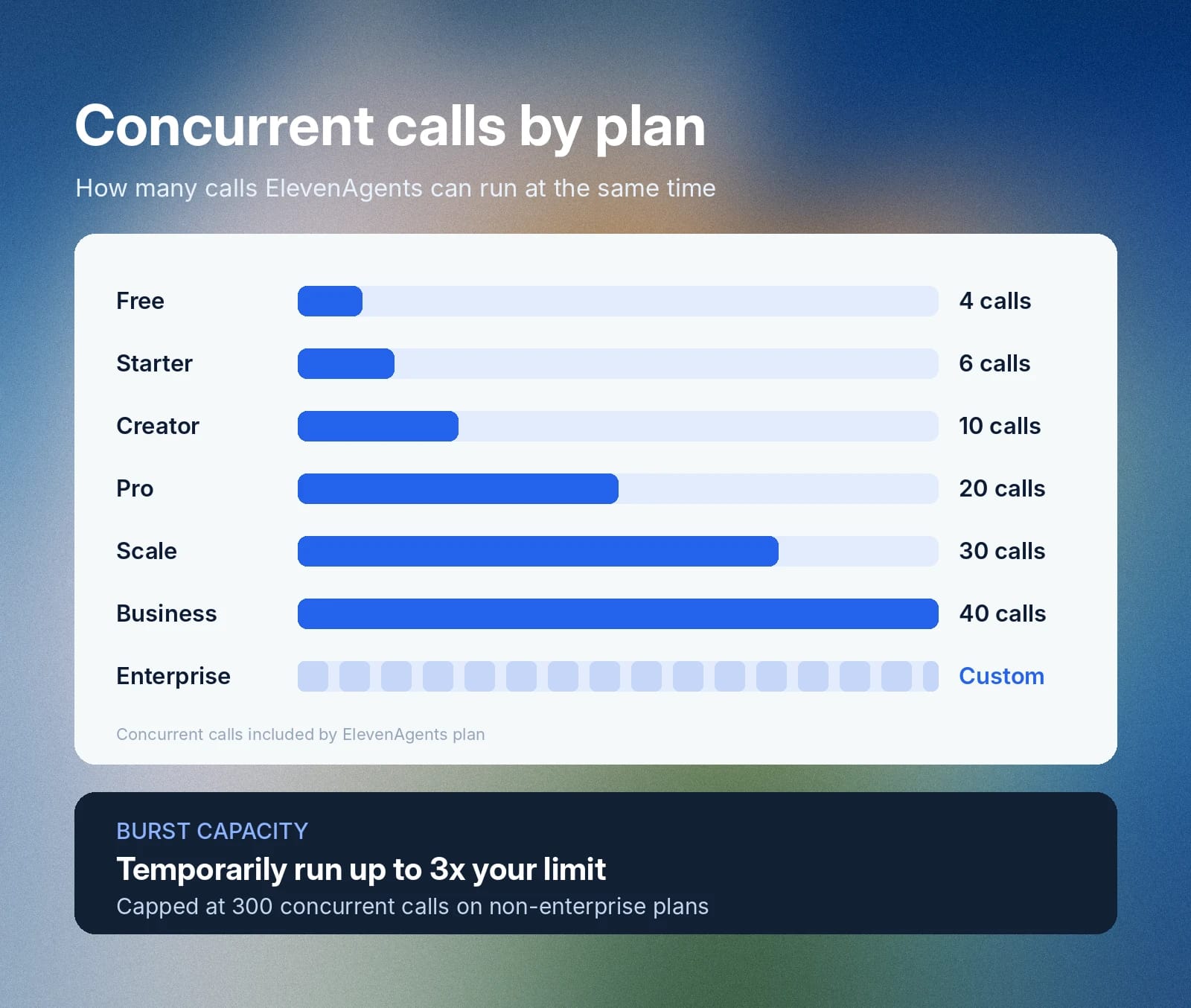
ElevenAgents scales with your plan. While concurrency begins at 4 calls on the Free plan, it scales to 40 on Business and goes beyond it for Enterprise customers. Burst pricing also lets you temporarily run up to three times your limit for those high-demand moments.
Combined with low-latency models and transparent AI voice agent pricing per minute, ElevenAgents offers your team the technology it needs to deliver fast and reliable customer experiences at scale. Let’s find out more.
Summary
- When reviewing how many calls can an AI voice agent handle, it’s important to start with the plan tier used by your company on your chosen platform.
- Subscription plan tiers also set your simultaneous line allocation and determine your AI voice agent pricing per minute.
- Ops managers can address unexpected call surges by calculating the peak number of concurrent calls that a platform or plan can handle to avoid rejected calls and long hold times.
- Automated voice agents resolve routine caller queries end to end, and then escalate more complex issues to human operators.
- Companies need to review proper consent protocols and regulatory compliance to ensure that the automated voice agents they deploy comply with the laws in every market they serve.
How many calls can an AI voice agent handle at once?
A human team handles call concurrency by simply staffing more people, with each staff member taking one call at a time. To reduce wait times, call centers need to scale their number of representatives, which adds to the operations bill.
To find out how many concurrent calls an AI voice agent can have, there are a few factors you need to consider.
Concurrency defines capacity
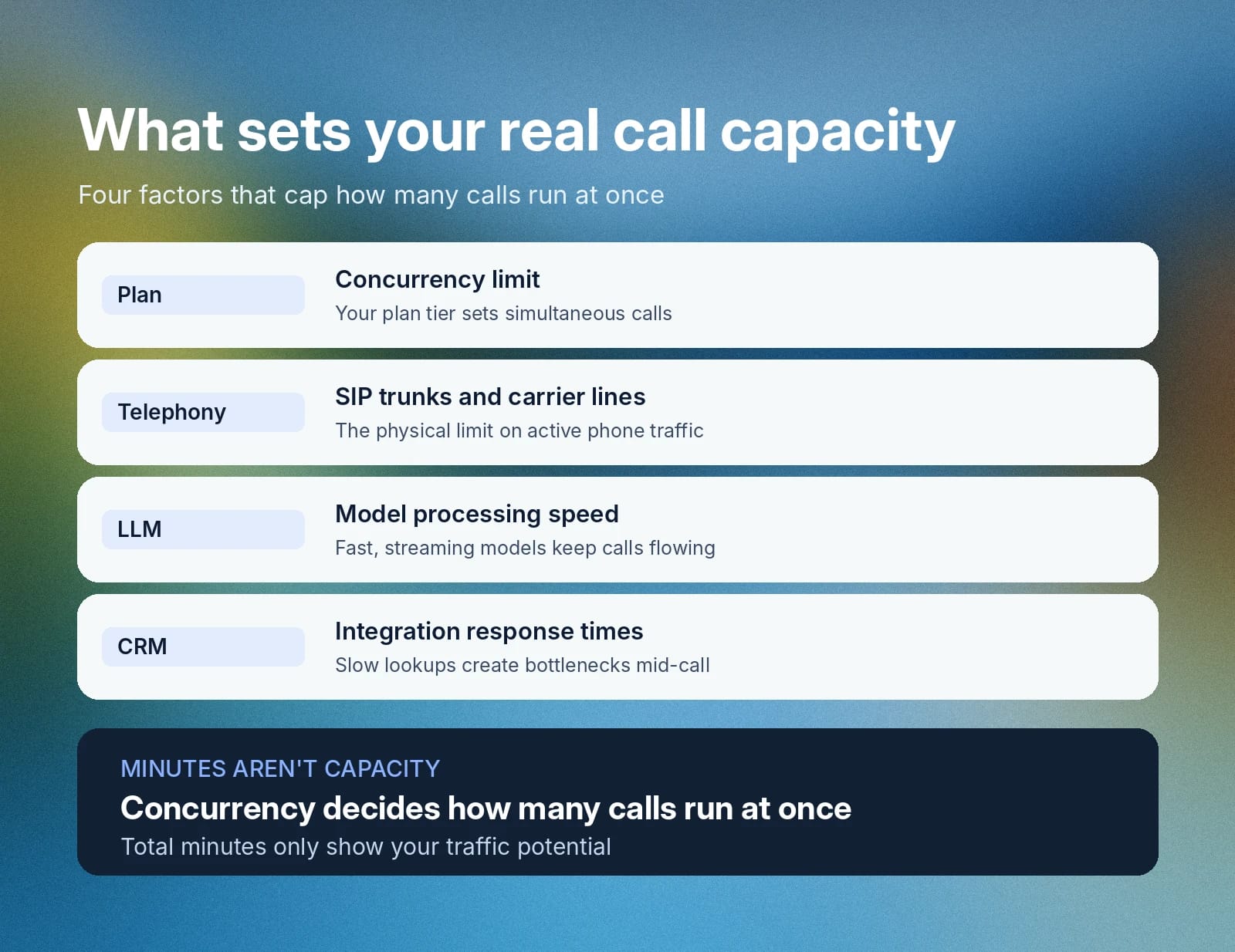
Most agent platforms you come across will offer a total number of minutes. While that gives an insight into your traffic potential, it doesn’t reveal much about how well your current configuration can handle an incoming customer call bottleneck.
Agent concurrency is the determining factor for how many calls you can run at once.
What determines real-world concurrent call capacity?
Regardless of the platform you choose, your true concurrency cap depends on the plan tiers you work from. For example, ElevenAgents provides smooth scaling from 4 concurrent calls on free plans to 40 lines on Business tier, with even higher limits available on the Enterprise plan.
Other determining factors include:
- Underlying telephony trunks: SIP trunks and carrier lines set the physical limit on active phone traffic. Calls rarely distribute evenly across a day in the real world, so consider the peak call volume when sizing your trunk. This prevents dropped calls and busy signals for customers.
- LLM processing speeds: Fast language models process caller requests and generate natural responses at sub-second speeds. Streaming models keep live conversations running smoothly by instantly converting text to audio.
- Connected CRM databases: AI voice agent integrations execute live database lookups during calls to confirm account details and access customer history. High-speed API endpoints update CRM records live without creating delays or bottlenecks in your workflow.
Estimate the peak concurrent calls your business needs
Knowing how your provider’s concurrent capacity works is important, but you also need to know how to calculate your business’s concurrency needs. Use these three steps to ensure your system answers every call even during peak hours and unexpected spikes:
- Identify your highest peak-hour call volume based on historical call logs rather than daily averages: For example, your SaaS business might know that 75 incoming calls is the highest call volume at your peak hour of 2 PM EST.
- Multiply your peak-hour call volume by your average call duration in minutes and then divide by 60: Multiply your 75 peak-hour calls by an average duration of 4 minutes (75*4 = 300) and divide by 60 for a call capacity of 5 concurrent calls (300/60 = 5).
- Add a 20% to 30% safety buffer to absorb unexpected call clumping, marketing surges, or burst traffic: Add a 20% safety buffer and plan to provision 6 lines (5*1.2 = 6) instead. To model headroom statistically, use the ElevenLabs concurrency estimator.
Plan for call surges, overflow, and human handoffs
Once you calculate your required concurrency capacity, your operations team should configure your workspace to manage those calls.
During unexpected surges, your team may choose to enable burst pricing for an agent. After you enable it, the agent can temporarily handle up to three times your concurrency limit, capped at 300 concurrent calls on non-enterprise plans.
Calls within your limit are billed at the standard rate, while burst calls are billed at twice the standard rate ($0.16 per minute). Burst calls are deprioritized, so they may see slightly higher latency. If you also enable call queueing, callers above the limit wait on hold and connect as soon as a slot frees up, and queue time isn't billed.
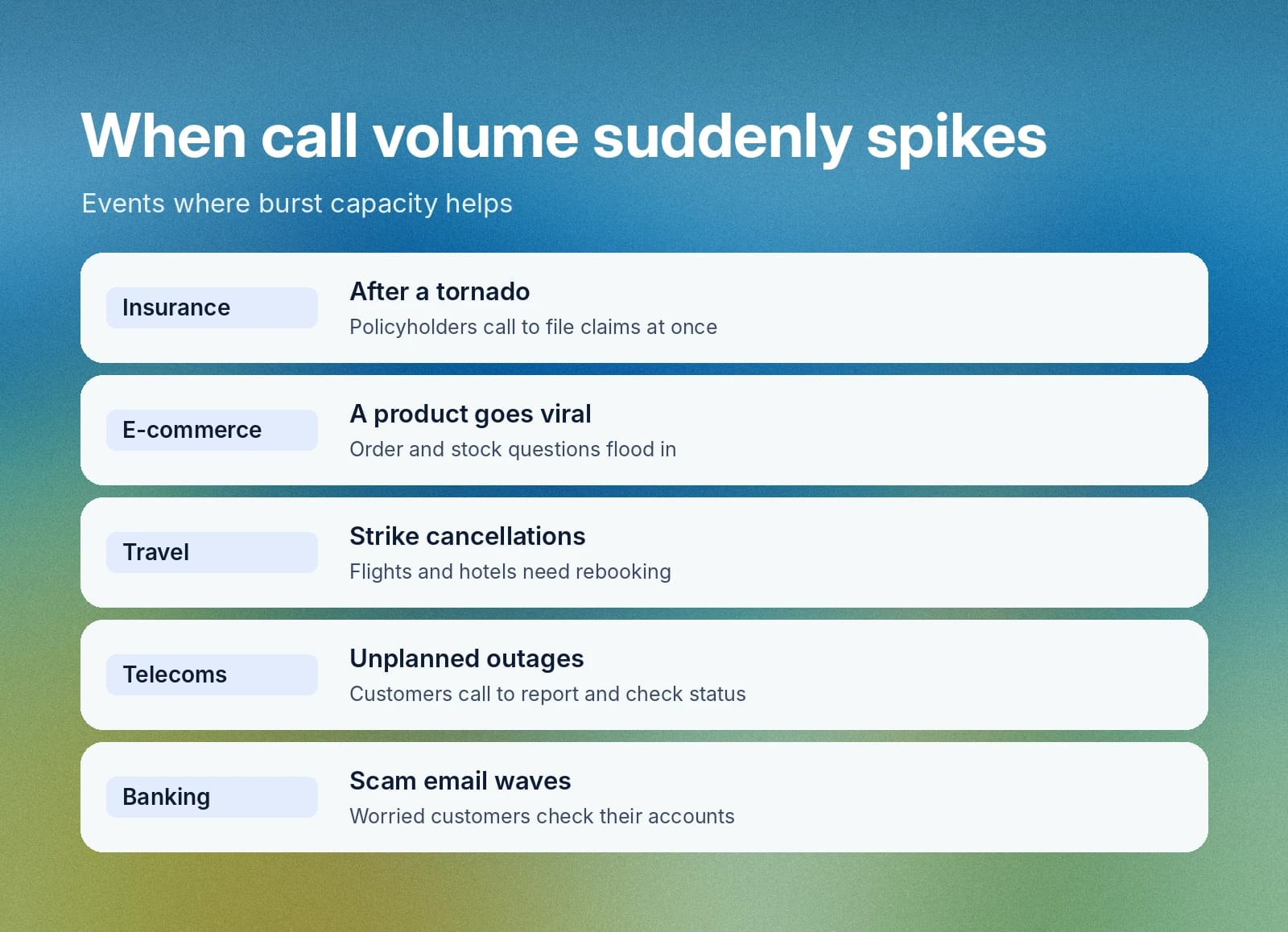
Burst capacity is especially helpful for companies that may experience increased call volumes due to external factors, such as:
- Home insurance companies after a tornado passes through a residential area
- E-commerce retailers when a niche product unexpectedly goes viral
- Airlines and travel agencies after sudden flight or hotel cancellations due to local strikes
- Telecommunications companies after an unplanned outage caused by technical issues
- Banks after a spoofed email from scammers telling customers their accounts are frozen for fraud
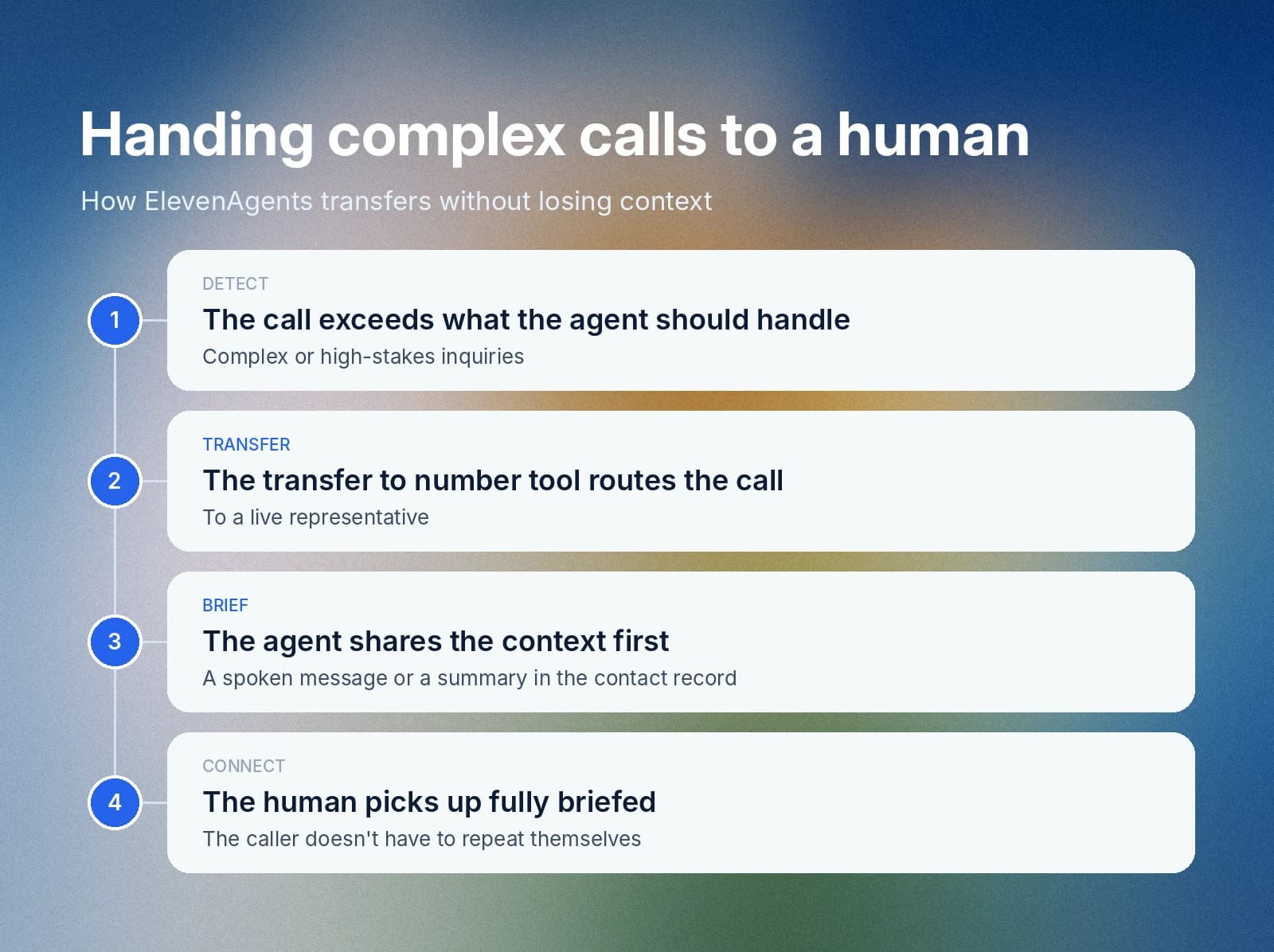
When complex inquiries exceed automated workflow capacity, ElevenAgents can transfer calls to live representatives using the transfer to number tool.
With native Twilio integrations, the agent can speak a short message to the human operator before connecting them to the caller, so the customer doesn't have to repeat themselves. For setups such as Amazon Connect, a webhook tool can write a conversation summary to a contact attribute right before the transfer.
How AI voice agent pricing per minute relates to capacity
ElevenAgents ties subscription tiers directly to concurrency limits and includes call minutes without charging per-line fees. Your subscription tier creates a baseline call capacity, whether that’s four free concurrent lines or 40 on the Business plan.
For those on the enterprise tier, you can expand call line allocations to handle even greater call volumes. Additional minutes cost $0.08 per minute on every paid tier. LLM and telephony costs are billed separately at cost based on usage.
Review our AI voice agent pricing guide for full plan details.
ElevenAgents Tiers
Price per month
Call minutes included
Number of concurrent calls
Free
$0
15 minutes
4 concurrent calls
Starter
$6
75 minutes
6 concurrent calls
Creator
$22
275 minutes
10 concurrent calls
Pro
$99
1,238 minutes
20 concurrent calls
Scale
$299
3,738 minutes
30 concurrent calls
Business
$990
12,375 minutes
40 concurrent calls
Enterprise
Custom pricing
Higher limits on minutes
Higher concurrency limits
Selecting the right plan tier makes your spend easier to forecast and helps maintain line availability when call spikes occur. You’ll also reduce the risk of paying for unused infrastructure if your plan matches your real-world usage.
What AI voice agents can and cannot do on phone calls
Your AI voice agents hold conversations with customers at scale, reducing burden on your human staff and helping to improve the reliability of your contact center operations.
There are various services that AI voice agents handle in a call center:
- Inbound call handling: Receiving and fielding incoming support calls and resolving routine customer queries
- Lead qualification: Asking qualifying questions and scoring prospective customers in real time
- Appointment scheduling: Setting up, confirming, and making changes to calendar appointments
- System integration: Using tool calling to update CRM contact records, creating support tickets, and triggering webhooks mid-call
- Outbound outreach: Sending automated payment reminders, re-engagement, and customer follow-ups via call
AI voice agents should not handle any high-stakes negotiations. Anything that could impact your business more significantly should be routed through a human for their expertise and judgment.
Get started with ElevenAgents for scalable customer calls
Deploying ElevenAgents gives your organization access to scalable infrastructure for high call volumes without paying extra for unused resources. Your team manages this by configuring voice models, knowledge bases, and custom guardrails to match. Salesforce, HubSpot, and Zendesk are available as native integrations, and you can connect other tools through webhooks, Zapier, or MCP servers.
Explore how ElevenAgents optimizes your call management on the platform page or contact sales to start building today.
FAQ

Jack Limebear is on the Growth team, acting as a content writer and strategist across the blog and insights pages. Before ElevenLabs, he spent over a decade leading content strategy for organizations ranging from fast-growing SaaS startups to Fortune 500 companies. He holds a Master's degree in English Literature from the University of Cambridge.