
Conversational AI vs. generative AI: Key differences explained
- Written by
- Jack Limebear
- Published
- Last updated
ListenListen to this article
What is AI to you? For some, the answer might be a personal chatbot you ask questions to. For others, it might be the customer support agent you reach when you call to book an appointment. Both examples may seem like the same thing: something that talks back. Underneath, they run on distinct architecture and are built for different purposes.
Ask your personal chatbot to pull information about a specific account, and it will guess or fail. Ask a customer support AI agent to write a marketing brief for your next ad, and you’ll get something generic, if anything at all. The first is generative AI. The second is conversational AI.
This article explores the differences between these two types of AI, demonstrates where conversational AI vs. generative AI overlap, and outlines how products increasingly use both at once for a more coherent customer experience.
Summary
- Conversational AI refers to tools that hold conversations within a specific context and scope; generative AI produces new content.
- Conversational AI uses natural language understanding and generation to power voice agents and chatbots.
- Generative AI uses large language models (LLMs) and deep learning to produce original images, text, code, videos, and more.
- Conversational AI and generative AI are both categorized as weak AI with limited memory.
What is conversational AI?
Conversational AI describes technology that is able to simulate back-and-forth dialogue with a person via text or voice. Its main purpose is to interact, whether that’s finding out what someone needs or responding to a question. Conversational AI works by mixing natural language understanding, dialogue management, and natural language generation. It typically calls on tools or draws from connected databases to produce responses that are accurate and on-brand for a company.
Modern conversational AI systems use large language models to handle more varied phrasing and unexpected follow-up questions. You especially see these capabilities in conversational AI deployments like customer service AI agents, as they interact with a user, troubleshoot their problem, recommend a solution based on internal information, or escalate the query to a human agent if needed.
What is generative AI?
Generative AI moves away from interpreting and analyzing information toward creating and extrapolating. Instead of identifying information, generative AI models understand the underlying patterns within data and are able to use them to create new content. For example, a text LLM trains on a vast amount of data and learns the statistical relationship between words to establish a plausible pattern to predict the next word or sentence. When prompted, it can draw upon this data and understanding and write new text in response.
These models extend across text, video, audio, images, and code, letting people create content based on natural language prompting. LLMs, built on transformer architecture, handle most of this for text and code, while diffusion models tackle much of the video, image, and audio creation.
Conversational AI vs. generative AI: Key differences
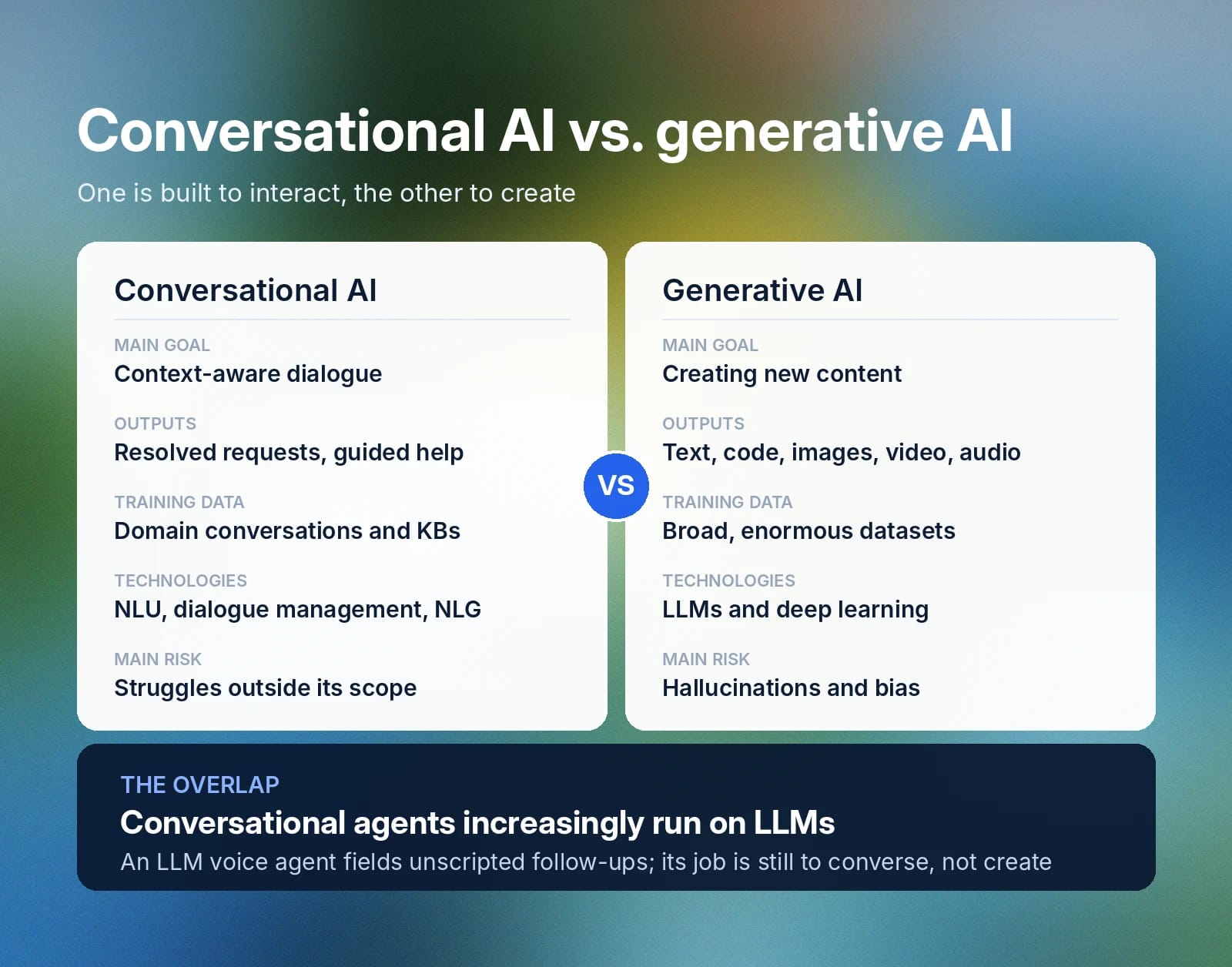
Conversational AI and generative AI are optimized for distinct uses. The former focuses on real-time dialogue and interaction, while the latter is made for producing new content based on natural inputs.
Here’s a full breakdown of the main differences between conversational AI and generative AI:
While these technologies are different, they have begun to overlap more significantly as many conversational AI tools run LLMs that allow them to handle topics beyond their intended scope. A voice agent built on an LLM can hold natural conversation and field follow-up questions beyond a fixed script, the same way a generative AI model manages an unpredictable prompt. But its main job is still to converse accurately, while generative AI’s is to create.
Where do conversational AI and generative AI fit among the types of AI?
AI is typically classified by either capability or functionality. Capability is broadly defined by three categories: weak AI, general AI (Artificial General Intelligence, AGI), and superintelligent AI. The latter group is still theoretical, envisioning a technology that is cognitively far more advanced than humans.
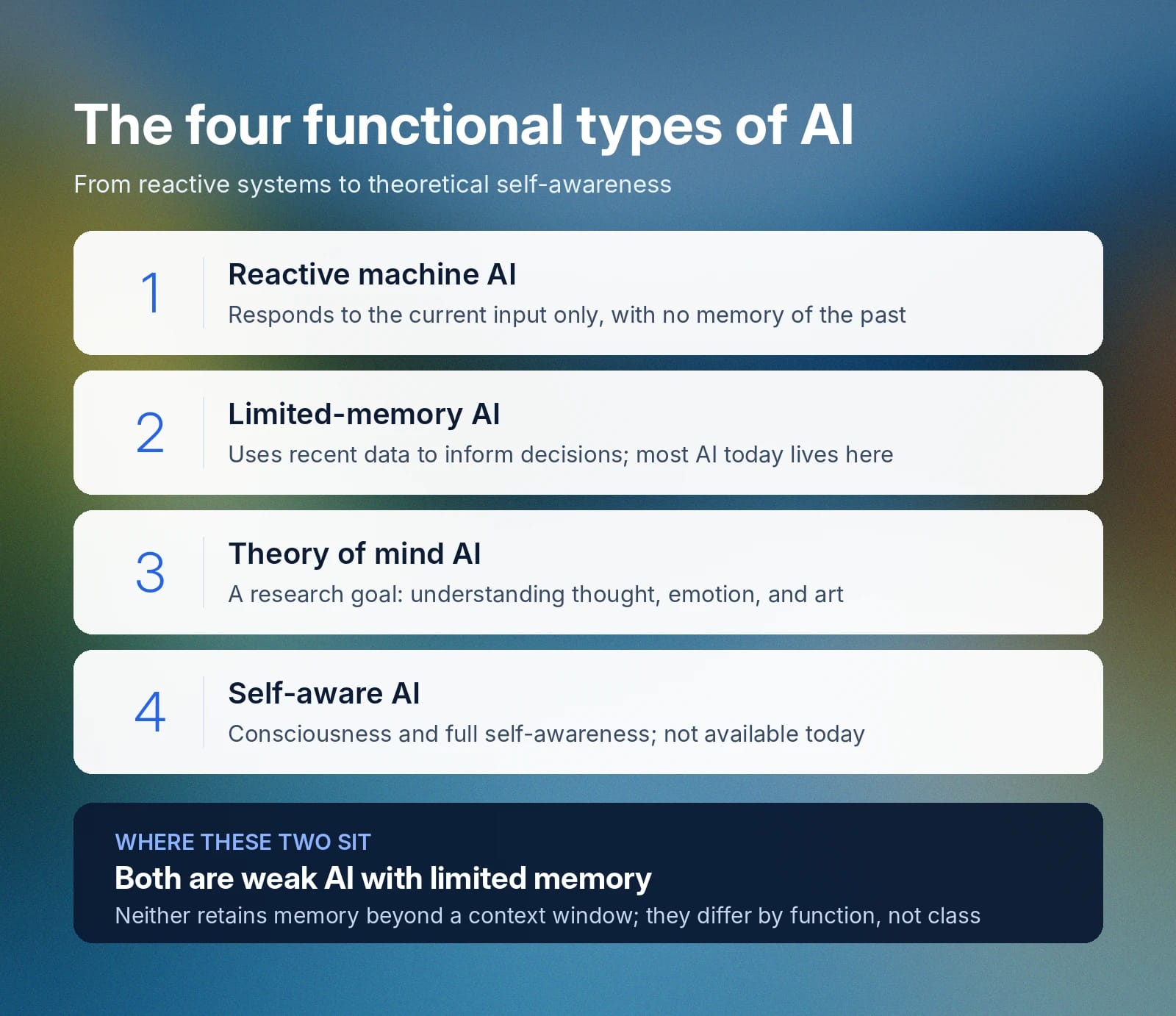
By functionality, AI is split into four groups:
- Reactive machine AI: Reacts to a current input without memory of previous conversations, working only with data that is presently available.
- Limited-memory AI: Uses recent data to inform decision-making, being the group of AI systems that is most commonly used today.
- Theory of mind AI: AI researchers are attempting to build a class of AI that’s able to understand thought and emotion, simulating human understanding of art and responding on an emotive level.
- Self-aware AI: Self-aware AI has its own consciousness and full self-awareness, another category that is possible but not available today.
In terms of capability and functionality, conversational AI would fit into weak AI with limited memory. Generative AI finds itself within those same categories. Neither technology retains memory outside of a defined window of context. Inside these categories, they differ due to their function, as one aims to dialogue with users while the other is for creating content.
Choosing the right AI for your business goal
Choosing between conversational AI and generative AI comes down to the main task you want to achieve. If you need to resolve a high volume of incoming requests, like users that need to find information or check on their orders, then conversational AI is the natural choice.
If you’re looking to produce new content, whether for a personalized marketing campaign or localized content, then generative AI is the better fit.
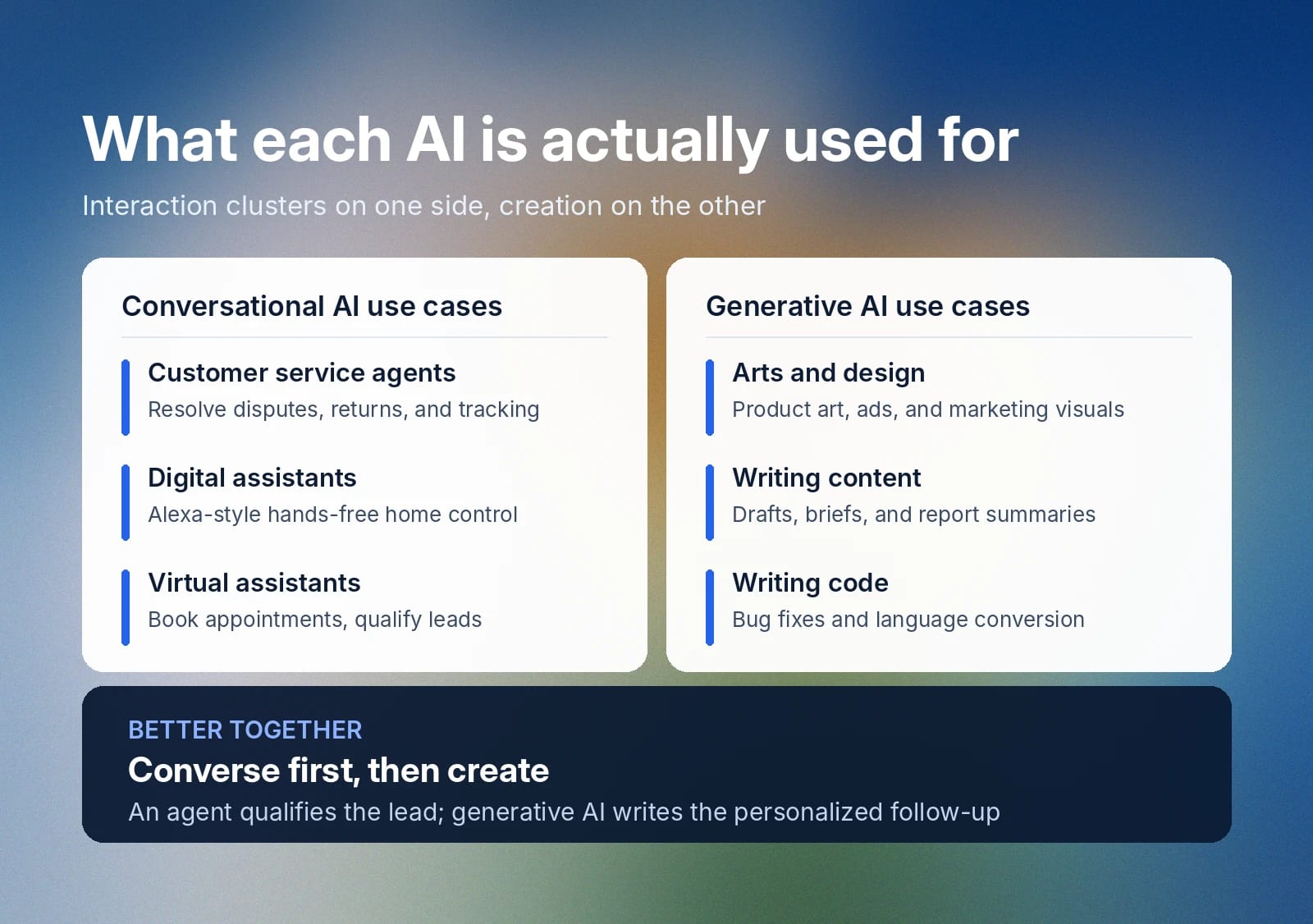
Of course, these tools don't need to run in isolation. You can combine different AI models within a workflow. For example, you could use conversational AI to interact with an incoming lead and implement generative AI to produce a personalized follow-up proposal for them as a result of your conversation.
Use cases of conversational AI
Conventional AI use cases typically cluster around supporting users or providing a specific service.
Here are a few common examples:
- Customer service agents: Voice and chat agents can resolve incoming customer disputes, answer questions related to your internal documents, process order returns or updates, and provide tracking information without having to loop in a human agent.
- Digital assistants: Consumer devices, especially Alexa and Google Home, have become popular in-home systems that people use to handle hands-free tasks like turning off lights, playing music, setting reminders, or controlling other connected smart devices.
- Virtual assistants: Business agents can manage workflows like receiving a customer call and booking an appointment for them or qualifying a sales lead before a rep gets involved.
Here’s an example of a conversational AI agent that qualifies leads in real time.
Try our AI lead qualification agent
Handle inbound screening and lead scoring automatically
Generative AI use cases
The main use cases of generative AI stem from its ability to produce novel content from your prompts. For example:
- Arts and design: Generate art for a product, build out entire ads from a prompt, make a poster for your upcoming show, and create marketing visuals.
- Writing content: Draft ideas, brainstorm copy for a newspaper campaign, quickly summarize an internal report, and write a content brief.
- Writing code: Identify bugs and write fixes, create new tools with a few prompts, or convert code from one language to another in a fraction of the time it would take manually.
Get started with ElevenAgents for conversational AI solutions
ElevenAgents allows teams to build complex conversational AI voice agents that handle entire workflows. Teams can deploy agents to support enterprise use cases, such as handling customer intake, qualifying inbound leads, resolving support tickets, and automating customer service systems.
Discover more about ElevenAgents or sign up to build a conversational AI agent for your business.
Frequently asked questions about conversational AI vs. generative AI

Jack Limebear is on the Growth team, acting as a content writer and strategist across the blog and insights pages. Before ElevenLabs, he spent over a decade leading content strategy for organizations ranging from fast-growing SaaS startups to Fortune 500 companies. He holds a Master's degree in English Literature from the University of Cambridge.