
Neural text to speech (TTS) explained: How AI voices work
- Written by
- Jack Limebear
- Published
- Last updated
ListenListen to this article
Neural text to speech (TTS) is the technology that underpins the AI voices you hear everywhere. The little button on your news website that reads out your article. Automated support calls. Video narration on sites like TikTok and YouTube. The list goes on. Neural TTS replaced traditional, robotic forms of text to speech.
The TTS market passed $4.8 billion in 2026 and is growing at a compound annual growth rate (CAGR) of 22.4%, exploding year over year as more use cases hit the market and creators and businesses alike flock to this technology.
This guide explains what neural text to speech is and why it’s central to the rapid growth of this industry. We’ll touch on how it differs from traditional TTS and what you should look for when integrating a TTS API into your applications.
Summary
- Neural text to speech uses deep learning to generate speech from scratch.
- Neural voices capture prosody, intonation, stress patterns, and rhythm to build up context of what a human voice sounds like.
- Traditional concatenative and parametric TTS still exists in legacy systems, but neural synthesis has replaced it wherever voice quality matters.
- Developers can integrate neural TTS through APIs, with streaming latency now low enough for real-time conversation.
What is neural text to speech?
Neural text to speech (neural TTS) is a form of speech synthesis that uses deep neural networks to produce human-sounding speech. A neural network in artificial intelligence is made of layers of interconnected processing units, named as such due to loosely resembling the neural network in human brains.
Earlier text to speech models relied on handwritten rules and recorded audio fragments to map out language and develop the ability to produce speech from text samples. A neural TTS model derives its own rules, learning from context to tackle more challenging parts of speech, like where to pause or which word to stress in a sentence.
Elements like an understanding of prosody and emotion set a neural TTS apart from traditional models.
How neural TTS works: technology overview
On the surface, a neural TTS converts text to audio while preserving the features that carry meaning: pronunciation, emotional intent, rhythm, emphasis, and tone. Under the surface, there is a pipeline of models working together to transform text into human-sounding speech.
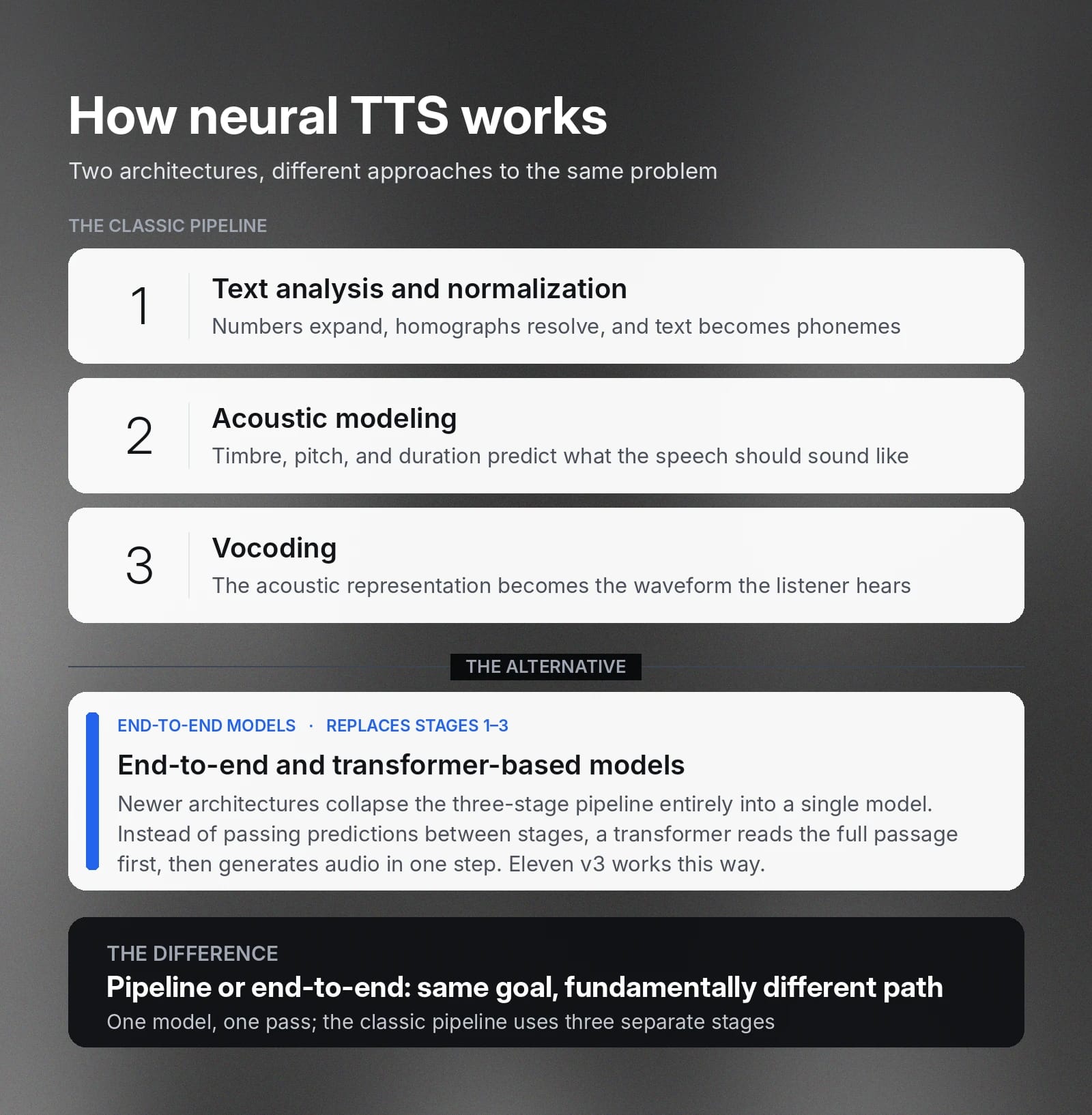
While the exact architectures vary across different providers, neural TTS typically has the following core stages.
Text analysis
Written text is full of ambiguity. There’s a famous example sentence in English where stressing a different word across the phrase changes its meaning: “I didn't say he stole the money.” Stress "I," and you suggest someone else said it. Stress “he,” and you suggest someone else stole it. Stress “money,” and suddenly something else was stolen.
Text analysis solves this ambiguity before generating audio. It expands abbreviations and converts common text elements (dates, numbers, symbols, etc.) into spoken forms. Homographs like “read,” “lead,” and “bass” will be identified and pronounced correctly depending on the context of the wider sentence. It also predicts prosodic markup, locating which words carry the most weight. The acoustic model renders that markup in the next stage.
Normalized text is then converted into individual phonemes in a process called grapheme-to-phoneme conversion. This step helps make sure the final audio is stable and correct, even in languages (like English) with notoriously unreliable pronunciation rules.
We’ve written a phoneme guide that breaks down this layer in more depth.
Acoustic modeling
The acoustic model is the neural core of the system, taking the phoneme sequence and predicting what speech should sound like.
There are three main dimensions to the acoustic layer:
- Timbre: The texture that makes a voice recognizable as a specific speaker, sometimes called the “voiceprint” of a person.
- Pitch: The tone contour across a sentence, including the intonation of a phrase and the rise of a question or fall of a statement.
- Duration: How long the model holds each phoneme, which controls the pacing of a sentence and keeps a word like “jump” from becoming “jjjjump.”
Together, these determine the prosody of a sentence. A neural TTS uses these to produce a less robotic reading. By practicing on hours of real speech, the model places pauses and emphasis in a way that resembles human speech. It’s context-based learning that gathers data from training data instead of from specific rules implemented by developers.
Architectures like FastSpeech and Tacotron 2 are pillars of this stage, known for their ability to convert a phoneme sequence into a mel spectrogram. A mel-spectrogram is a map of the audio frequencies over time. These describe speech but aren’t playable audio. They’re simply a digital representation of the sounds.
Vocoding
A vocoder is the final network in a classic pipeline. It converts the acoustic representation we covered above into an actual waveform, which is what the final user hears.
One problem that the industry faced when developing and using vocoders was that they were typically far too slow for use in any real production pipelines. It was only with iterations like HiFi-GAN, which improved on early vocoders like DeepMind's WaveNet, that speeds became fast enough for real production scenarios.
Real-time neural TTS only became possible through innovations in this part of the pipeline.
End-to-end and transformer-based models
Traditional TTS models move through the three stages above to produce audio from text. Newer generations collapse this pipeline entirely. A transformer-based model (which uses the same architecture as large language models) maps text to audio in a single end-to-end process, instead of passing predictions between separate acoustic and vocoder networks.
A pipeline model has to process a sentence at a time, while a transformer reads the entire passage before deciding with that wider context how a line should sound. The same sentence may read completely differently in a comedy compared to a drama.
ElevenLabs models such as Eleven v4 adapt to that nuance and accept inline audio tags like [whispers] or [nervous] to give users more control over how their scripts sound.
Neural text to speech vs. traditional TTS
Before the popularization of neural networks, TTS systems took one of two main approaches. Both of these still surface in legacy IVR menus and screen readers.
These are the two traditional TTS types:
- Concatenative TTS: Recorded a voice actor reading thousands of sentences and cut them up into tiny fragments. When speech needed to be produced, it would stitch fragments together. While individual words might sound human, the seams between each fragment would create a choppy and robotic cadence that people still associate with a computer-generated voice.
- Parametric TTS: Generated audio from a statistical model of speech parameters instead of recordings. It was smaller and more flexible than concatenative synthesis, but the audio has a muffled, buzzy quality because the simplified model discarded the fine detail of real speech.
By contrast, neural TTS generates the complete waveform from a learned model of speech, removing both failure modes at once.
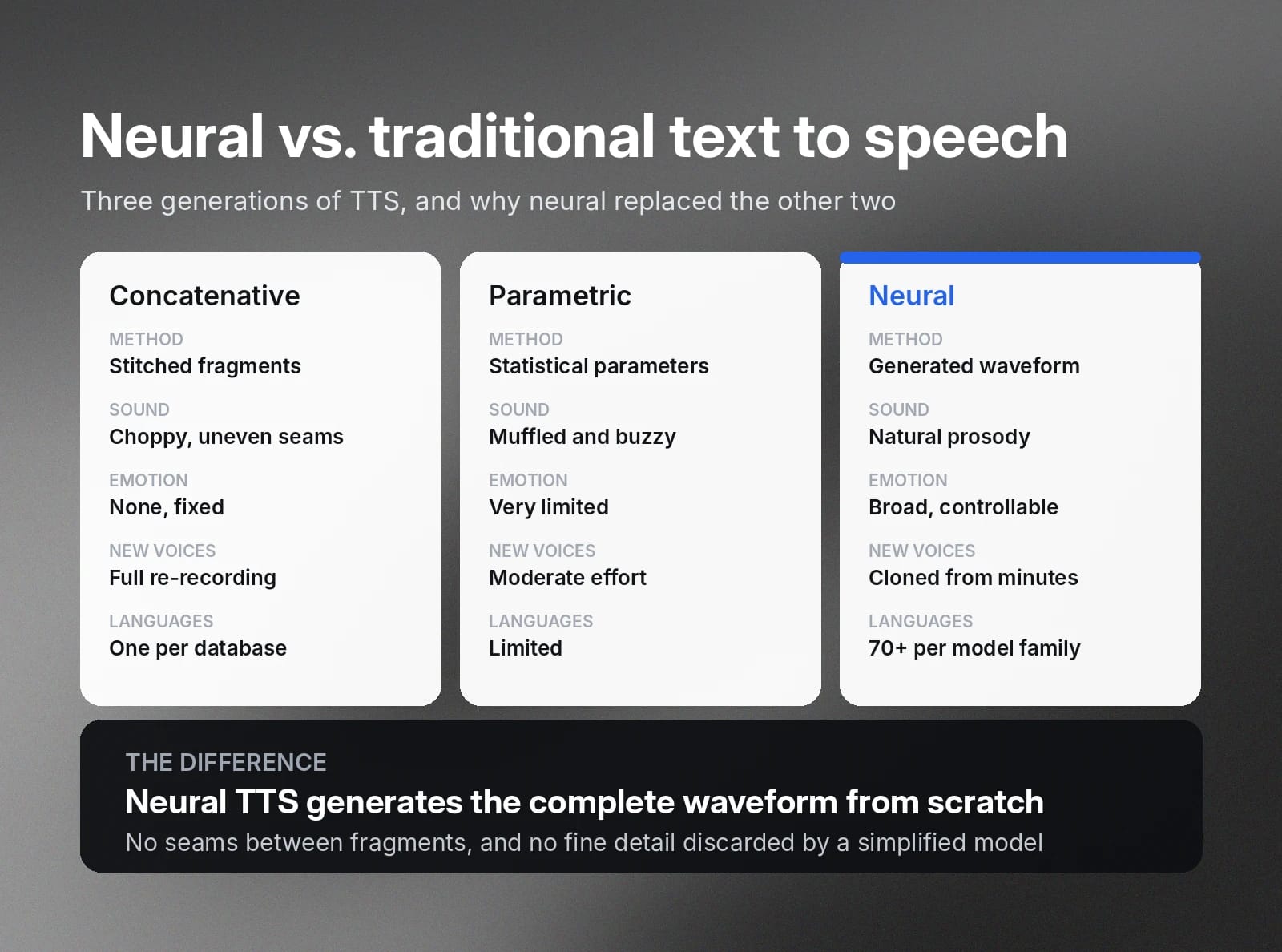
Here’s how neural text to speech compares to traditional TTS across the board.
Key features and benefits of neural TTS
The smooth, human-sounding audio of neural TTS enables a number of use cases while the jump in naturalness unlocks new capabilities that weren’t possible in traditional TTS.
Here are some of the main features and benefits of neural text to speech:
- Natural prosody: Voices place stress, pauses, and intonation the way a human speaker would, which keeps listeners engaged across long-form content instead of frustrating or fatiguing them.
- Emotional expression: Modern models can deliver expressive speech, whether dramatic monologues or calm readings. With Eleven v4, writers direct this through audio tags that you write directly into the script.
- Voice cloning: A neural model learns a specific speaker’s timbre and style from a short sample. You can use Voice Cloning (whether Instant or Professional) to maintain a consistent voice across all of your TTS deployments.
- Multilingual reach: A neural model can speak dozens of languages, with a voice clone carrying identity across each of them. A brand can leverage this to make sure its chosen voice sounds the same in London as it does in Rome.
- Real-time speed: A neural text to speech model can synthesize speech faster than it plays back, with streaming latency being low enough for live conversation.
- Scale: After training a neural TTS, a voice could narrate millions of words, including new product names and descriptions, with ease, dramatically cutting down studio recording costs.
Across the board, neural text to speech dramatically changes how TTS as a whole functions. With that shift comes new opportunities for accessibility, business, reach, and emotive expression.
Top use cases for neural TTS solutions
By changing how the fundamental architecture of a text to speech model works, its improvements to speed and delivery facilitate a range of new use cases.
Here are some of the applications where it delivers most value today.
Conversational AI and voice agents
Customer support agents, virtual receptionists, phone-based assistants, and AI SDRs all rely on voices that sound trustworthy and respond nearly instantly.
Conversational AI is the most demanding use case for neural TTS, combining the highest quality bar with the strictest latency budgets.
Audiobooks and publishing
Neural narration makes it economical to produce audio editions of back-catalog titles that normally would never justify studio recording costs. You can generate a full audiobook in hours with neural Text to Speech.
ElevenCreative makes that as easy as possible, with the Character Casting automatically finding the best voices for a character and populating their lines across an entire manuscript.
Gaming and interactive media
Dynamic dialogue, procedurally generated content, and NPC conversations are enormous projects when recorded manually in a studio. Neural TTS lets studios voice them at scale, fixing mistakes by editing text rather than billing more studio hours.
Localization and dubbing
Neural TTS combined with translation carries video and audio content into new markets, all while preserving the original speaker’s vocal identity.
A creator’s audience in Medellín hears the same recognizable voice as the one in Boston, just speaking Spanish.
How to integrate neural text to speech with your application
For developers, neural TTS is just an API call away.
Here’s a complete example that converts text into speech with ElevenAPI using the Python SDK.
The same endpoint is available over REST or through SDKs from Python, JavaScript, and other languages. There are three integration patterns that cover most applications:
- Batch synthesis: Send text, receive a complete audio file. This fits pre-produced content across articles, IVR prompts, audiobooks, and videos.
- HTTP streaming: Audio chunks arrive as they’re generated, so playback starts before synthesis finishes. Use this for reading through long documents or generating podcast-style content on demand.
- WebSocket streaming: For conversational agents, a persistent WebSocket connection accepts text incrementally, such as tokens streaming out of an LLM, and returns audio with the lowest possible latency.
Production integrations also need retry logic, request timeouts, and sensible error handling. For more information, we’ve written a Text to Speech API integration patterns guide.
Choosing a Text to Speech API: What to look for
While Text to Speech APIs may seem similar, there are an enormous number of features under the surface which may make one better than another for your particular use case.
While not an exhaustive list, this is what you should look for in a TTS API:
- Audio quality: Above all else, if the audio that arrives from a neural TTS API doesn’t sound good, the provider isn’t right for you. Run blind listening tests, especially on long-form narration, as that’s where the cracks are likely to show.
- Latency: For conversational AI pipelines or applications, look at time to first byte. Regional infrastructure matters here too. We were able to cut global API latency by up to 40% by routing traffic through data centers closer to users.
- Streaming support: Check whether both HTTP and WebSocket streaming exist and are documented. Batch-only APIs rule out real-time use cases entirely.
- Language and voice coverage: Look for neural text to speech APIs that have wide language coverage, especially in the languages you need routinely in your apps.
- Expressive control: Look for direction tools that let you customize how a neural TTS sounds in practice. ElevenLabs audio tags give granular control over speech.
- Speaker similarity: If you’re using voice cloning, check how closely the model preserves a cloned voice’s delivery and prosody across a longer passage. Scripts with more characters may degrade over time, making the voice sound different from the original sample.
- Licensing and ethics: Confirm you receive commercial rights to the output, and review how the provider handles things like voice consent, data retention, and misuse prevention. Enterprise buyers should ask about SOC 2 compliance and third-party AI safety certification (like the AIUC-1 and ISO 42001).
- Documentation and developer experience: An hour combing through developer docs will tell you everything you need to know about how comprehensive a product is. Stick to docs and advice from engineers over sales pitches.
- Pricing model: Many APIs charge per character/credit. Model your monthly volume and compare tiers at that number rather than the entry price.
Get started with ElevenAPI for high-quality neural TTS
ElevenAPI gives developers direct access to the neural Text to Speech models behind ElevenLabs, with 90+ languages and thousands of voices. We provide HTTP streaming and WebSocket support, as well as low latency that’s built for real-time conversation.
Explore the Text to Speech API product page to hear the models or sign up and create a free API key to get started.
FAQ

Jack Limebear is on the Growth team, acting as a content writer and strategist across the blog and insights pages. Before ElevenLabs, he spent over a decade leading content strategy for organizations ranging from fast-growing SaaS startups to Fortune 500 companies. He holds a Master's degree in English Literature from the University of Cambridge.