
How teams use conversational AI in healthcare (with results)
- Written by
- Jack Limebear
- Published
- Last updated
ListenListen to this article
Conversational AI in healthcare handles the routine patient conversations that consume staff time. From scheduling and intake to follow-ups, after-hours support, and post-call documentation, AI agents take on the high-volume work that keeps phones ringing and inboxes full.
Instead of routing every call to the front desk, organizations deploy healthcare AI voice agents to resolve common requests automatically, only escalating to staff when a situation needs human judgment.
This guide covers how conversational AI works in healthcare, five use cases with deployment results, what a successful rollout requires, and how to evaluate platforms for your healthcare AI agent.
Summary
- Conversational AI helps healthcare organizations handle routine patient communication, including scheduling, intake, follow-ups, and support calls.
- Agents work as one layer of a wider healthcare support system, resolving routine conversations on their own and handing off to staff with full context when human judgment is needed.
- Healthcare AI can handle data-sensitive tasks, including those involving protected health information (PHI), as long as the right safeguards are in place.
- ElevenAgents supports healthcare use cases with HIPAA-eligible configurations, Business Associate Agreements (BAAs), Zero Retention Mode, knowledge bases, tool calls, and voice customization.
What is conversational AI in healthcare?
Conversational AI in healthcare is software that handles routine patient interactions autonomously, using approved knowledge sources and connected systems to answer questions, complete tasks, and route patients to the right place.
Unlike traditional phone menus and rule-based chatbots, conversational AI lets patients speak in their own words. Responsive pacing and a warm, human-sounding voice make the exchange feel close to a real conversation, and emotionally aware agents can pick up on a patient's tone and adjust their delivery in response.
This emotional awareness matters in healthcare, where conversations are rarely routine for the patient on the other end. Someone calling about a diagnosis, a billing problem, or an urgent symptom may be anxious or distressed, and a conversational AI system that can read that tone and respond calmly makes a real difference.
Security and compliance are also central in healthcare automation. Patient conversations often involve sensitive data, while healthcare organizations must meet compliance requirements and 24/7 patient expectations for scheduling and administrative support. Any AI system used in this context needs to handle all interactions reliably without disrupting existing clinical workflows.
Where conversational AI fits in the patient experience
Conversational AI works best as a first layer for inbound patient communication, handling high-volume administrative requests and routine tasks, like appointments, form questions, and care instructions, before they reach the front desk.
Healthcare organizations are adopting conversational AI because it helps address several common operational challenges at once.
- 24/7 availability: Provides answers, appointment scheduling, and routine task completion outside standard business hours, including evenings, weekends, and holidays.
- Reduced administrative burden: Automates high-volume, routine inquiries so staff can focus on clinical questions that require medical judgment, sensitive patient concerns, and urgent situations.
- Shorter wait times: Answers routine questions in real time or routes more complex issues to the right staff member.
- Multilingual support: Communicates with patients in multiple languages without requiring separate support teams for every language served.
- Scalable patient communication: Manages large volumes of conversations at the same time, helping organizations maintain service levels during seasonal spikes, outreach campaigns, or rapid growth.
What are the top use cases for conversational AI in healthcare?
Instead of just routing calls or taking down a name, modern conversational AI can connect directly to healthcare systems such as electronic health records (EHRs), scheduling platforms, patient databases, and CRM tools to get things done.
Here are five ways healthcare teams are using conversational AI right now:
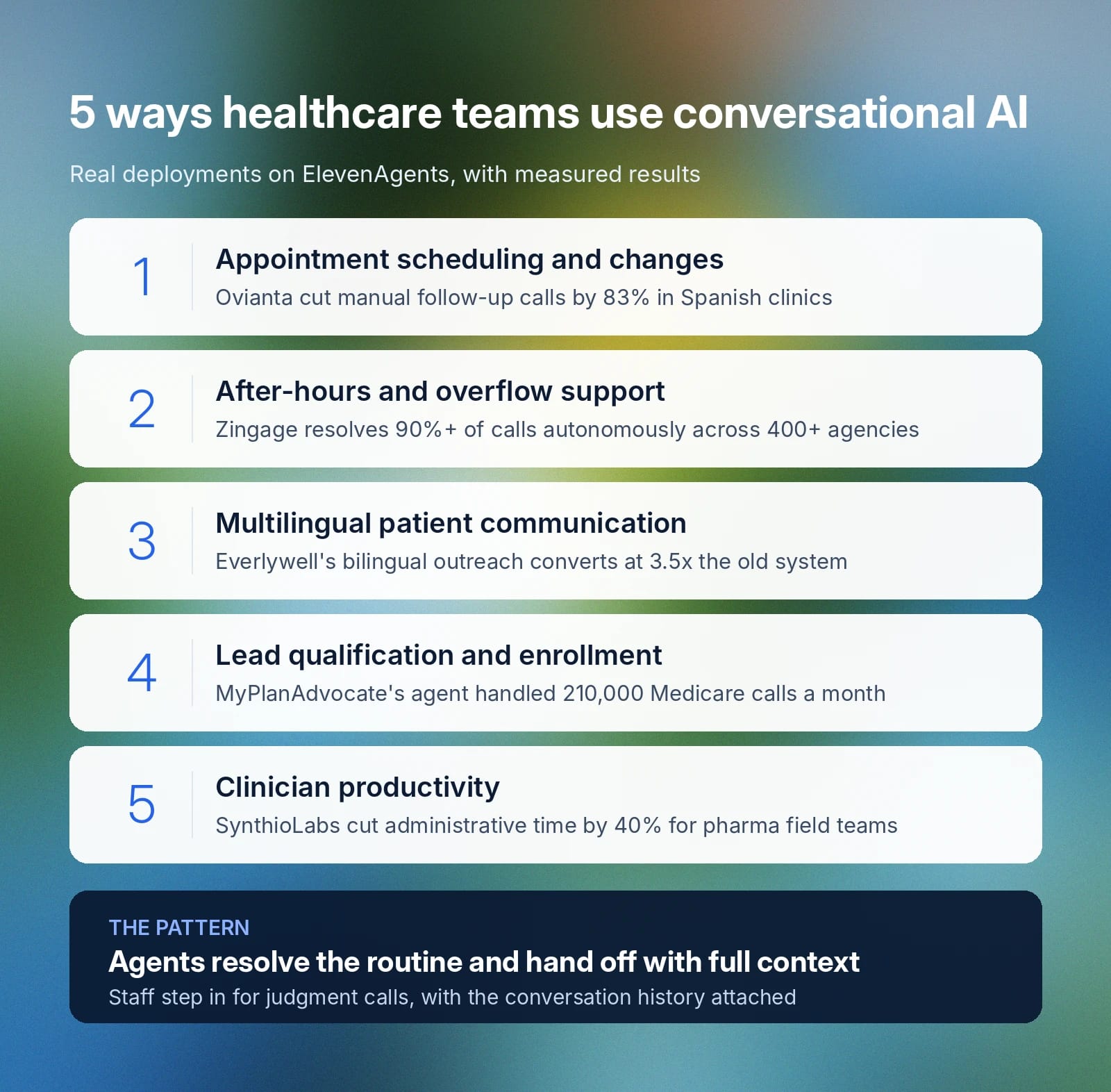
1. Appointment scheduling and changes
Conversational AI can help clinics follow up after an appointment, consultation, or treatment proposal without relying on staff to make every call manually. The agent can contact patients, answer basic questions, address common concerns, and reconnect them with the clinic team when they’re ready to take the next step.
Ovianta uses AI voice agents for outbound patient follow-up in Spain, where clinics need voice agents that can speak with the right regional accent and tone. For treatment proposal follow-ups, Ovianta reported a 68% patient engagement rate, an 83% reduction in manual follow-up calls by clinic staff, and a 25% increase in treatment conversion after follow-up.
2. After-hours and overflow support
After-hours and overflow calls often involve time-sensitive requests, such as schedule changes, caregiver callouts, or urgent care questions that can’t wait until the next business day. If those calls go unanswered, patients may wait longer for help, and staff may start the next shift with unresolved issues.
Zingage supports more than 400 home care agencies with voice agents that handle routine inbound and outbound calls around the clock while routing urgent cases to the right person. Since deploying ElevenAgents, Zingage has scaled call volume by 3x and resolved more than 90% of calls autonomously, with human escalation for cases that need staff involvement.
3. Multilingual patient communication
Multilingual systems allow healthcare organizations to communicate with patients in their preferred language, so they can accurately describe their issues and fully understand the next steps. Eliminating communication barriers in this way reduces delays and helps make healthcare services more accessible.
For example, Everlywell launched Eva, its AI health companion, to support personalized health outreach in English and Spanish, including reminders about eligible screenings and services. Compared with traditional automated phone systems, Everlywell reported a 10% improvement in screening completion and 3.5x higher conversion rates among Spanish-speaking members.
4. Lead qualification and enrollment
In healthcare and insurance, "leads" are typically prospective patients or consumers looking to enroll in a specific health plan or care program. Conversational AI qualifies these callers by verifying baseline eligibility criteria, such as age, location, or current insurance coverage, before routing them to a licensed agent. This screening ensures that staff spend their time exclusively on callers who meet the necessary prerequisites for the service.
MyPlanAdvocate uses AI voice agents during the Medicare Annual Enrollment Period, when inbound call volume rises sharply over a short window. The agent verifies Medicare eligibility before transferring qualified callers to licensed representatives. During that enrollment period, MyPlanAdvocate’s AI agent handled about 210,000 calls per month, and calls that reached licensed agents after AI pre-qualification converted at 2x the historical baseline.
5. Clinician productivity
Conversational AI can improve productivity around complex medical and pharmaceutical conversations by reducing the administrative work that follows them. Instead of spending hours on manual data entry, teams can use AI agents to summarize discussions about drug efficacy, clinical trial data, or treatment protocols. The system can then turn those summaries into structured notes, follow-up actions, and CRM updates for review.
SynthioLabs uses Jarvis, its voice-driven copilot, to help pharma field teams and medical science liaisons plan outreach, retrieve scientific information, and create structured post-call notes. Since adopting ElevenLabs, SynthioLabs reported a 40% reduction in administrative time, 30% more interactions with healthcare professionals, and a 6x improvement in note and insight quality.
What a successful healthcare deployment requires
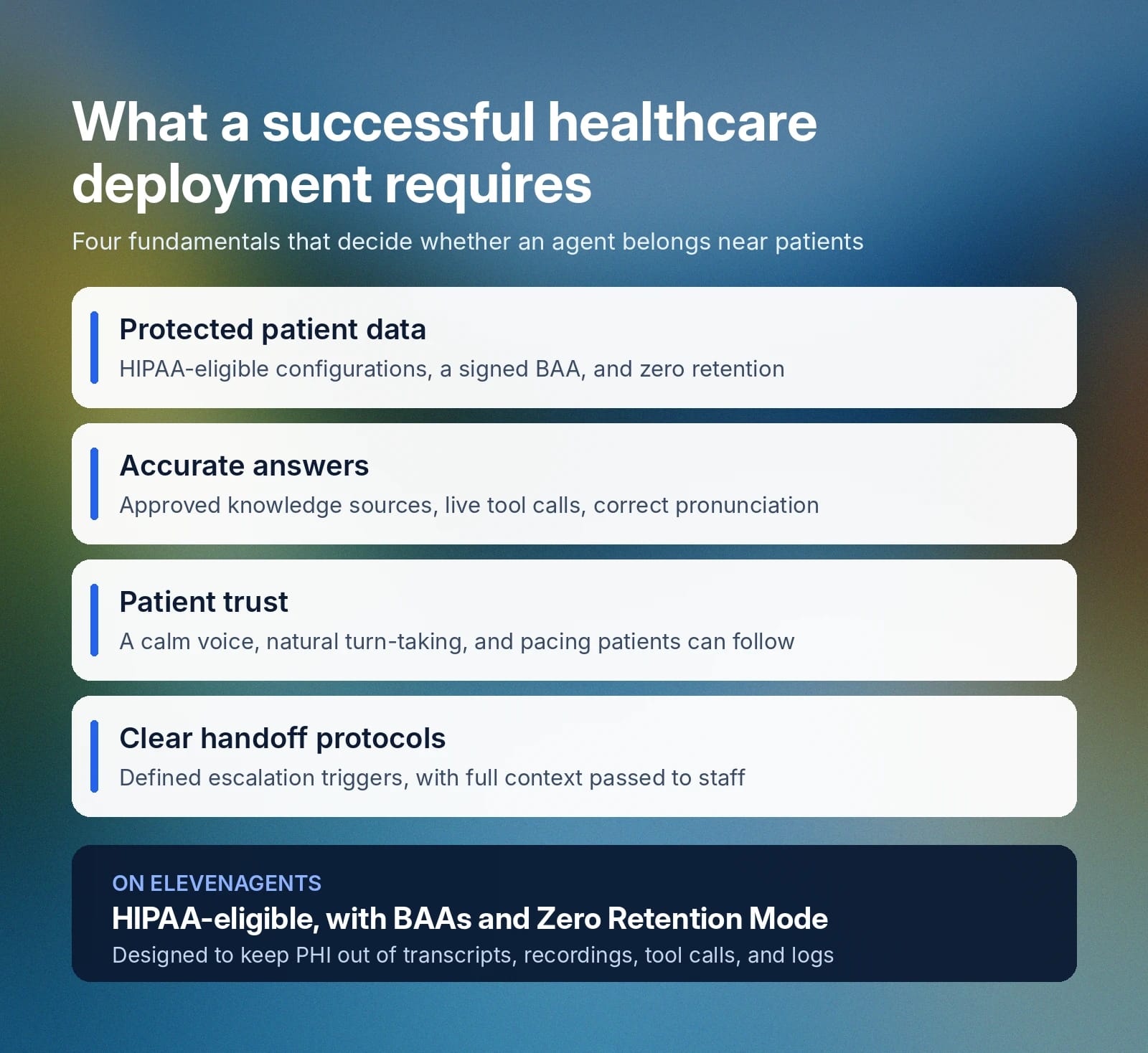
Successful healthcare deployments get four fundamentals right: protecting patient data, keeping answers accurate, building patient trust, and designing clean handoffs to staff. Here’s a closer look at what each one requires.
Protected patient data
To safely handle PHI, an AI platform needs HIPAA-eligible configurations and a signed BAA to establish legal accountability. However, legal frameworks alone don’t eliminate data security risks. Organizations also need strict technical safeguards, such as zero-retention architecture, to ensure that sensitive call transcripts and audio recordings are never stored on a vendor's servers, where they could become a liability.
ElevenAgents is HIPAA-eligible, with BAAs available and Zero Retention Mode designed to prevent PHI from being stored or logged anywhere in the system. For healthcare teams, this helps reduce the risk of sensitive patient data being retained in transcripts, audio recordings, tool calls, analytics, or system logs. You can read the ElevenLabs HIPAA & Legal Docs to see how this is built.
Accurate answers
Accuracy carries real weight in healthcare, where a wrong answer about a medication, policy, or appointment can put a patient at risk. Keeping conversational AI reliable comes down to three safeguards:
- Approved sources only: A verified knowledge base grounds the AI in your own documents, URLs, and policies instead of open-ended model knowledge.
- Live data on demand: Tool calls pull current information from EHR and scheduling systems, so the agent works with accurate availability and patient details rather than guesses.
- Correct pronunciation: Pronunciation dictionaries help the agent handle medical jargon, provider names, and medication names that voice models often mishear.
ElevenAgents supports all three: a verified knowledge base, tool calls that connect to live systems, and pronunciation dictionaries for specialized terminology.
Patient trust
In healthcare, a voice agent needs to feel calm, clear, and easy to follow, because patients may be calling about sensitive or stressful issues.
ElevenAgents gives you a library of more than 10,000 voices to match the tone your patients expect, or you can clone a specific voice of your own. Either way, your conversational AI sounds right for your practice and puts patients at ease. And with support for 90+ languages, including regional accents, you can interact with patients in the language they're most comfortable with.
Another crucial factor in building trust is to get the timing of conversations correct. Patients can tell when a conversation feels off, especially when the AI agent talks over them or leaves an awkward gap before replying. To get around this problem, ElevenAgents uses a turn-taking model that handles the natural rhythm of conversation, detecting interruptions, pauses, and when a patient has finished speaking, so the exchange feels like a real back-and-forth.
You can fine-tune pacing further through conversation flow controls to allow for shorter or longer pauses depending on your needs. For example, you can give patients extra time when they're reading out an insurance number or date of birth.
Clear handoff protocols
Conversational AI is often best used as one part of your wider patient communication strategy, not a replacement for it. Integrating it comes down to clean handoffs between the AI and your human staff. Handled right, the two operate in tandem: the agent takes what it can, and a person steps in when a situation calls for human judgment.
ElevenAgents lets teams define human handoff rules before launch through the Agent Workflows settings. Using this feature, even non-technical team members can set how these handoffs work, down to the criteria the AI agent uses to decide when to hand off. Common triggers include urgent medical concerns, patient distress, out-of-scope clinical questions, repeated confusion, or requests that require staff judgment.
The escalation flow also transfers the conversation's context to the incoming staff member, so patients don’t have to repeat themselves.
How to evaluate conversational AI platforms for healthcare
Choosing a conversational AI platform for your healthcare organization requires you to review data security alongside conversational accuracy. To verify that an AI agent can support your daily operations while reducing compliance risk, look for confirmed privacy protections, system integrations, natural dialogue mechanics, and clear escalation rules.
The table below outlines the criteria to use during your software reviews.
When reviewing platforms, test the agent in a live conversation rather than relying on polished voice samples or edited demos. During the test:
- Ask the kinds of questions patients are likely to ask.
- Interrupt the agent.
- Pause mid-sentence.
- See how it handles everyday speech.
Live voice testing gives you a clearer view of how the agent will perform in real conversations before patients start using it.
Getting started with conversational AI in healthcare with ElevenAgents
Deploying conversational AI in healthcare is more involved than in most industries. You have HIPAA obligations to meet, protected health information to safeguard, and an agent that needs to understand your specific protocols, providers, and patient policies before it can be useful.
ElevenAgents is built for exactly these kinds of complex use cases. We offer HIPAA-eligible configurations and Zero Retention Mode for compliance, verified knowledge bases and tool calls to ground the agent in your own systems, and configurable handoffs for the moments that need a person.
Plus, we've made it easy to get started. To jump in and build now, start from an agent template preconfigured for healthcare-specific use cases. Or, for more complex enterprise build-outs, talk to our team about Forward Deployed Engineers who can scope, build, and launch production-ready agents alongside your team.
Conversational AI in healthcare FAQ

Jack Limebear is on the Growth team, acting as a content writer and strategist across the blog and insights pages. Before ElevenLabs, he spent over a decade leading content strategy for organizations ranging from fast-growing SaaS startups to Fortune 500 companies. He holds a Master's degree in English Literature from the University of Cambridge.