
Agent-to-agent communication: How AI agents work together
- Written by
- Jack Limebear
- Published
ListenListen to this article
Agent-to-agent communication is a structured process for AI agents to communicate and collaborate on requests from human users and systems. The Agent2Agent (A2A) protocol, also known as the agent-to-agent protocol, is the primary open standard for this operation.
The Model Context Protocol (MCP) is a similar open standard, but designed for connecting AI agents to external tools and data repositories through a universal interface. MCP helps customer service agents access the knowledge bases, CRM systems, booking systems, and other tools necessary to facilitate front-line contacts.
Summary
- Agent-to-agent communication helps agents communicate with each other, discover each other’s capabilities, and solve complex, multi-step problems for users. Direct communication reduces the need for slow, human intervention between steps. Open standards such as A2A and MCP also help avoid the M x N integration problem, where M agents each need custom connections to N external tools.
- Agentic AI is an approach to giving artificial intelligence autonomy to take real-world actions. An AI agent is a specific implementation of that approach.
- A2A is the primary agent-to-agent communication protocol. A2A allows agents to collaborate directly. MCP is a complementary protocol that allows agents to access external tools and data. They are regularly used together.
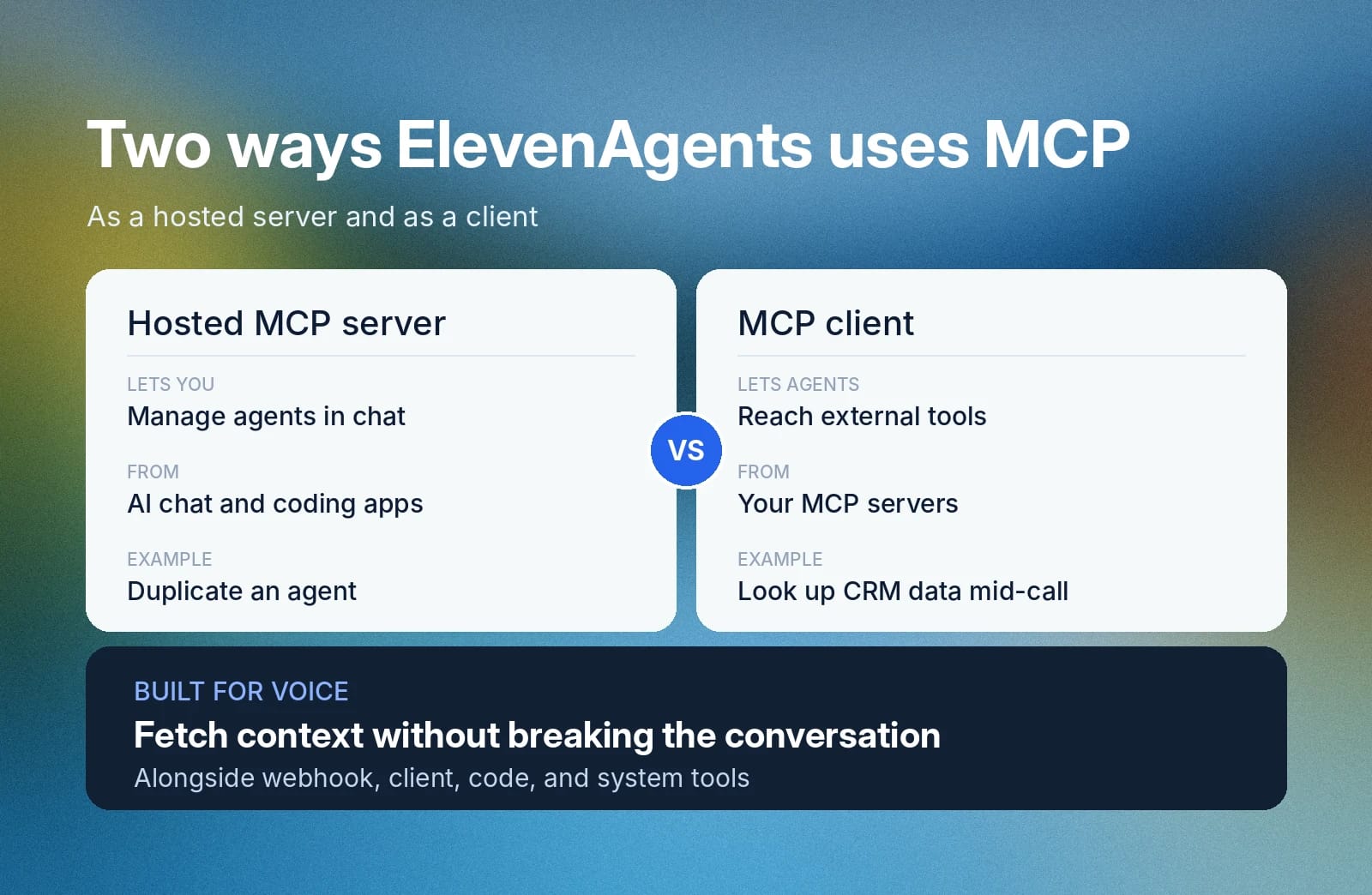
- ElevenAgents supports MCP both as a hosted server and as a client, and handles multi-agent handoffs natively through agent transfer and Workflows. As a server, it makes your ElevenAgents workspace accessible from natural language chat interfaces in Claude, Cursor, or ChatGPT. As a client, your voice agents can access your external resources, such as calendars and knowledge bases via MCP.
What is agent-to-agent communication?
Agent-to-agent communication is a standardized method for AI agents to discover one another’s capabilities, delegate tasks, and exchange contexts and data for larger, ongoing, multi-step tasks. Its purpose is to facilitate AI agents coordinating among themselves without a human operator needing to shuttle workloads back and forth or attempting to force a generalist large language model (LLM) to process workloads that require enough specialized knowledge and concurrent activity to strain its context window.
Standardized collaboration that avoids historical barriers
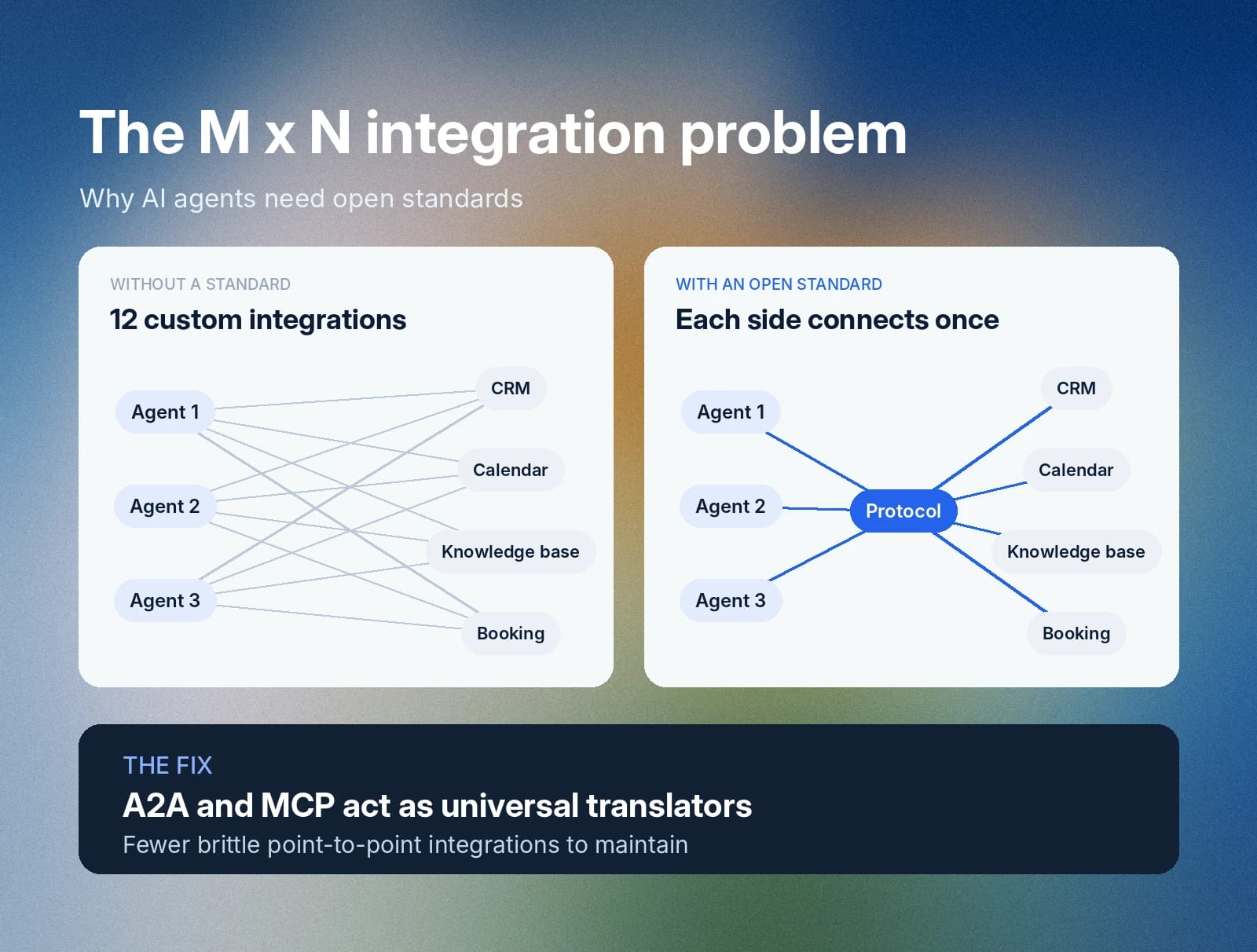
Open standards such as A2A and MCP help resolve two problems: siloed resources and the M x N bottleneck in systems integration.
Agentic AI works best when you can configure agents to operate within a specific subdomain or scope of work. That helps keep their context window within manageable tolerances. However, that requires siloing them from each other, which means either relying on a human operator to facilitate communication between systems or relying on bespoke network integrations, which creates its own problem.
The M x N problem arises when, without universal communication standards, M AI agents need N point-to-point APIs to external resources. Managing M x N brittle integrations at scale quickly becomes unsustainable.
What are the core capabilities of an agent-to-agent network?
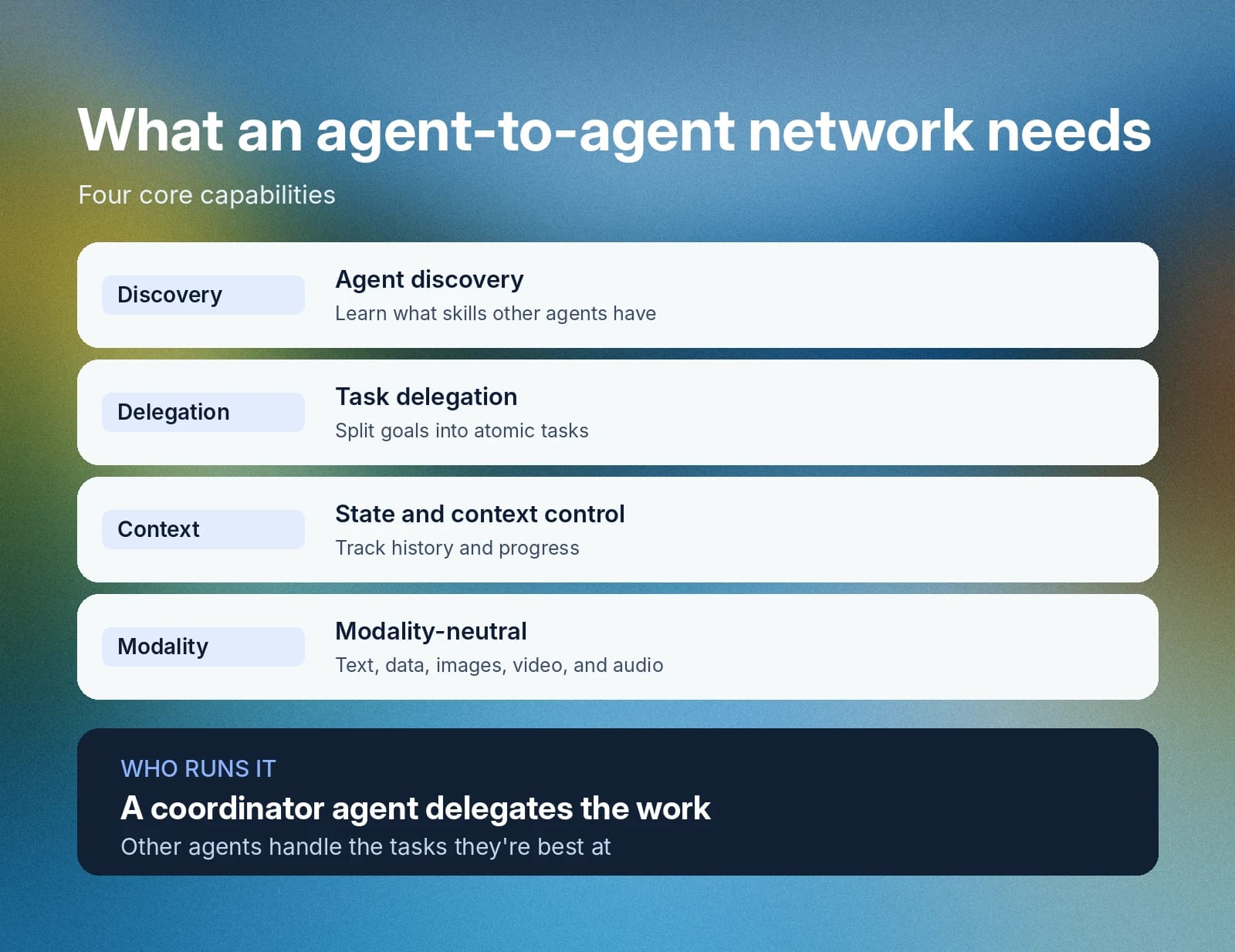
A viable agent-to-agent network needs to demonstrate four key capabilities:
- Agent discovery: Agents should be able to discover what skills neighboring agents possess, for example by reading published capability descriptions or querying a registry.
- Task delegation: A mechanism needs to exist to deconstruct complex, multi-step goals into a series of self-contained (atomic) tasks that can be distributed among agents in the network. The agent filling this role is often called the coordinator.
- State and context control: To achieve complex goals, there needs to be a mechanism to track the history and progress of work towards achieving that goal so agents know how to operate in context.
- Modality-neutral: Agents need to be capable of transmitting and receiving data in all formats, including structured and unstructured data, images, videos, and audio
How do agent-to-agent systems plan, delegate, and share context?
Multi-agent systems, where several specialized AI agents work together toward a shared goal, can exist in several topologies: centralized, hierarchical, decentralized, or sequential. A2A is the primary protocol for agent-to-agent communication in most of them, and MCP gives the agents access to tools and data. These topologies are explored in depth in our article, Multi-agent systems explained: How AI agents work together, but in brief, multi-agent systems operate in a plan-delegate-execute loop.
- A single client-facing agent ingests the initial prompt from the client user or system.
- It evaluates intent and breaks the workflow down into atomic tasks.
- It then queries its agent network over A2A to see what relevant skills or tool access other agents have and delegates tasks to them to run. They can run sequentially or in parallel.
- It organizes results and returns results and confirmation of actions taken to the client.
Agentic AI vs AI agents: what is the difference?
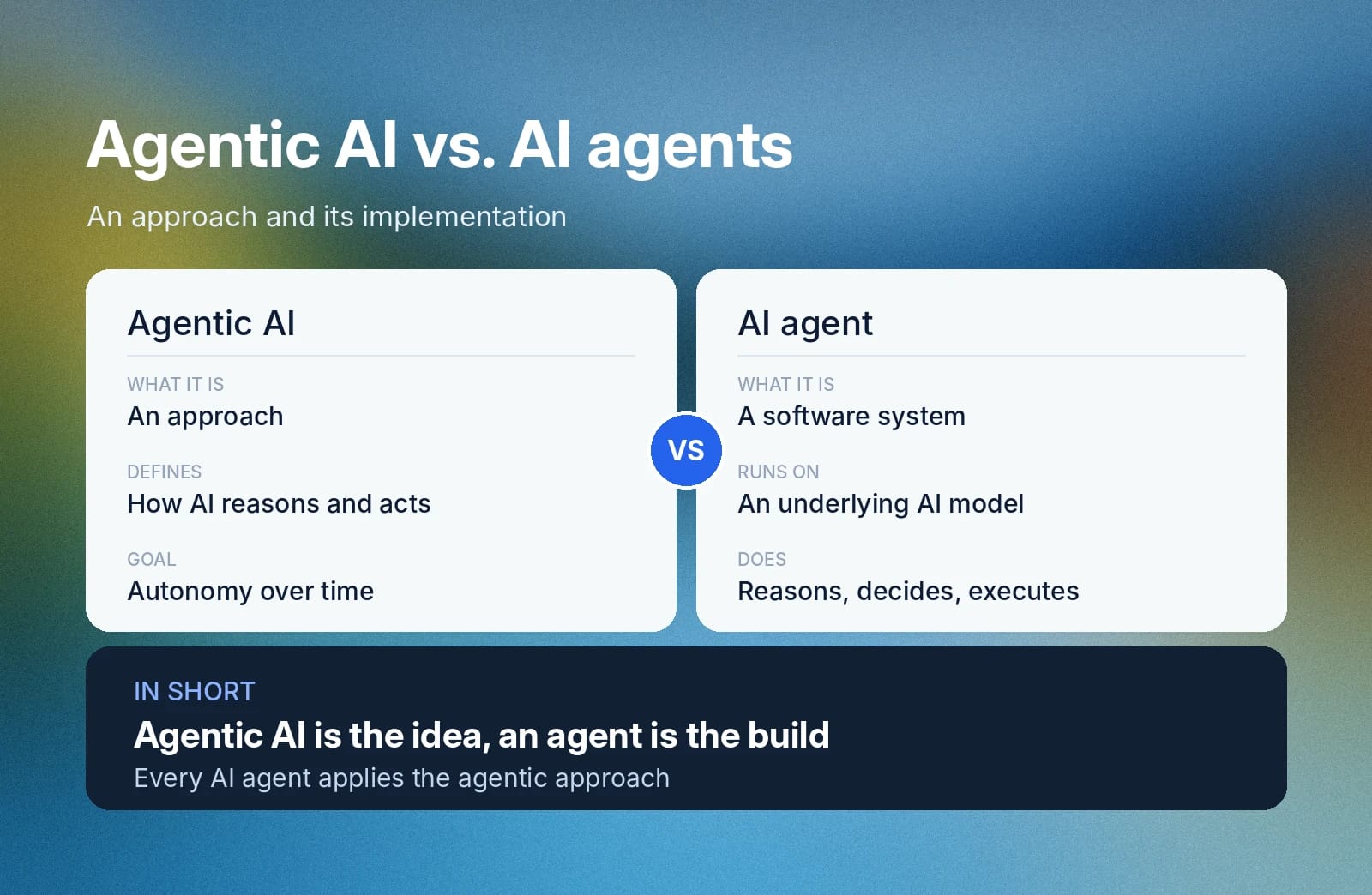
Agentic AI is the approach to giving artificial intelligence agency. In other words, it lays out how AI can receive inputs, autonomously reason on them, and make decisions and execute actions. The goal is to enable autonomy over time, rather than autonomy to react to a single-turn prompt.
An AI agent is a specific implementation of this approach. It’s a self-contained software system run by an underlying AI model that is capable of receiving inputs, reasoning and making decisions, and executing one or more tasks autonomously
.
Conversational AI vs. agentic AI
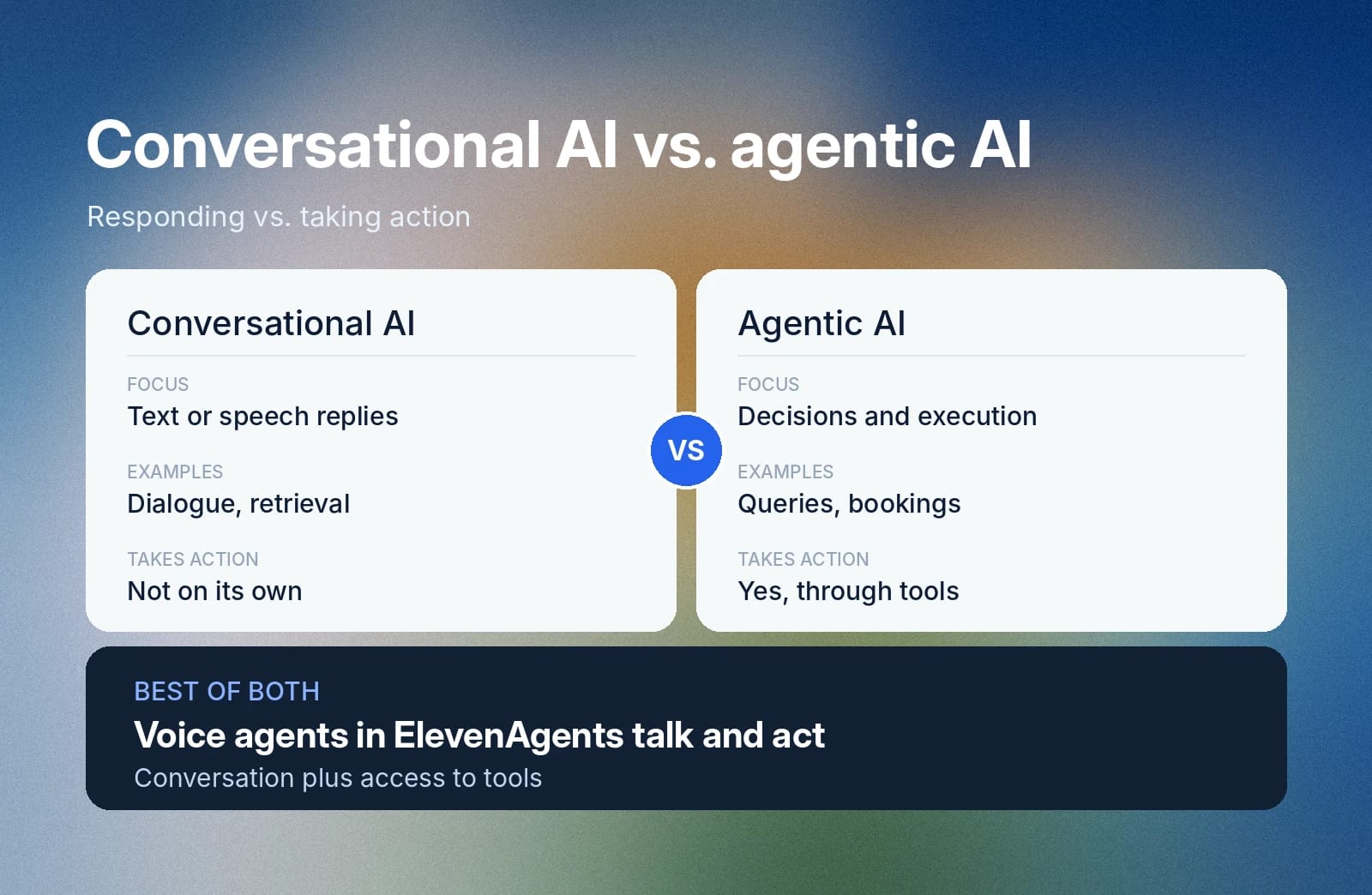
Conversational AI is an artificial intelligence system specialized in generating text or speech responses to prompts. For example, it can handle generative dialogues, transcriptions, sentiment matching, or information retrieval.
Agentic AI may include conversational capabilities, but it is defined by its decision-making, problem-solving, and tool-execution capabilities. AI agents can often take deterministic system actions, such as executing a database query or scheduling an appointment in a calendar system. A conversational AI system on its own generates responses and does not take these actions unless it is built as an agent with access to tools, as voice agents in ElevenAgents are.
The A2A protocol and MCP: how AI agents connect and share tools
Agent-to-agent communication occurs primarily through two open-standard protocols: Agent2Agent and Model Context Protocol. They aren’t competitors, they solve different problems. A2A connects agents to each other. MCP connects agents to tools.
A2A and MCP are not the only protocols proposed for connecting agents. Others, such as IBM’s Agent Communication Protocol (ACP), have also appeared, and the space is still evolving.
The importance of open standards
It’s possible to build AI agents using closed proprietary frameworks. You use one vendor’s SDKs, host on their infrastructure, and connect to other services within that “walled garden” using internal APIs. This model can work well in many use cases. However, as soon as you want your walled-off AI agent to communicate with any external agent or tool, you need to start writing bespoke APIs for them. In other words, you step into the M x N problem.
Open standards help counteract that problem by acting as universal translators. They reduce vendor lock-in, which can limit your systems’ functionality. You gain the ability to build novel cross-organizational and cross-framework workflows.
The Agent2Agent (A2A) Protocol
A2A is an open protocol originally developed by Google to allow AI agents to communicate directly with one another and delegate tasks. Agents don’t need to comprehend each other’s internal workings to communicate over A2A. It treats each agent as a black box (e.g., independent and opaque).
A2A defines three actors: the user, the client agent, and the server (remote) agent.
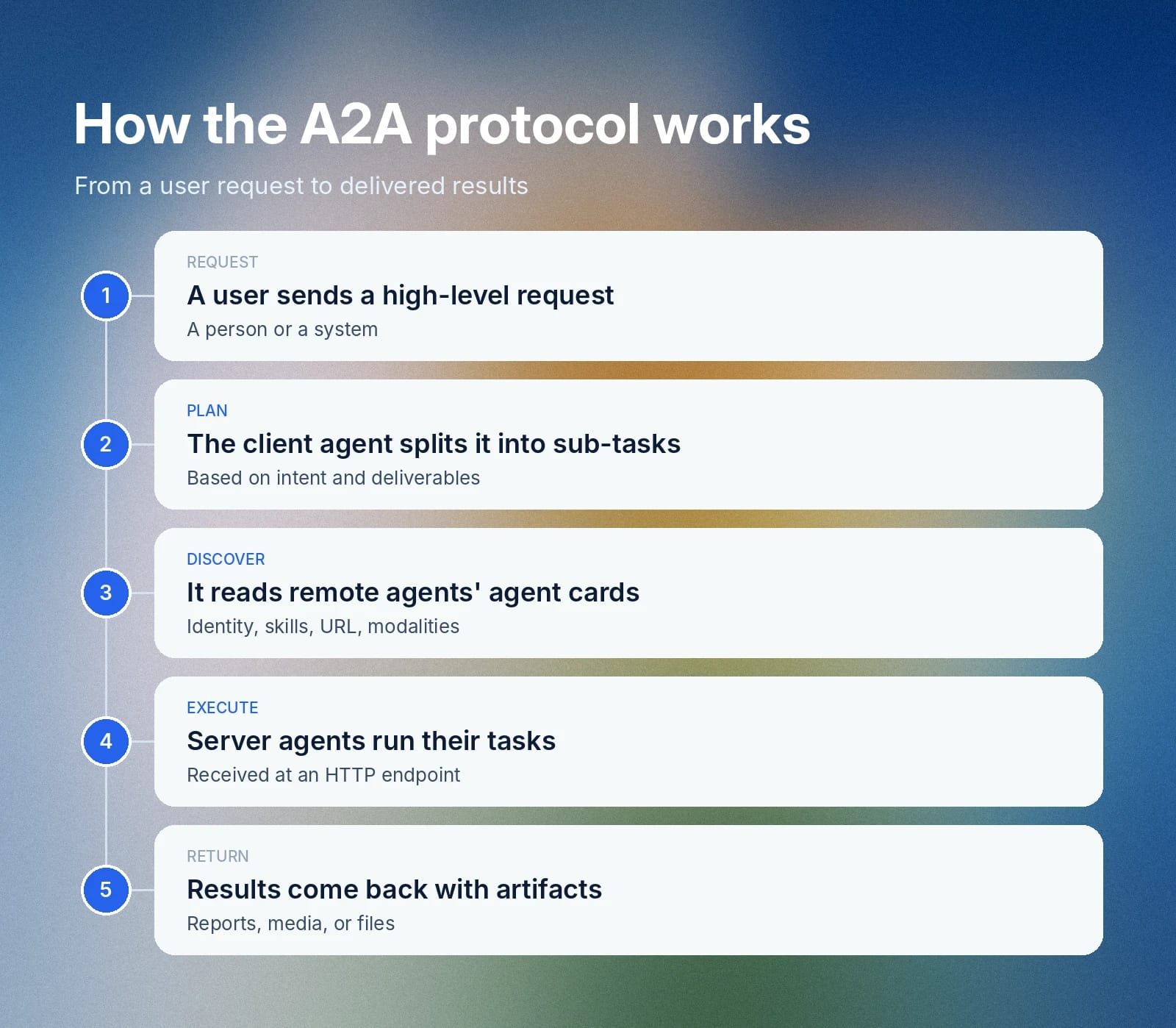
A user, whether a person or a system, submits a high-level request as a prompt to a client agent. That agent extracts intent and the final deliverables the user wants from the prompt, then parcels out sub-tasks that it and other agents can complete to achieve that goal.
The client agent identifies which other remote agents, or server agents, can perform those sub-tasks by reading their advertised agent cards. An agent card is like a digital menu that advertises an agent’s identity, skills, hosting URL, and the modalities it can work with (e.g., text, audio, video, etc.).
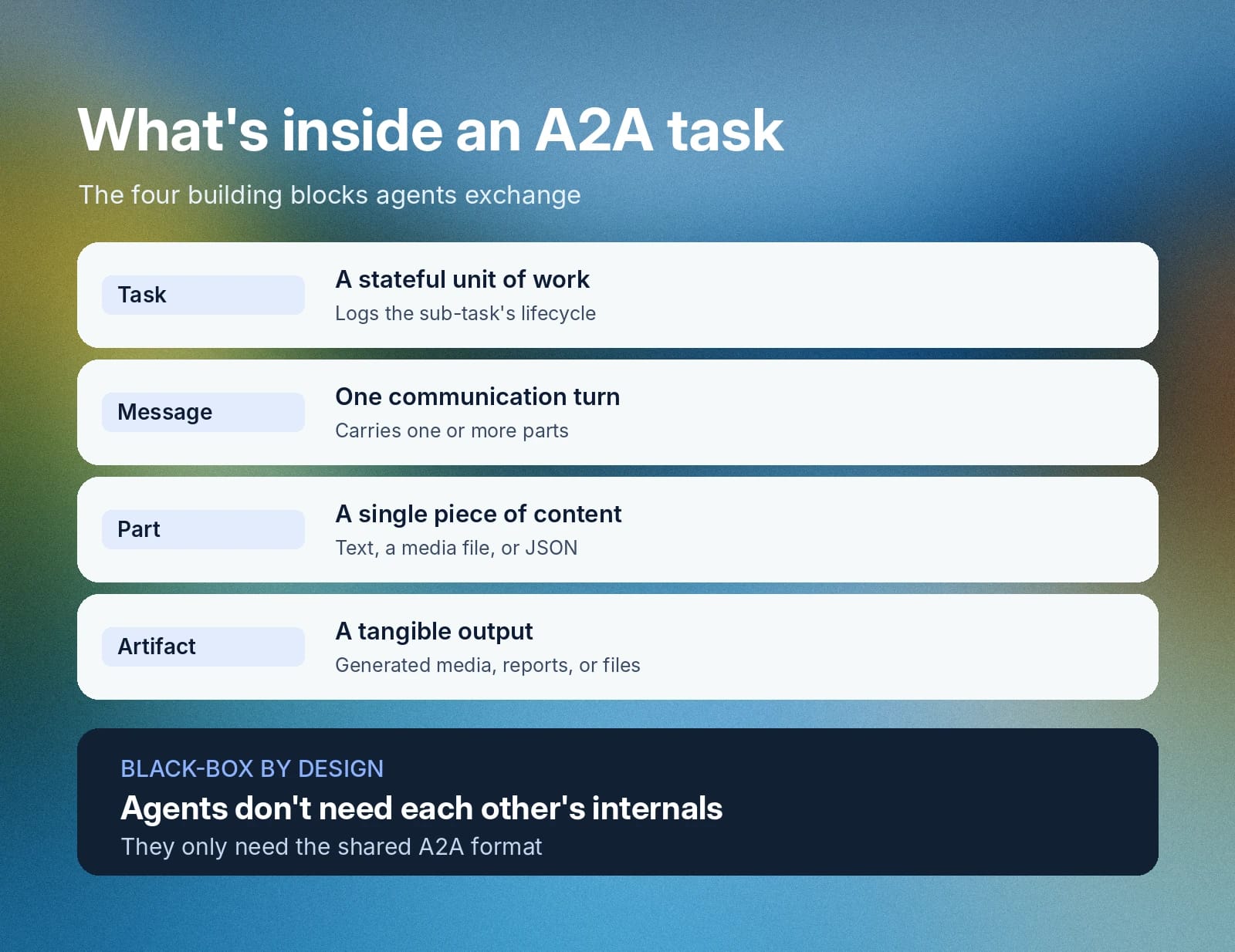
The client agent selects which server agents it needs to work with to complete the user’s high-level objectives and then structures tasks into A2A format for them, which includes four components:
- Task: A stateful unit of work with a log of the sub-task's lifecycle.
- Messages: A single communication turn between the client and server. A message contains one or more Parts, or the actionable payloads of an A2A task.
- Parts: An individual unit of content, such as text, a media file, or JSON data.
- Artifacts: One or more tangible outputs needed to complete the task’s specified deliverable. For example, artifacts can include generated media, reports, or files.
The server agent receives tasks via an HTTP endpoint at the URL on its agent card. It executes the task and returns the results along with any required artifacts in a return message.
The Model Context Protocol (MCP)
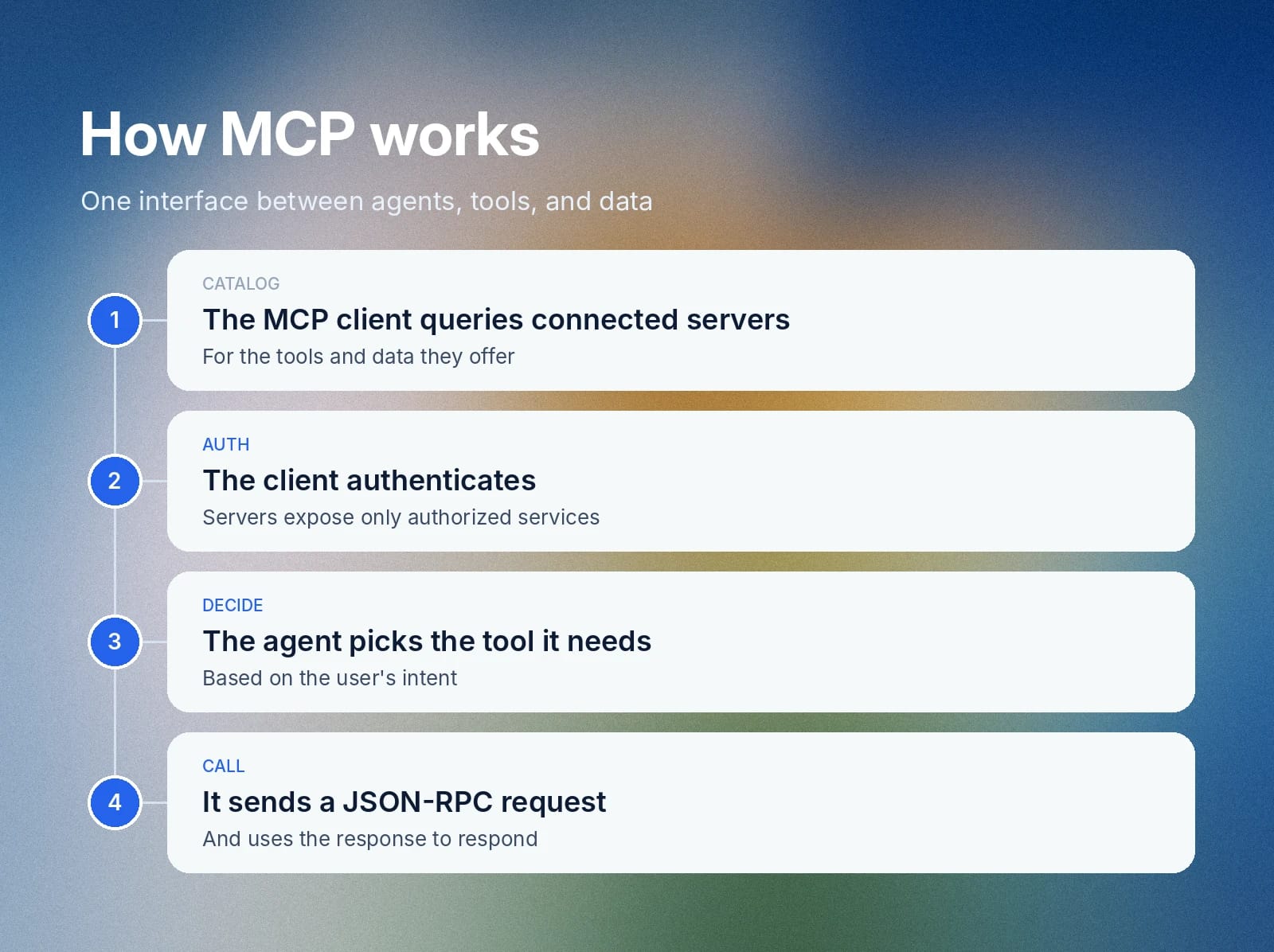
MCP is an open protocol developed by Anthropic to solve the M x N problem for agentic AI. It lets AI agents interact with external tools and data sources through a single, unified interface. An AI agent maintains a running MCP client that queries all connected MCP servers for a catalog of the services and data sources they offer on demand. The client has to authenticate with the server, which will only expose the services the client is authorized to use.
When a user submits a request to the agent, it extracts the user’s intent and checks its training data and those MCP catalogs to decide how it can best complete their request. If it decides it needs access to tooling or data available via an MCP server, it sends a JSON-RPC request to the server, which returns a response that the AI agent ingests and uses to fulfill the user’s request.
A2A vs MCP: key differences
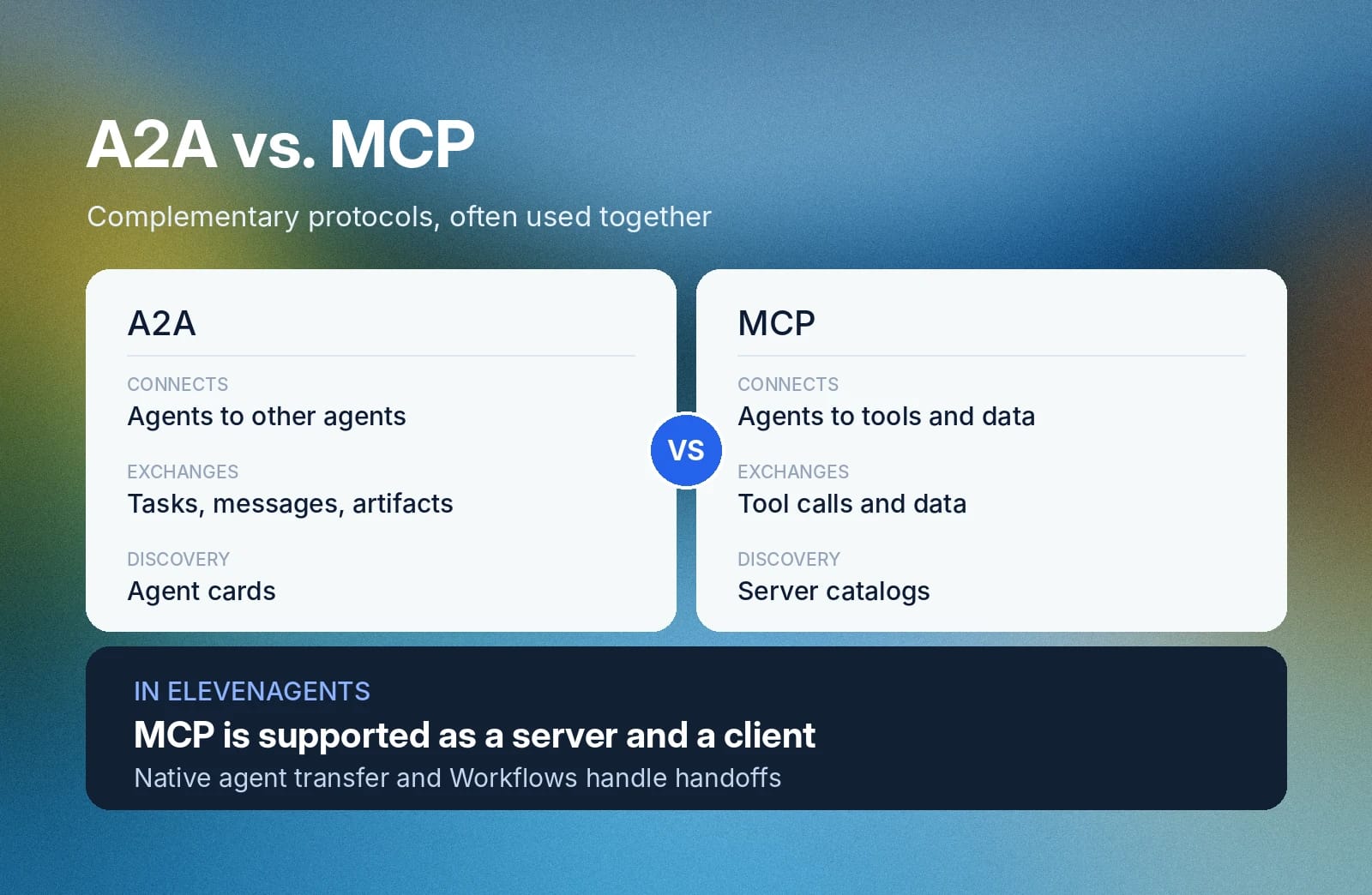
A2A and MCP solve different problems. They’re not mutually exclusive, with many teams using both in similar workflows.
A2A
MCP
Purpose
Connects agents to other agents
Connects agents to tools and data
Developed by
Originally Google
Anthropic
What it exchanges
Tasks, messages, and artifacts
Tool calls and data from MCP servers
How capabilities are found
Agent cards
Catalogs exposed by MCP servers
Typical use
Delegating work between specialist agents
Giving an agent access to a CRM, knowledge base, or calendar
In ElevenAgents
Not used. Native agent transfer and Workflows handle handoffs
Supported as a hosted server and as a client
How MCP works with conversational voice agents
When an AI agent makes an MCP tool call, there will be some degree of latency. That is usually tolerable to a user in a text chat interface, but even a short delay when talking to a conversational agent can disrupt the customer experience. Running conversational agents at enterprise scale requires backend MCP integration that can operate in near real time.
MCP is one of several ways to connect ElevenAgents to your systems, alongside webhook tools, client tools, code tools, and system tools. Mid-conversation, agents can fetch key contextual information from your connected systems and take action without disrupting the conversational flow.
ElevenLabs supports MCP in two deployment models:
Hosted MCP servers
An ElevenAgents hosted MCP server allows you to have a natural language interface to your ElevenAgents workspace directly from Claude, Cursor, or ChatGPT. For example, you can ask Claude in natural language to build a new customer service agent that duplicates your production agent but uses a new voice model. Then deploy it to a test environment for your team to evaluate.
ElevenAgents as an MCP client
ElevenAgents can also use MCP as a client. You can connect your ElevenAgents workspace to external MCP servers. For example, you can configure your new customer service agent with access to your CRM so it can look up important customer details during a live call. Then also connect it to your support technician calendaring system to schedule service calls for customers.
How ElevenAgents handles multi-agent workflows
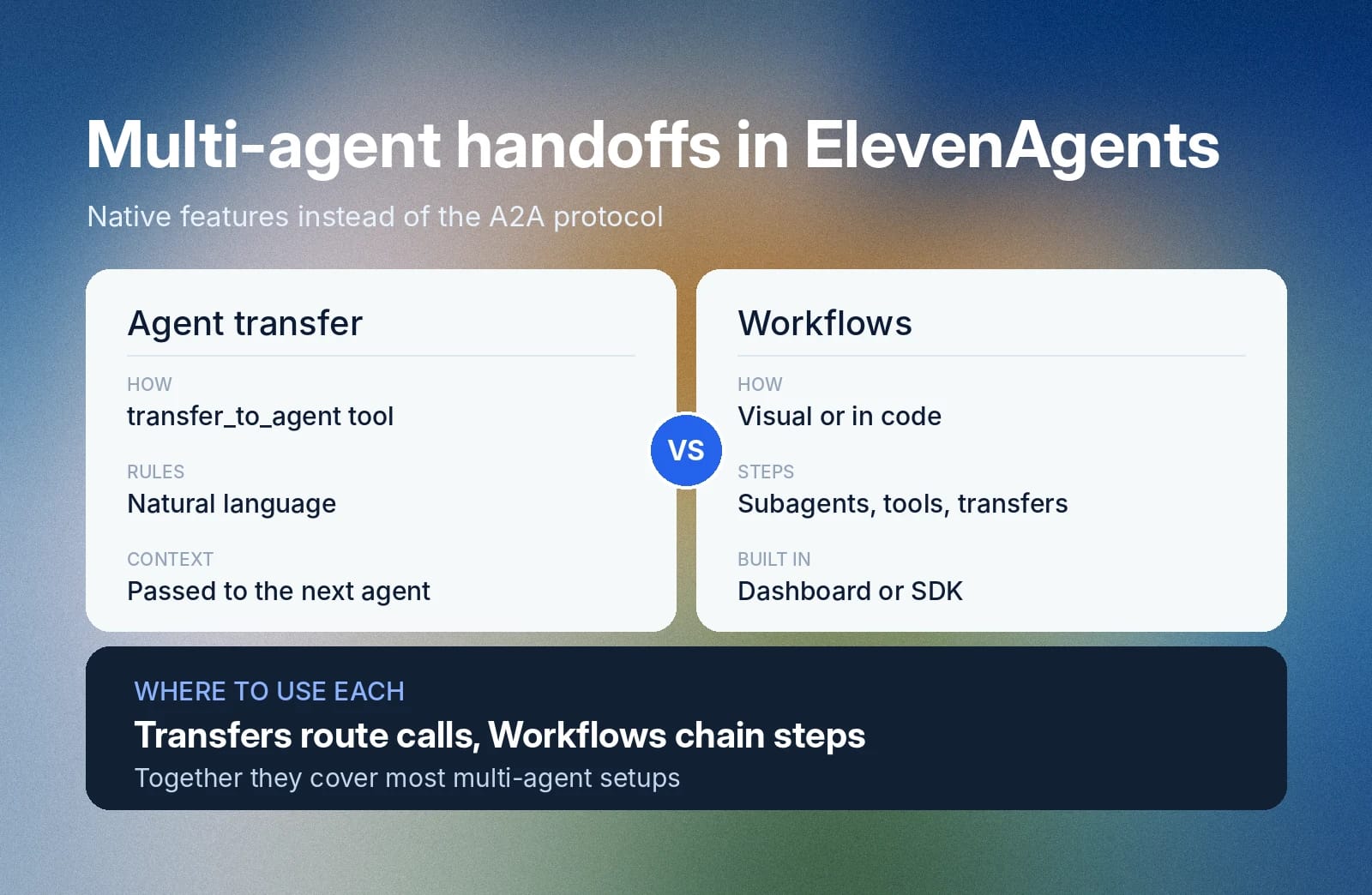
ElevenAgents handles agent-to-agent handoffs natively rather than through the A2A protocol. Two features cover most multi-agent setups:
- Agent transfer: The transfer_to_agent system tool lets you define natural-language rules, such as transferring billing questions to a billing agent. The first agent passes relevant conversation context to the next one.
- Workflows: Build multi-agent routing visually in the dashboard or in code with the SDK, chaining steps such as starting a subagent conversation, calling a tool, or transferring the call.
To see how this orchestration works under the hood, read our guide to the ElevenAgents orchestration engine.
Example of AI agents working together in customer service
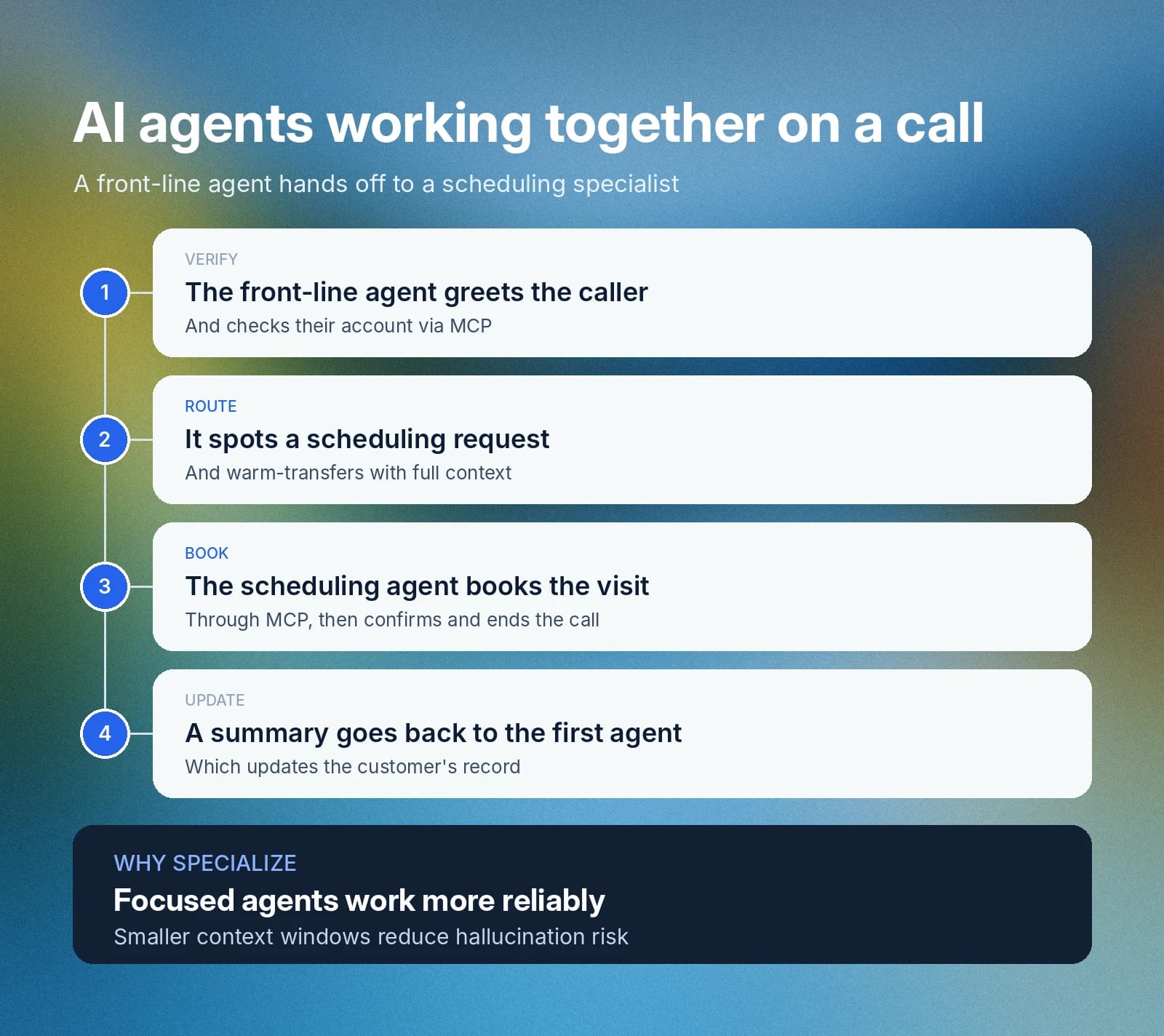
Keeping agents focused on specialist tasks makes them work more reliably within better-defined context windows. This reduces the risk of hallucination, and more focused instructions can improve operational performance. Let’s consider an example of a front-line contact center agent handing off a customer to a specialist scheduling agent.
- The front-line agent greets a caller and, through an MCP integration with your CRM, verifies their identity and account details.
- The agent parses the caller’s intent and determines they want to schedule routine service and are demonstrating positive sentiment. The agent initiates a warm transfer to a specialist AI scheduling agent to book a service call with a technician, passing along the chat history and verified customer details.
- The specialist agent books a call for them also via MCP, verifies the customer’s request is resolved, and ends the call.
- It sends summary information and a completed status back to the front-line agent, which updates the customer’s record with the call summary and details about the scheduled appointment.
Get started with ElevenAgents for customer service
ElevenAgents supports multi-agent collaboration through native agent transfer and Workflows, and connects to your tools through MCP as both a hosted server and a client.
Get started with multi-agent Workflows and MCP-connected ElevenLabs agents today or learn more about ElevenAgents.
Frequently asked questions about agent-to-agent AI

Jack Limebear is on the Growth team, acting as a content writer and strategist across the blog and insights pages. Before ElevenLabs, he spent over a decade leading content strategy for organizations ranging from fast-growing SaaS startups to Fortune 500 companies. He holds a Master's degree in English Literature from the University of Cambridge.