
What is an API endpoint? A guide to connected software
- Written by
- Jack Limebear
- Published
ListenListen to this article
An API (Application Programming Interface) endpoint is the specific URL where an API receives requests and sends back responses.
API endpoints serve as the exact web address where an application connects to a server to request data or run a command. While traditional architectures are still in use, modern applications rely on REST APIs to handle HTTP requests across diverse services.
This guide explains how endpoints process requests, how to format your calls, and how to maintain API endpoint security in production environments. We’ll also show you how to connect your systems cleanly using ElevenAPI, and ship production-ready audio workflows.
Summary
- An API endpoint is the specific URL where an API receives requests and sends back responses.
- Setting up automated communication paths between client applications and server infrastructure reduces friction for data exchange and system integration.
- The seven common API types include REST API endpoints, SOAP, GraphQL, RPC, WebSocket, gRPC, and Web APIs.
- Common API endpoint design best practices include intuitive resource-based naming and pairing standardized HTTP status codes with structured JSON error payloads.
- Engineering teams test and monitor API endpoints by validating HTTP codes, verifying basic request connectivity, and tracking real-time concurrency.
- Securing API endpoints involves key-based authentication, least-privilege permission scoping, and concurrency-based rate limits.
API endpoints explained: requests, responses, and routes
An API endpoint is a digital location that an API uses to receive requests and return responses. Client applications use a specific URL tied to this endpoint to access server resources.
Every endpoint route handles a distinct interaction by pairing an HTTP method with a resource path. The client sends a request to that route, and the server processes the data before sending a response with a status code.
For example, when an application requests user metadata or submits a data payload, it sends an HTTP request to a designated endpoint URL hosted on the API server.
API vs. endpoint vs. URL: What’s the difference?
While the terms API, API endpoint, and URL are frequently used together, they represent distinct components of software architecture.
An API provides the complete software interface that sets the rules and protocols for two applications to communicate. Meanwhile, an API endpoint serves as a specific digital entry point on a server that the apps use for two-way communication. Finally, a URL is the complete written web address string that client applications use to locate and connect to that endpoint over the network.
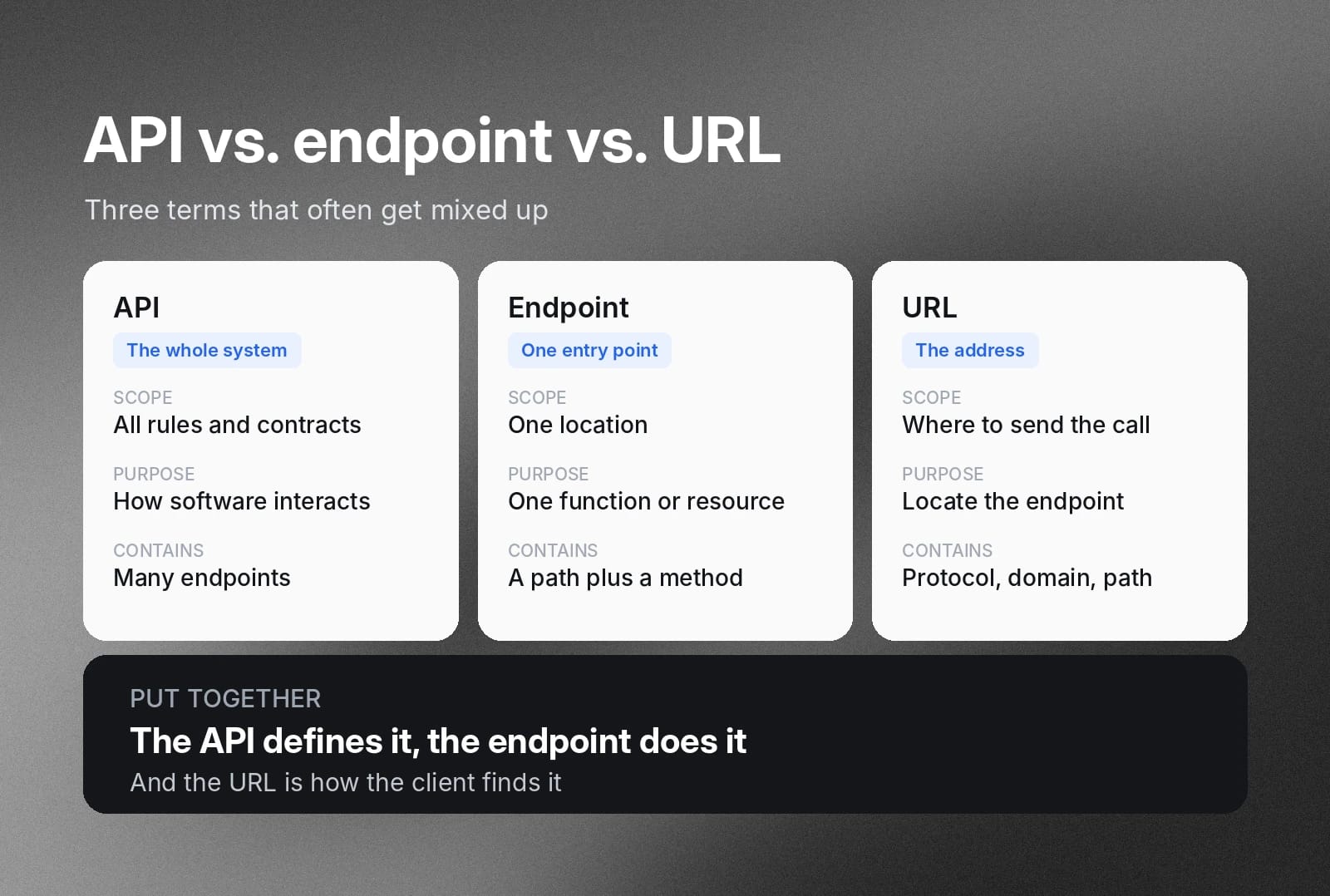
The main differences between API, endpoints, and URLs include:
- Scope and architecture: API covers the entire system of rules and data contracts, while the API endpoint only accounts for one specific location, and the URL is the address of that location.
- Function and purpose: An API specifies how software components interact with each other, while API endpoints provide access to a specific function or data resource and the URL tells the client application precisely where to direct its call.
- Composition: An API has multiple endpoints, but one API endpoint matches a specific resource path to an HTTP method. A URL also includes many parts, such as the network protocol, domain name, endpoint path, and query parameters.
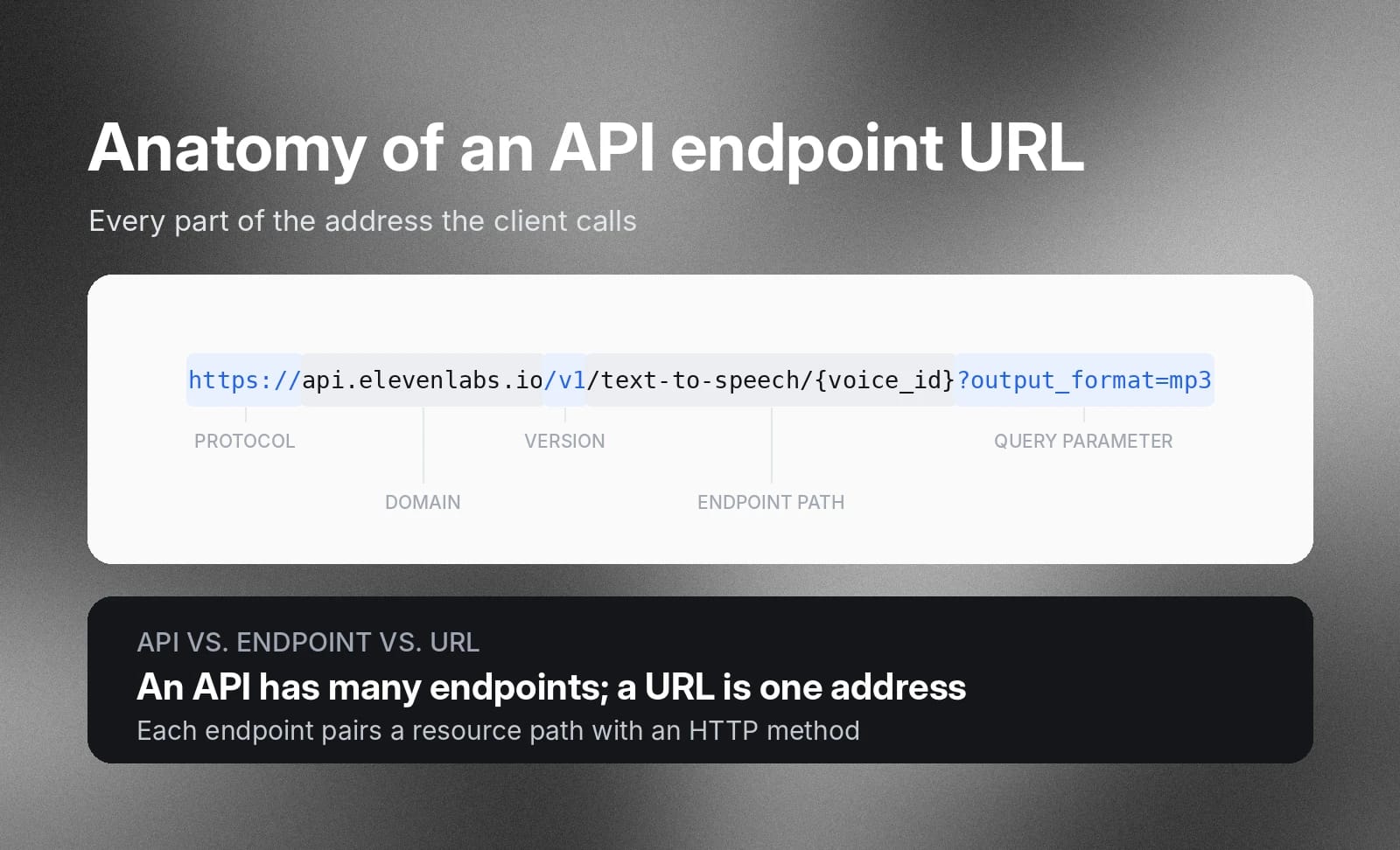
How do API endpoints work?
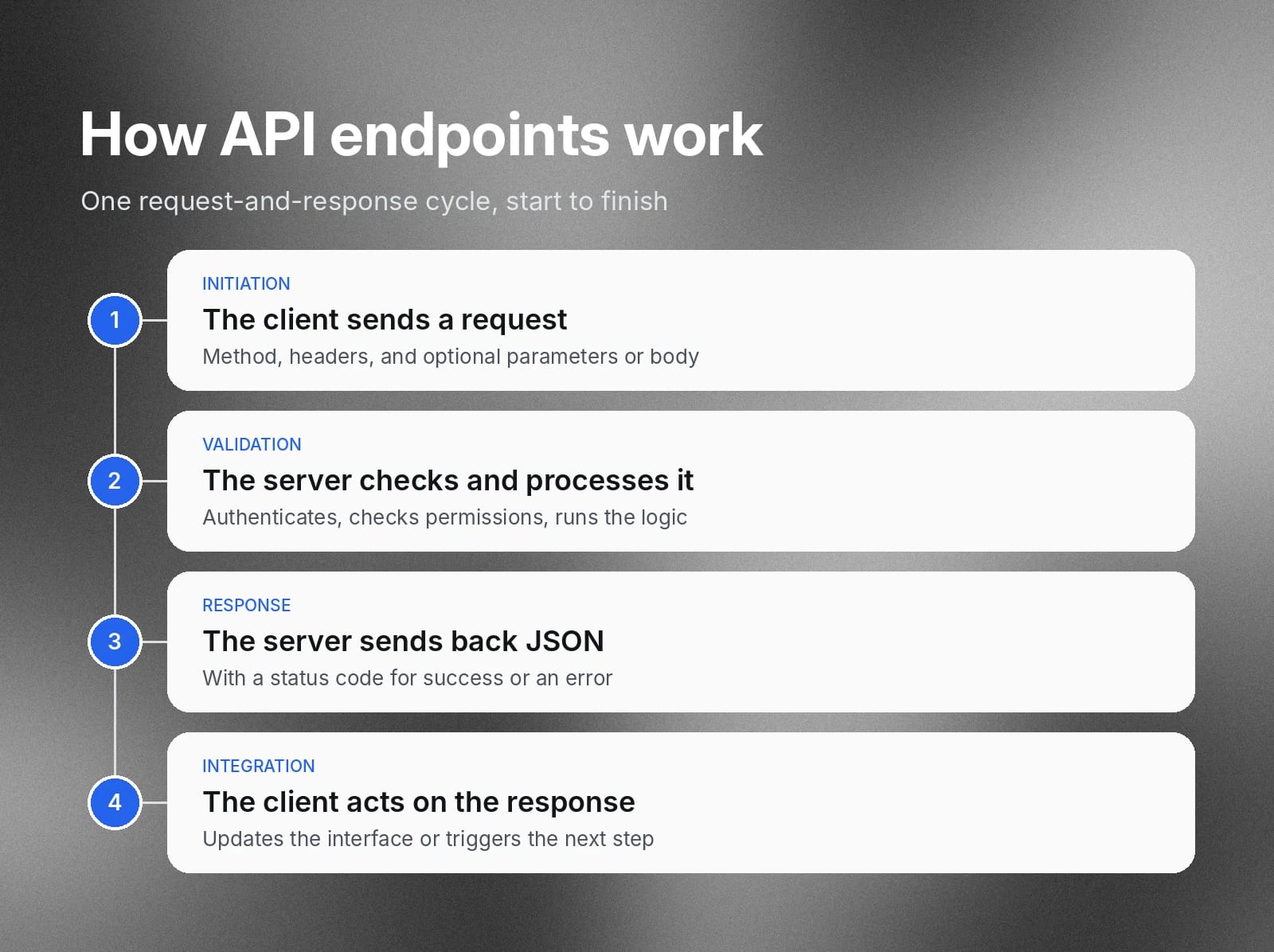
API endpoints use a structured request-and-response cycle between client applications and servers, which typically follows these steps:
- Initiation: The client sends an HTTP request directly to the endpoint URL. This request includes an HTTP method, HTTP headers, optional query parameters, and optional request body data.
- Validation and processing: The server receives the request, authenticates client credentials, and reviews access permissions. The backend system then queries internal databases or executes server-side business logic to process the requested operation.
- Response delivery: The server compiles the output into a structured JSON payload. It sends this payload back to the client along with an HTTP status code that confirms successful execution or provides details on generated errors.
- Integration execution: The client application parses the returned payload to update user interfaces, process data, and trigger downstream actions.
REST API endpoints and the HTTP methods they use
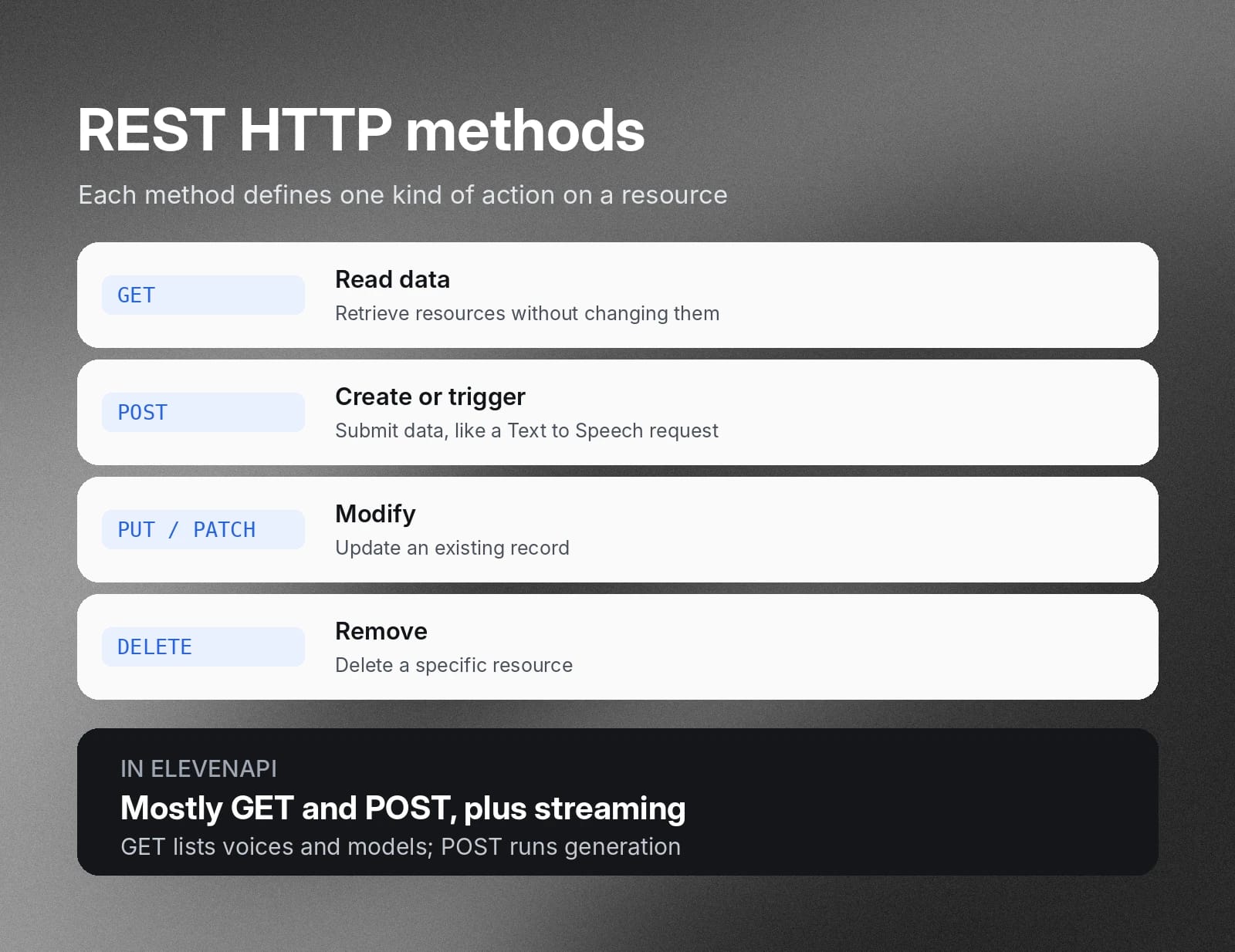
REST API endpoints use standard HTTP methods to define the actions clients execute on a server resource. GET requests read data and make no changes to backend resources. In contrast, POST requests write data by submitting new data to create resources or trigger server-side actions.
Additionally, developers use PUT or PATCH requests to modify existing records, and DELETE to remove specific resources from the database.
In ElevenAPI, integrations mostly rely on GET and POST requests, alongside streaming and WebSocket endpoints for real-time audio. GET endpoints retrieve available voice and model metadata, while POST endpoints execute generation tasks, such as running Text to Speech synthesis.
API endpoint examples: A practical look at common requests
Examining real-world requests in ElevenAPI illustrates how API endpoints function in production environments.
With ElevenAPI, each endpoint route maps to specific HTTP methods that perform certain tasks, such as fetching system metadata or generating audio. Client applications send GET requests to retrieve information and POST requests to submit data and execute processing tasks.
Here’s how these core routes work in production.
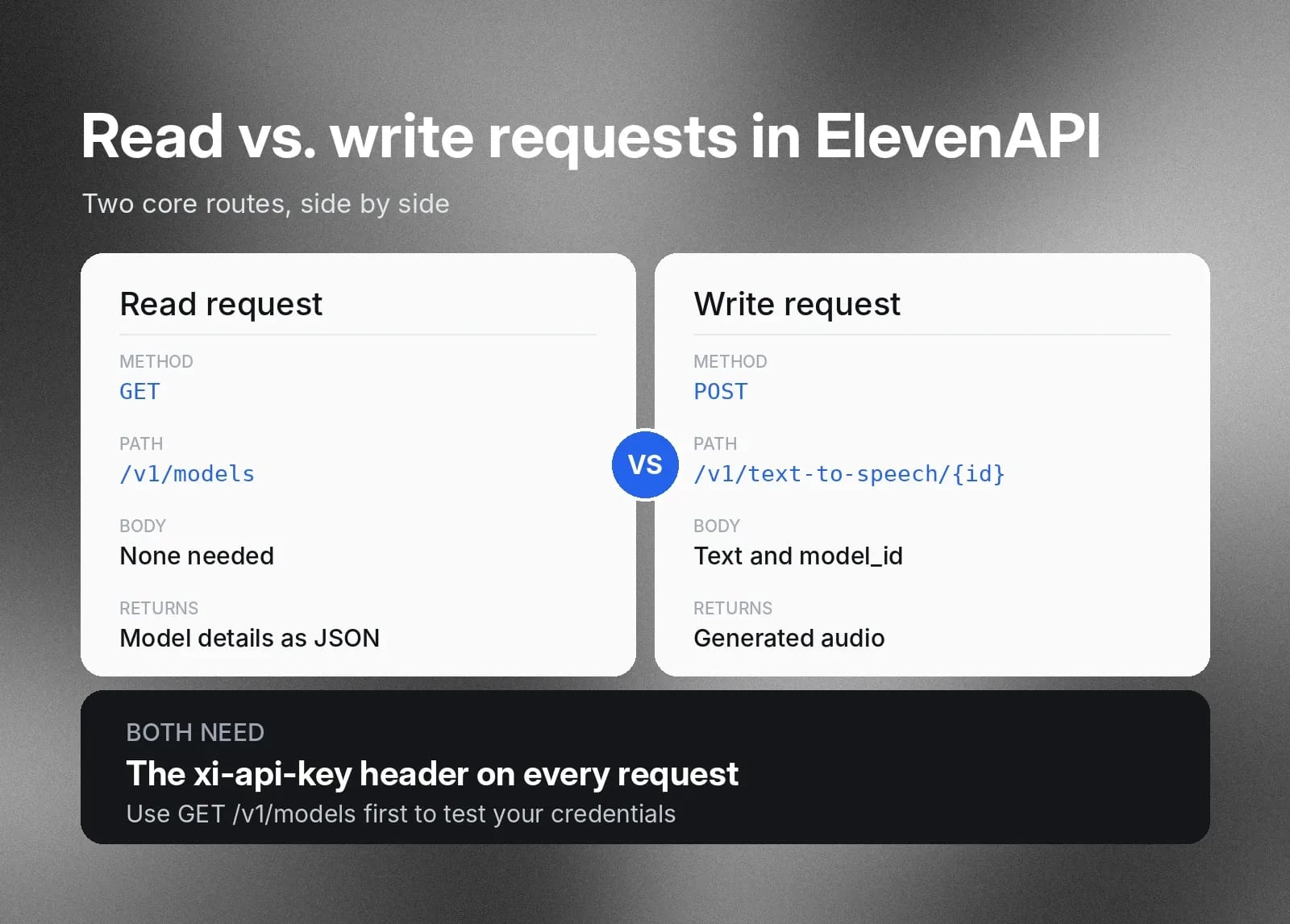
Read request
GET https://api.elevenlabs.io/v1/models retrieves a list of available voice synthesis models and their capabilities. This request requires the xi-api-key HTTP header for authentication but does not require a request body. The server processes the query and returns a JSON payload containing model details.
Write request
POST https://api.elevenlabs.io/v1/text-to-speech/{voice_id} sends payload data to the server to generate audio. Your application sends a JSON body containing parameters, such as text and model_id to execute Text to Speech synthesis. The endpoint processes these parameters and streams formatted audio back to your application.
Read more in the Text to Speech API reference.
The seven common API types and when to use them
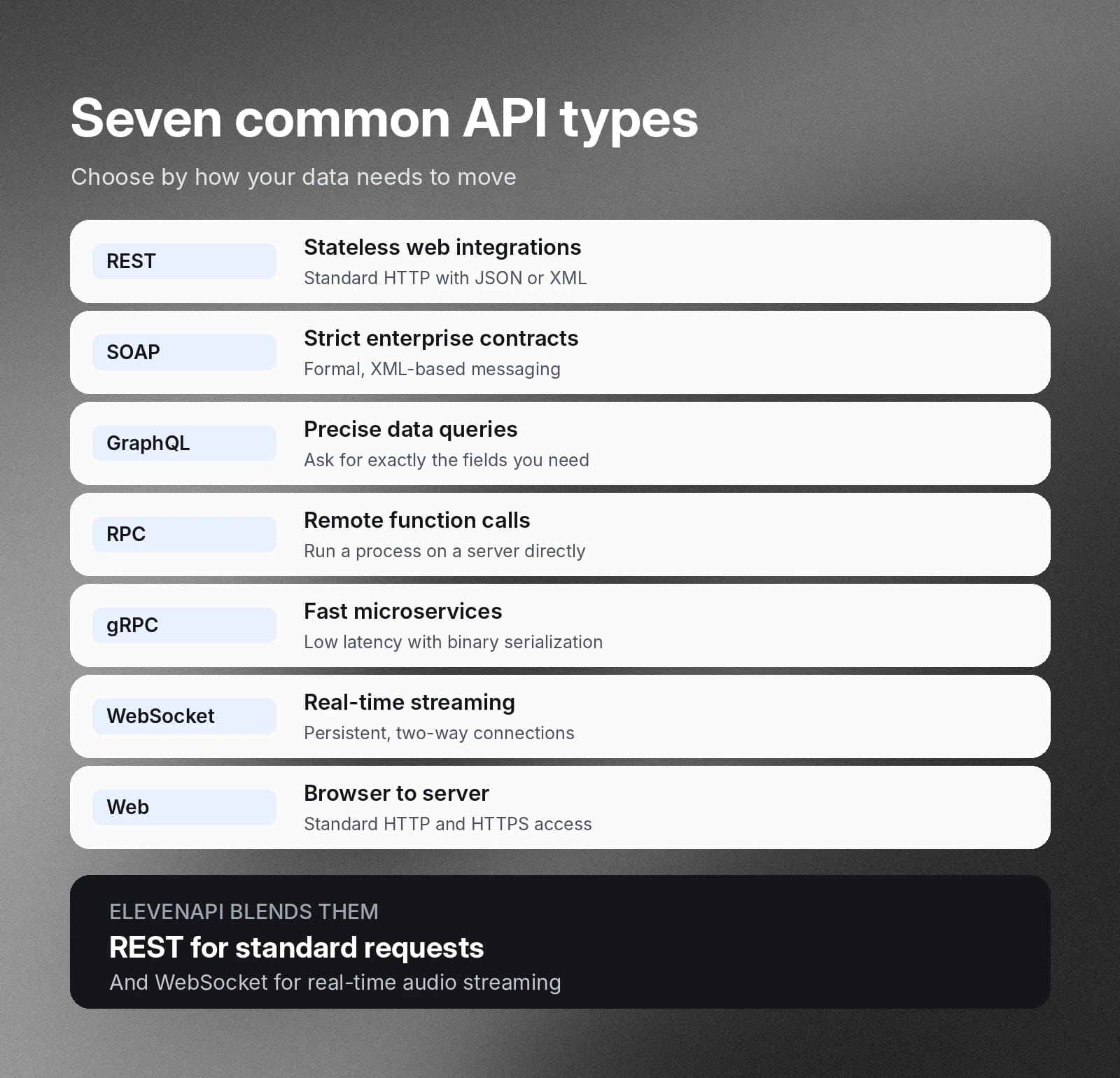
Development teams choose from seven common API architectures, and make decisions based on their data transfer needs.
API architectures
When to use
REST
Building web integrations that need stateless, standardized HTTP communication using structured JSON or XML data formats
SOAP
Enterprise apps demand strict security protocols, formal messaging contracts, and XML-based data exchange
GraphQL
Client apps need to query precise data fields in a single request to avoid overfetching or underfetching data
RPC
Client apps execute specific functions or processes directly on a remote server with minimal network overhead
gRPC
Connecting high-performance microservices that require low-latency communication and binary serialization
WebSocket
Building interactive apps that require persistent, two-way connections for real-time data streaming and instant response
Web
Connecting web browsers and client applications to server-side resources over standard HTTP and HTTPS protocols
ElevenAPI blends several architectural styles into a single platform to maximize efficiency and minimize latency. Typically, it uses REST for standard requests and WebSocket protocols for real-time audio streaming.
API endpoint design best practices for predictable integrations
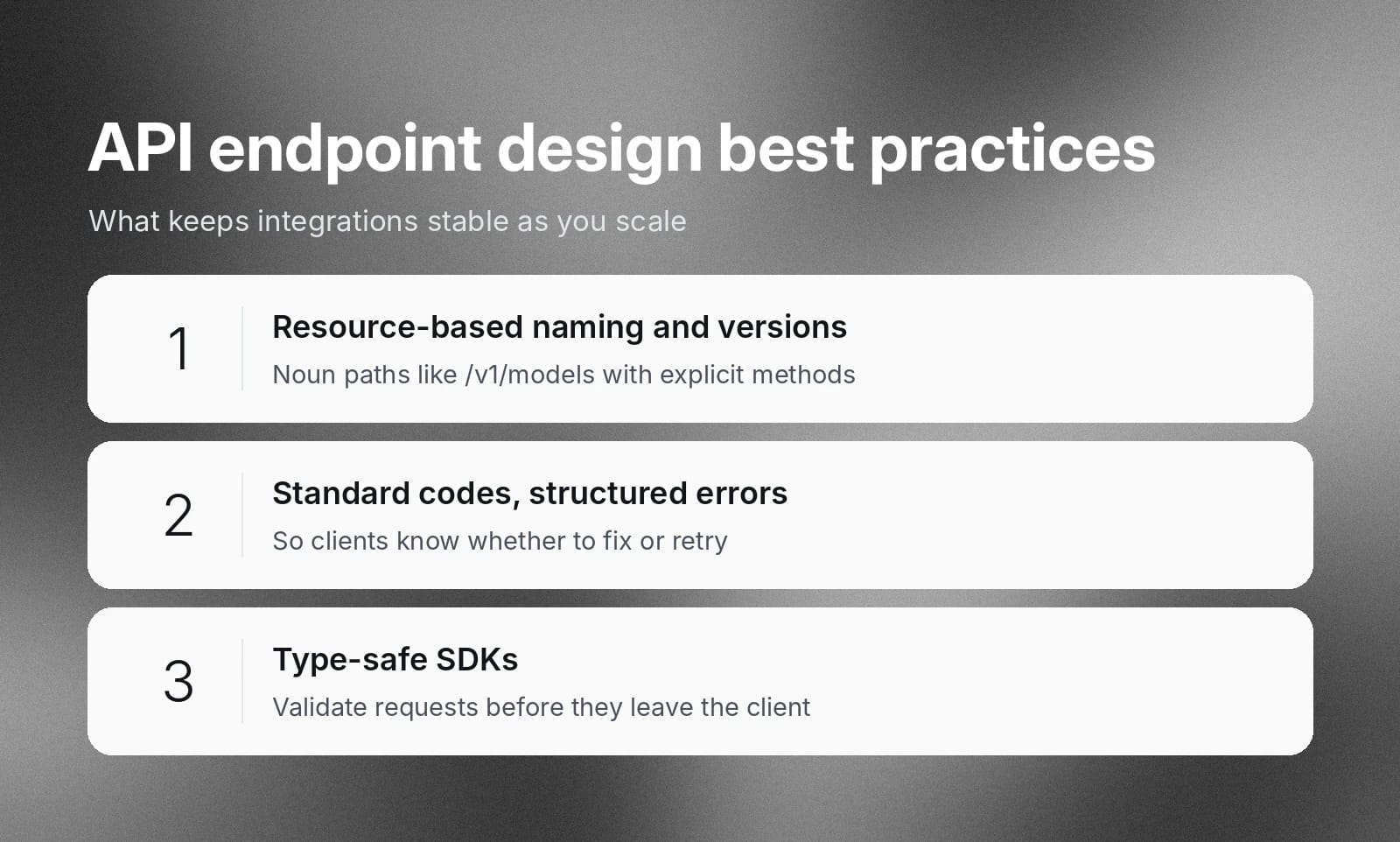
Using design best practices keeps API endpoints stable, maintainable, and resilient even when underlying platforms change and use cases scale. ElevenAPI uses clean REST rules to simplify integration for engineering teams, such as:
- Intuitive resource-based naming and versioning: Endpoints should use noun-based paths named directly after the resource they provide, then pair them with explicit HTTP methods for actions. For example,
/v1/models or /v1/text-to-speech/{voice_id}. - Standardized HTTP status codes and structured error payloads: Predictable endpoints return standard HTTP status codes to report the exact outcome of a request. Pairing these status codes with structured JSON error payloads allows client software to programmatically decide whether to fix request parameters or execute backoff retries.
- Type-safe SDKs and SDK parameter validation: Offering official, strongly typed SDKs in languages like Python and TypeScript simplifies integration. This method also enforces request schemas before network calls leave the client.
How to test and monitor API endpoints
Testing API endpoints early confirms authentication and validates network connectivity before developers write application logic.
Send a request to GET https://api.elevenlabs.io/v1/models (or run curl https://api.elevenlabs.io/v1/models) using the xi-api-key HTTP header to validate credentials, verify network access, and return available models.
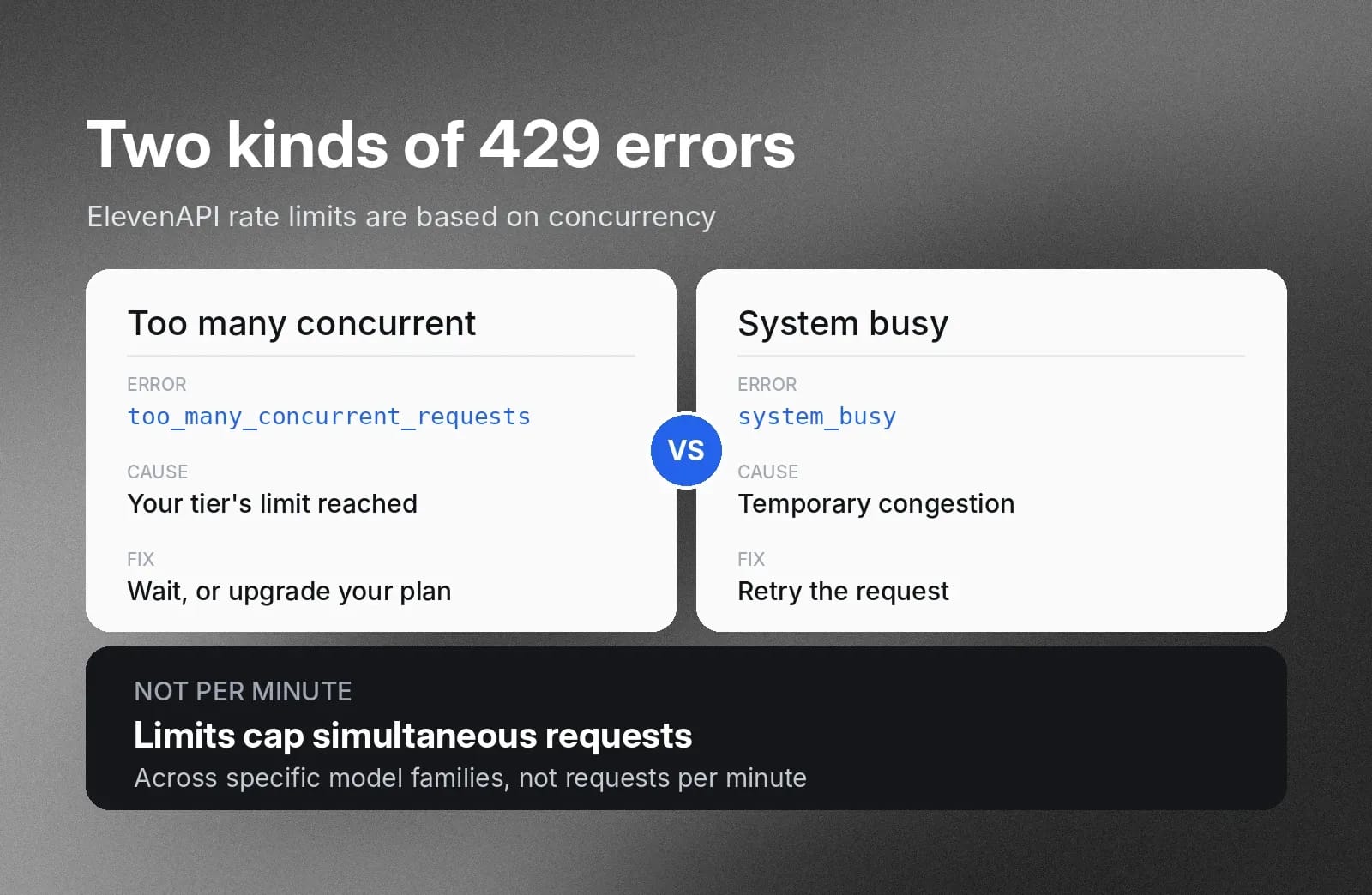
Then, monitor live traffic and watch for HTTP 429 error responses. Engineering teams track metrics to spot unexpected usage spikes and adjust outbound request rates accordingly.
A too_many_concurrent_requests error indicates that an account has maxed out its tier concurrency limit, so wait for in-flight requests to finish or move to a higher plan. In contrast, a system_busy error means that the platform is experiencing temporary congestion. Retrying the request usually succeeds.
API endpoint security: Authentication, authorization, and rate limits
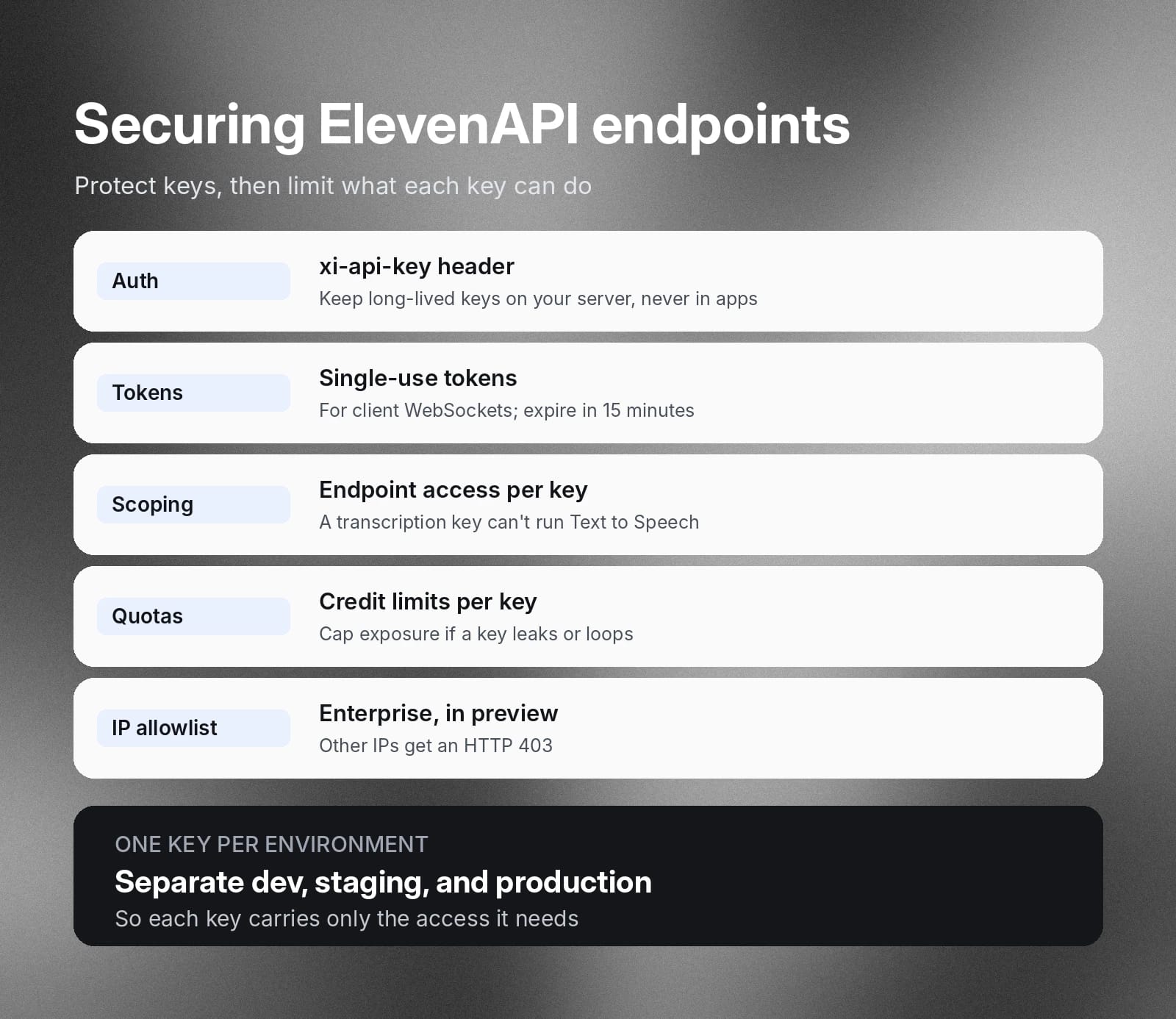
Securing API endpoints requires protecting secret credentials while establishing granular limits on what each credential can do. ElevenAPI uses three core mechanisms in addition to its recommended best practices to secure backend operations and client integrations.
1. Authentication
Every request carries the secret credential xi-api-key HTTP header. Long-lived API keys must remain strictly on secure servers and aren’t shown on the client-side code like browsers or mobile apps. For client-side Scribe and Text to Speech WebSocket connections, your server mints a single-use token so the long-lived key stays secure.
Single-use tokens expire after 15 minutes and are consumed on first use. Read more in the single-use token documentation.
2. Authorization and scoping
Issue separate keys for development, staging, and production environments. Then, configure each key based on these three granular security mechanisms:
- Endpoint access: Restrict the specific endpoints an API can call so that each credential only carries the permission needed for the job it’s executing. For example, a key dedicated to Speech to Text transcription doesn’t need access to Text to Speech generation.
- Credit quotas: Assign custom credit limits per key to cap financial exposure from unexpectedly high consumption, contain execution loops in application code, and protect account balances if a key leaks.
- IP allowlisting: Enterprise accounts can restrict key usage to specific IP addresses or CIDR ranges (currently in preview, available through your account manager). Requests from any other IP are rejected with an HTTP 403 error.
Rate limits
Rate limits are concurrency-based rather than simple per-minute quotas. They cap the number of simultaneous generations or in-flight requests running at the same time across specific model families.
Build voice and conversational AI workflows with ElevenAPI
ElevenAPI provides programmatic access to a comprehensive suite of AI audio capabilities, including Voice Agents, Text to Speech, and Speech to Text. Delivering low latency, high emotional expressiveness, and support for 90+ languages across its model suite, ElevenAPI embeds human-like audio directly into your tech stack. This expands the capability of the tech powering your business solutions in customer support, employee training, content production, and marketing.
Whether deploying real-time conversational agents or automating multilingual localization, ElevenAPI provides the infrastructure, speed, and security required for production applications.
Explore ElevenAPI to review endpoint references and integration cookbooks or request an API key to start building today.
Frequently asked questions about API endpoints

Jack Limebear is on the Growth team, acting as a content writer and strategist across the blog and insights pages. Before ElevenLabs, he spent over a decade leading content strategy for organizations ranging from fast-growing SaaS startups to Fortune 500 companies. He holds a Master's degree in English Literature from the University of Cambridge.