
Open source TTS vs paid APIs: How to choose wisely
- Written by
- Jack Limebear
- Published
ListenListen to this article
Neither open source nor paid text to speech (TTS) APIs are inherently better than the other. Each is a viable solution to different use cases and business needs. Paid APIs incur regular subscription or workload costs. Free and open source TTS shifts the costs to running additional infrastructure and the developer and engineering time to maintain it.
This article offers an unbiased take on open source TTS vs paid APIs, explores when each option is appropriate, and demonstrates how to evaluate TTS models, free or paid, to find the one best suited to your needs.
Summary
- Both paid and free open source TTS can output high-quality speech. Each addresses different business needs.
- Open source systems generally give you greater control over the TTS model, but at the cost of additional overhead. Paid TTS over an API gives you access to enterprise-grade speech synthesis out of the box.
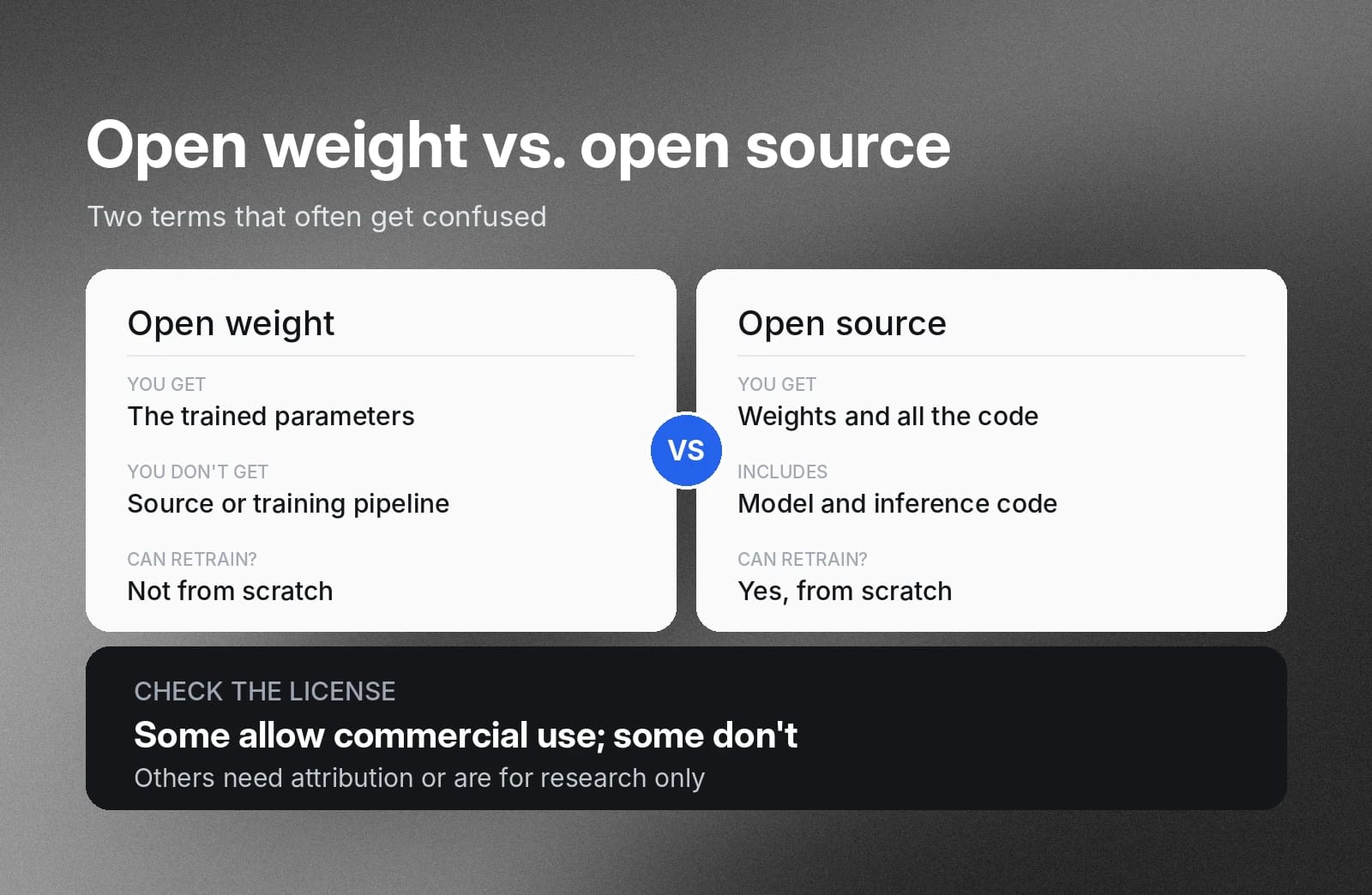
- Open weight TTS models are often confused with open source. Open weights mean the model’s parameters are freely available. Open source means the full source code is available.
- The specific use case dictates when open source models are most applicable. Common use cases include edge devices and large-batch audio generation.
Open source TTS vs paid APIs: What differences matter?
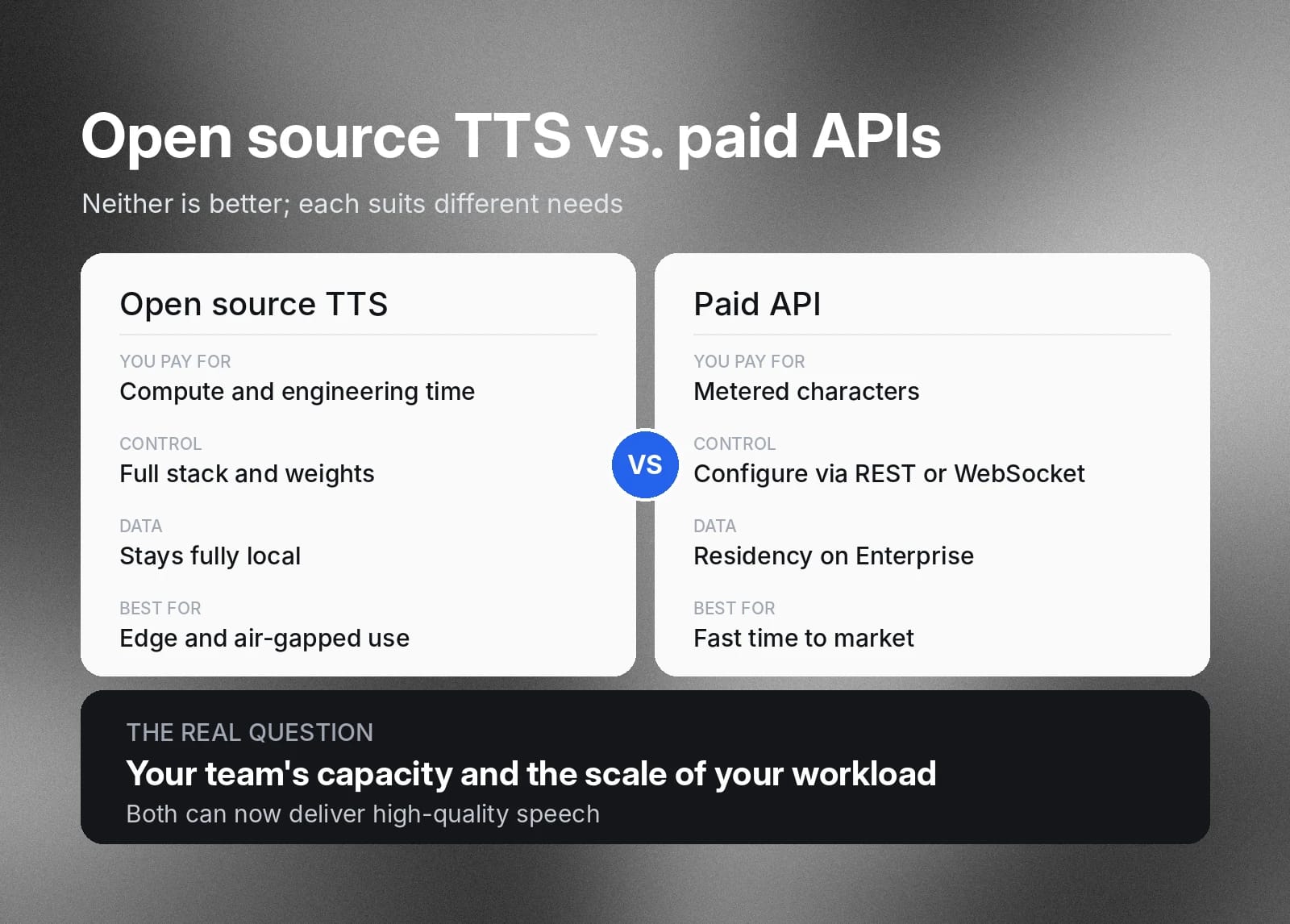
Open source text to speech (TTS) and paid APIs can both work well for different use cases. Models of all types are mature enough now that both design approaches can deliver sufficient speech quality. Which approach is best is more determined by your team’s capacity and the scale of your workload.
Where open source solutions excel
Open source and self-hosted TTS typically offers more control over the full stack. You don’t pay per character, but you do pay for the compute infrastructure and for the staff to manage that infrastructure and model code.
Self-hosting supports data sovereignty. Text and audio can stay completely local. Nothing needs to traverse the public internet, and all TTS operations stay within your jurisdiction and on the infrastructure you choose. This can be important or strictly required in sectors such as healthcare, finance, and government.
Self-hosting gives you direct access to the full architecture from bare metal on up. You can fully optimize internal runtimes. You have full experimental control over the model weights and the inference pipeline, and you can customize the vocabulary.
Where managed commercial APIs excel
Accessing TTS through managed APIs is a turnkey solution. The infrastructure is preconfigured and available when you need it, backed by clear SLAs and running on scalable, multi-region cloud infrastructure. You just need to integrate your application to it via REST or WebSocket.
Commercial APIs are also a common way to access the newest, high-parameter foundation models, which can deliver speech with natural prosody. If your goal is to accelerate your time to market using enterprise-grade resources, then a managed API may be the better choice. The trade-off is that you pay metered, per-character rates.
Data residency and zero retention for managed APIs
Some teams self-host only to control where their data goes. Managed APIs can meet that need too, but the options may be limited to Enterprise plans, as is the case with ElevenLabs.
For data residency, ElevenAPI stores customer data in the US by default. Enterprise customers can get isolated environments in the EU, India, and Singapore. Each is a fully separate workspace with its own URL, account, and API key. Residency controls storage only: processing can still happen outside the region through affiliates, subprocessors, support, and moderation, which the data processing agreement covers. For EU environments with Zero Retention Mode on, processing also stays in the EU, except for optional integrations such as custom LLMs or some post-call webhooks. Some products aren’t available in isolated environments.
Zero Retention Mode (ZRM) deletes the inputs and outputs of eligible API requests as soon as each request finishes, and the requesting account’s email isn’t logged. It covers API traffic only, never the web UI. Eligible products include text to speech (including WebSocket), Text to Dialogue, Voice Changer, Speech to Text, Forced Alignment, Sound Effects, Music, and ElevenAgents. Instant and Professional Voice Cloning, Dubbing, Studio, Image & Video, Music upload, and fine-tunes aren’t eligible.
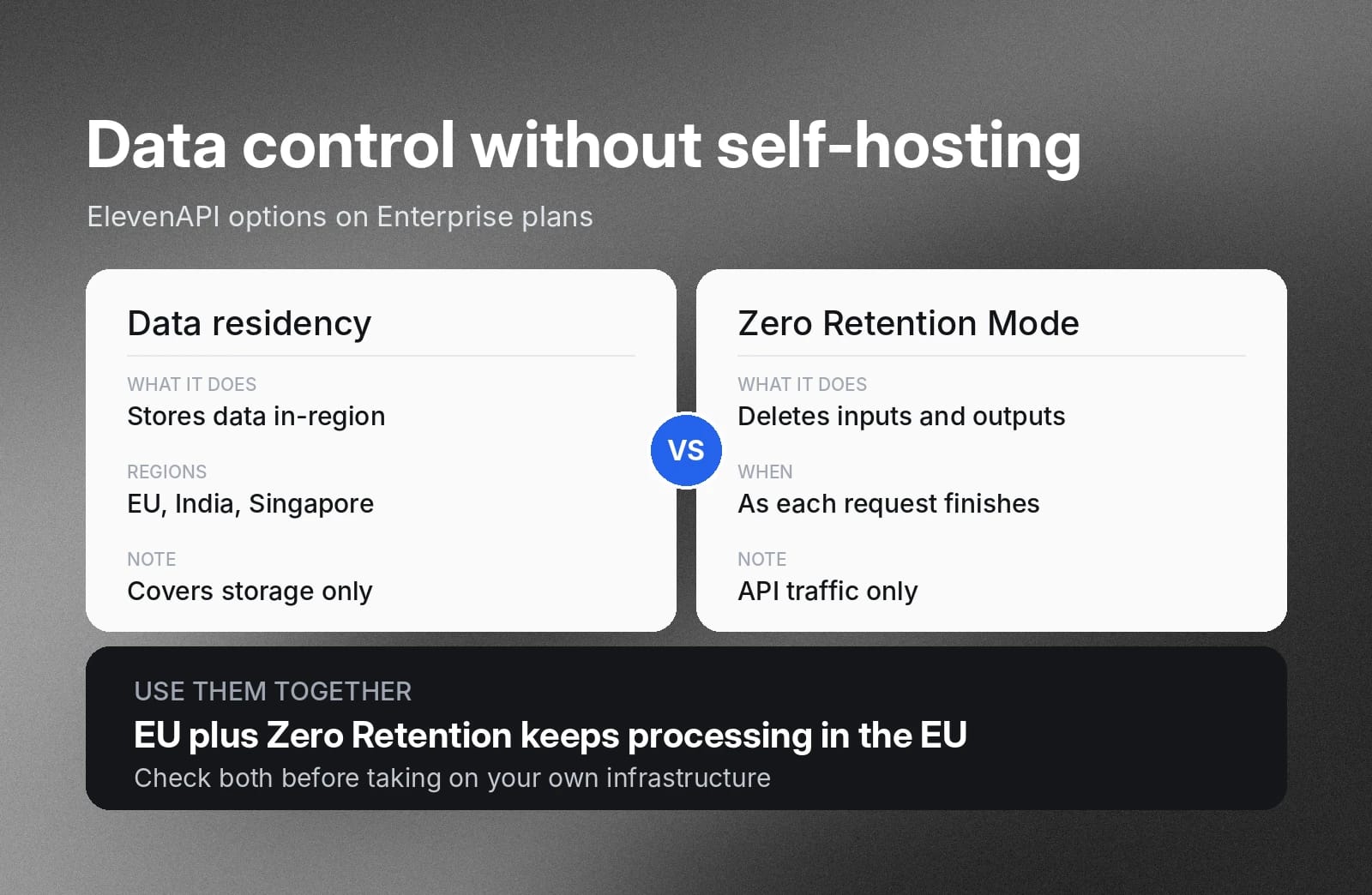
Existing Enterprise customers can request it through their success contact, and new prospects through sales. If your main reason for self-hosting is jurisdiction or retention, check whether these options meet your requirements before taking on the infrastructure.
What’s the difference between open weight vs. open source models?
Weights are the millions or billions of numerical parameters within a neural network that determine how it generates output. An open weight model makes these fully available for you to download, use, and customize to your needs.
But an open weight model does not include the full model source code or anything from the data pre-processing pipeline so you can see how it was trained. You only get the outcome of the training in the form of the weights. You can’t retrain the model from scratch if you discover any deep biases.
An open source model includes everything, including the weights, architectural scripts, and model and inference code, under some form of open license.
Open licensing considerations
Licensing for open source and open-weight models varies model by model. It’s important to check what the license for each model you’re considering allows you to do. Some licenses grant unrestricted commercial use, but not all. Some stipulate they’re specifically for research use only. Others specifically stipulate non-commercial use.
Others allow commercial use, but require full attribution of the model used in any commercially released products. That has downstream legal implications for any applications you develop incorporating such a licensed model. For example, if you used such a model for your customer service agent, it might require your customers to credit the model on external interfaces.
What does a free text to speech API cost at scale?
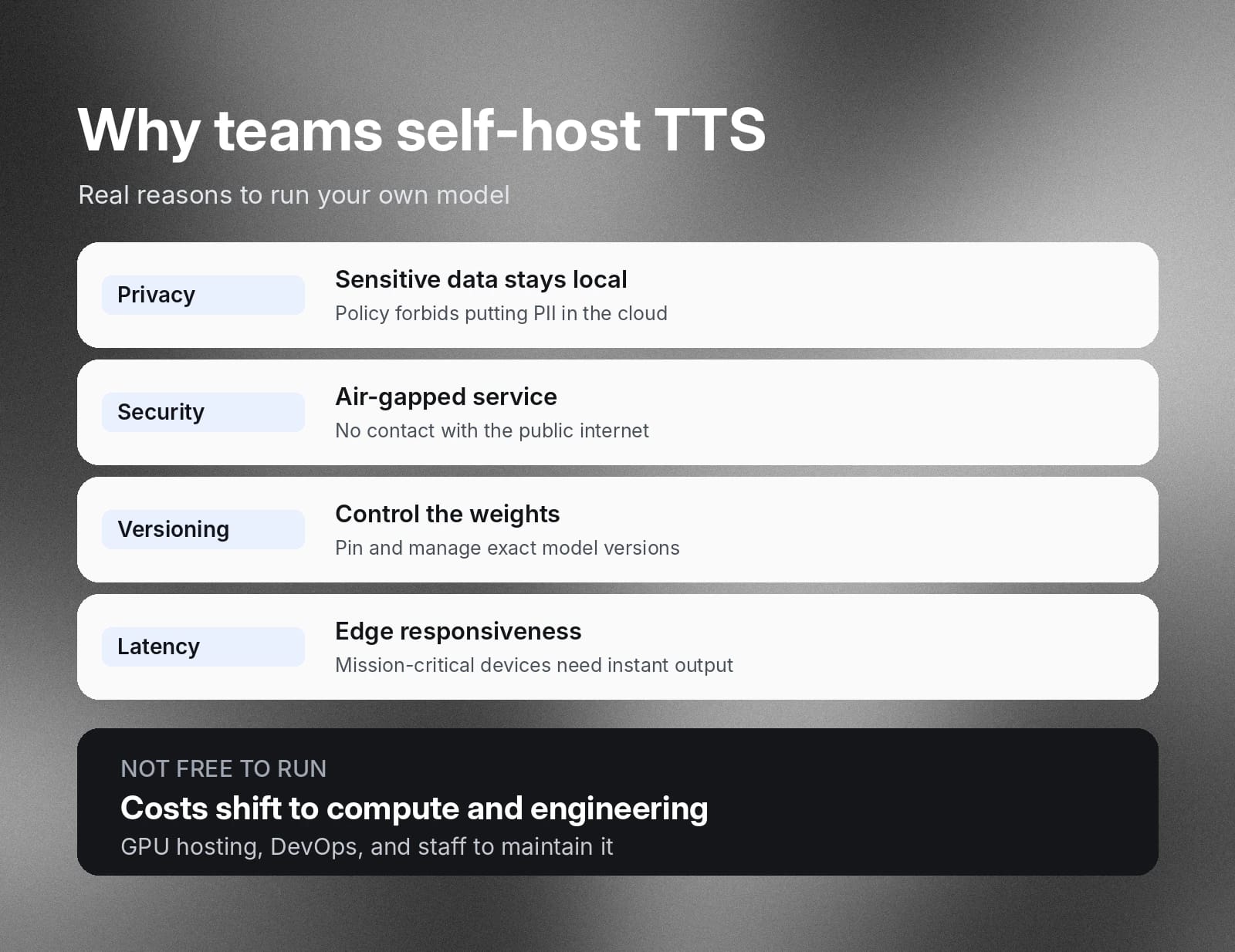
Open source TTS models are cost-effective in many scenarios, but they become so by shifting costs to hosting and development. Although free to access, they’re not free to run. Especially if you’re working at scale, this quickly becomes apparent.
Self-hosted TTS
Self-hosting shifts costs from access to the service to the compute infrastructure. You need to run the TTS service in your own data center or pay for GPU hosting in the cloud. That also incurs engineering and DevOps overhead to build and support the TTS infrastructure.
There are many real, legitimate reasons for organizations to choose to self-host TTS:
- Privacy: You can’t put PII or sensitive data in the cloud for policy reasons.
- Security: For regulatory or policy reasons, you need to run a local, air-gapped TTS service that doesn’t touch the public internet.
- Version control: You need strict control over your model’s weights.
- Latency: Mission-critical edge devices need your TTS model to be highly responsive.
It’s worth mentioning again that there are fully free, open source models whose license restricts or prohibits commercial use. If you’re evaluating open source TTS models, make sure you know which ones allow your business case.
Free tier TTS models
There are also free tier, or “freemium,” managed APIs. Usually, free tier plans have character quotas or monthly credit limits. Sometimes they’re less restrictive on workload scope but only make lower-quality TTS speech models available for free and lock the top-tier models behind a paid subscription. The freemium tier is a marketing channel for these other services.
How to evaluate voice quality, latency, reliability, and total cost
Free or paid, evaluate every model systematically to identify the one best-suited to your needs.
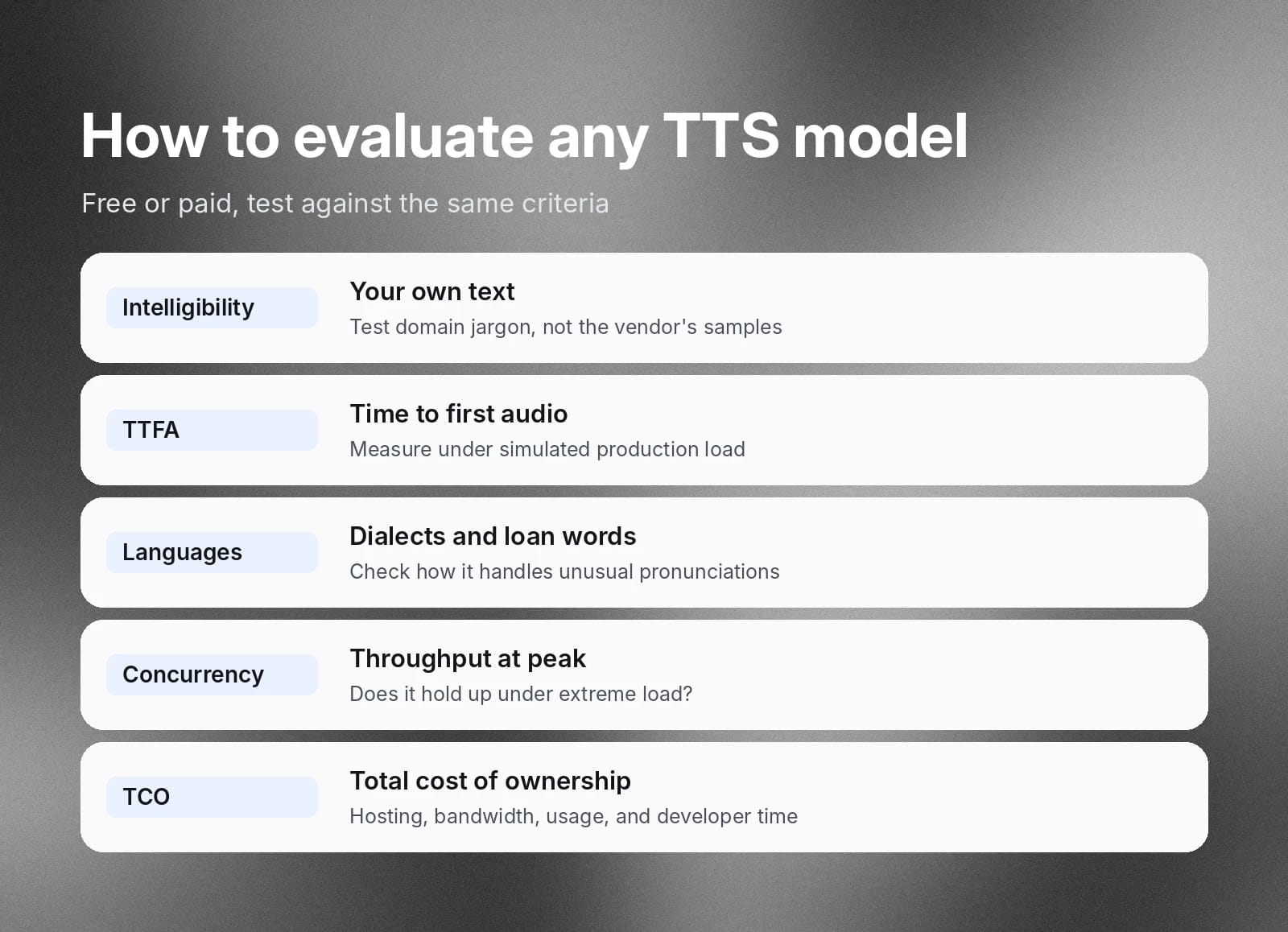
Feature
What to look for
Intelligibility
Use realistic text samples from your domain to test audio output quality, instead of the samples proposed by the vendor’s sales team. How does each model handle technical jargon and cadence?
Time to first audio (TTFA)
How quickly can each model generate final quality output? Make sure to simulate production load too.
Language & dialect support
How does each model handle pronunciations when encountering loan words, foreign languages, or obscure pronunciations in your domain?
Concurrency
Measure performance under extreme load. Does throughput stay at acceptable levels?
Total cost of ownership
Calculate your bottom line for each paid and free model under consideration. Include infrastructure hosting, bandwidth, cost per minute/character, and developer time.
Best local TTS models for your use case in 2026: What to look for in a local TTS model
For the best ranked local, open models specifically, see Hugging Face’s leaderboard.
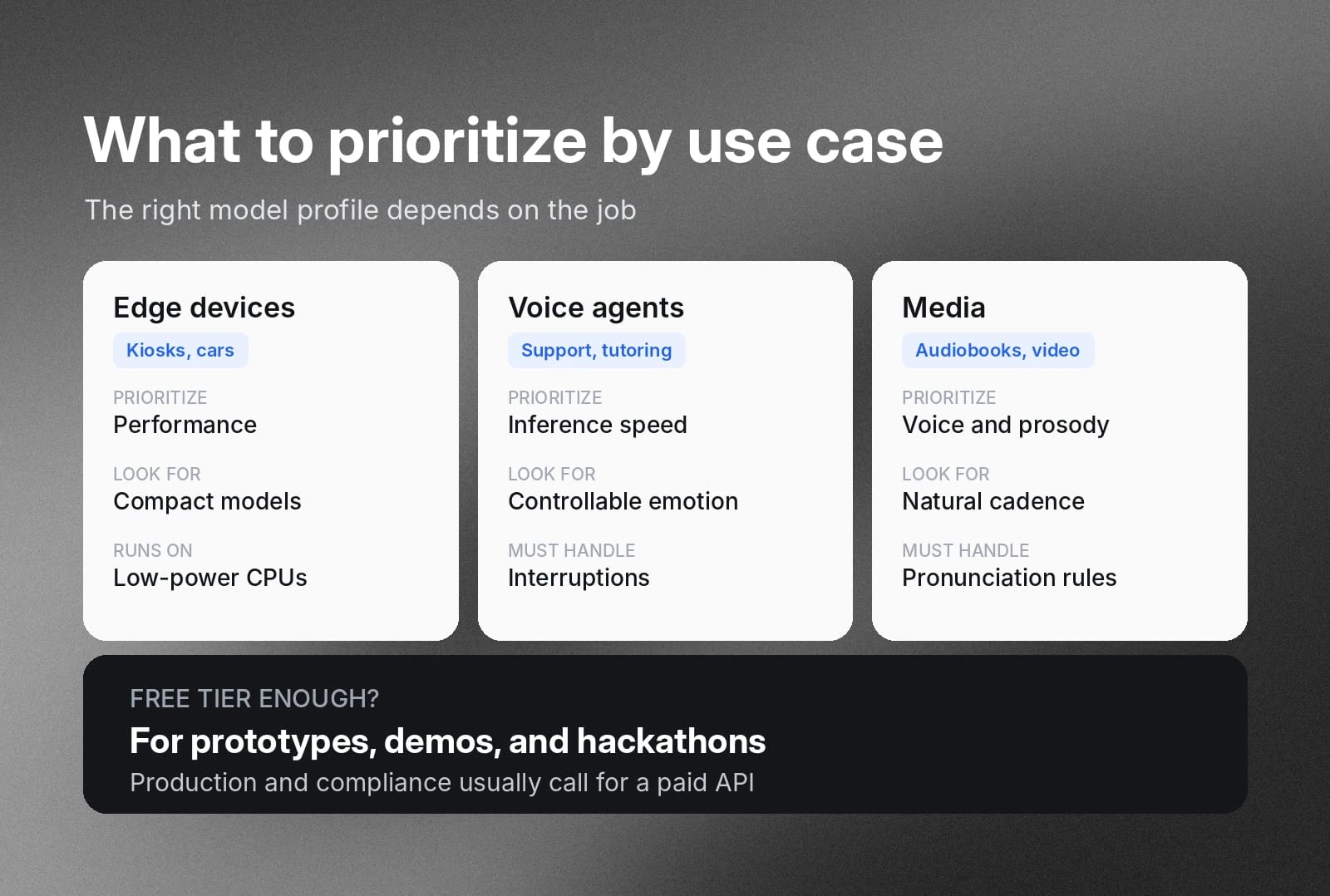
Here are the profiles you’re looking for when evaluating these models in each major TTS use case.
Edge deployments
Speech quality matters here, but in this use case you prioritize performance more. Models need to be ultra-lightweight to keep TTFA low while running on edge infrastructure. Look for compact models that can run efficiently on lower-power CPUs.
Examples: Smart devices (in-home or in-vehicle), check-in kiosks, assistive technology
Conversational agents
Speed of inference, speech quality, and interruption handling are the most important capabilities here. You’re looking for a TTS model that offers controllable style and emotion. In customer service roles, the person is also possibly in a heightened emotional state. They have a task they want completed or a problem solved and may be agitated about the situation. The agent needs to maintain a productive conversation that results in action.
Examples: Customer service agents, virtual receptionists, education and tutoring
Media production
Output speech quality (voice and prosody) typically matters more than any other feature in this use case. Speech length is longer, so you want a model with varied, natural cadence. It also needs to be responsive to customization with pronunciation dictionaries or phonetic tags. Strong multilingual support will also help ensure speech with many loan words, foreign pronunciations, or dialect sounds natural.
Examples: Audiobook narration, podcasts, online videos
Is a free TTS API enough for commercial use?
For small-scale, non-critical use cases, it often can be. Many internal or development tasks are good examples, such as prototyping, demonstrating proofs-of-concept, or hosting internal hackathons.
For production use cases where you need high-quality and reliable performance, especially when bound by regulatory compliance that requires enterprise-grade security certifications, a paid API may be the better choice.
Get started with ElevenAPI for production-ready speech
If you're looking for an out-of-the-box solution, ElevenAPI is for you. Access leading speech synthesis technology that’s ready for enterprise-grade applications without needing to self-host or wade through testing different OS options.
Get started today generating high-quality TTS for any use case with ElevenAPI or sign up to get your TTS API key today.
Frequently asked questions about open source TTS and paid APIs

Jack Limebear is on the Growth team, acting as a content writer and strategist across the blog and insights pages. Before ElevenLabs, he spent over a decade leading content strategy for organizations ranging from fast-growing SaaS startups to Fortune 500 companies. He holds a Master's degree in English Literature from the University of Cambridge.