Instant vs. Professional Voice Cloning: Key differences
- Written by
- Jack Limebear
- Published
- Last updated
ListenListen to this article
Speed vs. fidelity: that is the trade-off you choose between when considering Instant vs. Professional Voice Cloning.
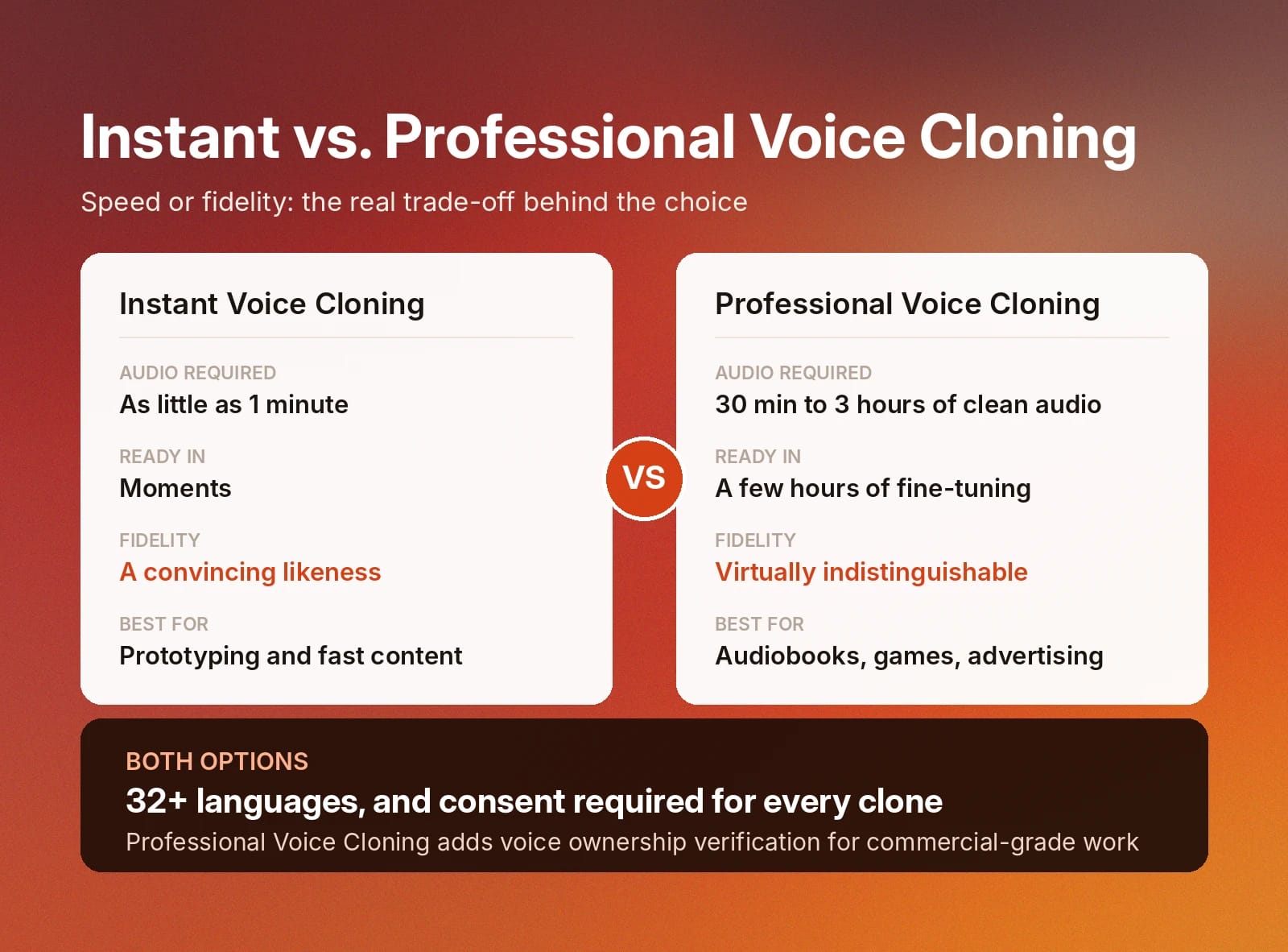
With Instant Voice Cloning (IVC), around a minute of voice data is enough to get started. Professional Voice Cloning (PVC) will need between 30 minutes and three hours of recordings, but produces a voice clone that is virtually indistinguishable from the original speaker.
This guide breaks down how each option works, where each excels, how to pick the right one for your project, and how to get started with voice cloning on ElevenCreative.
Summary
- Instant Voice Cloning creates a working voice replica in moments from a short audio sample.
- Professional Voice Cloning fine-tunes a dedicated model on more extensive recordings, capturing the subtleties of a voice for production-grade work.
- IVC requires around a minute of audio, while a PVC works best with 30 minutes to three hours of audio content.
- ElevenLabs requires explicit consent and voice verification before cloning.
- Choose an IVC for speed and a PVC for fidelity.
What is Instant Voice Cloning?
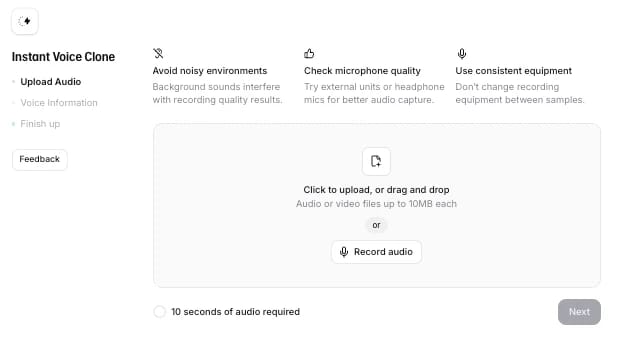
Instant Voice Cloning creates a digital replica of a voice from a short audio sample. You upload a clip of around a minute of speech and the system infers your vocal characteristics on the spot. As there isn’t any model training with your voice behind the scenes, your clone is ready to use in moments.
IVCs aim to capture the broad signature of a voice. Your tone, pitch, accent, natural prosody, and vocal quality all become considerations that the model uses to create a natural-sounding clone. Due to how little input audio is required, this is the fastest route if you want to clone your voice as quickly as possible.
What is Professional Voice Cloning?
Professional Voice Cloning trains a high-fidelity model of your voice using a much larger set of recordings. Instead of simply pinpointing the characteristics that make up your vocal identity, a PVC fine-tunes the clone on the quirks of your accent or the emotional inflection you commonly resort to. Everything from breath patterns to natural pacing becomes a part of your voice clone, helping to create a more realistic version of your voice.
A Professional Voice Clone will typically take 3 to 6 hours to process after submission. When using ElevenCreative Professional Voice Cloning, you’ll receive an email notification once training completes.
The result is a high-quality voice clone built for long-term or commercial-grade use. Below is a guide to recording a high-quality PVC with ElevenLabs.
For a more extensive guide on how to clone your voice with ElevenLabs, consult our in-depth voice cloning guide.
How does voice cloning work?
Voice cloning uses deep learning to analyze speech patterns and other distinctive vocal characteristics in an audio sample. While we can generalize here and include things like pitch and rhythm in the mix, there are hundreds of individual characteristics that make a voice unique.
Instant and Professional Voice Cloning share the same underlying technology but differ in terms of training depth. The former infers your voice from a small sample in real time, while PVC fine-tunes a dedicated model for hours on audio.
While not a linear relationship, the quality of a voice clone tends to scale based on the amount (and cleanliness) of the voice data you share.
Understanding the differences between Instant and Professional Voice Cloning
The right choice is the one that aligns with the reason you want to use a voice clone in the first place.
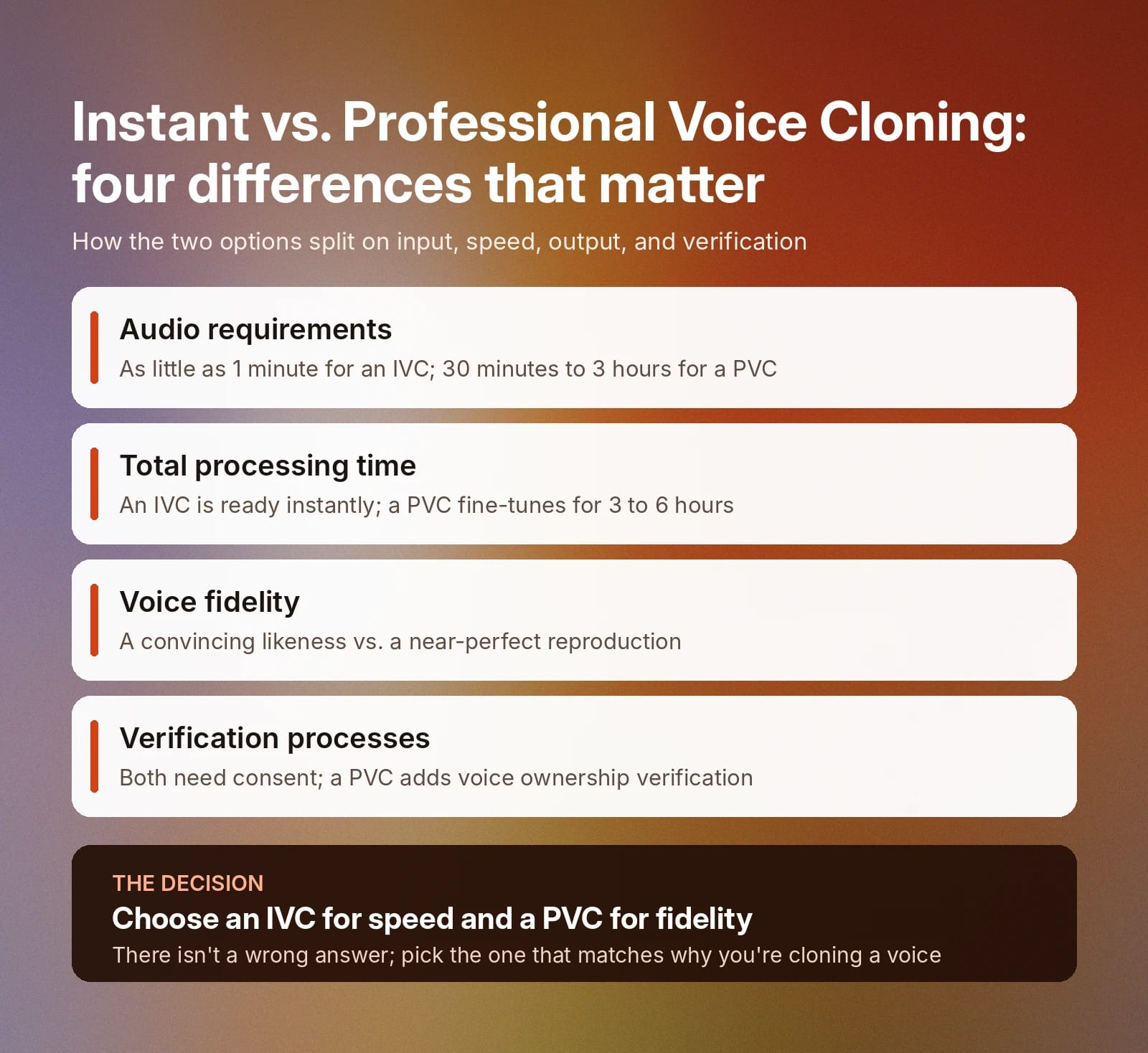
Here are four main differences between Instant and Professional Voice Cloning:
- Audio requirements: You can produce an IVC with around a minute of audio, meaning this is a go-to solution if you want a voice clone ready to go on the fly. PVC needs at least 30 minutes of clean, consistent recordings, although quality generally improves if you provide more audio data, up to a maximum of three hours.
- Total processing time: An Instant Voice Clone (hence the name) will be ready as soon as you provide your sample. A Professional Voice Clone goes through a fine-tuning process, which normally takes between three and six hours, meaning you’ll have to wait for the clone to become available.
- Voice fidelity: The final result of an IVC gives you a convincing likeness of your voice. A PVC reproduces your voice, right down to the finer details that make it your own.
- Verification processes: When producing a Professional Voice Clone, you’ll need to verify that you’re the owner of the voice being cloned, adding a layer of security needed for commercial work. The verification process involves you recording small samples that ElevenLabs compares against the voice in the longer samples you’ve provided. You’ll also need to confirm you have the right and the consent to clone a voice when using Instant Voice Clones, but the process isn’t as extensive.
Use cases for Instant Voice Cloning
Instant Voice Cloning fits into any workflow where speed matters more than perfect replication. An IVC still produces a convincing likeness of your voice.
The main use cases for Instant Voice Cloning are:
- Prototyping: If you want to test out ideas, run quick ad reads, try script variations, or experiment with different product voices before committing to full-scale production, an IVC will give you a working version in minutes.
- Video voiceovers: YouTube creators and social media teams can generate consistent narration at scale without needing to book recording studios.
- Podcast fixes: Misspoke during a podcast or messed up a segment? Use an IVC to correct the podcast and stitch in the new segment without having to re-record an episode.
- Product development: Add personal voice to apps and AI voice agents in minutes.
Use cases for Professional Voice Cloning
A Professional Voice Clone is for scenarios where voice is the main function or product. For content types that are voice-first, you need the highest possible quality. A PVC delivers that.
Here are the main use cases for Professional Voice Cloning:
- Audiobooks: Authors and publishers narrate entire catalogs in the author’s own voice without the need for studio sessions.
- Video game narration: Studios can generate character dialogue at scale with full emotional depth with a PVC.
- Voice actors: Voice actors can scale their presence online and take on more projects without having to record every line manually with a PVC.
- Accessibility: Text to Speech is a useful tool for boosting accessibility, with on-page audio guides allowing users to interact with text through audio. People who are losing their voice for medical reasons can also capture it with a PVC, preserving their voice long into the future for personalized TTS. If you’d like to hear more about our mission to empower 1 million voices, please read through our Impact page.
- Advertising and dubbing: If you want to localize a digital campaign into several languages, a PVC lets you scale across different markets with one consistent voice.
Quick-reference guide to Instant vs. Professional Voice Cloning
Is AI voice cloning legal and ethical?
AI voice cloning is legal when you clone a voice that you own or have explicit consent to use. However, laws vary by jurisdiction, with several regions regulating synthetic voices in commercial or political contexts. You should always verify the rules and regulations that apply to your own project.
ElevenLabs builds consent into the product. Voice cloning requires explicit permission from the voice owner. Professional Voice Cloning adds identity verification and built-in safety measures to detect and prevent misuse. Cloning someone’s voice without consent violates the ElevenLabs terms of service.
The ethical standard is the same as the legal one: Clone your voice, or get clear, documented permission before beginning.
Get started with Instant or Professional Voice Cloning on ElevenCreative
ElevenCreative gives you the option to create Instant and Professional Voice Clones in one platform. Get started by creating an IVC in moments for your media content or train a PVC for more in-depth production work that demands a near-perfect match.
Explore the full capabilities on the ElevenLabs Voice Cloning page, or sign up and clone your voice on the platform now.
Professional vs. Instant Voice Cloning FAQ

Jack Limebear is on the Growth team, acting as a content writer and strategist across the blog and insights pages. Before ElevenLabs, he spent over a decade leading content strategy for organizations ranging from fast-growing SaaS startups to Fortune 500 companies. He holds a Master's degree in English Literature from the University of Cambridge.