What is voice cloning and how does it work with AI?
- Written by
- Jack Limebear
- Published
- Last updated
ListenListen to this article
Cadence, natural prosody, accent, pronunciation. These are a few of the qualities that make your voice uniquely your own. Its personality, its rhythm, and what makes it identifiable to those around you. For most of human history, that linguistic and vocal complexity couldn’t be replicated. Not anymore.
Voice cloning now allows you to capture and use a life-like version of yourself in minutes. What once took hours of high-quality recording and time in a professional recording lab can now be done from the comfort of your home. Whether you’re using a voice model for business or just for fun, voice cloning is accessible and low-cost.
In this article, we’ll explore exactly what voice cloning is and explain how it works. We’ll touch on the AI tools that enable voice cloning in minutes and detail the various benefits that have made instant voice duplication a major asset to industries across the globe.
Summary
- Voice cloning uses AI to create a digital replica of your voice, aiming to capture your accent, tone, pitch, and cadence.
- Voice cloning moves through six steps: collecting voice samples, cleaning the audio, extracting vocal characteristics, training the model, synthesizing new speech, and deploying the finished voice clone.
- More input audio generally leads to higher quality final results, although only a few minutes’ worth of audio content is required.
- Businesses and creators use voice cloning for use cases spanning across faster content production, improving accessibility, building a consistent brand voice, and more.
What is voice cloning?
AI voice cloning is the use of artificial intelligence and machine learning to create a digital replica of someone’s voice. After training the model on recorded speech data, users are able to synthesize completely new speech in their own voice with text to speech. A well-trained AI voice clone is able to closely resemble the original speaker’s accent, intonation, pitch, pace, and resonance.
Leading voice cloning software can create a digital replica that is able to express complex human emotions and respond in near real time. With ElevenCreative, you only need a few minutes of audio data to generate a voice clone.
Want to try it for yourself? Upload a recording to our voice cloning page to see your digital voice in action in seconds.
How does AI voice cloning work?
AI voice cloning uses a combination of technologies to capture and replicate the essence of a person’s voice.
Three main systems work together to clone a voice:
- Deep learning: A subset of machine learning that allows models to identify complex and subtle patterns in audio data across millions of examples. By working at scale, deep learning models can iterate and become better over time.
- Neural networks: Neural networks provide the engines behind voice cloning, using deep learning to understand particular vocal quirks of a person’s speech, like accent or tone.
- Voice encoders: Voice encoders process and analyze audio samples to extract a speaker’s vocal identity. They work by encoding the phonetic structure and other vocal features into a numerical representation that machine learning models understand. When creating new speech, this representation is decoded to synthesize the original speech pattern factors.
Although you can produce a voice clone in just a few minutes, the most reliable and high-fidelity voice clones use more input voice data.
Here’s a high-level overview of how AI voice cloning works.
Step 1: Voice data collection
A user records a few short clips of their voice. This might happen during a dedicated recording session or come from older videos with clear audio. Especially for rapid duplication, ElevenLabs systems work on very little input.
However, it’s important to note that the quality and quantity of recordings in this stage directly influence the final product. If you want to make a voice clone that is highly similar to your real voice, then provide 2-3 hours of audio. Beyond that point, you won’t generally see further improvements.
Step 2: Audio cleanup and data processing
Before internal systems process the audio data, they first clean audio recordings to improve their quality. For vocal data, cleaning might include:
- Normalizing audio levels
- Trimming clips to remove moments of silence
- Identifying and removing background noise
Again, the quality of the samples you use is extremely important here. This step aims to holistically improve your audio data, making for the best possible AI voice clone.
Step 3: Vocal feature detection, extraction, and model training
AI systems work together to identify the characteristics that make a speaker’s voice unique. The factors included here are fairly extensive, as nuanced aspects of human speech can make an enormous difference when it comes to creating a human-like voice. Everything from pitch and tone to prosody and even breath patterns is detected, extracted, and recorded.
This speaker embedding is then passed to a pre-trained synthesis model, which maps out the relationship between these speech sounds and the speaker’s vocal characteristics. The goal in this step is to produce a high-quality digital representation of the input voice. More advanced models will have several extra stages here for fine-tuning and iterative improvement.
Step 4: Speech synthesis and deployment
After a model has been trained on your voice data, it’s ready to bring new text to life. You can type words in a text to speech program, selecting your voice as the model that will read them.
After hitting play, you’ll hear the product of the model synthesizing your voice based on the words you’ve written. To make the output recording as realistic and natural as possible, an AI voice clone attempts to recreate the exact speech patterns and pronunciation you used in your input.
Once you’re happy with the quality of your voice clone, it’s time to deploy. You’ll be able to embed your voice in other voice AI workflows you have. Whether you’re creating voice-overs for YouTube videos or developing a personal voicemail, your voice will be ready to go.
In professional environments, there is a much larger gap between model training and deployment. Studios may go back into the raw data and adjust the files they offer, refine vocal pronunciation, or iteratively fine-tune voice audio to improve it over time.
Benefits of voice cloning
Voice cloning is more accessible than ever. With a few minutes and your phone, you’ll be able to bring your digital voice clone to life. Voice cloning has many advantages, whether you use your voice for work or just for fun.
There are numerous reasons that a business or individual may want to use a voice clone:
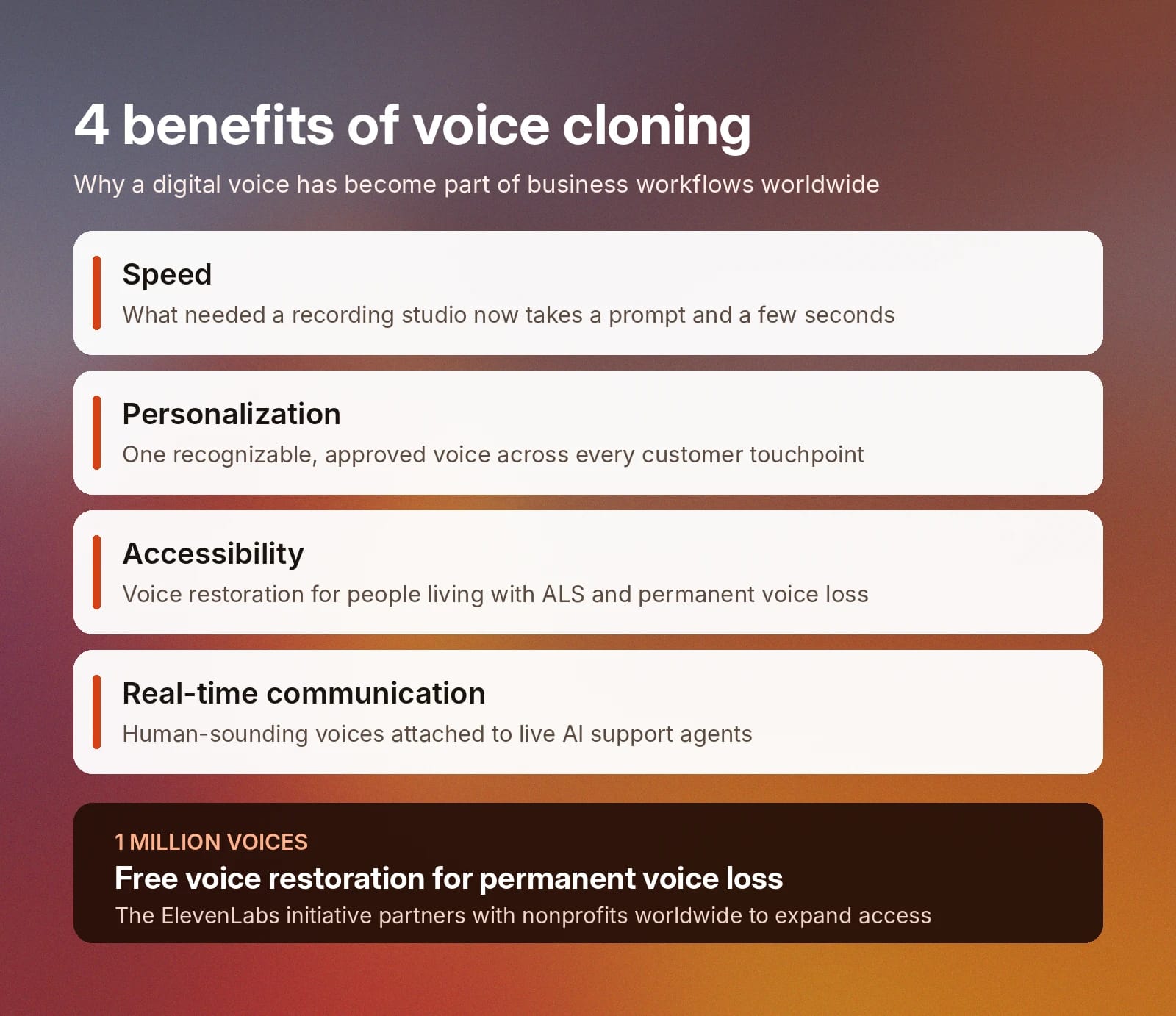
- Speed: After cloning a voice, any content creation that needs vocal audio becomes extremely easy and convenient to generate. What would previously have required a professional recording studio now only takes a prompt and a few seconds. Especially in production environments, voice clones can significantly accelerate existing workflows through their speed and agility.
- Personalization: Brands and content creators want to maintain a recognizable voice across every single customer touchpoint. With the rise of voice-based site interaction, being able to deliver support in an approved, customized voice brings a new level of brand personalization.
- Accessibility: For people living with ALS or other degenerative diseases that affect speech, voice cloning offers the transformative potential of giving someone back their voice. The 1 Million Voices initiative at ElevenLabs works to provide free access to voice restoration technology for people living with permanent voice loss around the globe. We’re currently in partnership with numerous nonprofits to realize that vision.
- Real-time communication: Voice cloning naturally connects to other AI technologies, like voice agents, to give customers a real-time experience. Businesses can attach high-quality, human-sounding voices to their AI customer support agents, leading to better customer experiences.
These benefits demonstrate why voice cloning has become an integral part of business workflows around the world. From content creation to healthcare, voice clones can bring a layer of humanity to customer-facing interactions.
Recent advancements in voice cloning technology
For someone who’s new to what voice cloning is, the ability to create a high-fidelity model in minutes is frankly unimaginable. Voice cloning needed hours of professional, studio-quality recordings and technical editing. Now, with your phone in your hand, you’ll have a working model before you know it.
That progress hasn’t materialized out of nowhere (nor has it arrived overnight). Here are some of the recent advancements in voice cloning technology that have led to these capabilities:
- Reduction in audio needed: Modern AI systems train on vast datasets of human speech, building up an understanding of the nuances of human speech at scale. With these reference points, a model can adapt to a new voice input by using its existing knowledge. These models never have to start from scratch, accelerating development and reducing the total amount of audio required significantly.
- Multilingual cloning: Models train across a wide variety of languages, learning the acoustic and prosodic structures that are unique (and shared). Human speech, despite the language, often shares similar emotional characteristics, allowing you to record input in one language and produce speech in a different one.
- Real-time cloning: Speech modeling used to rely on batch processing to ingest large amounts of data at once and then process it. A whole host of infrastructural improvements spanning from faster voice encoders to more effective synthesis architectures have reduced the latency of this process. You can now produce speech in real time, enabling an array of new use cases.
These improvements compound and interrelate. As one component of the end-to-end process evolves, its latency savings pass to the wider system. And, progress isn’t slowing down anytime soon.
Popular applications of AI-generated voice cloning
Voice cloning is now a part of day-to-day processes of industries all over the world. From publishing houses to educational institutions, AI-generated voice cloning is being used to solve accessibility problems and accelerate production.
Here are a few popular use cases of AI-generated voice cloning:
Content creation
From YouTubers and Podcasters to video producers and audiobook studios, businesses use voice cloning to generate narration and fix recording mistakes quickly. It enables faster turnaround times, reduces back-and-forth with editing, allows for script revisions without rerecording, and allows creators to scale content production. In many of these cases, voice makes high-quality voice content more accessible to smaller teams.
Bertelsmann partnered with ElevenLabs to streamline audiobook production across its portfolio. 36 companies across the Bertelsmann Group use ElevenLabs to improve production timelines, test new creative directions, and bring content to audiences across Europe.
Accessibility
Voice cloning provides individuals with degenerative conditions a method of preserving their voice before it’s lost, empowering them to speak long after natural speech becomes difficult. Beyond individual use, voice cloning offers low-cost access to high-quality voice models. With these models, businesses can scale their audio content in a way that wasn’t previously possible.
Shortly before his passing, ElevenLabs partnered with actor Eric Dane to recreate a digital copy of his voice. The voice model offered a way for his daughters to hear their father as he truly sounded. Speaking about the need to expand access to this technology, Rebecca Gayheart Dane stated that his ElevenLabs voice “made him emotional to have that part of himself back, and to know our daughters would always be able to hear his voice.”
Education
Voice technology allows educators to transform their lecture presentations into fully recorded files they can share with students. Instead of having to record every lecture, teachers can write up their content and have their AI voice clone do the talking. Especially with multi-lingual reproduction, tutors can record information in one language and deliver it to students in their native tongue.
PhysicsWallah partnered with ElevenLabs to bring its AI tutoring solution to life. With real-time, natural-sounding voice explanations, the platform has been able to use an AI voice while resolving over 90% of student questions. As 52% of PhysicsWallah students prefer audio-first learning, ElevenLabs was the natural choice.
How to recognize and avoid voice cloning scams
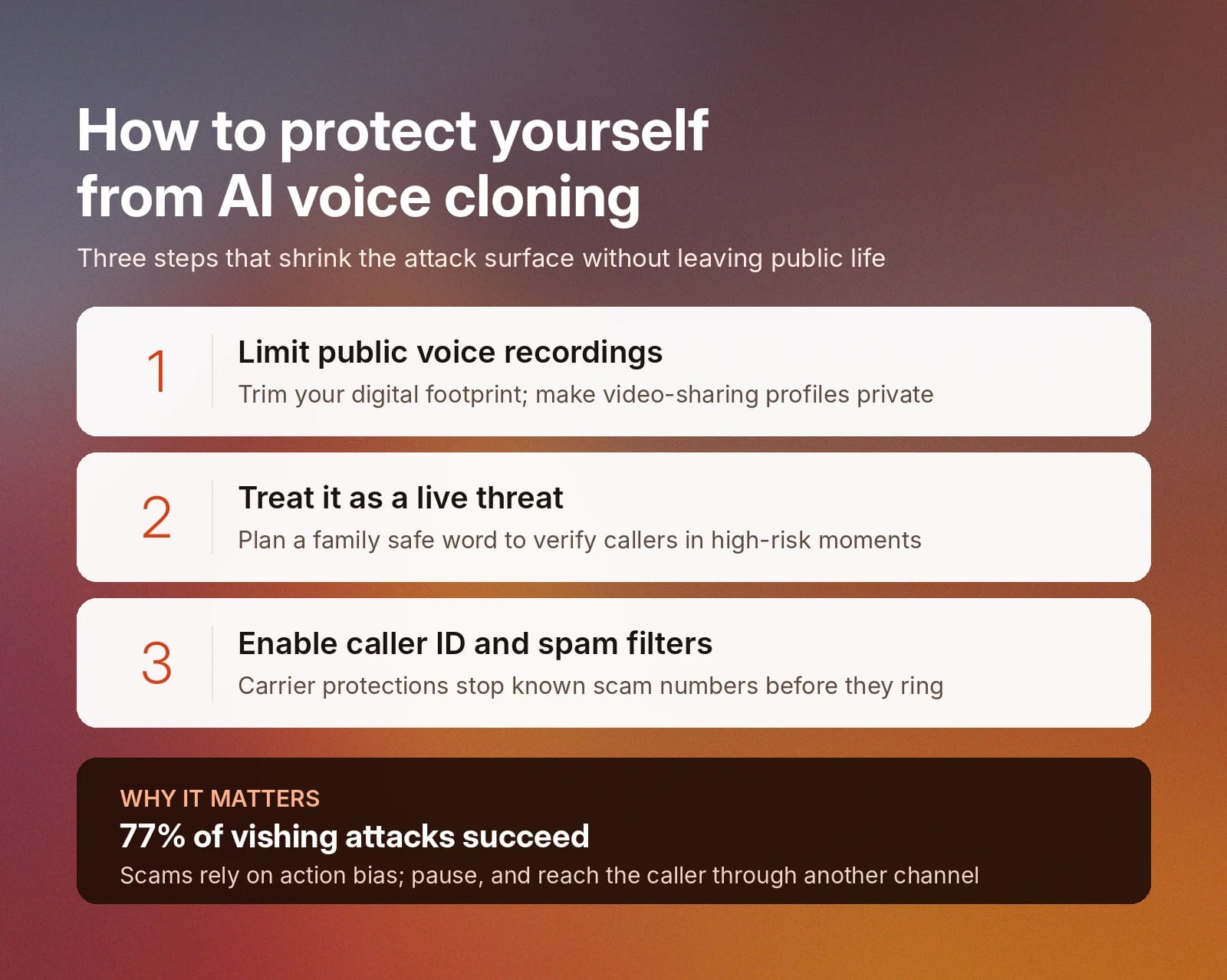
Voice cloning scams are a fairly novel threat vector that many individuals aren’t prepared for. Most of us know how to spot text-based phishing, but vishing (voice phishing) doesn’t have the same familiarity. In part, this is why 77% of all vishing attacks succeed, costing victims significant sums each year.
These scams use a cloned voice of the target’s loved one, often a spouse or family member calling urgently to siphon money. Like all phishing, they rely on action bias: the attacker wants you to react before you think. If you pause, think critically, or reach the “caller” through another channel, the illusion falls apart.
Be especially wary of requests to transfer money. An unknown number should raise the alarm further, even if the voice sounds familiar.
Above all, always take an extra moment to assess the situation and think critically. If you detect a voice phishing scam, report it to the local authorities and block the number.
How to protect yourself from AI voice cloning
ElevenLabs operates on a multi-layered safety system designed to prevent misuse. It blocks the cloning of celebrity and high-risk voices, requiring verification to access its Professional Voice Cloning mode and actively monitoring the platform for policy violations.
We also offer a public AI Speech Classifier, which allows you to check whether an audio clip was generated using ElevenLabs. These layers of protections mean that bad actors face significantly more friction than legitimate users.
From a personal perspective, here are three steps you can take to protect yourself from AI voice cloning:
- Limit publicly available voice recordings: Where possible, remove publicly available recordings and voice data from your profiles. Private your social media platforms if they share video content and limit your digital footprint to give bad actors as little to work with as possible.
- Understand this as a potential threat: Voice cloning scams are active at this very moment. Be sure to understand how they work and treat incoming phone calls from unknown numbers with caution. You could even plan a family safe word that verifies callers as the real person for high-risk situations.
- Enable caller ID and spam filters: Enabling any phone filtering protections that your device or carrier offers will help to prevent known scam numbers from reaching your phone. While not perfect, these can go a long way to stopping these scams before they begin.
None of these require you to stop using voice cloning technology or remove yourself entirely from public life. It’s about staying informed and up-to-date about what potential threats can look like, and adapting accordingly.
How ElevenLabs prevents unauthorized voice cloning
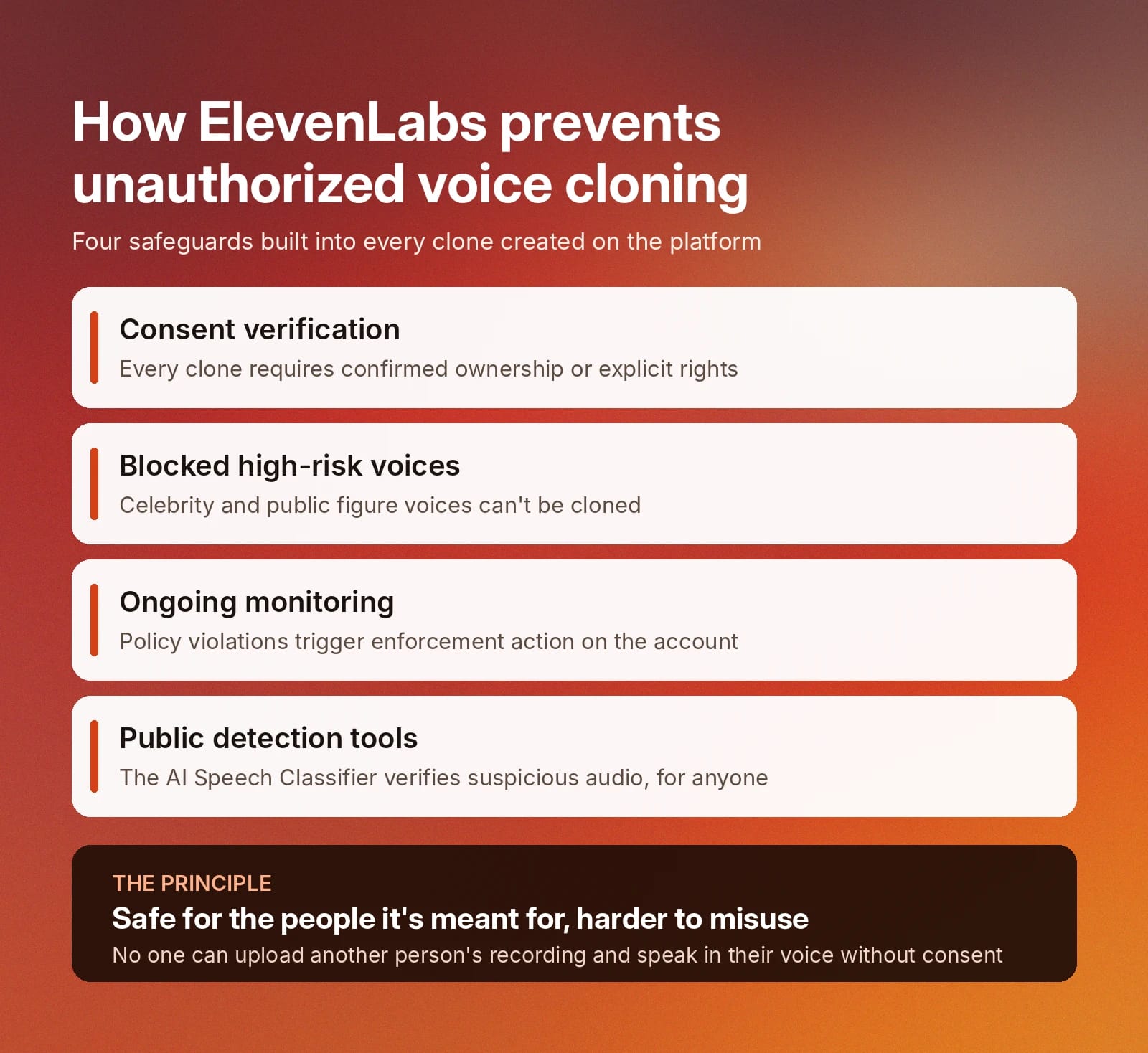
Cloning a voice you don't have permission to use isn't something ElevenLabs allows. Every voice clone created on the platform requires the speaker to verify that the voice is their own or that they have explicit rights to use it.
A few of the safeguards built into this process:
- Consent verification: Before a voice clone can be created, ElevenLabs requires confirmation that the person creating it owns the voice or has permission from the voice's owner to clone it. For Professional Voice Cloning, this includes additional identity verification steps.
- Blocked high-risk voices: ElevenLabs blocks the cloning of celebrity, public figure, and other high-risk voices to prevent impersonation.
- Ongoing monitoring: The platform actively monitors for policy violations and misuse, and accounts found violating these policies are subject to enforcement action.
- Public detection tools: Our AI Speech Classifier lets anyone check whether a piece of audio was generated using ElevenLabs, giving individuals and platforms a way to verify suspicious content.
These protections mean that someone can't simply upload a recording of another person and generate speech in their voice without that person's consent. The goal is to make voice cloning safe and accessible for the people it's meant for, while also making it meaningfully harder for anyone attempting to misuse it.
Get started with ElevenCreative for seamless voice cloning
Whether you’re learning more about voice cloning for fun or are ready to create an enterprise-scale voice AI chatbot, ElevenCreative is built to make quality voice output straightforward. Clone your voice on a short audio sample or go in-depth with a production-ready voice clone today. Deploy your new voice across 90+ languages, all while keeping your vocal identity front and center. Once cloned, your voice can power everything else you build in ElevenCreative, across Text to Speech and Dubbing to full video and Studio projects.
Create your voice clone today with ElevenCreative or explore the docs for more information.
What is voice cloning? FAQ

Jack Limebear is on the Growth team, acting as a content writer and strategist across the blog and insights pages. Before ElevenLabs, he spent over a decade leading content strategy for organizations ranging from fast-growing SaaS startups to Fortune 500 companies. He holds a Master's degree in English Literature from the University of Cambridge.