- Insights
What is AI dubbing?
- Written by
- Jack Limebear
ListenListen to this article
Dubbing has been central to cinema since its earliest iterations.
In November of 1928, The Observer reported “A new chapter of film evolution is beginning", referring to the first continuous “all-talkie” cinema project that featured synchronized voices alongside moving pictures.
For decades, dubbing remained a largely manual process. Fast forward almost a century and dubbing has never been easier or more widely used. From the extensive YouTube library that automatically dubs video content into other languages to marketing firms localizing ads for different audiences, dubbing is everywhere.
AI dubbing has radically expanded what’s possible here. Across advances in speech synthesis, voice cloning, and automatic translation, AI dubbing systems can translate spoken dialogue into new languages while preserving the expressiveness of the original content.
In this article, we’ll explain exactly what AI dubbing is, how it works, and how it’s enabling global localization workflows for enterprises and creators around the world.
Summary:
- AI dubbing automatically replaces a video’s original voice track with speech in a new language while preserving features of the voice, such as cadence and emotion.
- The process involves transcription, translation, voice cloning, speech generation, and audio synchronization.
- AI dubbing integrates into workstreams across entertainment, content creation, customer support, and more.
- Reputable AI dubbing platforms build security, consent verification, and misuse monitoring into their workflows.
- ElevenCreative offers a fully automated AI dubbing workflow that supports 90+ languages.
What is AI dubbing?
AI dubbing is the process of automatically replacing a video’s original voice track with audio in a different language. It leverages artificial intelligence to translate speech into multiple other languages while maintaining the natural characteristics of the original speaker’s tone, emotions, cadence, and style. In other contexts, you might see AI dubbing called either automatic or machine dubbing.
Under the hood, it combines transcription, machine translation, voice synthesis, and audio synchronization. We break down each step in the how does AI dubbing section below.
In advanced systems, AI dubbing can even retain the emotional nuance of a phrase, mapping out its tone, emotion, speaking pace, and emphasis to ensure users get the same experience despite the output language.
What are the use cases of AI dubbing?
In any field where video content is consumed by multiple audiences (whether that’s film, digital media, customer support, journalism, or something else entirely), AI dubbing makes an enormous difference.
Here is a quick overview of some use cases of AI dubbing and why it’s a useful addition to product workflows in each field:
- Media and entertainment: One of the most common use cases of dubbing is to localize movies, podcasts, TV shows, or other voice-based media for international audiences. Mati Staniszewski and Piotr Dabkowski, the co-founders of ElevenLabs, used to watch movies dubbed into Polish with robotic, monotone voices. They set out to solve that flat experience by building the first human-like AI voice model, capturing the emotional texture of language across 90+ languages.
- Content creators: YouTubers or other content creators typically have audiences that span multiple languages. With AI dubbing, users can experience their favorite content in their own language, without the creator needing to record multiple versions of the same video.
- Marketing and advertising: Localizing content into different languages allows marketing teams to advertise across the globe with the same marketing materials, representing enormous cost savings while boosting brand visibility.
- Customer support: Across video tutorials and help center walk-throughs, being able to instantly dub videos using AI helps customers from around the world access your content.
- Journalism: With automatic dubbing, publishers can distribute video reports to international audiences without the laborious manual localization process.
- Non-profits and governments: Using machine dubbing allows governments and NGOs to distribute their information to the public in the most accessible format possible. Whether it’s health guidance or updates on community-based initiatives, AI dubbing allows users to interact in the way that suits them best.
Where there is an audience in more than one language, there is a place for dubbing.
How does AI dubbing work?
AI dubbing is a composite process where several different tools work together to transform audio from one language to another.
There are five main steps to AI dubbing. Here is a high-level overview of the process:
- Transcription and analysis: An STT system converts the original audio into text. The system will also analyze other components like speaker identity, timing, vocal characteristics, and emotion to create a detailed representation of the source audio.
- Translation: A model translates the script into the target language while preserving important context like its intent, emotion, style, and meaning. Modern translation models can even substitute colloquialisms and idioms into a close match in a target language, helping to accurately lift and shift the full context of a sentence.
- Voice cloning: For workflows where voice cloning is enabled, the system will create a digital representation of the original speaker’s voice in a new language. The dubbing agent uses this to retain recognizable elements of the speaker’s identity across different languages. In some workflows, the model will simply use an existing voice in the target language.
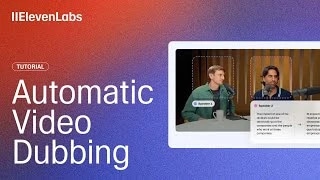
- Speech generation: A Text to Speech model then uses the translated dialogue and chosen voice to generate a new audio track in the target language. Dubbing v2 captures the speaker’s intonation and tone and transfers it across languages, making AI dubbing feel natural and expressive.
- Synchronization: Where necessary, the output’s timing and speed are slightly modified to ensure the dubbed audio closely matches what you see on-screen.
What are the differences between AI dubbing and human dubbing?
Both AI dubbing and human dubbing have the same final goal: to make content accessible in a new language. The main difference is in how quick and expensive that end-to-end process is.
From hiring voice actors and employing a post-production team to align audio and video data to renting out a recording studio, there are a lot of moving pieces.
AI dubbing collapses the entire process into a software pipeline, resulting in far less manual work and a scalable, multilingual output. Here are the main differences between AI dubbing and human dubbing:
- Faster turnaround: AI dubbing can produce a localized version of content in a matter of hours, while human dubbing in a studio could take several weeks or months.
- Lower cost: AI dubbing is significantly more cost-effective than human dubbing as it removes the need for studio rentals, voice actor fees, vocal directors, and translators, which makes it practical to localize into even languages with low audience demand.
- Wider reach: AI dubbing is highly scalable, as you can upload an audio file in one language and receive the output in numerous other languages. Dubbing scales to however many languages you want to service, allowing creators and studios alike to expand their reach to a global audience. Because each human dubbing project requires its own extensive pipeline, the traditional approach isn't nearly as scalable.
- Creative control: Human dubbing still has the edge when it comes to granular creative control. Especially if a director wants to make changes to how a scene feels in another language or many localization edits are needed on the script, then human-based dubbing is a more effective option.
At ElevenLabs, we’re passionate about ensuring voice actors have numerous opportunities in the AI-age of dubbing. Anyone can earn by sharing their Professional Voice Clone in our Voice Library, with payouts whenever your voice is used by paid subscribers.
Is AI dubbing safe? What you need to know about privacy and security
Like all AI technology, AI dubbing is safest when deployed with the appropriate safeguards and in line with governance policies. Reputable AI dubbing services will always build security, transparency, consent, and compliance into every stage of their workflow.
At ElevenLabs, we have the following protections to ensure AI dubbing is safe:
- Strict security protocols: We use enterprise-grade security controls to help protect uploaded audio, video, and voice data throughout the dubbing process.
- Verification and consent requirements: When working with voice cloning, we always require verification that the user has a right to recreate a digital replica of a voice. Especially in the case of high-risk voices (like public figures), we block cloning access without explicit permission.
- Zero tolerance for violations: We actively monitor our platforms for misuse and ban accounts that violate our policies.
For more information, consult our safety practices.
An important note is that dubbed content is generally considered derivative work, which means that organizations need to ensure they hold the necessary rights to the original video, audio, music, and any underlying creative assets before dubbing. Licensing agreements that permit distribution in one language may not extend to the same rights in a translated version, meaning you need to consult your legal team for guidance.
To use AI voices safely, be sure to partner with the best AI dubbing services that have all of these safeguards in place.
When should you use AI dubbing over subtitles?
AI dubbing works best when creators want to translate the experience their content offers faithfully from one language to another. While subtitles do allow users in other languages to experience content, they have to read a translation on screen while doing so, which may dampen the experience for some users.
By fully recreating the content in another language with AI dubbing, you maintain a consistent experience for your audience regardless of their native language. Dubbing is also important for accessibility, as it expands the reach of your content to users who may have a visual impairment that doesn’t allow them to read subtitles.
If in doubt, you can use both. Dubbing enables a better primary viewing experience, while subtitles give users who prefer to read along a way to do so.
Get started with ElevenCreative for seamless AI dubbing
AI dubbing expands the reach of your content to new markets, allowing users around the globe to engage in a way that feels natural to them. ElevenCreative combines an expansive voice library with a full production workflow, allowing you to dub a video into 90+ languages without coordinating separate vendors for translation, voice acting, and synchronization. Our dubbing pipeline handles the end-to-end dubbing experience in one pass.
With Dubbing v2, we pushed the limits of what was thought possible with AI dubbing. Over 1M creators and leading enterprises are already leveraging our fully automated workflow to dub content while capturing its emotion and context.
Sign up for an ElevenCreative account to begin dubbing today or contact sales if you want to create an enterprise-scale dubbing engine.