
Webinar Recap: How Cars24 Automates 3+ Million Minutes of Sales Calls with Voice AI
- Written by
- Ruta Bhatt
- Published
ListenListen to this article
Cars24 is running production voice agents at scale across 13 languages.
This post recaps Behind the Agent: How Cars24 Automates 3+ Million Minutes of Sales Calls with Voice AI featuring Jayesh Gupta, Head of AI and Innovation at Cars24, who walked through exactly how Cars24 built and deployed its voice AI system - from the first simple use case to a multi-agent architecture handling millions of minutes of customer conversations.
Why voice AI at this scale matters
Cars24 is one of India's largest used-car marketplaces, with operations across India, UAE, and Australia. They sell 4,000 - 4,500 cars per month, run 100,000+ inspections, and facilitate 22,000+ test drives.
That is before accounting for financing, post-delivery support, fine payments, and loans against cars. Their sales funnel alone spans 30 to 45 days per customer.
75% of their buyers are first-time car owners. For these customers, buying a car is not a transaction. It is a financially significant, emotionally loaded decision. That means 70 - 80% of the Cars24 product is not the app. It is the conversation. Human, guided, assisted sales at every stage of the funnel.
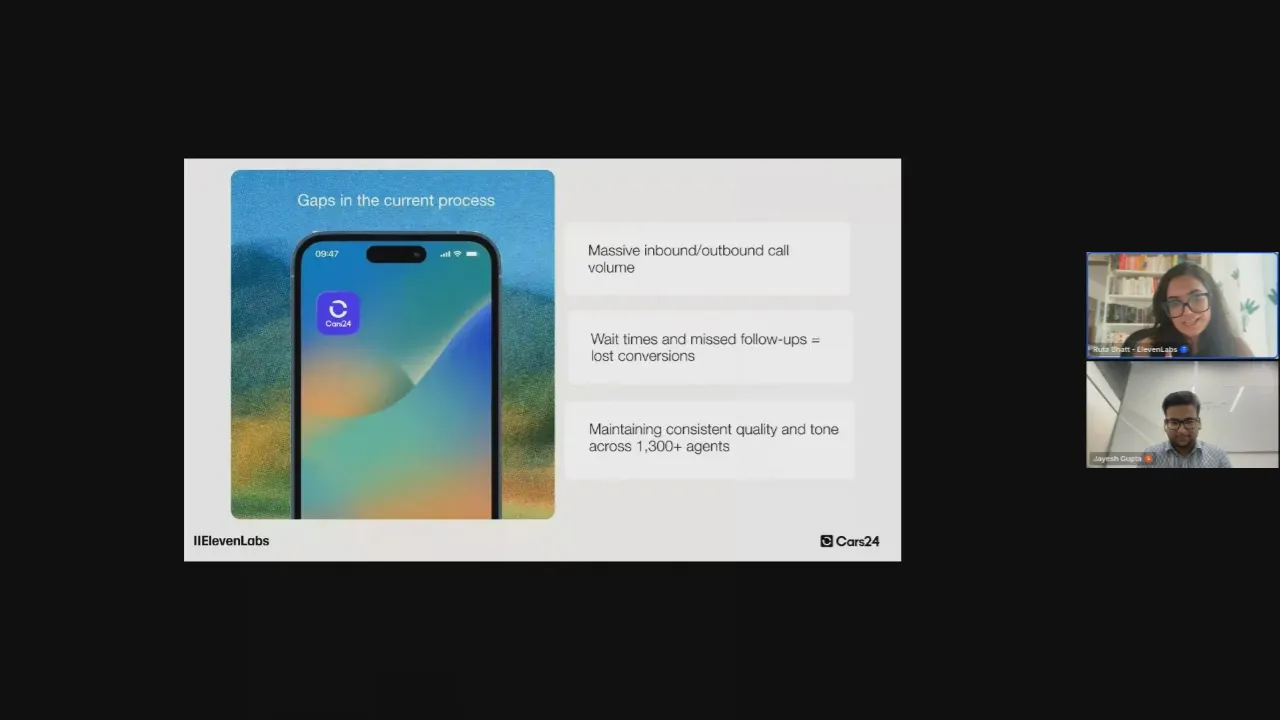
Before AI agents, the system was slowing down. Customers called the wrong teams - the sales team would be contacted for support use cases, leading to a longer wait time and inefficient customer experience.
Wait times were getting longer. Follow-ups got missed across a 30-day funnel.
Managing everything from lead qualification to loan documentation, the operation was expensive and hard to scale.
Today:
- 25% of all call volume is automated
- Nearly half of sales is assisted by voice AI
- Calling costs have dropped 50%
Demo 1: The Cars24 negotiation agent
Scenario: A Cars24 voice agent calls a seller who is considering selling their car, and negotiates in Hindi to convince them to choose Cars24 over competing platforms.
What was shown:
- The agent conducts a full sales negotiation in Hindi
- It handles objections and competes against other platforms in real time
- The conversation sounds natural, with low latency and no robotic pauses
- The agent closes the seller on committing to Cars24 during the call
Why it matters: These agents are doing active sales, handle ambiguity, push back on objections, and drive a conversion decision — all in a language that matches where the customer is most comfortable. Cars24 has found that language match directly increases speaking time and business outcomes.
Demo 2: Multi-agent orchestration to do a cross-sell
Scenario: A customer missed an inspection appointment. A qualification agent calls to reschedule, detects upgrade intent, and transfers the call live to a sales agent who picks up the conversation without losing context.
What was shown:
- Agent 1 (Sneha) opens by addressing the missed appointment and reschedules it
- Sneha probes for intent: is the seller upgrading or selling for financial reasons?
- Customer signals upgrade intent
- Sneha offers to transfer to the right team and does so mid-call
- Agent 2 picks up with full context and continues the conversation toward a used car purchase
- When the customer asks to be called back in an hour, the agent confirms, recaps the appointment status, and ends the call cleanly
Why it matters: This demo shows what multi-agent orchestration looks like in practice. Each agent handles one job and context passes between them. There is no repetition or dropped handoff. Cars24 is building toward a single 24/7 number where customers can navigate their entire journey - sell, buy, finance - without ever repeating themselves.
How Cars24 built it: the technical considerations
Cars24 started with the simplest possible use case: missed appointment reminders. Short calls, binary outcomes, low cost of error. That let them learn what works before expanding.
When they moved to longer, more complex inbound calls — car discovery conversations averaging 7 minutes, sometimes reaching 13 — they hit a hard limit with single-agent architectures.
Mini models started losing context past the 3 to 4 minute mark.
Larger models introduced latency.
Cramming everything into one prompt made the system fragile: a change to the loan flow could break the buying flow.
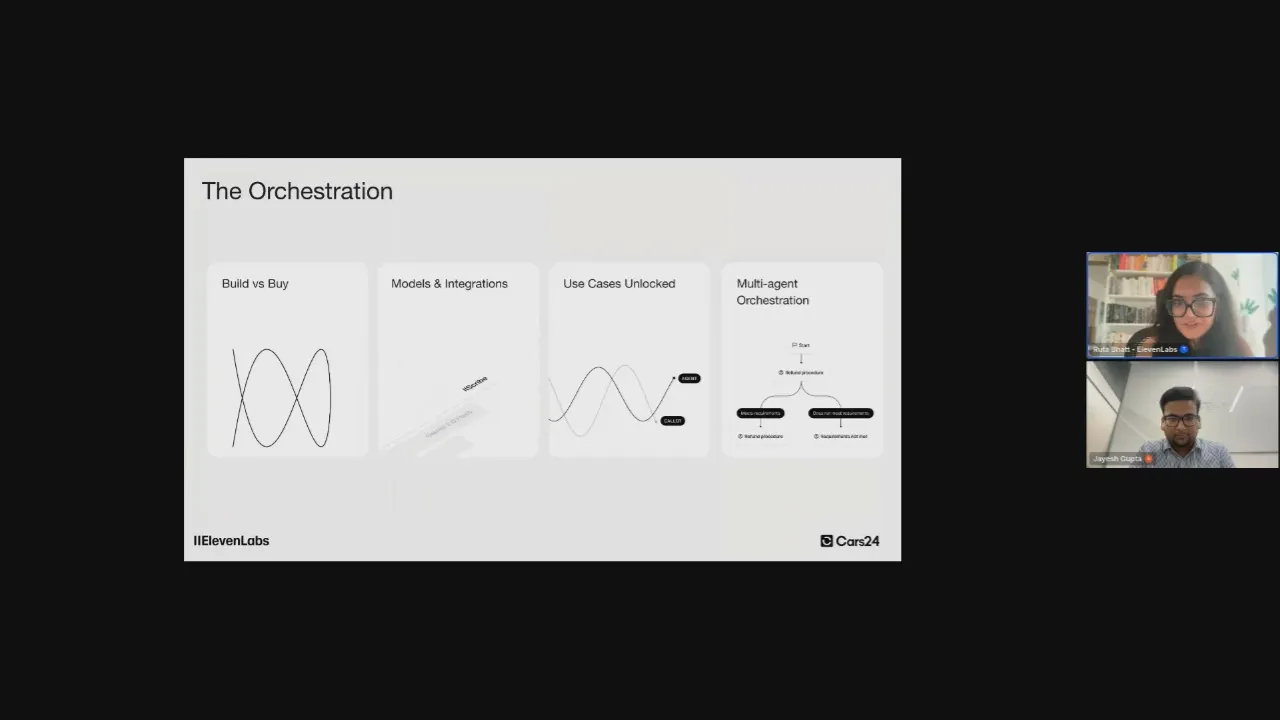
Their solution was multi-agent orchestration. They broke the conversation into stages:
- A small qualification agent using a mini model captures initial intent
- A larger model takes over for discovery once the customer is engaged and willing to wait slightly longer
- A third loan-focused agent activates only if price or financing comes up.
Each agent handles one thing well. Changes to one do not break the others.
The technical stack (orchestrated with the ElevenAgents platform):
- Speech-to-text: ElevenLabs Scribe v2 real-time, chosen for accuracy in noisy Tier 2 and Tier 3 environments across 13 languages
- Text-to-speech: ElevenLabs Flash 2.5, recently upgraded to Eleven v4 Turbo with measurable uplift in sales performance
- LLM: GPT-4.1 mini for most use cases, with GPT-4o or equivalent for longer discovery calls requiring deeper reasoning
- Telephony: WebSockets with PCM at 24kHz for audio quality; their providers include Twilio, Exotel, and Plivo in India
- Integrations: Custom API calls into the ElevenLabs Agents platform, MCP support, and native HubSpot integration for the Australian market
- Vector database: Qdrant, using binary quantization for large datasets above one million vectors to keep latency and cost low
The decision to use ElevenLabs Agents rather than assembling separate STT, LLM, and TTS components came down to one thing: latency.
Building the pipeline themselves, even with the same underlying models, consistently pushed latency above one second.
The ElevenLabs platform — owning the models and the orchestration layer together — brought that down by 30 to 40%. That reduction translated directly into a 30 to 40% uplift in conversions.
Best practices from Cars24
1. Start where the cost of failure is lowest. Cars24's first use case was missed appointment reminders — short, simple, low-stakes. Proving the model there created internal credibility and gave the team room to learn before touching higher-value parts of the funnel.
2. Run it on real customers, not simulations. Internal testing cannot replicate the chaos of real conversations. Cars24 ran their pilots on 10% of live traffic, accepted the temporary dip, and used real feedback to iterate.
3. Set prompt length as a hard constraint. Cars24 caps prompts at 4,000 to 5,000 tokens for calls under two minutes. Longer prompts slow the model and do not reliably improve outcomes. If a use case needs more, build another agent.
4. Keep common answers in the prompt, not the knowledge base. For the top questions customers actually ask, put the answers directly in the prompt. Reserve tool calls and RAG retrieval for the remaining 20%. This eliminates most latency spikes on knowledge lookups.
5. Pre-record the first message. ElevenLabs Agents can pre-generate and cache the opening message before the call connects. Combined with making the first message uninterruptible, this reduces early drop-offs caused by network lag or premature interruptions.
6. Build evaluation into every call. Cars24 uses ElevenLabs Agents evals on 100% of calls to track whether SOPs were followed, whether the customer showed frustration, and whether anything failed. Failed evals trigger a manual review. Random samples are audited daily. The team stays proactive rather than reactive.
7. Scale up in stages. New agent deployments follow a 5%, 10%, 20%, 50%, 100% rollout, with two-day holds at each stage to confirm eval metrics are stable before expanding further.
8. Do not call customers who did not ask to hear from you. Every Cars24 outbound call goes to someone who has already entered the funnel. Unsolicited AI outreach increases complaints and damages trust. The guardrail is simple: if they are not already engaged, they do not call.
9. Be honest when customers ask if they are talking to AI. Cars24 agents confirm they are virtual assistants when asked. If a customer wants a human, the call transfers immediately.
10. Treat AI spend as an investment line item, not a cost. Cars24 now includes AI costs in their annual operating plans with specific charters tied to measurable business outcomes. Every deployment is expected to move a real metric.
Watch the full session
Watch the full session here.
.webp&w=3840&q=80)

Ruta leads enterprise growth for ElevenLabs across Asia Pacific, helping top companies integrate AI Audio into their future. Previously, she led marketing at Jio Haptik, an AI SaaS company, and was a founding member at Libereka.