Webinar Recap: How AI Is Revolutionizing Learning
- Published
ListenListen to this article
Students are changing faster than institutions can keep up. 92% of students now use AI in their studies, up from 66% just a year ago. Most education platforms are still built around passive, one-way content delivery.
In our latest webinar How AI Is Revolutionizing Learning, our go-to-market and engineering teams walked through the current state of edTech, live demos of AI voice agents in action, and real customer examples from platforms already deploying this technology at scale.
Why AI voice in education matters
Higher education is under pressure from three directions at once.
High school graduate numbers are declining and are projected to drop 13% over the next 15 years. A proposed $12 billion cut to the Department of Education is squeezing institutional budgets. And a drop in international student enrollment is costing US institutions nearly $7 billion in revenue. Schools need to do more with less.
At the same time, students have moved faster than most platforms anticipated. The jump from 66% to 92% AI adoption in a single year is not incremental. It signals a fundamental shift in how students expect to learn.
The problem is not that students lack access to content.
Lecture recordings, PDFs, and video libraries are everywhere. The problem is that passive content does not adapt. It cannot tell when a student is lost. It cannot slow down, explain a concept a different way, or ask a follow-up question. Voice AI can.
The problem: one-to-one tutoring has historically been expensive and hard to scale.
AI voice changes that equation.
A student can now get a personalized, conversational learning experience at any hour, in almost any language, without a human tutor on the other end. That is not a replacement for great teaching. It is infrastructure that makes great teaching available to far more people.
Demo 1: AI-powered interactive tutoring from a powerpoint slide
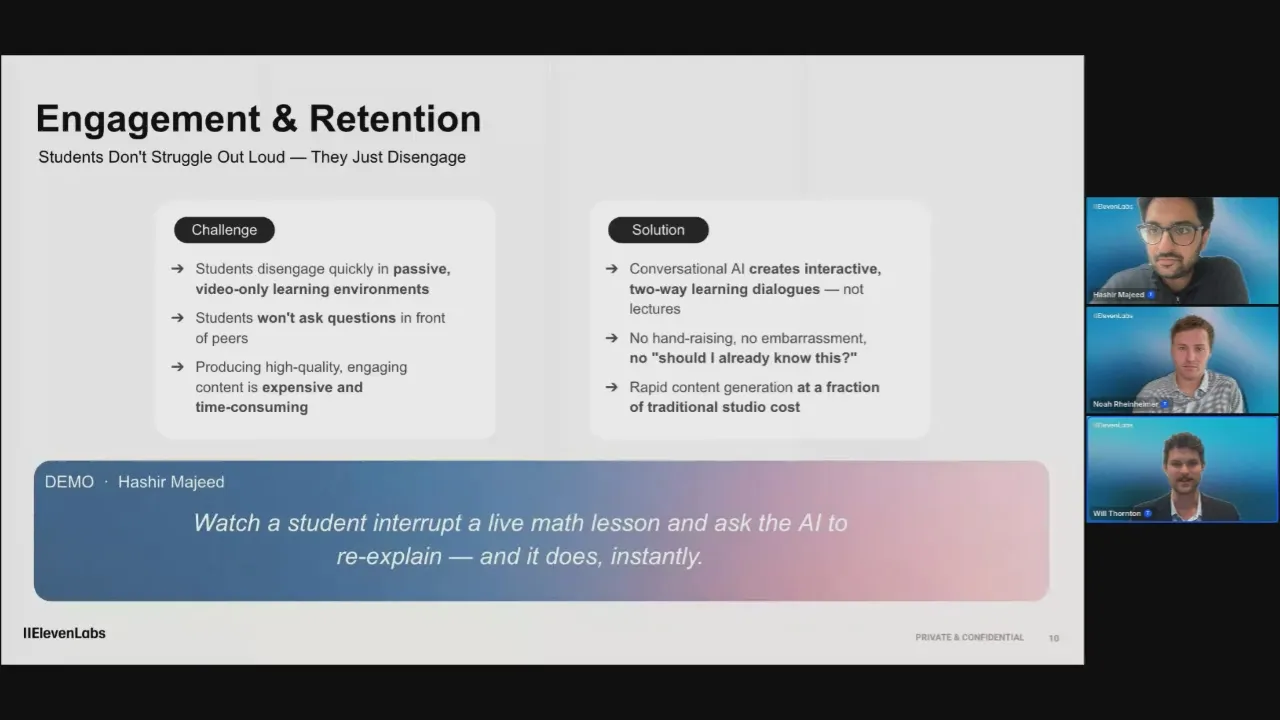
Scenario: A student works through an algebra lesson with an AI tutor built directly from a teaching slide deck.
What was shown:
- A PowerPoint slide was uploaded and an AI agent was generated from it within seconds
- The student indicated they already understood the introductory material and asked to skip ahead
- The agent adapted in real time and moved to more advanced problem sets
- When the student encountered unfamiliar bracket notation, the agent recognized the confusion and switched to a visual, geometric explanation
- The student worked through the problems and received immediate, accurate feedback
Why it matters: This kind of adaptive, two-way interaction used to require a human tutor. Here it was created in hours at a fraction of studio production cost. The agent did not just deliver content. It responded to where the student actually was, adjusted its approach, and kept the conversation moving forward.
Demo 2: Multimodal AI tutoring across WhatsApp
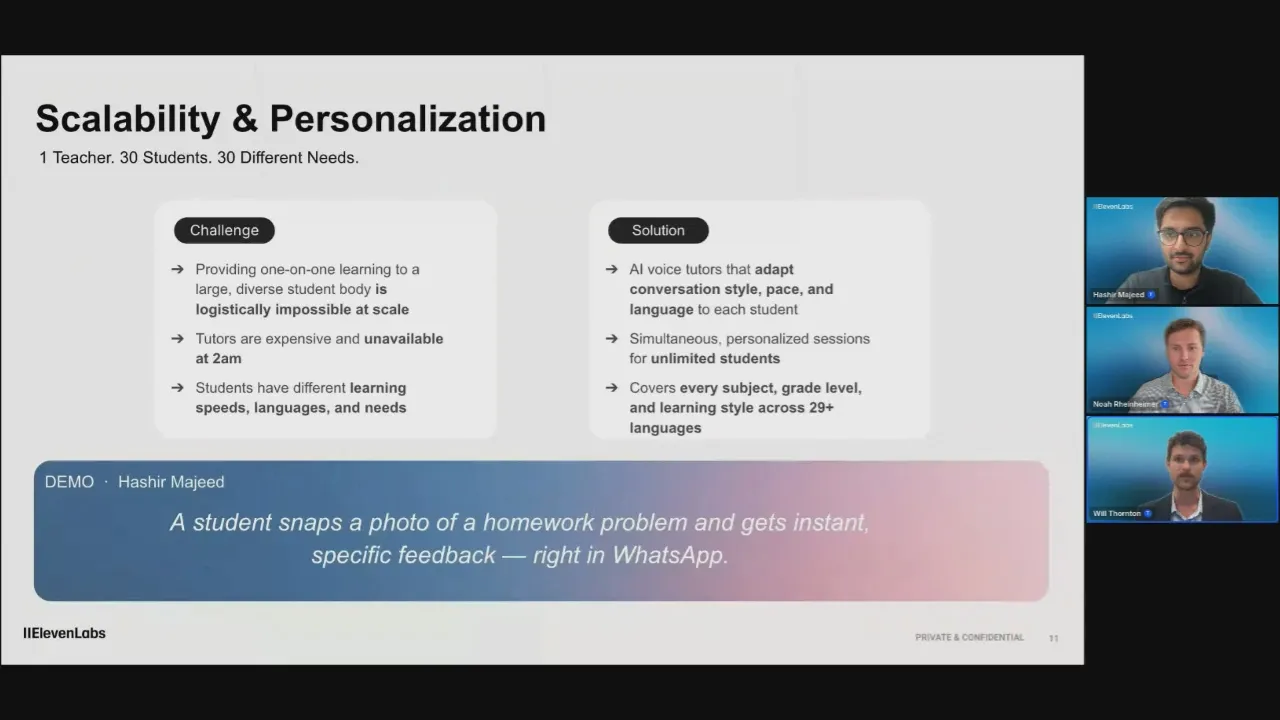
Scenario: A student submits a photo of handwritten homework through WhatsApp and receives personalized feedback from an AI tutor.
What was shown:
- The student photographed completed math problems and sent the image via WhatsApp
- The agent analyzed the handwritten work and identified that three of four answers were correct
- It flagged a specific error on question four with a targeted explanation
- The student sent a voice message asking the agent to re-explain using chocolates instead of numbers
- The agent responded with a completely reframed explanation using that analogy
Why it matters: Students do not always learn at a desk in front of a laptop. This demo shows that AI voice agents can meet students wherever they are, on the apps they already use, in the format that works best for them. The same agent works across chat, voice, phone, and web without rebuilding anything.conte
Success stories
Masterclass
Masterclass integrates ElevenLabs text-to-speech to give instructor voices to their AI Q&A feature, Masterclass On Call.
Rather than a generic chatbot answering student questions, users hear responses in the actual voice, tone, and pacing of the instructor they signed up to learn from.
Over 75% of users choose voice interactions when this option is available.
The platform reports higher user retention, stronger engagement, and significantly greater trust compared to text-based AI responses.
Chess.com
Chess.com serves 225 million learners across dozens of languages. Text-only coaching could not serve young learners, low-literacy users, or a truly global audience. ElevenLabs enabled spoken, real-time coaching voiced by world-class players including Magnus Carlsen. Learners keep their eyes on the board while receiving instruction naturally through audio. The result is a scalable coaching experience that feels nothing like a bot.
Key trends to watch
1. Voice AI unlocking role play and simulation at scale. Organizations are building voice agents to run realistic practice scenarios internally and externally. ElevenLabs used this approach with 100 employees at a recent company offsite. What previously required extensive coordination now runs simultaneously across an entire room.
2. Multimodal learning going mainstream. Students expect to learn across surfaces. Voice, image, chat, and phone are converging into a single experience. Platforms that only support one channel are already behind.
3. Hyper-personalized learning paths. Every student learns differently. AI voice agents can track where a student is struggling in real time, adjust the explanation, and continue the conversation. Curriculum that adapts to the individual learner has never been possible at this scale before.
Watch the full session
The full live session recording is available here.
The gap between what students expect and what most platforms deliver is growing. The tools to close it are available now. If you want to see what this looks like for your workflow, contact our sales team for a guided walkthrough tailored to your team.