
AI in publishing: The state of AI audio in publishing 2026
- Published
- Last updated
ListenListen to this article
We’ve all heard the figures about the decline of reading. While it’s true that fewer people read now than a decade ago, that doesn’t tell the whole story.
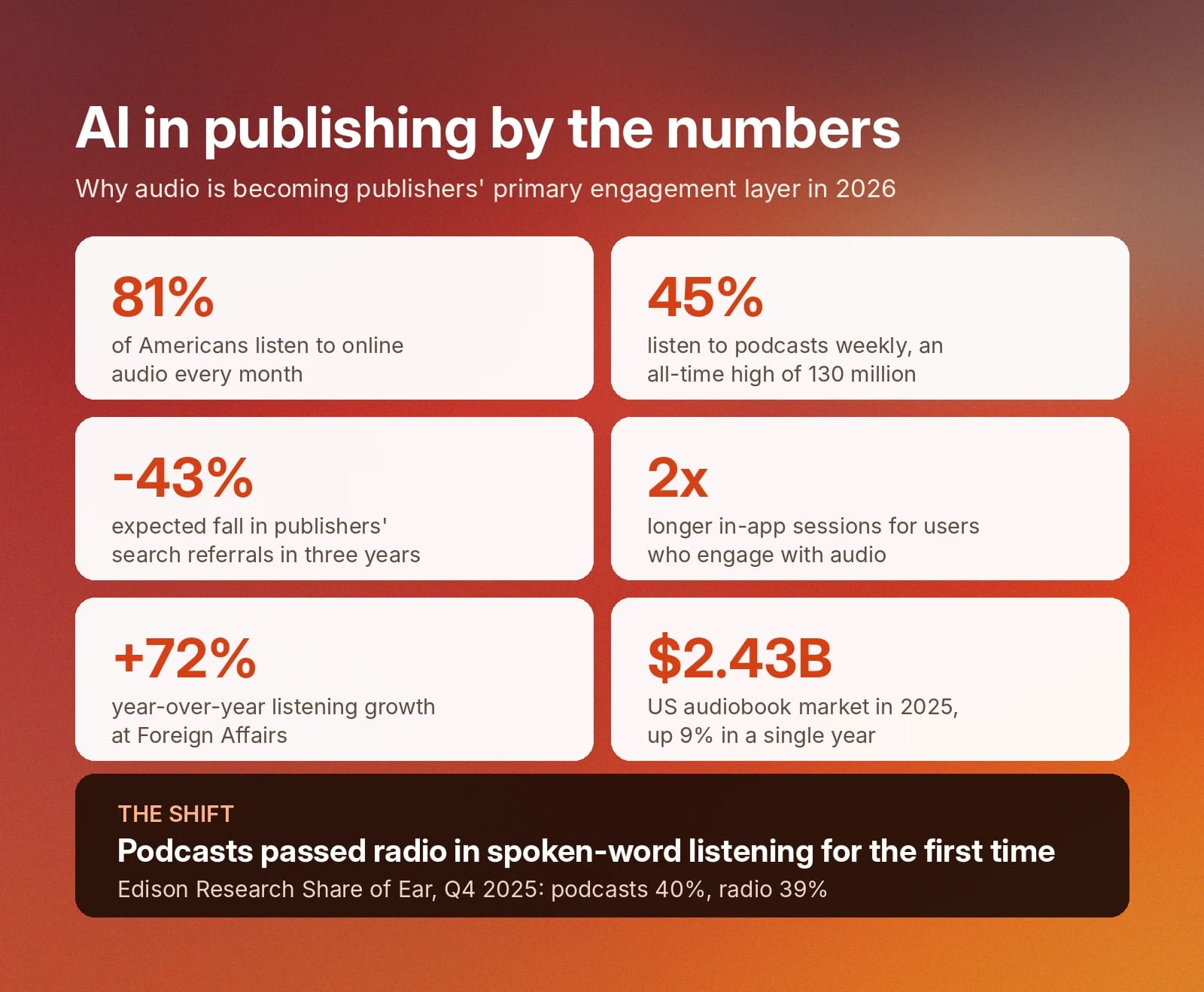
Around 81% of Americans (an estimated 233 million people) now listen to online audio every month, an all-time high. AI audio news is quickly becoming a preferred engagement layer, with users looking to listen to the news and other digital media rather than read it.
AI voice technology is at the heart of that transformation, allowing publishers to scale high-quality audio effortlessly, break down language barriers, and make content accessible with TTS. AI in publishing has meant that the production cost of creating high-quality audio is a fraction of what it was just years ago.
In this article, we’ll break down some of the major trends of AI in publishing, touching on the state of audio as a medium for digital media consumption in 2026.
Summary
- Podcasts passed radio in spoken-word listening for the first time in Q4 2025.
- Publishers expect search referrals to fall 43% within three years, with owned audio being one of the few channels answer engines can’t intercept.
- Audio Native turns published articles into narration through a single CMS embed, in a consistent brand voice.
- AI in publishing allows businesses to publish the same story in multiple languages without a second production team.
- Publishing houses and self-publishing authors can create full-cast audiobooks with ElevenCreative.
How newsrooms turn articles into AI audio news
The desire for audio news has been around for decades. Publishers have known for years that part of their audience would rather listen than read, especially on a commute, at the gym, or while making dinner. The main obstacle was cost: producing high-quality audio for every article on a site was prohibitively expensive.
AI narration removes that barrier to entry, allowing any newspaper or online magazine to produce AI audio news. Beyond just creating an audio sample, these versions are also available in numerous languages, making localizing content easier than ever.
Text to speech for news articles
Audio Native, the ElevenLabs voice publishing tool, converts articles into narration as they publish. It works as an embedded player: add a snippet to the CMS once, and every new story generates its own audio in a consistent voice. No recording, no editing, no upload step.
When your text changes, the audio adapts. How you offer audio content to your audience depends on your business goals. If you want to improve accessibility, then you can enable audio on all of your articles. Some businesses reserve narration for paying customers, turning the audio layer into a reason to subscribe.
AI news podcasts and daily audio briefings
Another common trend in AI publishing is automated briefings. Instead of asking readers to work through the top articles of the day, newspapers create an AI news briefing, which collects the top stories and their main points into a podcast feed for users to consume.
Perplexity produces its daily discovery audio with ElevenLabs voices, publishing on a schedule that would require a whole audio team to keep up with otherwise. For a newsroom, the same pipeline means the morning headlines become a five-minute listen without anyone needing to sit in front of a microphone at 5 a.m.
The engagement numbers back this up. Foreign Affairs mixes AI and human narration in its app, and after it made audio easier to find and queue, the share of app users listening doubled to 20% and listening grew 72% year over year, per Press Gazette's coverage of the Pugpig Media App Report.
Voice agents take this a step further. An agent trained on a newsroom’s archive lets readers ask questions instead of scrolling for answers. What events happened before this, what does a specific ruling mean, what did the paper report about this same company last month? The archive becomes a source that people can talk to.
Why audio is publishers’ hedge against AI search
The Reuters Institute published a report on journalism, media, and technology predictions for the publishing space. Its research highlights that publishers expect traffic from search engines to fall by 43% over the next three years. Another study shows that Google traffic to more than 2,500 news sites fell by over 33% in a single year, and by 38% in the United States.
With the rise of AI Overviews answering queries on the front page, zero-click searches have eaten into media publisher traffic. These engines scrape articles from newsites, summarize them, and then serve their content as results with a footnote to the original content.
When you host a daily briefing in your subscribers’ podcast app, that easy opportunity for AI engines doesn’t exist. The listener has a direct relationship with your application, with audio being one of the few formats where the audience will still come directly to you.
Reaching audiences in their native language
AI audio can cover content in English, Spanish, Mandarin, Arabic, and dozens of other languages with native-level fluency. By enabling an audio replay of your digital content, you allow users to consume the news in their own native language. Without having to manually localize content every time you hit publish, your AI narration tool can become a localization layer that boosts accessibility to your content.
Kuku FM tripled its production capacity after integrating ElevenCreative Text to Speech. CTO Vikas Goyal credits the technology with “near magical production efficiency” that left his team free to “simply focus on creativity and innovation.”
The high value of audio consumers: AI in publishing by the numbers
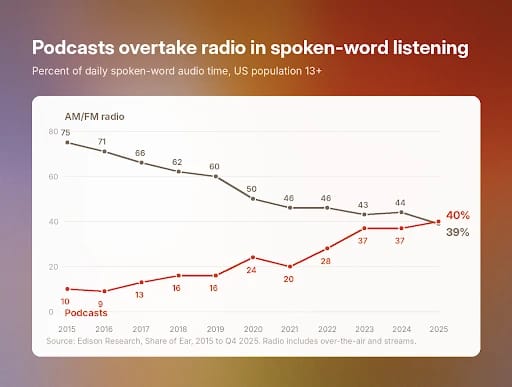
The shift in audience toward AI audio and podcasting crossed a symbolic line last year. Edison Research’s Share of Ear study found that in Q4 of 2025, podcasts overtook radio in spoken-word listening for the first time, at 40% of listening time against radio’s 39%.
The Infinite Dial 2026 puts weekly podcast consumption at 45% of Americans aged 12 and up, about 130 million people and an all-time high, with 58% listening monthly.
Recent research also demonstrates that users who engage with in-app audio spend nearly twice as long in the app as those who don’t. Publishers observe a similar pattern: audio users come back more often, stay subscribed longer, and churn less. For a subscription business, audio integrations are a leading business priority.
TIME and ElevenLabs: AI audio news in practice
TIME’s CTO, Burhan Hamid, went looking for Text to Speech technology and ended up integrating Audio Native across TIME.com. The embedded player generates a voiceover for an article automatically, so readers can listen to select stories in a natural-sounding AI voice instead of (or alongside) reading them.
The audio layer widened access to journalism, especially for readers who struggle with on-screen text. It also gave the newsroom a new engagement surface without the production overhead. TIME has since extended the work with voice agent technology from ElevenLabs: the TIME AI Toolbar adds chat, translation, and summarization on top of articles, with editorial safeguards governing how AI behaves.
QUOTE BLOCK: "A big thank you to Mati Staniszewski and the incredible team at ElevenLabs for their partnership and collaboration on this project. Their cutting-edge technology is helping us make TIME's content even more engaging and accessible. Stay tuned for more updates!" — Burhan Hamid, CTO, TIME
AI audio beyond the newsroom: AI in publishing and audiobooks
The same economics are moving through book publishing. The US audiobook market reached $2.43 billion in 2025, up 9%, with publishers reporting over 750,000 active titles, a 43% jump in a single year.
But until recently, producing a full-cast audiobook was a significant time and cost investment, meaning it wasn’t a feasible option for every studio.
With ElevenCreative Audiobooks, an author uploads a manuscript, and the tool detects the characters, proposes a voice for each, and assigns every paragraph to a speaker. Set pronunciations for invented names once and apply them across the book for high-quality, rapid audiobook generation.
A self-publisher can now produce the kind of multi-voice audiobook edition that was previously out of reach for anyone without a studio budget.
For publishers, news and books are converging on the same conclusion: if the audience wants to listen, the cost of letting them do so is no longer a prohibitive factor.
Add audio to your articles with Audio Native
Your next story can go live with narration attached. Audio Native embeds an AI-powered audio player in your CMS with one line of code, and the documentation covers the setup in minutes.
Start with one section of your site and make the listening data make the case for the rest. Sign up today to add natural-sounding audio on your digital content with Audio Native or create full-cast audiobooks with ElevenCreative.
AI in publishing FAQs

Matt joined our GTM team to help enterprises across Europe integrate AI audio across Media & Entertainment Enterprises. Previously, he supported customers within this industry at Amazon & Amazon Web Services.