What is ADR in film? How dialogue is replaced and improved
- Autor
- Jack Limebear
- Opublikowano
- Ostatnia aktualizacja
PosłuchajPosłuchaj tego artykułu
Post-production takes up a major part of a film studio’s budget. From sound design to visual effects and general editing, a lot of work goes into creating a film after actors have wrapped on set.
Automated Dialogue Replacement (ADR) is one of the post-production stages that contributes to this sizeable budget, often involving dialogue reshooting and meticulous editing. It’s how movie studios re-record spoken lines with bad audio or add lines that were never spoken on set.
We’ll break down what ADR is, how studios use it, and why AI ADR is quickly becoming the industry default for creative post-production audio editing.
Summary:
- ADR, or automated dialogue replacement, re-records an actor’s original lines in a studio to fix underlying audio problems from the shoot.
- ADR and dubbing aren’t the same thing, as the former replaces an actor’s lines with new recordings by the same person, and the latter is about swapping in a new voice and language.
- Filmmakers use ADR to fix mistakes in the original audio clips or replace audio files that have quality issues.
- AI voice tools speed up the ADR workflow and help studios cut back on studio time.
What is ADR in film production?
Automated Dialogue Replacement (ADR) is the process of re-recording audio for a scene in a sound booth. An actor will come into the studio, watch their performance back, and lip sync over the recording to give editors a cleaner audio file to work with. Editors turn to ADR for a number of reasons, whether the original audio is low-quality, background noises interfered with the clip, a line needs changing in post, or the shoot happened somewhere too loud to capture clear audio.
Whether an actor slightly messed up a line in their original take or a plane flying by ruined the audio, ADR is a simple solution. By matching the new audio recorded in studio to the existing performance, editors end up with a final version that they’re satisfied with.
The difference between ADR and dubbing in movies
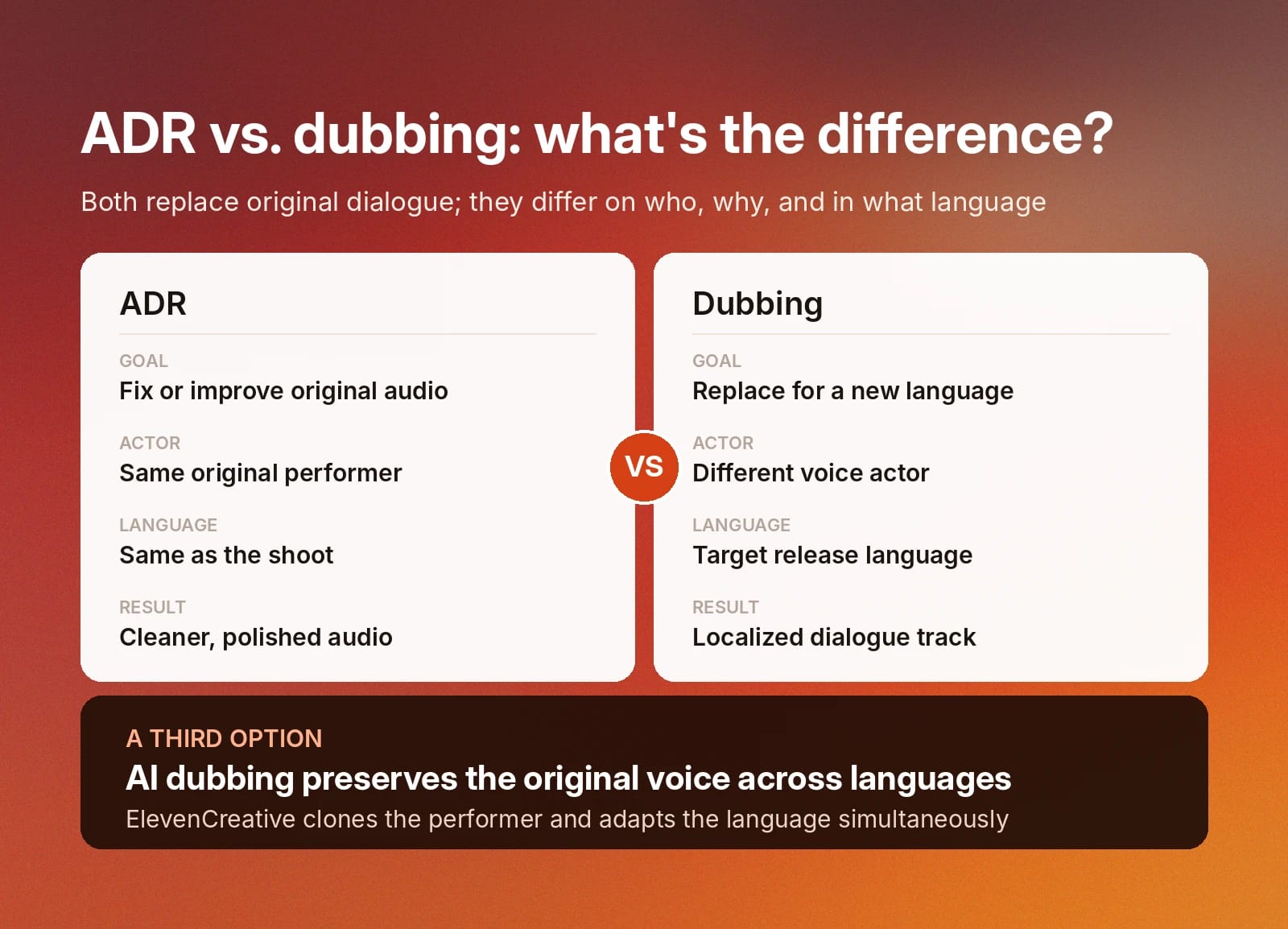
In practice, ADR and dubbing have many similarities. Both involve replacing original dialogue after a shoot with new audio. Both (traditionally) involve studio time for actors recording the new audio. Where they differ is who the actors are and what their goal is.
In ADR, the original actor returns to the studio and delivers the performance again in its original language. ADR is almost always used to fix an error or improve the quality of the film’s audio.
Dubbing completely replaces the entire dialogue track for a film release in a new language, often involving a new actor who dubs the entire character into a different target language. As it’s not the same original actor, there are sometimes discrepancies in how tone and emotion carry from one language delivery to another.
This gap is what led to ElevenLabs’ founding: Our co-founders noticed how monotone dubbed foreign films sounded compared to their originals and set out to build AI voice technology that could capture the actor’s original emotion and carry it across every language.
ElevenCreative Dubbing allows film studios to localize content across 90+ languages while retaining the authentic emotional quality and voice of a performer. Dubbing adapts meaning and phrasing for each target language while using Voice Cloning technology to preserve the identity of the original speaker.
Why filmmakers use ADR for clean audio
Shooting in the real world comes with a range of factors that aren’t in the production company’s control. Wind, passing traffic, crew walking, whispers in the background, the list goes on. ADR gives studios a fresh slate in controlled conditions where they can work from. In a soundproof studio, actors can deliver their lines with complete clarity to produce the best possible audio file for a clip.
Beyond just location and noise-dependent factors, there are a number of scenarios where filmmakers resort to ADR:
- Overlapping speech: In chaotic scenes with multiple characters speaking at once, getting a clean audio file is challenging. ADR provides high-quality audio of every speaker, which studios can then layer to create the same effect of many voices talking over each other.
- Line modifications: Due to broadcasting restrictions, some clips might have to be edited with a word or two altered for legal reasons. ADR allows studios to handle these moments without having to call for a total reshoot.
- Refining delivery: If a scene visually looks great but the audio isn’t quite up to par, ADR gives actors the opportunity to re-record their lines and get them perfect.
How the ADR process works: Step-by-step
Recording over existing content is a challenge because any slight deviation of timing will create a lack of synchronization between a voice and an actor’s mouth. The ADR process works to overcome this, with each stage helping to make the re-recorded audio as close to the original as possible.
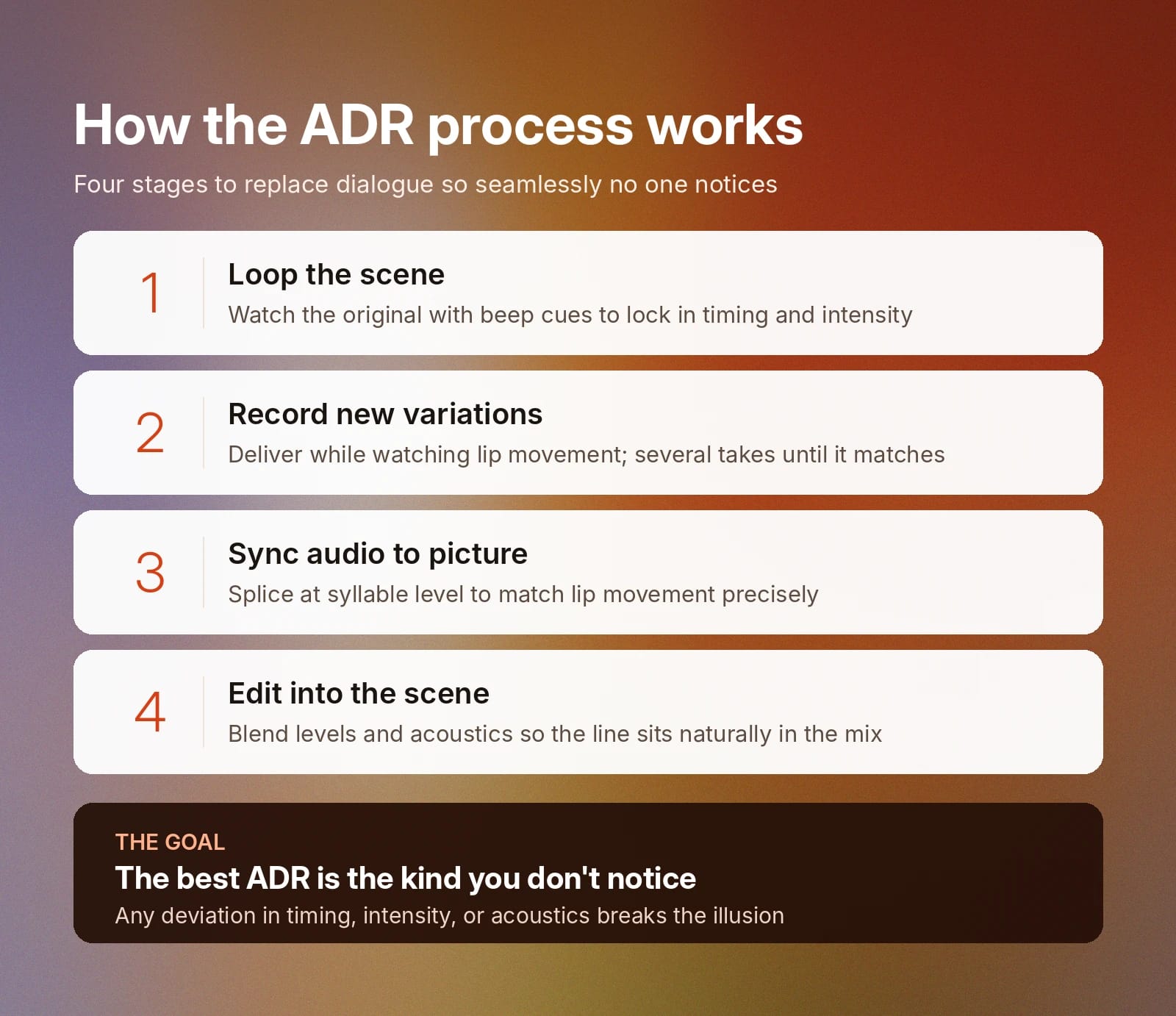
Once the lines for re-recording have been identified and the actor is in the studio, these are the steps to ADR:
- Loop the scene: The actor will watch their original scene, often several times, to get a precise idea of timing, emotion, intensity, and delivery style. Looping sometimes even uses a series of timed beeps to count actors into the specific moment they begin to help with time alignment.
- Record new variations: Next, the actors perform the line while watching their own lip movement. They attempt to recreate the line so that their voice perfectly matches mouth movement on screen. Production will typically record several takes here until they feel the output precisely matches the video.
- Sync audio to picture: Editors will work to splice the new audio into the existing video, doing so on a granular level to ensure each syllable aligns with lip movement.
- Edit into the scene: Audio teams blend the new line into the existing soundscape to ensure all levels match and nothing sounds off.
Across these steps, filmmakers will have successfully replaced the original audio of an actor’s line with a fresh take, helping to meet the standards in quality and delivery they’re looking for.
Tips for improving ADR in film
The best ADR takes in film are the kind you don’t even realize occurred. Audio should perfectly match the scene in delivery, timing, audio levels, and acoustics.
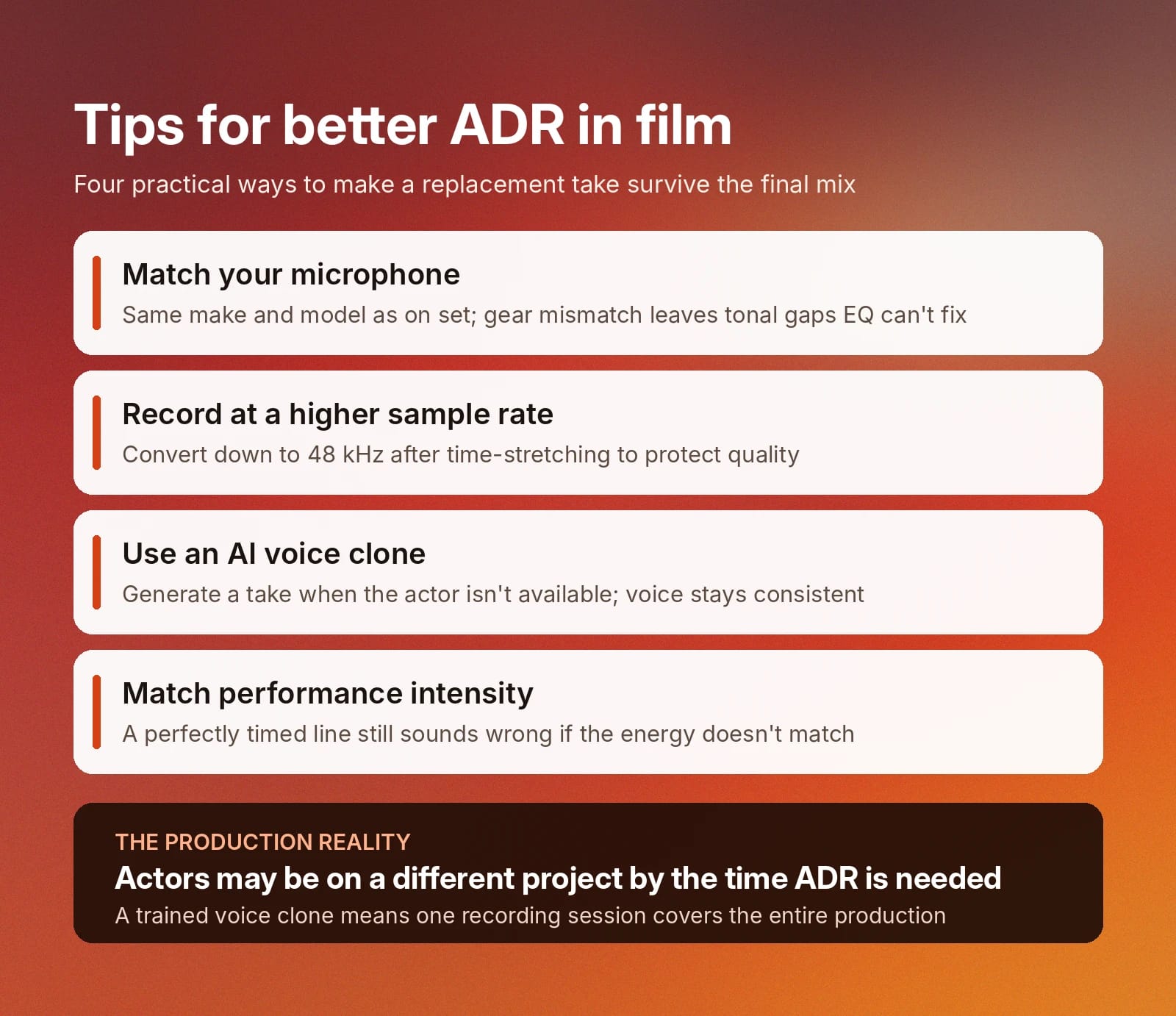
Here are a few practical ways to make ADR as effective as possible:
- High-quality sonic input: Record with the same microphone make and model as those used on set, capturing from both the boom and lav feeds at once. By matching gear, you avoid any tonal mismatch that EQ correction can only partially fix later on.
- Sample rate adjustment: Record ADR at a higher sample rate than the final delivery spec, then convert down to 48 kHz once time stretching is done. Audio held at 48 kHz will degrade faster when expanded or compressed to match timing. Keeping it at a higher rate gives you breathing room there, protecting audio quality.
- Use an AI voice clone: Generate a take from a voice clone whenever you can’t get an actor back into the room. You can slot generated dialogue into an original scene while keeping the performer’s voice consistent across your entire project.
- Match performance intensity: Play the actor the original audio so they get a feel for the level of intensity they should be replicating. Even when audio is synced in terms of words to lips, a mismatch in intensity will create a jarring effect.
For tips on choosing between Instant vs. Professional Voice Cloning, check out our full guide.
How AI ADR technology improves filmmaker workflows
Similar to how AI voice technology has transformed what’s possible with film and TV dubbing, artificial intelligence smooths out some of the main points of friction studios encounter with ADR.
In an ideal world, actors would have endless hours to spend on ADR, allowing studios to get every single line perfect. The reality is that by the time it comes to editing, an actor may already be on a different production. Or, instead of needing to fix whole sentences, there might just be a few word errors here and there across an entire production.
AI ADR allows editors to generate matching audio from a trained voice model and drop it straight into the timeline. By using high-quality voice clones with the consent of the actors, editors can quickly iterate on script delivery to get the exact sentence they’re looking for. Instead of having to get the actor back into the studio, they simply need to record for their voice clone once and have a high-fidelity voice copy ready to go.
AI-assisted alignment also helps expedite the syncing process, matching the new audio clip closely to lip movement in a fraction of the time of manual sync. Of course, human review still remains imperative here, as AI-assisted production needs to meet the same quality standards the studio is looking for.
Across the board, AI ADR can help filmmakers save time and streamline one of post-production’s most time-consuming stages.
Get started with ElevenCreative for professional ADR
ElevenCreative gives post-production teams an all-in-one platform for faster audio and video editing. Generate matching dialogue from a trained voice model, sync it to your video, and naturally splice it into the original sound in a fraction of the time. You have a full suite of tools to make professional ADR and dubbing workflows.
Combine a Professional Voice Clone with the wider suite of audio and video tools for dubbing, localization, and sound design in one workflow. Learn more about ElevenCreative or sign up to start working in Studio today.
FAQ

Jack Limebear is on the Growth team, acting as a content writer and strategist across the blog and insights pages. Before ElevenLabs, he spent over a decade leading content strategy for organizations ranging from fast-growing SaaS startups to Fortune 500 companies. He holds a Master's degree in English Literature from the University of Cambridge.

.jpg&w=3840&q=80)