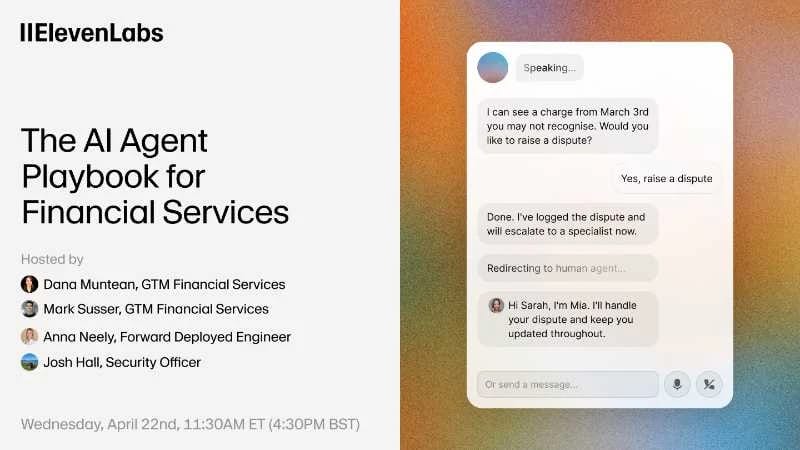
Webinar Recap: The AI Agent Playbook for Financial Services
- Published
- Last updated
ListenListen to this article
Webinar Recap: The AI Agent Playbook for Financial Services
Financial services customers expect more than phone trees and hold music - they expect seamless, intelligent experiences that actually solve their problems.
In our latest webinar, The AI Agent Playbook for Financial Services, we walked through how AI agents are being built, deployed, and trusted at scale in financial services — from live demos to real-world results at Revolut, Klarna, and Better.
Why this matters for financial services
The industry has spent over $2.8 trillion on digital transformation since 2011. Yet customers still don't feel served. Digital channels removed the friction of walking into a branch but replaced it with a different kind of frustration: impersonal, automated, emotionally flat interactions that treat people like tickets.
The gap comes with a cost that shows up everywhere. A meaningful share of interactions are repeat calls from customers who didn’t get resolution the first time. Agents burn out, and attrition increases, while the service quality stays flat.
The result is a loyalty problem. Customers are spreading their business across multiple banks because no single institution is treating them like a strategic relationship.
The gap isn't just about automation - it's about delivering consistent, policy-compliant experiences at scale without losing the human touch.
Multi-modal, multi-channel AI agents are helping close that gap.
Demo: Retail banking agent
Scenario: A retail banking customer calls in to check their account balance, review recent transactions, flag a suspicious withdrawal, and ask about their personal loan.
What was shown:
- The agent authenticated the caller through a structured sequence of security questions before allowing any account access
- Once verified, the agent retrieved live account and savings balances using direct backend tool calls
- When the customer flagged an unrecognized ATM withdrawal, the agent immediately escalated it as a suspicious transaction, generated a real-time fraud reference number, and logged it with the fraud team
- The conversation shifted mid-call to a personal loan inquiry — the agent detected the intent change and routed to the appropriate specialized sub-agent without any friction
- When the customer asked for advice on how much to pay off, the agent declined to give financial advice, explained why clearly, and offered what it could help with instead
Why it matters: This is not a scripted chatbot following a decision tree.
The agent handles authentication, account queries, fraud flagging, and loan inquiries in a single call — all while respecting compliance boundaries.
The guardrails are layered and built into the system prompt and include custom rules such as a financial advice restriction. Every conversation generates automated summaries, evaluation scores, and workflow-level analytics so teams can monitor performance across thousands of calls.
Compliance and security
AI adoption in financial services rarely fails because the technology does not work. It fails because organizations cannot get it through their security and compliance reviews.
ElevenLabs holds SOC 2 Type II and GDPR certifications and is a Level 1 PCI DSS service provider — the highest standard available and the first AI agents platform to achieve it. This means acquiring banks and merchants can use the platform without self-hosting or VPC requirements. You do not have to choose between speed and security.
For teams that need to go further, ElevenLabs Agents puts you 75% of the way toward AIUC-1 certification out of the box.
AIUC-1 certification is the first safety, security, and reliability standard purpose-built for AI agents - developed with over 75 Fortune 500 CISOs alongside researchers from Stanford, MIT, and MITRE.
It covers three things organizations consistently ask for: 1) validated safety through more than 5,000 adversarial simulations, 2) faster deployment through a clear trust signal that accelerates security reviews, and 3) access to AI agent insurance covering hallucination, data leakage, and unauthorized actions through Lloyd's of London.
Best practices for a financial services AI agent deployment
- Split complex agents into specialized sub-agents. Putting all instructions into a single prompt degrades reliability in production. Modular sub-agents — each with their own prompt, tools, and knowledge base — are easier to test, update, and trust.
- Combine deterministic controls with LLM flexibility. Use hard-coded routing for steps like authentication where there is no room for interpretation. Use LLM-based conditions for understanding intent and navigating open-ended queries. You need both.
- Layer your guardrails. Prompt-level instructions are a starting point. Native guardrails covering focus, manipulation, and content add a second layer. Custom guardrails — such as blocking financial advice — give you precise control over edge cases specific to your business.
- Define evaluation criteria before you deploy. Build in conversation scoring, intent categorization, hallucination detection, and containment tracking from the start. Teams deploying at scale typically use between twenty and seventy evaluation criteria per agent.
- Monitor at the workflow level, not just the call level. Understand how users move between sub-agents, where they get stuck, and which nodes create repeated loops. Workflow analytics surface problems that call-level reviews miss.
- Address authentication early in the design process. Authentication methods vary — security questions, one-time passcodes, in-app notifications, upstream telephony. The right approach depends on your risk model. Decide before you build, not after.
Watch the full session
Watch the full webinar here.