ElevenLabs vs Amazon Polly: Voice quality leader or AWS utility TTS?
Explore how ElevenLabs compares to Amazon Polly to help you choose the best AI audio platform for your use-case.
Explore how ElevenLabs compares to Google TTS so you can select the best AI voice generation platform for your specific needs.
ElevenLabs and Google Cloud Text-to-Speech both offer production-grade TTS, but they are fundamentally different products. ElevenLabs is a voice-first platform that leads in voice quality - ranked #1 in independent blind listening tests - and offers 14 products including voice cloning, AI dubbing, sound effects, and conversational AI. Google Cloud TTS is a cloud infrastructure component that excels in language breadth (40+ languages, 220+ voices), ecosystem integration with other Google Cloud services, and competitive pricing with a generous free tier. Choose ElevenLabs if voice quality, cloning, or a full audio AI platform matters most. Choose Google Cloud TTS if you are already in the Google Cloud ecosystem and need reliable, scalable TTS at the lowest possible cost.
ElevenLabs is the industry leader in voice quality. In independent evaluations by Labelbox, ElevenLabs achieved the lowest word error rate at 2.83%. On Poe.com, 80% of subscriber voice usage goes to ElevenLabs - a clear signal of user preference when multiple TTS providers are available side by side. The Eleven v3 model supports audio tags for expressive control ([excited], [whispers], [sighs]) and native multi-speaker dialogue, enabling voices that convey genuine emotion and natural conversational dynamics.
Google Cloud TTS offers four voice tiers: Standard (basic), WaveNet (powered by DeepMind), Neural2 (improved architecture), and Studio (highest quality). WaveNet and Neural2 produce good, clear speech that works well for informational content and IVR systems. However, the voices lack the emotional depth and naturalness of ElevenLabs, particularly in longer passages where Google voices tend to sound more monotone. Studio voices are better but cost 10x more than WaveNet ($160/1M chars vs $16/1M chars) and are available for fewer languages.
Bottom line: ElevenLabs delivers the most natural-sounding voice output by every available metric. Google Cloud TTS is adequate for standard informational TTS but falls short for content where emotional range and naturalness directly impact the listener experience.
ElevenLabs offers Professional Voice Cloning from just 30 seconds of high-quality audio, available starting at the $5/mo Starter plan. The platform provides both Instant Voice Cloning for quick results and Professional Voice Cloning for capturing subtle speech patterns, breathing, and emotional range. Cloned voices work across all ElevenLabs products, including conversational AI agents and dubbing.
Google Cloud TTS offers Custom Voice, which allows organizations to create custom voice models. However, this feature requires large datasets of professional recordings and enterprise agreements - it is not self-serve. There is no equivalent to ElevenLabs' 30-second cloning capability. For most users, Google TTS means choosing from the existing 220+ voices rather than creating custom ones.
Bottom line: ElevenLabs makes voice cloning accessible to everyone with just 30 seconds of audio. Google's Custom Voice is effectively enterprise-only and requires significantly more source material.
Google Cloud TTS benefits from Google's mature developer infrastructure. Client libraries are available in 10+ programming languages, documentation is thorough, and the service integrates deeply with the Google Cloud ecosystem - Cloud Functions, BigQuery, Dialogflow CX, and Contact Center AI. However, the initial setup involves Google Cloud project creation, IAM role configuration, and billing setup, which adds friction for teams that just want TTS.
ElevenLabs provides a simpler starting point: sign up, get an API key, and start making requests. The REST and WebSocket APIs are well-documented with an interactive playground. SDKs cover Python, JavaScript, React, React Native, Swift, and Kotlin. The WebSocket API enables sub-300ms streaming latency for real-time applications - a capability that Google Cloud TTS does not match. Advanced features include multi-context WebSocket connections, webhook notifications, and zero-retention mode.
Bottom line: Google offers more client libraries and deep cloud ecosystem integration. ElevenLabs offers simpler setup, real-time WebSocket streaming, and a better developer experience for teams that need TTS specifically rather than cloud infrastructure broadly.
Google Cloud TTS has the broadest language coverage among TTS providers, supporting 40+ languages with 220+ voices. Quality is relatively consistent across languages compared to many competitors. Google's Speech-to-Text service adds 125+ languages for transcription, and Dialogflow CX supports multilingual virtual agents.
ElevenLabs supports 70+ languages with native-quality output through its v3 model. While the language count is higher than Google's, the key differentiator is AI dubbing across 29 languages that preserves the original speaker's voice, emotion, and timing. This is a fundamentally different capability from multi-language TTS - dubbing translates and re-voices existing content while maintaining the speaker's identity.
Bottom line: Google has the most established multi-language TTS with consistent quality across languages. ElevenLabs supports more languages and adds true AI dubbing with voice preservation - a capability Google does not match.
Google Cloud TTS uses pure usage-based pricing with no monthly subscription. Standard voices cost $4 per million characters, WaveNet voices $16 per million characters, and Studio voices $160 per million characters. The free tier is generous: 4 million standard characters and 1 million WaveNet characters per month, ongoing. For high-volume basic TTS needs, Google's pricing is hard to beat.
ElevenLabs uses a credit-based subscription model starting at $5/month for 30,000 credits (~60 minutes of audio). The free tier provides 10,000 credits per month. At scale, ElevenLabs is more expensive per character than Google's WaveNet tier. However, ElevenLabs' plans include capabilities Google charges extra for or does not offer: voice cloning, AI dubbing, sound effects, conversational AI, and speech-to-text (Scribe). The total cost comparison depends on how many of these capabilities you need.
For context: generating 1 million characters of audio at Google's WaveNet tier costs $16. Generating a comparable amount through ElevenLabs costs more per character, but includes access to the full platform. Google's Studio voices at $160/1M chars are more expensive than ElevenLabs for comparable quality.
Bottom line: Google Cloud TTS is cheaper for high-volume, basic TTS needs - especially with WaveNet voices. ElevenLabs is the better value when you factor in voice quality, cloning, dubbing, and the full platform. Google's Studio voices, which approach ElevenLabs' quality, cost significantly more.
Google Cloud TTS is a component within the broader Google Cloud Platform. It integrates natively with Dialogflow CX (for conversational AI), Contact Center AI (for call centers), Cloud Functions (for serverless processing), and BigQuery (for analytics). For organizations already invested in Google Cloud, adding TTS is straightforward. However, Google Cloud TTS is not a standalone product - it requires a Google Cloud account and project setup.
ElevenLabs is a comprehensive audio AI platform with 14 products: Text to Speech, Speech to Text (Scribe), Voice Cloning, AI Dubbing, Sound Effects, AI Music, Conversational AI, Voice Isolator, Voice Changer, Voice Library marketplace, Projects/Studio, Audio Native, Pronunciation Dictionaries, and ElevenReader. The platform also includes image and video generation. It operates as a standalone product with no cloud infrastructure dependency.
Bottom line: Google Cloud TTS is ideal as a component within a larger Google Cloud architecture. ElevenLabs is a complete audio AI platform that stands on its own. The choice depends on whether you are adding TTS to an existing cloud stack or building around voice as a primary capability.
Google Cloud TTS is backed by Google's infrastructure, offering enterprise-grade reliability with SLAs. Support follows Google Cloud's tiered model, with comprehensive documentation and active community forums. The platform has been stable and available since 2018.
ElevenLabs maintains active customer support, comprehensive documentation, and an interactive API playground. The company raised $500 million at an $11 billion valuation in February 2026. While newer than Google Cloud TTS, ElevenLabs has rapidly built a reputation for reliability among production users - 80% of Poe.com's subscriber voice usage runs through ElevenLabs.
Bottom line: Google offers longer track record and Google-scale infrastructure reliability. ElevenLabs offers more responsive support and a developer experience specifically built for voice applications.
ElevenLabs is the right choice if you:
Ideal ElevenLabs customer: A developer, product team, or content creator who needs production-grade voice quality and a comprehensive audio AI platform, especially those building applications where voice quality directly impacts user experience.
Google Cloud TTS is a strong option if you:
Ideal Google Cloud TTS customer: An enterprise team already in the Google Cloud ecosystem that needs scalable, reliable TTS as a component within a larger cloud architecture, and where voice naturalness is less important than cost and language coverage.
If you are considering switching from Google Cloud TTS to ElevenLabs, here is what you need to know:
Basic TTS API migration typically takes 1-3 days. If Dialogflow CX or Contact Center AI is involved, allow 1-2 weeks for the full migration. ElevenLabs' free tier (10,000 credits/month) lets you test the platform before committing.
ElevenLabs outperforms Google Cloud TTS on voice quality, voice cloning accessibility, and platform breadth. In independent blind listening tests, ElevenLabs was chosen as the top voice 37 times compared to the next-closest competitor at 19, and achieved the lowest word error rate at 2.83%. ElevenLabs also offers 14 products including AI dubbing, sound effects, conversational AI, and speech-to-text that Google Cloud TTS does not provide. Google Cloud TTS has advantages in language coverage (220+ voices across 40+ languages), pricing for high-volume basic TTS, and integration with the Google Cloud ecosystem.
For basic TTS at high volume, yes. Google Cloud TTS charges $16 per million characters for WaveNet voices with a generous free tier of 1 million WaveNet characters per month. ElevenLabs' per-character costs are higher but include access to a broader platform (voice cloning, dubbing, sound effects, conversational AI). Google's Studio voices, which approach ElevenLabs' quality level, cost $160 per million characters - significantly more expensive. The total cost comparison depends on which features you need beyond basic TTS.
Yes. The migration is straightforward for basic TTS API usage - different authentication and endpoints, but similar REST patterns. ElevenLabs offers SDKs for Python, JavaScript, React, Swift, and Kotlin. SSML markup transfers with minor syntax adjustments. If you use Dialogflow CX, ElevenLabs' Conversational AI platform offers equivalent voice agent capabilities. Most basic TTS migrations take 1-3 days. Start with the free tier (10,000 credits/month) to test.
ElevenLabs is the top alternative to Google Cloud TTS for users who prioritize voice quality and platform breadth. ElevenLabs offers 1,200+ voices across 70+ languages, professional voice cloning from 30 seconds of audio, sub-300ms streaming latency, and a full platform including AI dubbing, sound effects, conversational AI, and speech-to-text. Other alternatives include Amazon Polly (for AWS-native workflows), Murf (for enterprise workflow integrations with Canva and PowerPoint), and OpenAI TTS (for teams already using OpenAI's API).
ElevenLabs operates as a standalone platform and does not require Google Cloud. However, ElevenLabs' REST and WebSocket APIs can be called from any infrastructure, including Google Cloud Functions, Cloud Run, or Compute Engine. Teams can use ElevenLabs for voice generation while keeping other services on Google Cloud. The integration is straightforward via ElevenLabs' Python or JavaScript SDKs.
ElevenLabs supports 70+ languages with native-quality output through its v3 model. Google Cloud TTS supports 40+ languages with 220+ individual voices. While Google has more distinct voice options per language, ElevenLabs covers more languages overall and adds AI dubbing across 29 languages that preserves the original speaker's voice - a capability Google does not offer.
Explore how ElevenLabs compares to Amazon Polly to help you choose the best AI audio platform for your use-case.
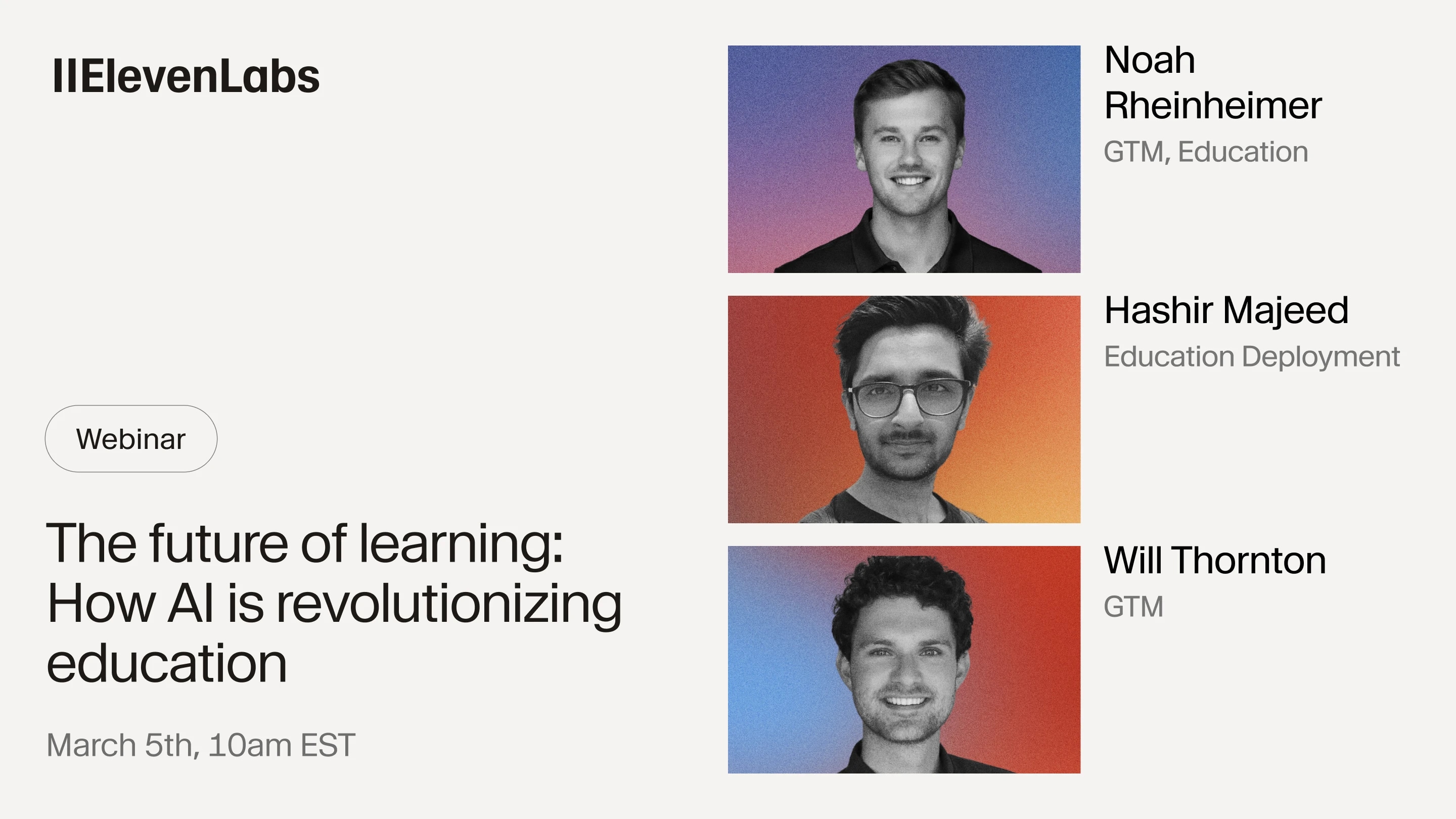
How Voice AI Is Reshaping the Future of Learning