
The best AI voices for YouTube videos and faceless channels (2026)
- Written by
- Jack Limebear
- Published
- Last updated
ListenListen to this article
On a faceless YouTube channel, voice is your primary method of communication with an audience. Find the right AI voice to represent your channel and viewers will come back for more. Get it wrong, and your bounce rate will begin to spike before you even make it through the intro.
This article covers how to choose an AI voice for YouTube and faceless channels. We’ll touch on the best AI voices for YouTube videos across different niches, the exact production workflow top faceless channels use, and what YouTube’s current rules on AI-generated content mean for disclosure and monetization.
Summary
- The right AI voice depends on the niche of your faceless YouTube channel.
- Voice consistency matters more than perfection. Pick your signature AI voice for your YouTube channel and keep it across all your videos.
- Model selection is important for creating consistently high-quality voiceovers at scale.
- AI-voiced videos are monetizable on YouTube, provided that your content is original and adds value. You need to tag synthetic voices via a toggle in YouTube Studio.
- A 10-minute video normally runs between 9,000 and 11,000 credits, so plan your Creative tier accordingly.
Why AI voices are perfect for YouTube automation
By now, you’ve probably come across a faceless YouTube channel at one point or another. These videos often include static images or AI-generated video footage combined with AI-generated voiceovers for narration.
Needless to say, advanced text to speech tools have made it easier than ever to create professional-quality videos without a microphone or studio setup. For those producing faceless YouTube videos, AI voice technology removes the need to record and edit voiceovers manually. Thanks to these innovations, content creators can scale video production effortlessly while maintaining a consistent sound across all videos.
With an AI video generator, creators can generate scripts, add AI voices, and produce videos in minutes. This possibility is especially useful for YouTube automation, where consistency and volume are key to growing a channel.
AI-generated narration allows creators to experiment with more YouTube video ideas without spending extra time on voice recording. This flexibility helps generate content across multiple niches, from educational videos to storytelling and news commentary.
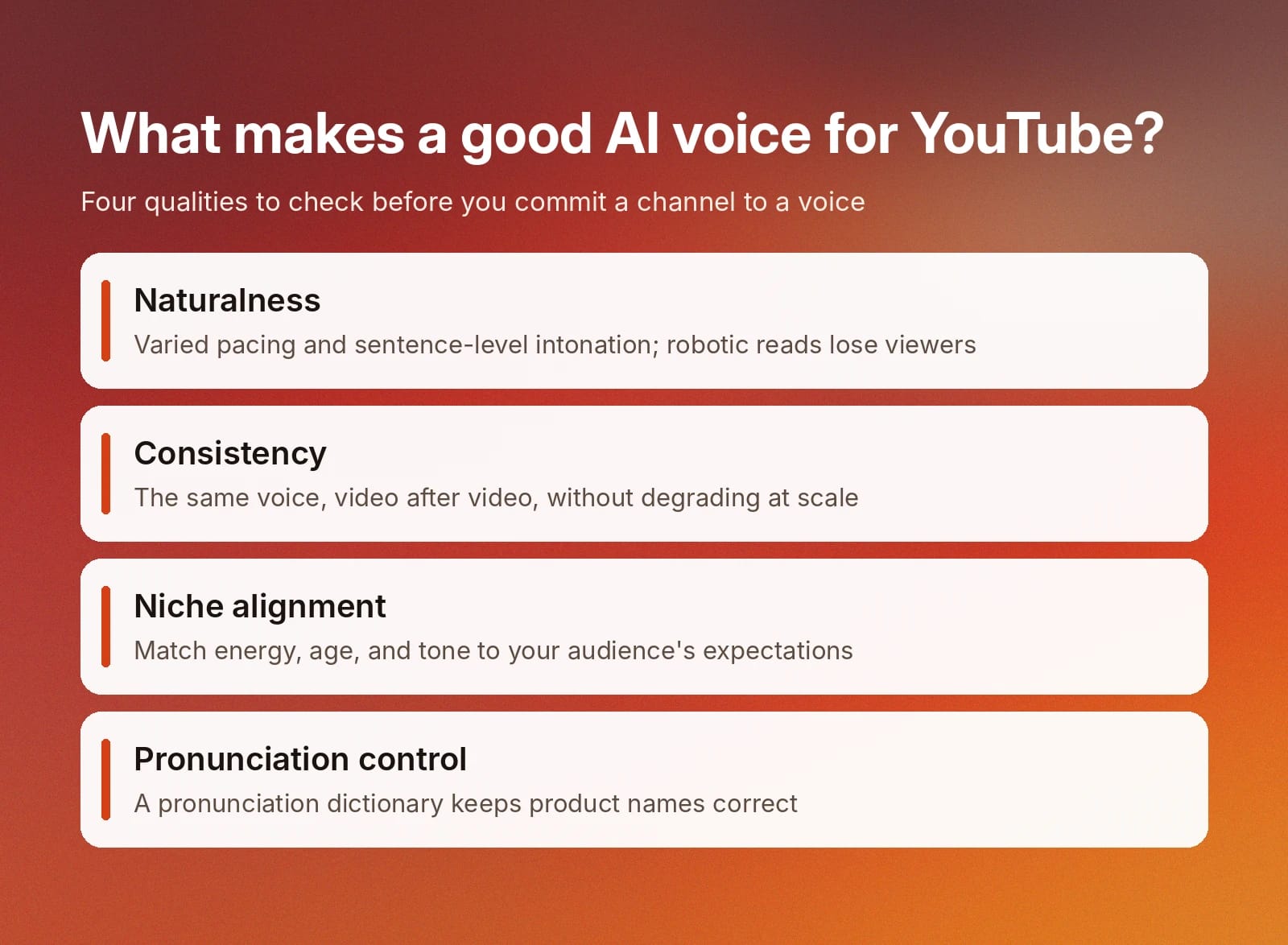
What makes a good AI voice for YouTube?
There are four main qualities that you should look for when selecting an AI voice for YouTube:
- Naturalness: A text to speech model that sounds robotic will grate on your audience and cause them to lose interest. Look for an AI voice for your YouTube channel that sounds natural, varies pacing according to the content it’s reading, and has sentence-level intonation changes.
- Consistency: An AI voice for YouTube should stay consistent across an entire video and across different videos. Look for voices that can perform at scale without degrading.
- Niche alignment: By fitting the voice you use to your niche, you create a more coherent experience for your viewers. Match energy, age, and overall tone to your audience’s expectations.
- Pronunciation control: Especially in industries with a lot of hyper-specific vocabulary, using a pronunciation dictionary can help keep product names or other proper nouns correct.
By focusing on these four qualities, you’ll be able to find the right voice for your channel.
The best AI voices for YouTube on ElevenLabs, by niche
The ElevenLabs Voice Library offers over 16,000 natural-sounding voices, spanning across dozens of languages and accents you can choose from.
All of the voices we’ve featured below come from the voice library, meaning you can select them and start generating faceless YouTube video content today.
Documentaries and true crime videos
Documentary and true crime channels turn long scripts into tension. Viewers stay for 20-minute videos when the narration builds atmosphere, so the voice needs a low register, deliberate pacing, and enough gravel to carry authority through case files, timelines, and reveals.
Suggested voices for documentary narration: Dan or Bill.
Dan delivers measured, serious narration that suits investigations and historical deep dives.
Bill brings a weathered, textured tone that adds weight to true crime storytelling.
Dan
Bill
Explainers and educational videos
Explainer channels compress complex topics into clear, watchable breakdowns, from finance and science to software tutorials. The voice carries the teaching load, so it needs warmth, crisp articulation of technical vocabulary, and a steady mid-tempo pace that never tires the listener.
Suggested voices: Robert or Nichalia.
Robert offers a calm, credible tone that suits finance, tech, and how-to content.
Nichalia pairs clarity with an approachable warmth that keeps educational scripts engaging.
Robert
Nichalia
Shorts, gaming, and fast-paced content
Short-form retention is decided in the first second, and gaming commentary competes with on-screen action. These formats need high energy, a quick natural pace, and articulation crisp enough to survive phone speakers at 1.5x playback speed.
Suggested voices: Alex or Allison.
Alex is an upbeat, energetic male voice built for YouTube, Shorts, and social media.
Allison is a bright, bubbly millennial voice that keeps top-10 lists and reaction content moving.
Alex
Allison
Kids and family content
Children's channels, such as for story time, learning songs, or family education, need voices that perform rather than narrate. Animated intonation, a bright, friendly character, and genuine expressiveness hold young attention spans and reassure the parents choosing what plays next.
Suggested voices: Emma or Amelia.
Emma is an adorable, upbeat character voice made for animated stories and playful learning content.
Amelia is a clear, enthusiastic storyteller that suits read-alongs and family-friendly narration.
Emma
Amelia
Your own voice
If you want to cultivate a strong brand on YouTube, you can always use your own voice. Voice Cloning creates an AI replica of your voice from a short sample, with Instant Voice Cloning only needing around a minute of clean audio. Instant Voice Cloning is available on the Starter plan and above.
With your clone, you'll be able to scale content production without needing to record voiceovers, helping to keep uploads coming out on time every single day.
How to produce a YouTube voiceover with AI: Step-by-step guide
Transforming your YouTube content with AI voices is relatively simple, as long as you know where to start. For a better understanding of the process, check out the four simple steps below:
1. Choose an AI voice generator
Selecting the right AI voice YouTube tool is essential for maintaining quality and consistency. Look for a platform that provides realistic speech synthesis and customizable voice settings to fit your video’s tone.
2. Generate and refine your script
A well-written script is the foundation of any great video. AI tools can assist in scriptwriting by analyzing trending YouTube video ideas and optimizing text for engagement. You should edit and refine your script to ensure its messaging is clear and narration flows smoothly.
In Studio, you can adjust voice stability (lower = more expressive variation, higher = more consistent) and use Eleven v4 audio tags to direct delivery where it matters.
Fix any mispronounced names or terms with a pronunciation dictionary so they're correct in every future video you produce.
3. Use an AI video generator for visuals
Pairing an AI-generated voiceover with an AI video generator allows creators to automate the video creation process. These tools provide stock footage, motion graphics, and animations that sync with the narration, making videos visually appealing without manual editing.
4. Edit and optimize your content for YouTube
Once the video is ready, final edits should include pacing adjustments, background music, and captions for accessibility. Proper optimization ensures the video meets YouTube automation best practices, helping it perform better in search rankings and audience retention.
What are YouTube’s rules for AI voices? Disclosure and monetization opportunities
AI voices are a standard part of a faceless YouTube channel’s production stack. When uploading a video that has an AI voice, you should know a couple of things before hitting publish.
First of all, the platform requires creators to disclose realistic synthetic content that could mislead viewers. The 2025 monetization update looked to disable monetization for channels making repetitious content, mass-produced, low-value uploads. that was making mass-produced, low-value uploads. That means you can stay monetized if you only use AI voices to deliver original, valuable content to your audience.
On the ElevenLabs side, using generated audio in monetized videos requires a commercial license, included with all paid ElevenCreative plans.
YouTube’s disclosure policy revolves around deceptive realism, rather than AI use itself. For example, you need to flag if AI has made someone appear to do something they didn’t actually do in a video. Under that system, synthetic audio that clones or imitates someone else's voice requires disclosure.
Interestingly, the AI disclosure requirements and examples (from August 2026) from YouTube state that you do not need to disclose if you use AI to create a voice clone of your own voice. If you’re producing voiceovers with your own voice at scale, this doesn’t fall into a category where you need to disclose.
How to disclose GenAI content on YouTube
If you’re using artificial intelligence voices for your YouTube channel or need to disclose for another reason, the process will only take a few seconds.
- Navigate to YouTube Studio
- Follow the steps indicated to upload content
- Navigate to the Attributes section. Select ‘Yes’ under ‘AI use’
- Continue to select other video details and publish
After following these steps, your video will have an AI label on it, letting users know that you used artificial intelligence in the production process.
Planning your character budget for faceless YouTube videos
AI voice pricing is credit-based, so plan your video content creation around the monthly credits included in your plan.
If your channel wants to publish two 10-minute videos per week, you’ll need roughly 80,000 credits per month. That’s not including regenerations or edits, so be sure to add in some headroom just in case. The Creator plan covers this schedule comfortably, and you can check what each ElevenCreative plan includes on the pricing page to see which is the best option for you.
The free plan of ElevenCreative is enough to test out voices and generate your first YouTube Short. Note that monetized content requires a commercial license, which is included on the Starter plan and above.
Create a faceless YouTube channel with ElevenCreative
Using AI-generated voices for YouTube automation and faceless YouTube videos is an efficient way to create high-quality content without the need for voice actors or expensive recording equipment. Whether you’re using an AI video generator or simply looking for the best AI voice YouTube tool, AI-powered narration can upgrade your content quality and help grow your channel.
With ElevenCreative, content creators can speed up production, improve engagement, and effortlessly bring their YouTube video ideas to life. Get started today by signing up or learning more about the ElevenLabs Voice Library.
Best AI voices for YouTube FAQ

Jack Limebear is on the Growth team, acting as a content writer and strategist across the blog and insights pages. Before ElevenLabs, he spent over a decade leading content strategy for organizations ranging from fast-growing SaaS startups to Fortune 500 companies. He holds a Master's degree in English Literature from the University of Cambridge.