

Post-call webhooks
Overview
Post-call Webhooks allow you to receive detailed information about a call after analysis is complete. When enabled, ElevenLabs will send a POST request to your specified endpoint with comprehensive call data.
ElevenLabs supports three types of post-call webhooks:
- Transcription webhooks (
post_call_transcription): Contains full conversation data including transcripts, analysis results, and metadata - Audio webhooks (
post_call_audio): Contains minimal data with base64-encoded audio of the full conversation - Call initiation failure webhooks (
call_initiation_failure): Contains information about failed call initiation attempts including failure reasons and metadata
Enabling post-call webhooks
Post-call webhooks can be enabled for all agents in your workspace through the ElevenAgents settings page.
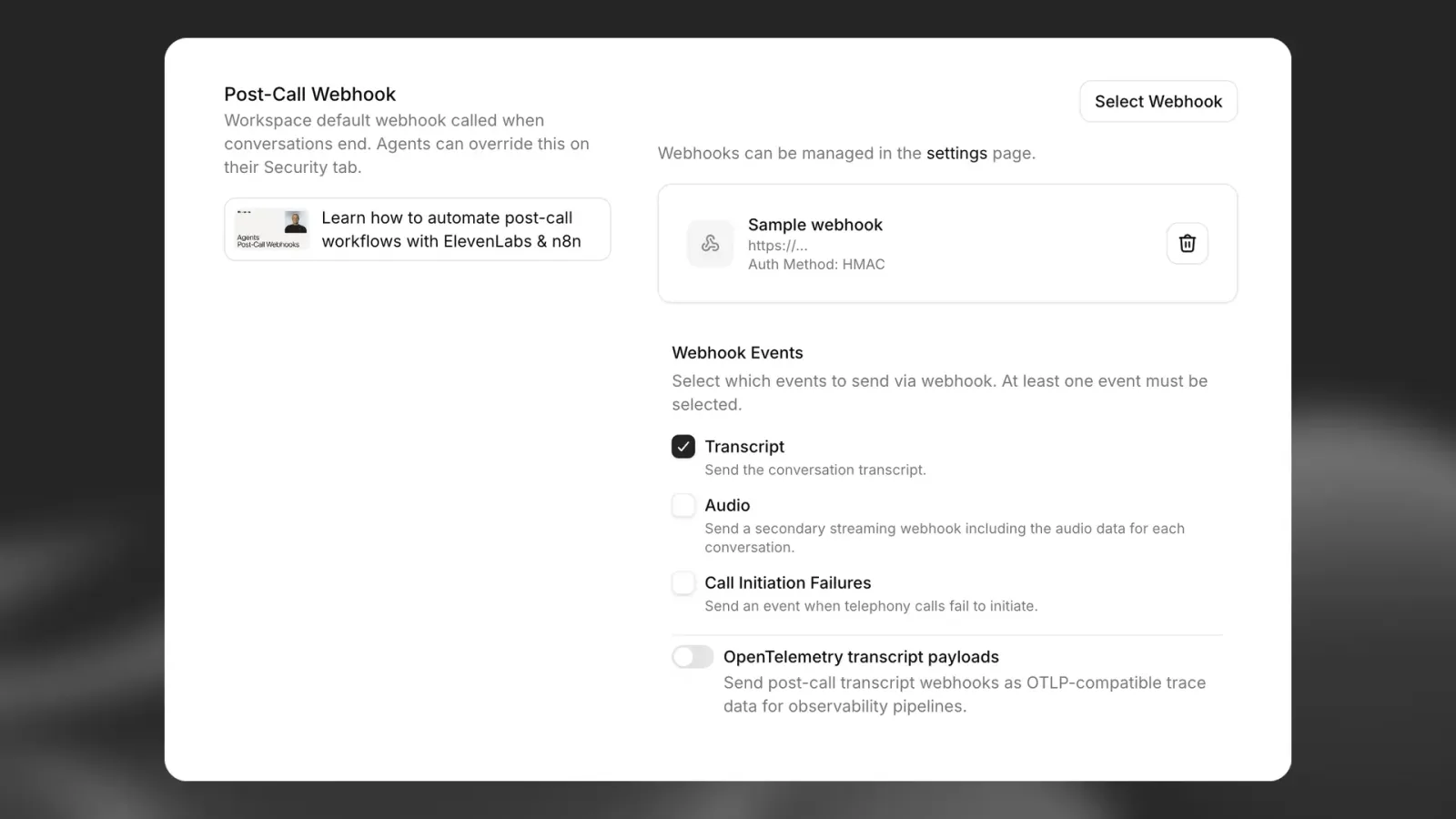
Post-call webhooks must return a 200 status code to be considered successful. Webhooks that repeatedly fail are auto disabled if there are 10 or more consecutive failures and the last successful delivery was more than 7 days ago or has never been successfully delivered.
Post-call webhooks can be automatically retried if they fail. See webhook retries.
Authentication
It is important for the listener to validate all incoming webhooks. Webhooks currently support authentication via HMAC signatures. Set up HMAC authentication by:
- Securely storing the shared secret generated upon creation of the webhook
- Verifying the ElevenLabs-Signature header in your endpoint using the SDK
The JavaScript SDK exposes constructEvent; the Python SDK exposes construct_event with rawBody, sig_header, and secret (these are not named payload / signature in Python). Both verify the signature, validate the timestamp, and parse the JSON payload.
Python
JavaScript
Example webhook handler using FastAPI:
IP allowlisting
For additional security, you can add ElevenLabs’ static egress IPs to your allowlist. See IP allowlisting for the complete list of IP addresses.
Using IP allowlisting in combination with HMAC signature validation provides multiple layers of security.
Webhook response structure
ElevenLabs sends three distinct types of post-call webhooks, each with different data structures:
Transcription webhooks (post_call_transcription)
Contains comprehensive conversation data including full transcripts, analysis results, and metadata.
Top-level fields
Data object structure
The data object contains:
Audio webhooks (post_call_audio)
Contains minimal data with the full conversation audio as base64-encoded MP3.
Top-level fields
Data object structure
The data object contains only:
Audio webhooks contain only the three fields listed above. They do NOT include transcript data, metadata, analysis results, or any other conversation details.
Call initiation failure webhooks (call_initiation_failure)
Contains information about telephony call initiation attempts, including failure reasons and telephony-provider metadata.
Call initiation failure webhook events are sent when a call fails to initiate due to connection errors, user declining the call, or user not picking up. If a call goes to voicemail or is picked up by an automated service, no call initiation failure webhook is sent as the call was successfully initiated.
Top-level fields
Data object structure
The data object contains:
Metadata object structure
The metadata object structure varies depending on whether the outbound call was made via Twilio or via SIP trunking. The object includes a type field that distinguishes between the two, and a body field containing provider-specific details.
SIP metadata (type: "sip"):
The body object for SIP metadata contains:
Twilio metadata (type: "twilio"):
Example webhook payloads
Transcription webhook example
Audio webhook example
Call initiation failure webhook examples
Twilio metadata example
SIP metadata example
Audio webhook delivery
Audio webhooks are delivered separately from transcription webhooks and contain only the essential fields needed to identify the conversation along with the base64-encoded audio data.
Audio webhooks can be enabled or disabled using the “Send audio data” toggle in your webhook settings. This setting can be configured at both the workspace level (in ElevenAgents settings) and at the agent level (in individual agent webhook overrides).
Streaming delivery
Audio webhooks are delivered as streaming HTTP requests with the transfer-encoding: chunked header to handle large audio files efficiently. Each request times out after 5 minutes.
Retries
When retries are enabled on the webhook, failed audio deliveries are retried on the same schedule as transcription webhooks. A retry resends the full audio payload, so deduplicate by conversation_id. See webhook retries for the schedule, retryable errors, and audio size limits.
Processing audio webhooks
Since audio webhooks are delivered via chunked transfer encoding, you’ll need to handle streaming data properly:
Audio webhooks can be large files, so ensure your webhook endpoint can handle streaming requests and has sufficient memory/storage capacity. The audio is delivered in MP3 format.
Use cases
Automated call follow-ups
Post-call webhooks enable you to build automated workflows that trigger immediately after a call ends. Here are some practical applications:
CRM integration
Update your customer relationship management system with conversation data as soon as a call completes:
Stateful conversations
Maintain conversation context across multiple interactions by storing and retrieving state:
- When a call starts, pass in your user id as a dynamic variable.
- When a call ends, set up your webhook endpoint to store conversation data in your database, based on the extracted user id from the dynamic_variables.
- When the user calls again, you can retrieve this context and pass it to the new conversation into a {{previous_topics}} dynamic variable.
- This creates a seamless experience where the agent “remembers” previous interactions