> This is a page from the ElevenLabs documentation. For a complete page index, fetch https://elevenlabs.io/docs/llms.txt. For the full documentation in a single file, fetch https://elevenlabs.io/docs/llms-full.txt.
# Vite (Javascript)
This tutorial will guide you through creating a web client that can interact with a ElevenLabs agent. You'll learn how to implement real-time voice conversations, allowing users to speak with an AI agent that can listen, understand, and respond naturally using voice synthesis.
Looking to build with React/Next.js? Check out our [Next.js
guide](/docs/eleven-agents/guides/quickstarts/next-js)
## What You'll Need
1. An ElevenLabs agent created following [this guide](/docs/eleven-agents/quickstart)
2. `npm` installed on your local system
3. Basic knowledge of JavaScript
## Project Setup
Open a terminal and create a new directory for your project:
```bash
mkdir elevenlabs-conversational-ai
cd elevenlabs-conversational-ai
```
Initialize a new npm project and install the required packages:
```bash
npm init -y
npm install vite @elevenlabs/client
```
Add this to your `package.json`:
```json package.json {4}
{
"scripts": {
...
"dev:frontend": "vite"
}
}
```
Create the following file structure:
```shell {2,3}
elevenlabs-conversational-ai/
├── index.html
├── script.js
├── package-lock.json
├── package.json
└── node_modules
```
## Implementing the Voice Chat Interface
In `index.html`, set up a simple user interface:
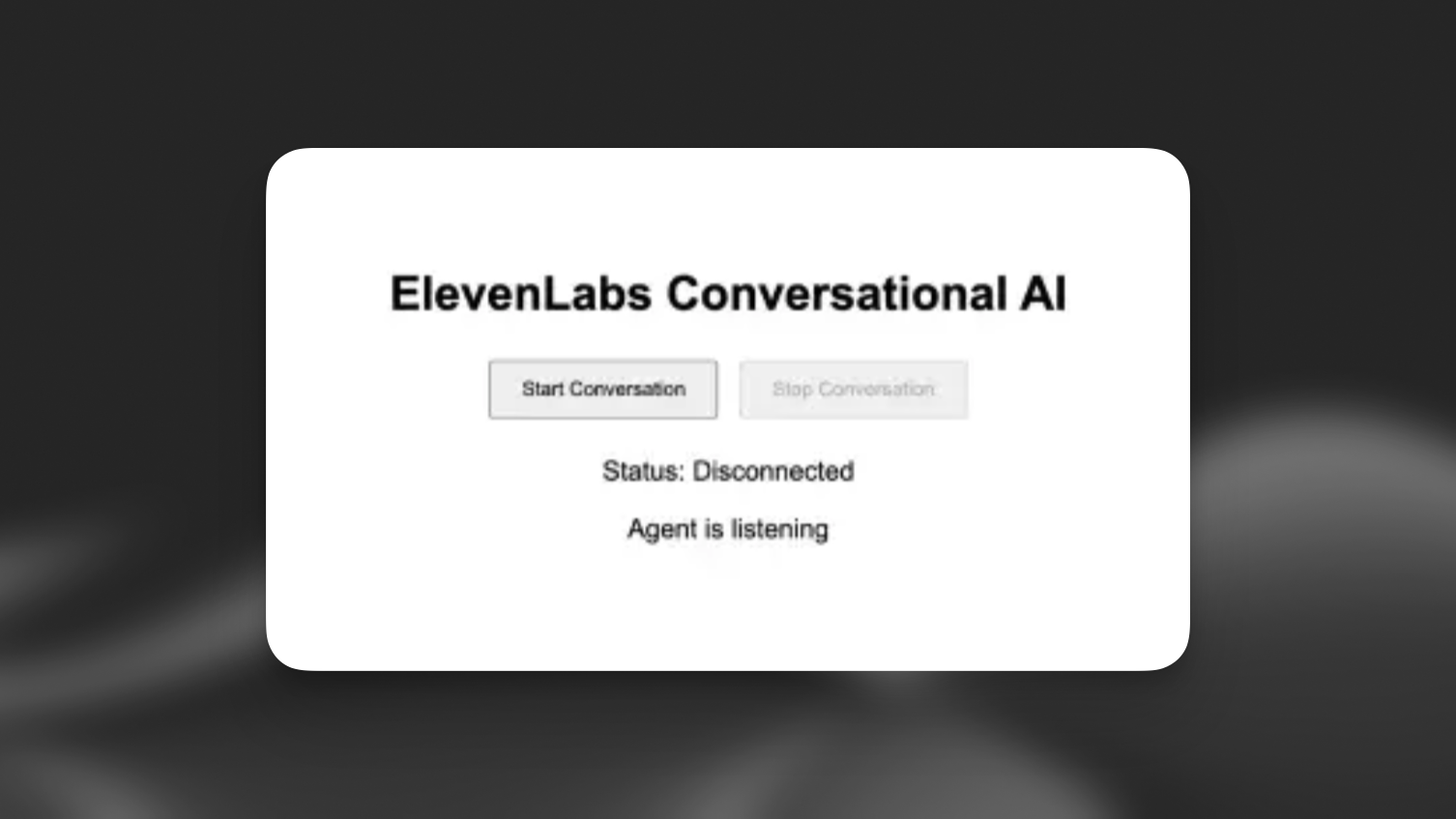
```html index.html
ElevenLabs Agents
ElevenLabs Agents
Status: Disconnected
Agent is listening
```
In `script.js`, implement the functionality:
```javascript script.js
import { Conversation } from '@elevenlabs/client';
const startButton = document.getElementById('startButton');
const stopButton = document.getElementById('stopButton');
const connectionStatus = document.getElementById('connectionStatus');
const agentStatus = document.getElementById('agentStatus');
let conversation;
async function startConversation() {
try {
// Request microphone permission
await navigator.mediaDevices.getUserMedia({ audio: true });
// Start the conversation
conversation = await Conversation.startSession({
agentId: 'YOUR_AGENT_ID', // Replace with your agent ID
onConnect: () => {
connectionStatus.textContent = 'Connected';
startButton.disabled = true;
stopButton.disabled = false;
},
onDisconnect: () => {
connectionStatus.textContent = 'Disconnected';
startButton.disabled = false;
stopButton.disabled = true;
},
onError: (error) => {
console.error('Error:', error);
},
onModeChange: (mode) => {
agentStatus.textContent = mode.mode === 'speaking' ? 'speaking' : 'listening';
},
});
} catch (error) {
console.error('Failed to start conversation:', error);
}
}
async function stopConversation() {
if (conversation) {
await conversation.endSession();
conversation = null;
}
}
startButton.addEventListener('click', startConversation);
stopButton.addEventListener('click', stopConversation);
```
```shell
npm run dev:frontend
```
Make sure to replace `'YOUR_AGENT_ID'` with your actual agent ID from ElevenLabs.
This authentication step is only required for private agents. If you're using a public agent, you can skip this section and directly use the `agentId` in the `startSession` call.
Create a `.env` file in your project root:
```env .env
ELEVENLABS_API_KEY=your-api-key-here
AGENT_ID=your-agent-id-here
```
Make sure to add `.env` to your `.gitignore` file to prevent accidentally committing sensitive credentials.
1. Install additional dependencies:
```bash
npm install express cors dotenv
```
2. Create a new folder called `backend`:
```shell {2}
elevenlabs-conversational-ai/
├── backend
...
```
```javascript backend/server.js
require("dotenv").config();
const express = require("express");
const cors = require("cors");
const app = express();
app.use(cors());
app.use(express.json());
const PORT = process.env.PORT || 3001;
app.get("/api/get-signed-url", async (req, res) => {
try {
const response = await fetch(
`https://api.elevenlabs.io/v1/convai/conversation/get-signed-url?agent_id=${process.env.AGENT_ID}`,
{
headers: {
"xi-api-key": process.env.ELEVENLABS_API_KEY,
},
}
);
if (!response.ok) {
throw new Error("Failed to get signed URL");
}
const data = await response.json();
res.json({ signedUrl: data.signed_url });
} catch (error) {
console.error("Error:", error);
res.status(500).json({ error: "Failed to generate signed URL" });
}
});
app.listen(PORT, () => {
console.log(`Server running on http://localhost:${PORT}`);
});
```
Modify your `script.js` to fetch and use the signed URL:
```javascript script.js {2-10,16,19,20}
// ... existing imports and variables ...
async function getSignedUrl() {
const response = await fetch('http://localhost:3001/api/get-signed-url');
if (!response.ok) {
throw new Error(`Failed to get signed url: ${response.statusText}`);
}
const { signedUrl } = await response.json();
return signedUrl;
}
async function startConversation() {
try {
await navigator.mediaDevices.getUserMedia({ audio: true });
const signedUrl = await getSignedUrl();
conversation = await Conversation.startSession({
signedUrl,
// agentId has been removed...
onConnect: () => {
connectionStatus.textContent = 'Connected';
startButton.disabled = true;
stopButton.disabled = false;
},
onDisconnect: () => {
connectionStatus.textContent = 'Disconnected';
startButton.disabled = false;
stopButton.disabled = true;
},
onError: (error) => {
console.error('Error:', error);
},
onModeChange: (mode) => {
agentStatus.textContent = mode.mode === 'speaking' ? 'speaking' : 'listening';
},
});
} catch (error) {
console.error('Failed to start conversation:', error);
}
}
// ... rest of the code ...
```
Signed URLs expire after a short period. However, any conversations initiated before expiration will continue uninterrupted. In a production environment, implement proper error handling and URL refresh logic for starting new conversations.
```json package.json {4,5}
{
"scripts": {
...
"dev:backend": "node backend/server.js",
"dev": "npm run dev:frontend & npm run dev:backend"
}
}
```
Start the application with:
```bash
npm run dev
```
## Next Steps
Now that you have a basic implementation, you can:
1. Add visual feedback for voice activity
2. Implement error handling and retry logic
3. Add a chat history display
4. Customize the UI to match your brand
For more advanced features and customization options, check out the
[@elevenlabs/client](https://www.npmjs.com/package/@elevenlabs/client) package.