> This is a page from the ElevenLabs documentation. For a complete page index, fetch https://elevenlabs.io/docs/llms.txt. For the full documentation in a single file, fetch https://elevenlabs.io/docs/llms-full.txt.
# Pronunciation dictionaries
## Overview
Pronunciation dictionaries allow you to customize how your AI agent pronounces specific words or phrases. This is particularly useful for:
* Correcting pronunciation of names, places, or technical terms
* Ensuring consistent pronunciation across conversations
* Customizing regional pronunciation variations
## Configuration
Phoneme tags only work with the `eleven_flash_v2` model. When used with
other models, the tags are silently skipped and the default pronunciation is used.
Phoneme tags (IPA or CMU) only work for English. For other languages, use alias tags instead to
substitute spellings or phrases that produce the pronunciation you need.
### Attach a dictionary to your agent
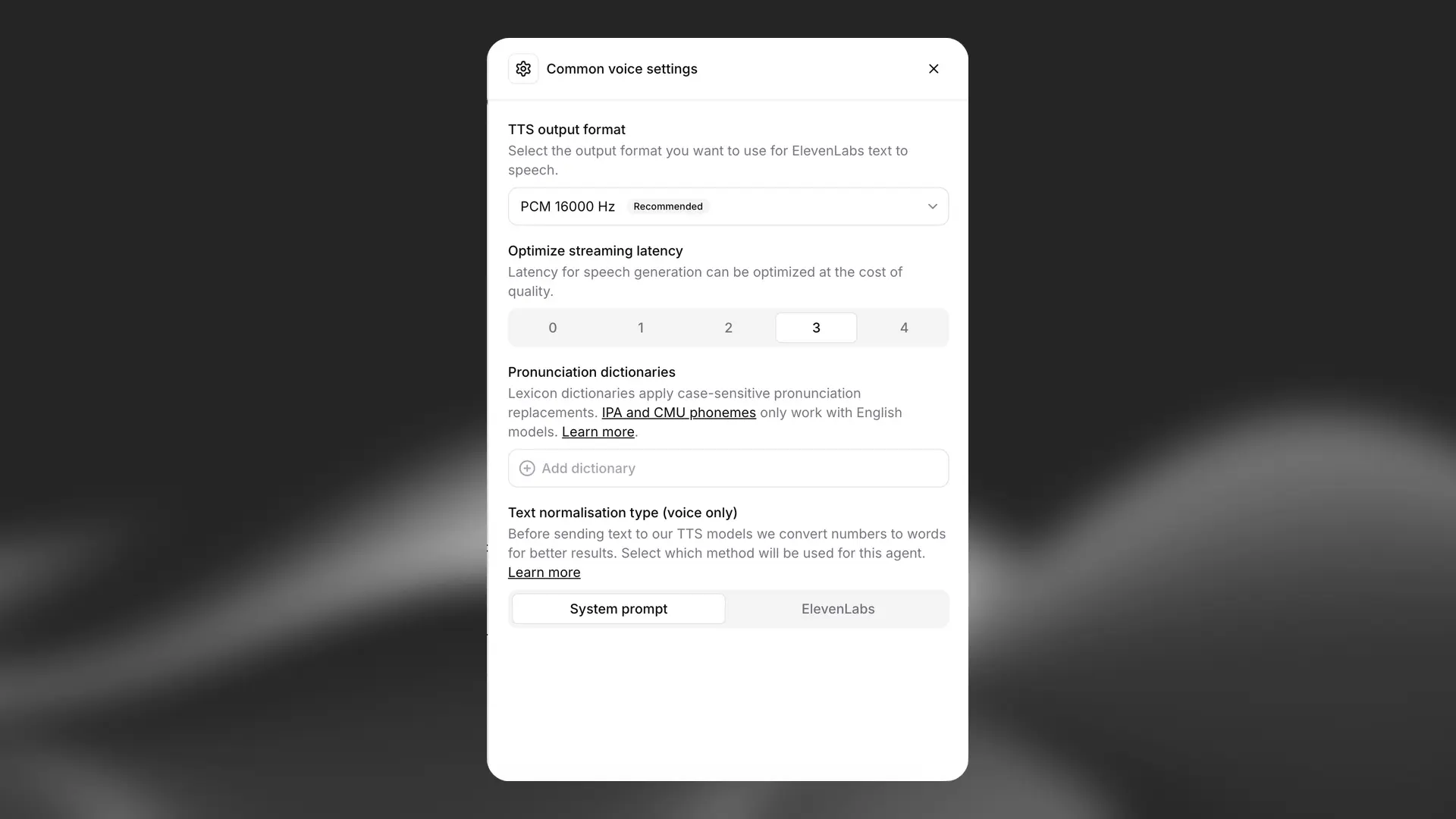
Open your agent in the dashboard, navigate to **Voice Settings**, and add a pronunciation dictionary. Save your changes.
 ```bash
elevenlabs agents pull --agent ""
```
Set `conversation_config.tts.pronunciation_dictionary_locators`:
```json
{
"conversation_config": {
"tts": {
"pronunciation_dictionary_locators": [
{
"pronunciation_dictionary_id": "",
"version_id": ""
}
]
}
}
}
```
```bash
elevenlabs agents push --agent ""
```
```python
from elevenlabs import ElevenLabs
elevenlabs = ElevenLabs()
elevenlabs.conversational_ai.agents.update(
agent_id="agent_7101k5zvyjhmfg983brhmhkd98n6",
conversation_config={
"tts": {
"pronunciation_dictionary_locators": [
{
"pronunciation_dictionary_id": "",
"version_id": "",
}
]
},
},
)
```
```typescript
import { ElevenLabsClient } from "@elevenlabs/elevenlabs-js";
const elevenlabs = new ElevenLabsClient();
await elevenlabs.conversationalAi.agents.update("agent_7101k5zvyjhmfg983brhmhkd98n6", {
conversationConfig: {
tts: {
pronunciationDictionaryLocators: [
{
pronunciationDictionaryId: "",
versionId: "",
},
],
},
},
});
```
## Dictionary file format
Pronunciation dictionaries use XML-based `.pls` files. Here's an example structure:
```xml
Apple
ˈæpl̩
UN
United Nations
```
## Supported formats
We support two types of pronunciation notation:
1. **IPA (International Phonetic Alphabet)**
* More precise control over pronunciation
* Requires knowledge of IPA symbols
* Example: "nginx" as `/ˈɛndʒɪnˈɛks/`
2. **CMU (Carnegie Mellon University) Dictionary format**
* Simpler ASCII-based format
* More accessible for English pronunciations
* Example: "tomato" as "T AH M EY T OW"
You can use AI tools like Claude or ChatGPT to help generate IPA or CMU notations for specific
words.
## Best practices
1. **Case sensitivity**: Create separate entries for capitalized and lowercase versions of words if needed
2. **Testing**: Always test pronunciations with your chosen voice and model
3. **Maintenance**: Keep your dictionary organized and documented
4. **Scope**: Focus on words that are frequently mispronounced or critical to your use case
## FAQ
Phoneme tags are supported on `eleven_flash_v2`. All other models skip the phoneme entry and
fall back to their normal pronunciation. For non-English languages, rely on alias tags because
phoneme tags only cover English pronunciations.
Yes, you can upload multiple dictionary files to handle different sets of pronunciations.
The model will use its default pronunciation rules for any words not specified in the
dictionary.
## Additional resources
* [Professional Voice Cloning](/docs/eleven-creative/voices/voice-cloning/professional-voice-cloning)
* [Voice Design](/docs/eleven-creative/voices/voice-design)
* [Text to Speech API Reference](/docs/api-reference/text-to-speech/convert)
```bash
elevenlabs agents pull --agent ""
```
Set `conversation_config.tts.pronunciation_dictionary_locators`:
```json
{
"conversation_config": {
"tts": {
"pronunciation_dictionary_locators": [
{
"pronunciation_dictionary_id": "",
"version_id": ""
}
]
}
}
}
```
```bash
elevenlabs agents push --agent ""
```
```python
from elevenlabs import ElevenLabs
elevenlabs = ElevenLabs()
elevenlabs.conversational_ai.agents.update(
agent_id="agent_7101k5zvyjhmfg983brhmhkd98n6",
conversation_config={
"tts": {
"pronunciation_dictionary_locators": [
{
"pronunciation_dictionary_id": "",
"version_id": "",
}
]
},
},
)
```
```typescript
import { ElevenLabsClient } from "@elevenlabs/elevenlabs-js";
const elevenlabs = new ElevenLabsClient();
await elevenlabs.conversationalAi.agents.update("agent_7101k5zvyjhmfg983brhmhkd98n6", {
conversationConfig: {
tts: {
pronunciationDictionaryLocators: [
{
pronunciationDictionaryId: "",
versionId: "",
},
],
},
},
});
```
## Dictionary file format
Pronunciation dictionaries use XML-based `.pls` files. Here's an example structure:
```xml
Apple
ˈæpl̩
UN
United Nations
```
## Supported formats
We support two types of pronunciation notation:
1. **IPA (International Phonetic Alphabet)**
* More precise control over pronunciation
* Requires knowledge of IPA symbols
* Example: "nginx" as `/ˈɛndʒɪnˈɛks/`
2. **CMU (Carnegie Mellon University) Dictionary format**
* Simpler ASCII-based format
* More accessible for English pronunciations
* Example: "tomato" as "T AH M EY T OW"
You can use AI tools like Claude or ChatGPT to help generate IPA or CMU notations for specific
words.
## Best practices
1. **Case sensitivity**: Create separate entries for capitalized and lowercase versions of words if needed
2. **Testing**: Always test pronunciations with your chosen voice and model
3. **Maintenance**: Keep your dictionary organized and documented
4. **Scope**: Focus on words that are frequently mispronounced or critical to your use case
## FAQ
Phoneme tags are supported on `eleven_flash_v2`. All other models skip the phoneme entry and
fall back to their normal pronunciation. For non-English languages, rely on alias tags because
phoneme tags only cover English pronunciations.
Yes, you can upload multiple dictionary files to handle different sets of pronunciations.
The model will use its default pronunciation rules for any words not specified in the
dictionary.
## Additional resources
* [Professional Voice Cloning](/docs/eleven-creative/voices/voice-cloning/professional-voice-cloning)
* [Voice Design](/docs/eleven-creative/voices/voice-design)
* [Text to Speech API Reference](/docs/api-reference/text-to-speech/convert)